

Phase 1: Embrace Cozy Winter Vibes (스토리 몰입형 오프닝)
안녕하세요! (An-nyeong-ha-se-yo!) Hello there, beautiful souls! It’s your favorite Daily Hangul Editor, your ultimate local culture guide, back with a winter edition that will warm you right down to your toes.
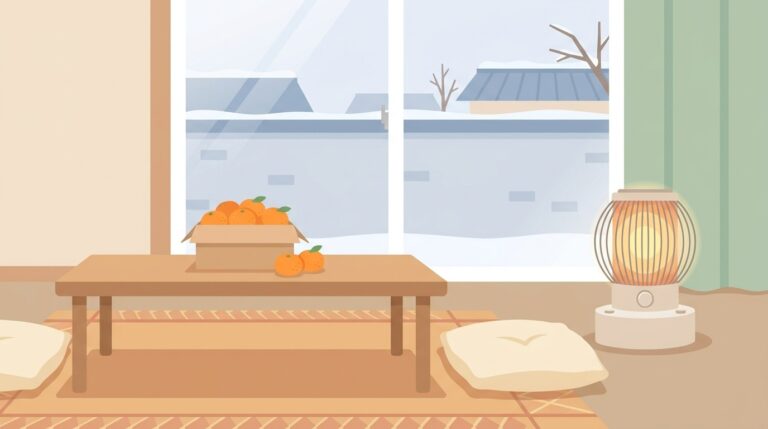
Imagine this: the temperature outside in Seoul has plunged to a freezing -10°C (14°F). The wind is howling, but you are inside. Your floor is deliciously warm thanks to the Korean ondol (온돌 – underfloor heating). You slide your legs under a plush blanket, turn on your jeon-gi-jang-pan (전기장판 – electric heating pad), and pull a heavy, cardboard box toward you. Inside is 5 kilograms of bright, sun-kissed, fragrant Jeju tangerines (귤 – gyul).
You peel one, your fingers instantly getting stained with a bright yellow hue, and pop a juicy segment into your mouth. Ah, heaven. This is not just eating fruit; this is the sacred Korean winter ritual of 귤 한 박스 사서 까먹기 (gyul han bak-seu sa-seo kka-meok-gi)—buying a whole box of tangerines and mindlessly peeling them all day long.
Many of my intermediate (B2) students often ask: “Editor, I know how to say ‘I eat fruit.’ But how do I describe this cozy, lazy, winter lifestyle like a true Korean?” Today, we are moving beyond textbook sentences to master the warm, casual, and incredibly comfy Korean expressions that define winter at home. Let’s dive in!
Phase 2: Core Phrases Deep Dive (핵심 표현 3선 심층 분석)
Let’s unpack the three golden phrases you need to sound like an absolute local while lounging at home this winter.
1. 귤 까먹다 (Gyul kka-meok-da)
- Pronunciation: gyul kka-meok-da (Sounds like “gyool” + “kka” as in the start of “car” + “muck-dah”)
- Meaning: Literally “to peel and eat tangerines,” but culturally it implies “relaxing, vegging out, and mindlessly snacking.”
- K-Culture Moment: You will see this constantly in slice-of-life K-Dramas like Reply 1988 or Our Blues, where characters sit in a circle on the floor, gossiping while their hands move automatically to peel mountains of tangerines.
- Editor’s Insight: The verb 까다 (kka-da) means “to peel” or “to crack open.” When combined with 먹다 (meok-da – to eat), it becomes a compound verb 까먹다. Watch out! In other contexts, 까먹다 is a very common casual slang meaning “to forget” (e.g., “아, 맞다! 까먹었다!” – Oh, right! I forgot!). But here, it’s all about delicious citrus.
- Situation Spectrum: Casual (✅) / Semi-formal (⚠️ – use 귤을 까서 먹다) / Formal (🚫)
- 🤔 Think About It: In many Western cultures, tangerines are just a quick snack on the go. Why do you think Korean culture associates the active, physical process of “peeling together” (까먹기) with family bonding and home comfort?
2. 손이 노랗게 되다 (Son-i no-rah-ke dwe-da)
- Pronunciation: son-ee no-rah-keh dweh-da (Sounds like “son-ee” + “no-rock-eh” + “dweh-dah”)
- Meaning: “For one’s hands to turn yellow.”
- K-Culture Moment: In winter, if you meet a friend and their palms look slightly orange/yellow, you point and laugh. It’s the ultimate proof that they’ve been a certified winter couch potato.
- Editor’s Insight: The science behind this is carotenodermia—eating too many tangerines rich in beta-carotene temporarily turns your skin slightly yellow! In Korea, saying “My hands turned yellow” (손이 노랗게 됐어) is a badge of cozy honor.
- Situation Spectrum: Casual (✅) / Semi-formal (✅) / Formal (⚠️)
- 🤔 Think About It: Is there a seasonal “physical trademark” in your country? For example, getting a summer tan or having your tongue turn blue from a childhood summer popsicle?
3. 이불 밖은 위험해 (I-bul bakk-eun wi-hyeom-hae)
- Pronunciation: ee-bool bakk-eun wee-hyum-hae (Sounds like “ee-bull” + “back-eun” + “we-hyum-hay”)
- Meaning: “It’s dangerous outside the blanket.”
- K-Culture Moment: This is a massive, legendary Korean internet meme that eventually became the title of a famous MBC variety show starring famous homebody K-pop idols.
- Editor’s Insight: Use this when it’s freezing outside and you refuse to leave your warm bed or electric blanket. It perfectly captures the spirit of self-care and staying safe from the harsh winter winds.
- Situation Spectrum: Casual (✅) / Semi-formal (⚠️) / Formal (🚫)
- 🤔 Think About It: Korea is famous for its fast-paced, high-energy “Ppalli-Ppalli” (빨리빨리 – hurry hurry) culture. Why do you think a meme celebrating absolute laziness under a blanket (이불 밖은 위험해) became so universally loved?
Phase 3: Textbook Korean vs. Real-Life Korean
Let’s upgrade your intermediate Korean from “technically correct” to “culturally flavorful.”
Situation 1: Explaining that you bought a huge amount of tangerines
- 📖 Textbook Korean: “귤을 많이 샀어요.” (gyul-eul man-i sat-seo-yo)
- “I bought a lot of tangerines.” (A bit plain and dry.)
- 🗣️ Real-Life Korean: “겨울이라 귤 한 박스 떼왔어요!” (gyeo-ul-i-ra gyul han bak-seu tte-wat-seo-yo!)
- “Since it’s winter, I went and grabbed a whole box of tangerines!”
- 💡 Why the difference? The verb 떼오다 (tte-o-da) originally means to buy goods wholesale for retail. In daily life, saying you “떼왔다” a box of fruit playfully implies you went out on a mission and scored a massive haul for a great deal.
Situation 2: Deciding to stay cozy inside instead of going out
- 📖 Textbook Korean: “추우니까 그냥 집에 있읍시다.” (chu-u-ni-kka geu-nyang jib-e is-eup-si-da)
- “Let’s just stay home because it is cold.” (Sounds like a 1990s grammar textbook.)
- 🗣️ Real-Life Korean: “날도 추운데 이불 속에 콕 박혀서 귤이나 까먹자!” (nal-do chu-un-de i-bul sok-e kok bak-hyeo-seo gyul-i-na kka-meok-ja!)
- “The weather is freezing, so let’s just stay snug as a bug under the covers and peel some tangerines!”
- 💡 Why the difference? 콕 박히다 (kok bak-hi-da) means to be deeply and snugly wedged/cooped up in a cozy spot. Adding ~이나 (i-na) to 귤 implies “tangerines or whatever, let’s do something cozy and low-effort.”
Phase 4: K-Culture Deep Dive & Non-Verbal Manners
4-1. The Art of the Gyul Massage (손기술)
To eat a tangerine like a true Korean, you must master the 손놀림 (son-nol-lim – hand movement). Before peeling, place the tangerine between your palms and gently squeeze and roll it for a few seconds.
* Why? Doing this releases an enzyme called ethylene, which actually makes the tangerine taste sweeter!
* Nunchi Tip: If you are sitting with a friend or a partner, never just peel and eat your own. It is considered sweet and caring to peel a tangerine, split it in half, and offer the first half to the other person with a warm look.
4-2. The Holy Trinity of Korean Winter
In Korea, winter happiness is highly accessible. It consists of:
1. 전기장판 (Jeon-gi-jang-pan – Electric heating blanket)
2. 귤 한 박스 (Gyul han bak-seu – A box of tangerines)
3. 넷플릭스 (Net-peul-lik-seu – Netflix)
This is called 소확행 (so-hwak-haeng)—a trendy Korean acronym meaning “small but certain happiness.” It represents a shift in young Koreans’ mindsets from striving for big, unreachable goals to finding pure bliss in warm, simple moments.
Phase 5: Real-Life Roleplay Scenario (실전 롤플레이)
The Setting
You (Sarah) are chilling in a cozy, warm apartment in Seoul with your Korean roommate, Minjun (민준). Outside, the wind is howling, and the window is fogged up.
Characters
- Minjun (민준): The ultimate homebody roommate who knows exactly how to maximize winter coziness.
- Sarah (세라 – You): An eager intermediate learner enjoying her first real Korean winter.
🎭 The Dialogue
- 민준: (Rubbing his hands together, looking out the cold window)
“세라야, 오늘 진짜 춥다. 밖에 바람 부는 것 좀 봐.”
(Sarah-ya, o-neul jin-jja chup-da. bak-ke ba-ram bu-neun geot jom bwa.)
“Sarah, it’s seriously freezing today. Look at the wind blowing outside.” -
세라: (Shivering slightly, pulling the blanket tighter)
“맞아, 장난 아니야. 오늘 같은 날은 나가기 싫어.”
(Ma-ja, jang-nan a-ni-ya. o-neul ga-teun nal-eun na-ga-gi sil-heo.)
“Right, it’s no joke. I really don’t want to go out on a day like today.” -
민준: (Smiling mischievously, pointing at a heavy cardboard box by the door)
“내가 이럴 줄 알고 어제 시장에서 귤 한 박스 떼왔지!”
(Nae-ga i-reol jul al-go eo-je si-jang-e-seo gyul han bak-seu tte-wat-ji!)
“I knew this would happen, so I went to the market yesterday and grabbed a whole box of tangerines!” -
세라: (Eyes widening in delight)
“대박! 귤 한 박스나? 역시 민준이야. 빨리 먹자!”
(Dae-bak! gyul han bak-seu-na? yeok-si Minjun-i-ya. ppal-li meok-ja!)
“Awesome! A whole box? That’s my Minjun. Let’s eat them quickly!” -
민준: (Plugging in the electric pad and patting the warm spot next to him)
“자, 전기장판 켰으니까 얼른 이불 속으로 들어와. 이불 밖은 위험하니까.”
(Ja, jeon-gi-jang-pan kyeot-seu-ni-kka eol-leun i-bul sok-eu-ro deul-eo-wa. i-bul bakk-eun wi-hyeom-ha-ni-kka.)
“Alright, I turned on the electric pad, so get under the blanket quick. Because it’s dangerous outside the blanket.” -
세라: (Crawling in and grabbing a tangerine, gently rolling it in her hands)
“이거 봐, 나 이제 귤 까기 전에 마사지하는 법도 알아!”
(I-geo bwa, na i-je gyul kka-gi jeon-e ma-sa-ji-ha-neun beop-do al-a!)
“Look at this, I even know how to massage the tangerine before peeling it now!” -
민준: (Laughing warmly as he hands her a peeled segment)
“오, 이제 진짜 한국 사람 다 됐네? 손 노래질 때까지 까먹어 보자!”
(O, i-je jin-jja Han-guk sa-ram da dwaet-ne? son no-rae-jil ttae-kka-ji kka-meok-eo bo-ja!)
“Oh, you’ve basically become a real Korean now! Let’s peel and eat until our hands turn yellow!” -
세라: (Happily chewing)
“좋아! 오늘 넷플릭스 정주행하면서 끝까지 달리는 거야!”
(Jo-ah! o-neul Net-peul-lik-seu jeong-ju-haeng-ha-myeon-seo kkeut-kka-ji dal-li-neun geo-ya!)
“Deal! We’re binge-watching Netflix and going all the way today!”
🔀 Interactive Choice Point
Minjun offers you another tangerine, but you notice your fingers are already turning slightly orange. What do you say?
- Option A: “아니요, 저는 노란 손이 싫어서 그만 먹을래요.” (An-i-yo, jeo-neun no-ran son-i sil-heo-seo geu-man meok-eul-rae-yo.)
- Option B: “내 손 벌써 노랗게 된 것 같아! 그래도 멈출 수 없어, 더 줘!” (Nae son beol-sseo no-rah-ke doen geot gat-ah! Geu-rae-do meom-chul su eop-seo, deo jwo!)
- Option C: “귤이 맛없어서 그만 먹을게요.” (Gyul-i mat-eop-seo-seo geu-man meok-eul-ge-yo.)
💡 Feedback on Your Choice:
- Best Choice – Option B (Best Cozy Friend Vibe): Perfect! It shows you understand the playful “yellow hands” joke and fully embrace the lazy winter spirit. Minjun will laugh and hand you three more!
- Too Formal/Cold – Option A (Bad): While grammatically correct, using “아니요” and “싫어서” sounds incredibly stiff and polite for a cozy roommate setting. It breaks the friendly vibe.
- Vibe Killer – Option C (Risk): Telling someone who just bought a whole box of tangerines that they taste bad (맛없어서) is a major buzzkill! Keep the cozy vibes alive!
Phase 6: 10-Second Emotion Shadowing Drill (감정 섀도잉)
Let’s practice speaking with real Korean emotion. Pay attention to the pauses (/) and the emotional cues!
- [🥺 Cozy & Whiny – Wishing to stay warm]
“날도 추운데 / 이불 속에 / 콕 박혀서 / 귤이나 까먹자~”
(Nal-do chu-un-de / i-bul sok-e / kok bak-hyeo-seo / gyul-i-na kka-meok-ja~)
“Since it’s freezing… let’s just snuggle up tight under the blanket… and peel some tangerines~” -
[😲 Playfully Shocked – Teasing a friend]
“너 손 좀 봐! / 귤을 얼마나 먹었길래 / 벌써 노랗게 됐어?”
(Neo son jom bwa! / gyul-eul ol-ma-na meog-eot-gil-rae / beol-sseo no-rah-ke dwaet-seo?)
“Look at your hands! Just how many did you eat for them to turn yellow already?”
Phase 7: K-Culture Mini Dictionary (겨울 간식 미니 사전)
- 전기장판 (Jeon-gi-jang-pan) | Electric Heating Pad/Blanket
- The holy grail of Korean winter apartments. Instead of heating the entire air volume, Koreans heat the floor and the bed directly, which is highly efficient and incredibly cozy.
- 집돌이 / 집순이 (Jib-dol-i / Jib-soon-i) | Male Homebody / Female Homebody
- Derived from 집 (jib – home). Used lovingly to describe someone who thrives in isolation, especially during winter.
- 뀰 (Kkyul) | Honey Tangerine
- A brilliant portmanteau of 꿀 (kkul – honey) and 귤 (gyul – tangerine). Use this word when you bite into a tangerine that is phenomenally sweet.
- 정주행 (Jeong-ju-haeng) | Binge-watching
- Originally meant driving straight ahead, but in modern slang, it means watching a drama series from the very first episode to the end without stopping.
Phase 8: Traveler’s Survival Kit (여행자를 위한 생존 키트)
If you find yourself in Korea during the winter months, here are three survival sentences you’ll need at a traditional market or a local fruit stand.
Survival Expressions
- “이거 한 박스에 얼마예요?”
- Pronunciation: I-geo han bak-seu-e ol-ma-yeo-yo?
- Translation: How much is this for a whole box?
- Pro Tip: Buying by the box is significantly cheaper than buying small plastic bags at convenience stores.
- “제일 단 걸로 골라주세요!”
- Pronunciation: Je-il dan geol-ro gol-ra-ju-se-yo!
- Translation: Please pick the sweetest ones for me!
- Pro Tip: Traditional market owners love when customers ask for recommendations and will gladly pick the best box for you.
- “서비스로 몇 개만 더 넣어주세요~”
- Pronunciation: Seo-bi-seu-ro myeot gae-man deo neo-eo-ju-se-yo~
- Translation: Could you throw in a few extra as a bonus? (Aegyo-tone is key here!)
🗺️ Editor’s Travel Note
For the best winter fruit shopping experience, download the 네이버 지도 (Naver Map) app and head to Mangwon Market (망원시장) in Seoul or any traditional market in Jeju Island. Jeju Island is the birthplace of Korean tangerines, and during winter, you can find specialty varieties like Hallabong (한라봉) and Red향 (레드향) that are incredibly juicy!
(Note: Fruit prices fluctuate seasonally depending on harvest conditions.)
Phase 9:
Frequently Asked Questions (FAQ)
Q: What does "귤 까먹다 (Gyul kka-meok-da)" mean in Korean and how do you pronounce it?
A: In Korean, "귤 까먹다 (Gyul kka-meok-da)" is pronounced [gyul kka-meok-da (Sounds like "gyool" + "kka" as in the start of "car" + "muck-dah"] and means: Literally "to peel and eat tangerines," but culturally it implies "relaxing, vegging out, and mindlessly snacking."
Q: What does "손이 노랗게 되다 (Son-i no-rah-ke dwe-da)" mean in Korean and how do you pronounce it?
A: In Korean, "손이 노랗게 되다 (Son-i no-rah-ke dwe-da)" is pronounced [son-ee no-rah-keh dweh-da (Sounds like "son-ee" + "no-rock-eh" + "dweh-dah"] and means: "For one's hands to turn yellow."
Q: What does "이불 밖은 위험해 (I-bul bakk-eun wi-hyeom-hae)" mean in Korean and how do you pronounce it?
A: In Korean, "이불 밖은 위험해 (I-bul bakk-eun wi-hyeom-hae)" is pronounced [ee-bool bakk-eun wee-hyum-hae (Sounds like "ee-bull" + "back-eun" + "we-hyum-hay"] and means: "It's dangerous outside the blanket."







