

Phase 1: Empathy (스토리 몰입형 오프닝)
안녕하세요! Your local culture navigator and the Senior Editor of Daily Hangul is back!
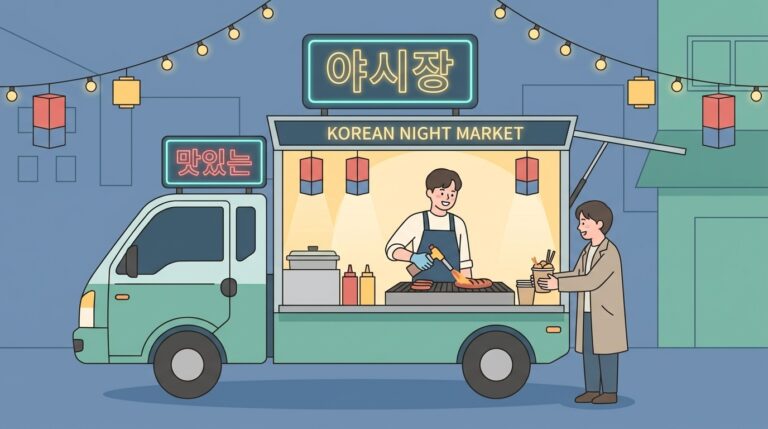
Imagine this: The sun has set over Seoul, and you find yourself wandering into a vibrant, neon-lit alleyway nestled inside a traditional market. But this isn’t your grandmother’s market. Upstairs, you find a hip sanctuary called a 청년몰 (Cheongnyeon Mall / Youth Mall), where Gen Z entrepreneurs serve artisanal craft beers, and downstairs, the aroma of torch-seared pork belly rolls from a night market food truck fills the air.
You step up to a food truck with a glowing menu. You want to customize your order, ask for the bestseller, and maybe throw in a lighthearted joke about your low spice tolerance. But suddenly, your mind goes blank. You know how to say “이거 주세요” (Give me this), but as a C1-level learner, you want to sound like a local who belongs here, not a tourist holding a phrasebook.
Many of our advanced learners at Daily Hangul confess: “I can discuss politics in Korean, but banter with a trendy food truck owner? My Korean suddenly feels way too stiff!” Don’t worry. Today, we’re going to master the art of casual, high-context street banter, so you can navigate Korea’s dynamic night markets with ultimate confidence and social flair.
Phase 2: Core Expression Deep Dive (핵심 표현 3선 심층 분석)
Let’s dissect three advanced, culturally rich expressions that will instantly elevate your night market game.
1. 입가심으로 딱이네요 (Ip-ga-sim-euro ddak-i-neyo)
- Pronunciation: [ip-ga-seem-oo-ro tuck-ee-neh-yo] (Sound Analogy: Think of the “ddak” as the satisfying snap of your fingers—hitting the nail right on the head.)
- Meaning: “This is the perfect palate cleanser!” or “This is the ultimate way to wrap up the meal!”
- K-Culture Moment: You often hear this in gourmet K-Dramas or food variety shows like Street Food Fighter. After eating a heavy, savory dish like spicy grilled intestines (곱창), the host will grab a sweet rice punch (식혜) or a cool craft beer and sigh, “아, 입가심으로 딱이네요!”
- Editor’s Insight: 입가심 (palate cleanser/mouth-wash) combined with ~으로 딱이다 (to be perfect for) shows a deep understanding of the Korean culinary journey, which highly values the harmony and transition between savory, spicy, and sweet.
- Situation Spectrum: Casual: ✅ | Semi-formal: ✅ | Formal: ⚠️
- 🤔 Think About It: In your culture, is there a specific food or drink designated as the “official” palate cleanser, or do you transition straight to dessert without a linguistic distinction?
2. 이거 요즘 여기서 제일 잘나가는 거예요? (I-geo yo-jeum yeo-gi-seo je-il jal-na-ga-neun geo-yeo-yo?)
- Pronunciation: [ee-goh yo-jeum yuh-gi-suh je-il jal-nah-gah-neun guh-yuh-yo] (Sound Analogy: jal-na-ga flows smoothly, like water “running well” out of a tap.)
- Meaning: “Is this your current bestseller?” (Lit. “Is this what goes out best here lately?”)
- K-Culture Moment: Used constantly at trendy food trucks where the menu changes seasonally based on Instagram trends.
- Editor’s Insight: Instead of asking the basic “뭐가 맛있어요?” (What is delicious?), asking what is 잘나가는 (trending/selling best) acknowledges the vendor’s business dynamic. It shows you respect their current hottest craft.
- Situation Spectrum: Casual: ✅ | Semi-formal: ✅ | Formal: 🚫
- 🤔 Think About It: Korea is a highly trend-sensitive society. How does this reflect in the way people order food compared to your home country, where individual preference might override popularity?
3. 혹시 소스 따로 주실 수 있나요? 부먹 찍먹 예민해서요. (Hok-si so-seu dda-ro ju-sil su in-na-yo? Bu-meok jjik-meok ye-min-hae-seo-yo.)
- Pronunciation: [hok-shee so-seu dah-ro joo-sheel soo een-nah-yo? boo-meok jjeek-meok yeh-meen-hae-suh-yo]
- Meaning: “Could you possibly put the sauce on the side? I’m a bit sensitive about the whole ‘pour-over vs. dipping’ debate.”
- K-Culture Moment: This references one of Korea’s most legendary food debates: 부먹 (Pour-over sauce) vs. 찍먹 (Dipping in sauce), usually applied to sweet and sour pork (탕수육) or any fried street food with glaze.
- Editor’s Insight: Saying you are 예민하다 (sensitive) here is a brilliant piece of self-deprecating humor. It signals to the young chef that you are fully immersed in Korean internet and food culture.
- Situation Spectrum: Casual: ✅ | Semi-formal: ⚠️ | Formal: 🚫
- 🤔 Think About It: What is the equivalent of the “pineapple on pizza” debate in your country? How would you translate that level of cultural playfulness into Korean?
Phase 3: Textbook Korean vs. Real-World Korean (교과서 한국어 vs 진짜 한국어)
Situation 1: Asking for a smaller portion to save room for other food trucks.
- 📖 Textbook: “더 작은 크기로 판매합니까?” (Do you sell in a smaller size?)
- 🗣️ Real Korean: “혹시 이거 맛보기용으로 조금만 살 수 있을까요? 다른 것도 먹어보고 싶어서요.” (Could I possibly get a tiny ‘tasting portion’ of this? I really want to try other stalls too.)
- 💡 Why the difference? 맛보기용 (tasting portion) is a warm, polite way to ask for a custom small size without sounding demanding. It appeals to the vendor’s pride in wanting you to experience their food as part of a larger market journey.
Situation 2: Inquiring about the spice level of a trendy food truck item.
- 📖 Textbook: “이 요리는 많이 매운 편입니까?” (Is this dish on the spicier side?)
- 🗣️ Real Korean: “이거 혹시 신라면 기준으로 얼마나 매워요? 제가 완전 맵찔이라서요.” (How spicy is this compared to Shin Ramyun? I’m a total spice-wimp.)
- 💡 Why the difference? In Korea, Shin Ramyun is the gold standard benchmark for spiciness. Labeling yourself a 맵찔이 (spice-wimp) immediately lowers the seller’s guard and usually earns you a friendly laugh and a milder sauce adaptation.
Phase 4: K-Culture Deepdive & Non-verbal Manners (문화 딥다이브)
4-1. The Art of “Nunchi” (눈치) at the Night Market Food Truck
- The Queue Etiquette: Night market lines can get chaotic. When waiting for your buzzer (진동벨) to ring, never stand directly in front of the pickup window. Step back and maintain a 45-degree angle. This non-verbal cue shows you have 눈치 (situational awareness) and aren’t rushing the chef.
- The Two-Hand Hand-off: Even if you are buying a 3,000 won cup of tteokbokki, when the young owner hands it to you, receive it with both hands (or with your left hand gently supporting your right forearm). It bridges the age gap and shows deep respect for their hard work.
4-2. The “Newtro” (뉴트로) Culture Code
Cheongnyeon Malls (청년몰) are a government-backed initiative to revitalize aging traditional markets by introducing hip, youthful businesses. In places like Jeonju Nambu Market or Seoul Gyeongdong Market, you will experience a beautiful contrast: elderly grandmothers selling fresh garlic on the first floor, while Gen Z brewers sell lavender-infused ale on the second floor. Respecting both spaces is the hallmark of a culturally conscious traveler.
Phase 5: Real-World Roleplay Scenario (실전 롤플레이)
Characters:
* Leo (레오): An advanced Korean learner who loves street food.
* Min-woo (민우): The trendy, friendly owner of “Youth Steak” food truck.
* Ji-hyeon (지현): Leo’s local Korean friend.
- Setting: The bustling, neon-lit Han River Night Market on a breezy Friday night.
- 민우 (Owner): (Torching a thick slab of steak, flame roaring) “어서 오세요! 청년스테이크입니다. 주문 도와드릴까요?”
(Welcome! This is Youth Steak. How can I help you?) -
레오 (Leo): (Looking at the menu with excitement) “와, 불 쇼 장난 아니네요! 혹시 이거 요즘 여기서 제일 잘나가는 거예요?”
(Wow, the flame show is no joke! By the way, is this your current bestseller here?) -
민우 (Owner): (Grinning proudly) “아, 알아보시네요! 저희 ‘눈꽃치즈 스테이크’가 요즘 인스타에서 완전 난리 났어요. 강력 추천합니다!”
(Ah, you recognize quality! Our ‘Snow Cheese Steak’ is absolutely blowing up on Instagram lately. Highly recommended!) -
레오 (Leo): “좋아요, 그걸로 할게요! 아, 그런데 혹시 소스는 따로 주실 수 있나요? 제가 완전 찍먹파라 부먹 찍먹 예민해서요.”
(Great, I’ll take that! Oh, but could you possibly put the sauce on the side? I’m a die-hard dipping fan, so I’m sensitive about the pour-vs-dip debate.) -
민우 (Owner): (Laughs out loud, giving a thumbs up) “오, 찍먹파이시구나! 배우신 분이네. 당연히 따로 챙겨드려야죠! 굽기는 미디엄으로 해드릴까요?”
(Oh, a dipping fan! A person of true culture, indeed. Of course I’ll put it on the side! Would you like it cooked medium?) -
지현 (Friend): “레오, 너 진짜 한국인 다 됐다. 부먹 찍먹 드립까지 치고!”
(Leo, you’ve basically become Korean. Doing the ‘bu-meok jjik-meok’ joke!) -
레오 (Leo): “하하, 시장 투어 할 때는 제대로 해야지. 사장님, 저희 다른 푸드트럭도 돌 거라서 혹시 맛보기용처럼 고기 조금만 더 작게 잘라주실 수 있을까요?”
(Haha, if you do a market tour, you gotta do it right. Boss, we are planning to hit other food trucks too, so could you cut the steak into slightly smaller, bite-sized pieces for easier sharing?) -
민우 (Owner): “센스 최고시네요! 다른 데서도 맛있는 거 많이 드시라고 먹기 편하게 큐브 크기로 딱 썰어드릴게요!”
(Top-tier sense! I’ll cut them perfectly into cube sizes so you can easily enjoy other delicious foods elsewhere too!)
🔀 Interactive Decision Point (인터랙티브 분기점)
After receiving your steak, Min-woo hands you a cup of homemade hot cinnamon cider. How do you respond to show your C1 conversational depth?
- Option A: “감사합니다. 잘 마실게요.” (Simple, polite, but a bit too basic.)
- Option B: “우와, 서비스 대박! 안 그래도 스테이크 먹고 살짝 기름졌는데, 입가심으로 딱이네요!” (High-level, warm, uses the perfect idiomatic phrase.)
- Option C: “공짜로 주시는 거예요? 돈 안 내도 돼요?” (A bit too direct and makes the friendly gesture feel transactional.)
💡 Feedback Matrix
- Best Choice: Option B. It acknowledges the seller’s generosity while naturally applying the idiom 입가심으로 딱이다. Min-woo will likely remember you and give you extra pieces of meat next time!
- Risk Choice: Option A. It’s grammatically perfect but lacks the “friendly neighbor” vibe that thrives in night markets.
- Bad Choice: Option C. While honest, questioning the cost of a clear gift can sometimes make the atmosphere slightly awkward.
Phase 6: 10-Second Emotion Shadowing Drill (10초 감정 섀도잉)
To master the natural rhythm and emotional cadence of an advanced speaker, practice saying these with the designated pauses (/) and emotional cues.
- [😊 Expressing excited curiosity to the chef]
“와 / 이거 요즘 여기서 / 제일 잘나가는 거예요?”
(Wa / i-geo yo-jeum yeo-gi-seo / je-il jal-na-ga-neun geo-yeo-yo?) -
[😜 Playing around with local food debates]
“혹시 소스는 따로 주실 수 있나요? / 제가 부먹 찍먹 예민해서요!”
(Hok-si so-seu dda-ro ju-sil su in-na-yo? / je-ga bu-meok jjik-meok ye-min-hae-seo-yo!) -
[🥺 Satisfied, cozy sigh after eating]
“캬~ / 역시 마지막은 / 입가심으로 딱이네요!”
(Kya~ / yeok-si ma-ji-mak-eun / ip-ga-sim-euro ddak-i-neyo!)
Phase 7: K-Culture Mini-Dictionary (K-Culture 미니 사전)
- 청년몰 (Cheongnyeon-mall): State-supported, highly stylish shopping/dining zones within traditional markets operated entirely by young merchants under 39.
- 야시장 (Ya-si-jang): Night markets. Famous for bringing public spaces (like the Han River or old market squares) to life with food trucks and craft vendors.
- 맵찔이 (Maep-jjil-i): A slang portmanteau of 매운 (spicy) + 찌질이 (loser/wimp). A lighthearted self-deprecating term for someone who can’t handle spicy food.
- 입가심 (Ip-ga-sim): Something eaten or drunk to clear the taste of a previous meal. Usually sweet, minty, or refreshing.
Phase 8: Survival Kit for Travelers (여행자를 위한 생존 키트)
Survival Expressions TOP 3
- “카드 결제 되나요?” (Ka-deu gyeol-je doe-na-yo?)
- Meaning: “Do you accept credit cards?”
- Pro Tip: Almost all modern food trucks accept cards, but inside older traditional market buildings, having this phrase ready is a lifesaver.
- “덜 맵게 해주실 수 있어요?” (Deol maep-ge hae-ju-sil su iss-eo-yo?)
- Meaning: “Could you make it less spicy, please?”
- Pro Tip: Essential if you realize a dish uses Gochujang (red chili paste) base.
- “쓰레기통 어디 있어요?” (Sseu-re-gi-tong eo-di iss-eo-yo?)
- Meaning: “Where is the trash can?”
- Pro Tip: Night markets have strict waste separation zones. Always ask instead of leaving cups on benches.
Editor’s Travel Note 🗺️
When planning your market crawl, rely on 네이버 지도 (Naver Map) instead of other foreign map apps, as it updates temporary night market vendor layouts much faster. While most vendors accept digital payment, always keep about 10,000 KRW in physical cash just in case you run into an elderly vendor outside the youth zone! (Note: Street market operating hours and food truck lineups are subject to seasonal changes).
Phase 9: “One Step Deeper” (한 발 더 깊이)
In many Western cultures, markets are strictly transactional places to buy groceries. However, in Korea, the 전통 시장 (Traditional Market) is a living ecosystem of social history. The rise of 청년몰 (Youth Malls) represents a unique cultural compromise: Gen Z doesn’t want to destroy the old; they want to preserve it by blending it with modern trends. When you speak to a young vendor using local slang, you aren’t just ordering food—you are actively participating in the linguistic bridge that keeps these historical markets alive.
💬 Your Turn: Have you ever visited a traditional night market in Korea, or do you have a similar “new-meets-old” culinary space in your home country? Share your stories in the comments below!
Phase 10: FAQ & Common Mistakes (자주 묻는 질문과 실수)
Q: Is it rude to use slang like ‘맵찔이’ (Maep-jjil-i) with vendors who look older than me?
A: Yes, it can be. Keep slang like 맵찔이 and 부먹/찍먹 for young vendors at food trucks or youth malls (who are usually under 40). For elderly grandmothers (할머니), stick to polite, respectful phrases like “제가 매운 걸 잘 못 먹어서요” (Because I cannot eat spicy food well).
Q: Do I need to tip the food truck owners if they give amazing service?
A: No! Tipping is not part of Korean culture and can actually cause confusion. Instead, express your gratitude with a bright smile, a deep bow, and a warm “진짜 맛있게 잘 먹었습니다! 대박 나세요!” (I ate so well! May your business hit the jackpot!).
Q: Why do some vendors look unhappy when I ask for one dish to share between three people?
A: Night market food trucks operate on razor-thin margins. While “snacking around” is normal, ordering a single 5,000 won item for a large group to sit at a private table is considered bad manners. The rule of thumb is: at least one order per two people.
🚨 Common Mistakes Warning Board
- Calling young male food truck owners “아저씨” (A-jeos-si):
- Why it’s bad: 아저씨 implies a much older, middle-aged man.
- Correct Action: Address them as 사장님 (Sa-jang-nim / Boss) or simply avoid titles and use polite sentence endings.
- Throwing food waste into general recycling bins:
- Why it’s bad: Korea has incredibly strict food waste sorting laws.
- Correct Action: Look for containers specifically labeled 음식물 쓰레기 (Food Waste) to discard leftovers before recycling the paper cup.
- Demanding cash discounts:
- Why it’s bad: While older markets sometimes offer a tiny discount for cash, demanding it from young startup owners at Youth Malls is seen as outdated and rude.
- Correct Action: Pay the listed price cheerfully.
Phase 11: Action Mission & Participation (액션 미션)
- 🥉 Bronze Mission (Level 1): Practice saying “입가심으로 딱이네요!” out loud three times with different emotional registers (e.g., highly refreshed, subtly satisfied, pleasantly surprised).
- 🥈 Silver Mission (Level 2): Go to Instagram or YouTube and search the hashtag
#청년몰or#야시장푸드트럭. Find one menu item that catches your eye and write a comment in Korean asking if it’s their bestseller using today’s C1 phrase. - 🥇 Gold Mission (Level 3): During your next trip to Korea, visit a Youth Mall or Night Market. Order fusion food, make a 부먹/찍먹 joke to a young merchant, and secure a warm local smile!
🎮 K-Culture Mission
Watch a food-themed K-Drama or variety show (like 백종원의 골목식당 – Baek Jong-won’s Alley Restaurant). Listen closely for the word 사장님 (Sa-jang-nim) and notice the diverse vocal tones people use to address different business owners.
Phase 12: Interactive Quiz Challenge (인터랙티브 퀴즈)
1. Situational Judgment
You are at a trendy fusion taco food truck. You want to ask if the spicy pork taco is too spicy for you in a natural, highly cultural C1 way. Which phrase do you use?
* A) 이 타코는 고추가 많이 들어있습니까?
* B) 이거 혹시 신라면보다 매운가요? 제가 맵찔이라서요.
* C) 저는 매운 음식을 못 먹는 사람입니다.
View Answer & Explanation
Correct Answer: B
Explanation: While A and C are grammatically correct, B uses the universal spice metric (Shin Ramyun) and the self-deprecating slang (맵찔이), which builds immediate, friendly rapport with the young chef.
2. Fill-in-the-Blank
After eating a very spicy cup of tteokbokki, you buy a cool sweet sikhye (rice punch) to soothe your tongue. You can say:
“역시 매운 거 먹고 나서는 이 식혜가 ( ) 딱이네요!”
View Answer & Explanation
Correct Answer: 입가심으로 (ip-ga-sim-euro)
Explanation: “입가심으로” fits perfectly here to express that the sweet drink is the ultimate palate cleanser after a burning-hot meal.
3. True or False
True or False: Every business owner in a traditional market, regardless of age, will love being called “아저씨” (A-jeos-si) or “이모” (I-mo).
View Answer & Explanation
Correct Answer: False
Explanation: Calling young entrepreneurs at a youth mall “아저씨” (middle-aged man) can be offensive, as they are often in their 20s or 30s. Stick to the highly versatile and polite term 사장님 (Sa-jang-nim).







