

Space, Gaze, and Connection: Debating Architecture with the Lens of Yoo Hyun-jun
Phase 1: Empathy (An Invitation to Korean Spaces)
안녕하세요! (Annyeonghaseyo!) Your friendly editor from Daily Hangul here!
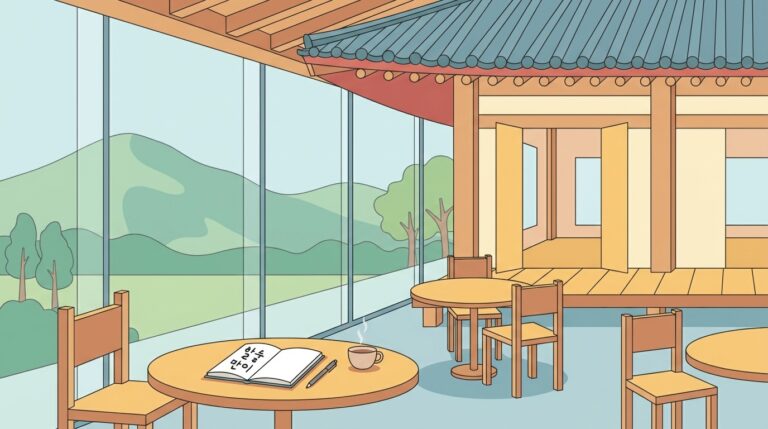
Imagine this: You are sitting in a gorgeous, high-ceiling cafe in Hanok-inspired Eunpyeong Hanok Village, looking out through a massive glass window that perfectly frames Bukhansan Mountain. Your Korean friend sips their hot Americano and asks: “Sarah, what do you think makes this space feel so relaxing?”
If you answered with a simple “Because it’s pretty!”—don’t worry, we’ve all been there! But as a B2 intermediate learner, you are ready to dive deeper. If you’ve watched the famous Korean architect Yoo Hyun-jun (유현준) on his hit YouTube channel, Sherlock Hyun-jun (셜록 현준), you know that Koreans love debating how architecture shapes our relationships, social status, and happiness. Today, we will upgrade your Korean from simple descriptions to intellectual, culture-rich architectural debates. Let’s step inside!
Phase 2: Key Expressions for Architectural Debates
1. 소통을 유도하는 공간 (Sotong-eul yudohaneun gonggan)
- Pronunciation: [So-tong-eul yu-do-ha-neun gong-gan] (Sounds like: “So-tong-ool you-do-ha-noon gong-gahn”)
- Meaning: A space that induces/encourages communication.
- K-Culture Moment: You’ll hear Architect Yoo Hyun-jun use this when criticizing modern Korean apartments that lock families behind thick walls, contrasting them with traditional alleyways where neighbors naturally chat.
- Editor’s Insight: 소통 (communication) and 유도하다 (to induce/guide) combined show that architecture isn’t passive; it actively shapes human behavior.
- Situation Spectrum: Casual ⚠️ | Semi-formal ✅ | Formal ✅
- 🤔 Think About It: Does your current home have a “소통을 유도하는 공간”? Or does it separate everyone?
2. 시선이 머무는 곳 (Siseon-i meomuneun got)
- Pronunciation: [Si-seon-i meo-mu-neun got] (Sounds like: “She-sun-ee muh-moo-noon got”)
- Meaning: The place where the gaze rests / where the eyes linger.
- K-Culture Moment: In K-Dramas, when characters stare out of a beautifully designed cafe window at the falling rain, they are looking at where the 시선 (gaze) naturally rests.
- Editor’s Insight: 머물다 means to stay or linger. In Korean architecture, design is all about control of the gaze—who can see whom, and what beautiful scenery is captured.
- Situation Spectrum: Casual ✅ | Semi-formal ✅ | Formal ✅
- 🤔 Think About It: When you enter a room, what is the first thing that catches your gaze (시선이 머무는 곳)?
3. 경계를 허물다 (Gyeonggye-reul heomulda)
- Pronunciation: [Gyeong-gye-reul heo-mul-da] (Sounds like: “Kyung-gyeh-ruhl huh-mool-da”)
- Meaning: To break down boundaries / dissolve the walls.
- K-Culture Moment: Used when discussing modern cafes that use massive sliding glass doors to merge the indoor seating seamlessly with the outdoor garden.
- Editor’s Insight: 허물다 is a powerful verb meaning to demolish or pull down. Dissolving the boundary between nature (안) and building (밖) is a core philosophy of traditional Korean architecture (Hanok).
- Situation Spectrum: Casual ✅ | Semi-formal ✅ | Formal ✅
- 🤔 Think About It: Why does modern society try to build higher walls, while great architects try to break down boundaries?
Phase 3: Textbook Korean vs. Real-Life Korean
Scenario 1: Describing a Cafe’s Atmosphere
- 📖 Textbook Korean: “이 카페는 인테리어가 아주 예쁩니다.” (This cafe’s interior design is very pretty.)
- 🗣️ 진짜 Korean: “이 카페는 공간감이 진짜 장난 아니네요!” (The sense of space in this cafe is absolutely insane/incredible!)
- 💡 Why the difference? B2 speakers don’t just say things are “pretty” (예쁘다). They talk about 공간감 (gong-gan-gam – sense of space), which refers to the volumetric feeling, ceiling height, and emotional scale of a room. “장난 아니다” is a natural intermediate idiom for “is no joke/is incredible.”
Scenario 2: Describing Large Glass Windows
- 📖 Textbook Korean: “유리창이 커서 바깥이 잘 보입니다.” (Because the window is big, you can see the outside well.)
- 🗣️ 진짜 Korean: “통창이라 개방감이 아주 끝내줘요.” (Since it has floor-to-ceiling windows, the sense of openness is absolutely superb.)
- 💡 Why the difference? Real Koreans use 통창 (tong-chang – floor-to-ceiling window) and 개방감 (gae-bang-gam – sense of openness) to describe that airy, breezy, modern architectural vibe.
Phase 4: K-Culture Deep-Dive & Non-Verbal Manners
4-1. The Art of “Siseon” (시선) and Nodding
When debating architectural design in Korea, it is polite to maintain soft, indirect eye contact, especially when disagreeing. Staring directly into someone’s eyes while saying “I disagree” feels aggressive. Instead, look at the architectural feature you are discussing (e.g., pointing gently with an open palm toward a window) and nod slowly while saying: “그것도 맞지만…” (That is also true, but…).
4-2. The Cultural Code: Chagyeong (차경 – Borrowed Scenery)
In his lectures, Yoo Hyun-jun heavily praises Chagyeong (차경). Unlike Western architecture, which historically built walls to block out nature and hang paintings, traditional Korean Hanok treats windows as empty frames. Nature itself is “borrowed” to act as a living, breathing painting. When you visit places like the Dongdaemun Design Plaza (DDP) or San Museum in Wonju, look for how modern architects blend this traditional concept of merging nature with concrete.
Phase 5: Real-Life Roleplay Scenario
Background: Minho (a local architecture student) and Sarah (you) are having a coffee at a newly designed terrace cafe in Seoul. You both love Architect Yoo Hyun-jun’s theories and are analyzing the space.
- 민호: 사라 씨, 이 카페 어때요? 새로 생겼는데 마음에 들어요?
(Sarah, how do you like this cafe? It’s newly opened, do you like it?) - 사라: 🎭 [눈을 반짝이며 주위를 둘러본다] 와, 들어오자마자 공간감이 장난 아니라고 생각했어요!
(Wow, as soon as I walked in, I thought the sense of space was incredible!) - 민호: 맞아요. 천장이 높아서 시원한 느낌이 들죠?
(Right. The high ceiling makes it feel so refreshing, doesn’t it?) - 사라: 네! 게다가 저 통창 덕분에 안과 밖의 경계를 허문 것 같아요.
(Yes! Plus, thanks to that floor-to-ceiling window, it feels like it broke down the boundary between inside and outside.) - 민호: 오, 사라 씨 완전 건축가 다 됐네요! 유현준 교수님이 하신 말씀이랑 똑같아요.
(Oh, Sarah, you’ve basically become an architect! That’s exactly what Professor Yoo Hyun-jun said.) - 사라: 🎭 [부끄러워하며 웃는다] 에이, 그냥 유튜브를 많이 봐서 그래요. 근데 이 자리가 진짜 명당이네요.
(Ah, it’s just because I watched a lot of YouTube. But this spot is truly the prime seat.) - 민호: 왜 그렇게 생각해요?
(Why do you think so?) - 사라: 여기가 바로 자연스럽게 사람들의 시선이 머무는 곳이니까요. 조경이 너무 아름다워요.
(Because this is exactly where people’s gaze naturally rests. The landscaping is so beautiful.)
🔀 Interactive Choice Point
How would you reply if Minho asks: “그럼 이 카페 디자인에서 조금 아쉬운 부분은 없어요?” (Then is there anything slightly lacking in this cafe’s design?)
- Choice A: “소통을 유도하는 공간이 조금 부족한 것 같아요. 테이블이 다 벽을 보고 있네요.”
(I think it lacks space that induces communication. All the tables are facing the walls.) - Choice B: “여기 너무 비싸고 좁아요. 다른 데 가요.”
(It’s too expensive and cramped here. Let’s go somewhere else.) - Choice C: “저는 인테리어 전문가가 아니라서 잘 모르겠어요.”
(I’m not an interior expert so I don’t really know.)
🔍 Feedback on Your Choice:
- Best (Choice A): Perfect! You correctly applied B2 vocabulary (소통을 유도하는 공간) to criticize the layout constructively, matching the analytical style of Yoo Hyun-jun!
- Risk (Choice B): Too blunt and ruins the intellectual, cozy mood of the conversation.
- Bad (Choice C): Defensive. Don’t be afraid to voice your opinion in Korean!
Phase 6: 10-Second Shadowing Drill
Practice speaking with emotional nuance. Master the flow by pausing at the slashes (/).
- Sentence: “이 카페는 / 안과 밖의 경계를 허물어서 / 개방감이 진짜 장난 아니에요!”
- Pronunciation: [I ka-pe-neun / an-gwa bak-kui gyeong-gye-reul heo-mul-eo-seo / gae-bang-gam-i jin-jja jang-nan a-ni-e-yo!]
- Emotion Target:
[😊 Expressively and with awe]Imagine telling your best friend about a stunning view you just discovered.
Phase 7: K-Culture Mini Dictionary
- 마당 (Madang): The traditional Korean inner courtyard. Unlike Western lawns, it is kept empty to allow multi-functional gatherings and natural airflow.
- 차경 (Chagyeong): “Borrowed Scenery.” The practice of framing outdoor nature through windows like a painting.
- 골목길 (Golmokgil): Narrow traditional alleyways. Yoo Hyun-jun often describes them as warm social hubs that are disappearing due to giant apartment complexes.
- 배산임수 (Baesanimsu): The ideal traditional location layout—mountains in the back (배산), water in the front (임수).
Phase 8: Traveler’s Survival Kit
Survival Phrases for Architectural Lovers:
- “여기 전망 좋은 자리 있어요?” (Yeo-gi jeon-mang jo-eun ja-ri is-seo-yo?)
- Pro Tip: Use this at trendy cafes to ask for seats with the best scenic view.
- “이 건물의 시그니처 공간이 어디예요?” (I geon-mul-ui si-geu-ni-cheo gong-gan-i eo-di-yeo-yo?)
- Pro Tip: Great when visiting modern spots like the Amorepacific Headquarters or the Starfield Library.
- “우와, 사진 진짜 잘 나오네요!” (U-wa, sa-jin jin-jja jal nao-ne-yo!)
- Pro Tip: “Wow, this place is so photogenic!” (Perfect for photogenic architectural masterpieces).
🗺️ Editor’s Travel Note:
To discover these architectural gems yourself, don’t rely on global map apps which don’t update well in Korea. Instead, search on the Naver Map App for terms like “대형 카페” (large architectural cafes) or “한옥 갤러리” (Hanok galleries). Note: Operating hours and entry requirements for independent galleries may change without notice, so always double-check the Naver app before heading out!
Phase 9: “한 발 더 깊이” (Deepening Thought)
Have you ever wondered why over 60% of Seoul’s population lives in uniform high-rise apartments? Architect Yoo Hyun-jun argues that because modern apartments lack private balconies and yards, Koreans are forced to go outside to “rent” space. This is why Korea has developed such an incredibly vibrant cafe and Bang (방 – room, like Karaoke rooms, PC bangs) culture. Our cafes are essentially living rooms we rent for the price of a cup of coffee. By understanding Korean architecture, you unlock the psychological key to modern Korean lifestyle and socialization.
💬 Your Turn: Do you prefer cozy, closed spaces, or open spaces that dissolve boundaries? Leave a comment below in Korean!
Phase 10: FAQ & Common Mistakes
Q: What is the difference between ‘경계’ (boundary) and ‘벽’ (wall)?
A: 벽 (byeok) refers to a physical solid structure made of concrete or wood. 경계 (gyeong-gye) is a broader, psychological or conceptual boundary. For example, a glass wall physically exists (벽), but visually dissolves the boundary (경계를 허물다).
Q: Why does Yoo Hyun-jun talk so much about ‘골목길’ (alleys)?
A: He believes that narrow alleys naturally slow down traffic and invite people to walk, talk, and make eye contact, fostering a stronger community spirit than wide, car-centric asphalt streets.
Q: Can I use ‘장난 아니다’ in formal business settings?
A: No, “장난 아니다” is highly casual and idiomatic. In a business meeting, instead say “매우 훌륭합니다” (It is highly excellent) or “압도적입니다” (It is overwhelming/stunning).
🚨 Common Mistakes Warning Board
- Saying “창문이 오픈해요” (Incorrect): Open is not used as a verb this way. Use “개방감이 있어요” (It has a sense of openness) or “창문을 열었어요” (The window was opened).
- Confusing ‘시선’ (gaze) and ‘시점’ (point of view): If eyes are physically looking at a spot, use 시선이 머무는 곳. If discussing literary narrative perspective, use 시점.
Phase 11: Action Missions
- 🥉 Bronze: Watch a short video on the YouTube channel Sherlock Hyun-jun (셜록 현준) and try to spot the word 공간 (space) or 소통 (communication).
- 🥈 Silver: Take a picture of your favorite room or local cafe and post it on Instagram. Tag us with the caption: “이곳은 시선이 머무는 곳입니다.”
- 🥇 Gold: Next time you visit a cafe with a friend, use at least two B2 architecture terms from today to describe the vibe!
Phase 12: Interactive Quiz Challenge
Test your skills! Can you get 3/3?
1. Choose the most natural phrase to describe a room with high ceilings and huge windows.
- A) 방이 아주 높고 투명합니다.
- B) 천장이 높아서 개방감이 느껴집니다.
- C) 이곳은 벽이 많아서 좋습니다.
2. Fill in the blank:
“전통 한옥은 자연과 사람 사이의 ( )를 허무는 디자인이 특징입니다.”
* A) 시선
* B) 경계
* C) 공간감
3. True or False: ‘Chagyeong’ (차경) means building high brick walls around a garden to keep it secret. ( T / F )
👉 Click to reveal Answers & Explanations!
- Answer: B. High ceilings (천장) and openness (개방감) are the perfect B2 collocations to describe a spacious modern room.
- Answer: B. 경계 (Boundary). Traditional Hanok dissolves the boundary between nature and humans.
- Answer: F (False). Chagyeong actually means “borrowing scenery” by leaving windows open to frame the existing outdoor nature naturally!







