

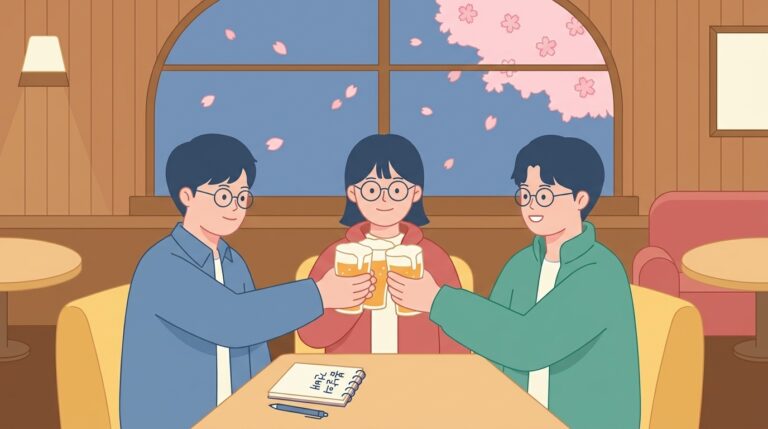
Welcome to the Ultimate Guide to Surviving a Korean ‘Gaegang Party’!
Phase 1: Empathy (Opening)
안녕하세요! (Annyeonghaseyo!) I’m your lead editor at Daily Hangul, your trusted local culture navigator. Spring is finally here in Korea! The cherry blossoms (벚꽃) are blooming, the air is sweet, and if you are on a Korean university campus, there’s a unique buzz in the air. It’s the start of the spring semester, which means one thing: 개강 파티 (Gaegang Pati) – the New Semester Welcoming Party!
If you’ve ever watched a university-themed K-Drama, you’ve probably seen students gathered in a noisy Hof (호프집), drinking, laughing, and playing games. But if you’re an international student or a traveler trying to blend in, this lively atmosphere can feel incredibly intimidating. “What if I make a mistake while pouring drinks?” “What do I say when someone invites me to the next round?”
Don’t worry! This guide is built from real-world experiences of students who went from feeling lost to becoming the soul of the party. By the end of this post, you’ll have the exact vocabulary, cultural hacks, and confidence to navigate any spring social gathering in Korea like a natural!
Phase 2: Core Expressions (3 items)
1. 2차 가요! (I-cha gayo!)
- Pronunciation: “Ee-chah gah-yo!” (Sounds like saying “Each” with an “ah” at the end, followed by “go” in Spanish: “Ee-chah gah-yo”)
- Meaning: “Let’s go to round two!” (Directly: Go to the 2nd stage/place)
- K-Culture Moment: You’re at a BBQ restaurant, the plates are empty, but the energy is still high. The leader of the group stands up and shouts this to keep the night alive.
- Editor’s Insight: Korean social outings rarely end at one location. “1차” (Il-cha) is usually for dinner, “2차” (I-cha) is for a pub or Hof, and “3차” (Sam-cha) might be karaoke (노래방). Saying this shows you’re enthusiastic and having a great time.
- Situation Spectrum: Casual ✅ | Semi-formal ⚠️ | Formal 🚫
- 🤔 Think About It: In many Western cultures, people stay at one bar for hours. Why do you think Korean culture emphasizes moving to multiple venues (1차, 2차, 3차) in a single night?
2. 술기운에 (Sulgione)
- Pronunciation: “Sool-ghee-oon-eh” (Rhymes with “cool” followed by “ghee” and “un-eh”)
- Meaning: “Under the influence of alcohol” or “thanks to liquid courage”
- K-Culture Moment: In K-Dramas, this is when the second lead finally confesses their love after having a few glasses of Soju.
- Editor’s Insight: “술” (sul) means alcohol, and “기운” (giun) means energy or vibe. It’s a very soft, natural way to explain why you became unusually brave, talkative, or did something silly last night.
- Situation Spectrum: Casual ✅ | Semi-formal ✅ | Formal 🚫
- 🤔 Think About It: How does your native language describe the courage you get from drinking? Is it viewed as positively or lightheartedly as “술기운” is in Korea?
3. 분위기 메이커 (Bunwigi meikeo)
- Pronunciation: “Boon-wee-ghee may-ee-keo”
- Meaning: “Mood maker” (The life of the party)
- K-Culture Moment: This is the energetic student who leads the drinking games, claps the loudest, and makes sure everyone is laughing.
- Editor’s Insight: This is a classic Konglish (Korean-English) term. Koreans highly value group harmony. Calling someone a “분위기 메이커” is one of the highest social compliments you can give!
- Situation Spectrum: Casual ✅ | Semi-formal ✅ | Formal ⚠️
- 🤔 Think About It: Who is the “분위기 메이커” in your friend group back home? How do they keep the energy up?
Phase 3: Textbook Korean vs. Real Korean
Let’s bridge the gap between classroom Korean and what you’ll actually hear on the streets of Sinchon or Hongdae.
- Situation 1: Inviting someone to drink
- 📖 Textbook: “같이 술을 마십시다.” (Gachi sureul masipsida. – “Let’s drink alcohol together.”)
- 🗣️ Real Korean: “오늘 한잔해야죠!” (Oneul hanjan-haeyajyo! – “We should grab a drink today!”)
- 💡 Why is it different? The textbook version sounds stiff and almost too serious, like an official decree. “한잔” (literally “one glass”) is a warm, friendly metaphor for social drinking, even if you end up drinking more than one!
- Situation 2: Expressing excitement about the new term
- 📖 Textbook: “새 학기가 시작되어 기쁩니다.” (Sae hakgiga sijakdoe-eo gippeumnida. – “I am glad the new semester has started.”)
- 🗣️ Real Korean: “드디어 개강이다!” (Deudio gaegang-ida! – “Finally, classes start!”)
- 💡 Why is it different? While “새 학기” (new semester) is grammatically perfect, college students exclusively use “개강” (starting lectures) to express the collective mixture of excitement and playful dread that comes with going back to university.
Phase 4: K-Culture Deep Dive & Non-verbal Manners
- 4-1. Nunchi & Drink Etiquette:
Korean drinking culture is built on 눈치 (Nunchi), which is situational quick-wittedness.- Two Hands Rule: When someone older or a senior (선배) pours you a drink, hold your cup with both hands. When pouring for them, hold the bottle with both hands (or place your left hand gently under your right elbow/on your chest).
- The Angle of Respect: When drinking in front of a senior, turn your head slightly to the side and cover your glass with your hand as you sip. It’s a sign of respect showing you don’t drink directly in their face.
- 4-2. Cultural Code: Somaek & Anju:
At a Gaegang Party, you’ll definitely witness the art of mixing 소맥 (Somaek), which is Soju + Maekju (Beer). It’s not just a drink; making it is a performance! And never drink on an empty stomach. Koreans always pair alcohol with 안주 (Anju), meaning side dishes like crispy Korean Fried Chicken, spicy Buldak, or savory Jeon (pancakes).
Phase 5: Real-Life Roleplay Scenario
- Background: You are sitting at a bustling Hof in Sinchon. Neon lights glow, and the table is covered with Somaek glasses and a sizzling pan of spicy rice cakes (떡볶이).
-
NPC: 민우 (Min-woo) – A friendly sophomore senior who wants to make sure the international students are having fun.
-
Dialogue:
- 민우: 🎭 (Smiling warmly, holding a Soju bottle) “지호 씨, 우리 오늘 처음 만났는데 한잔해야죠!”
- 지호 (You): 🎭 (Holding the cup with both hands) “네, 선배님! 한잔 받겠습니다.”
- 민우: 🎭 (Pouring the drink carefully) “한국 개강 파티 분위기는 처음이죠? 어때요, 적응 잘하고 있어요?”
- 지호 (You): 🎭 (Taking a sip while turning head slightly) “조금 부끄럽지만, 분위기 메이커인 선배님 덕분에 진짜 재밌어요!”
- 민우: 🎭 (Laughing loudly, clapping) “하하, 제가 좀 분위기 메이커죠? 안주도 많이 먹어요. 자, 다 같이 건배합시다!”
- 지호 (You): 🎭 (Raising the glass high) “짠! 오늘 끝까지 달리는 건가요?”
- 민우: 🎭 (Winking and pointing out the door) “당연하죠! 벌써 1차 끝났으니까 바로 2차 가요!”
- 지호 (You): 🎭 (Laughing and nodding) “좋습니다! 2차도 제가 빠질 수 없죠!”
- 🔀 Choose Your Next Move:
- Option A: “선배님, 저 너무 취해서 집에 가야겠어요.” (Sunbae, I’m too drunk, I must go home.)
- Feedback (Risk): It’s totally fine to prioritize your health, but saying this too early without a polite excuse might damp the mood. Try saying you have an early morning class instead to soften the blow!
- Option B: “좋습니다! 2차 가요! 다음은 노래방이죠?” (Great! Let’s go to round 2! Is karaoke next?)
- Feedback (Best): Perfect! This shows incredible energy and shows you understand the flow of Korean night life. You are officially the new mood maker!
- Option C: “저는 술기운에 실수를 많이 해서 2차는 무서워요.” (I make many mistakes when drunk, so I’m scared of round 2.)
- Feedback (Bad): Too honest! While self-awareness is good, saying you’re “scared” of making mistakes makes the atmosphere awkward. Just say “오늘 재미있었어요!” and head home gracefully.
Phase 6: 10-Second Shadowing Drill
Practice these sentences with the right emotion and natural pauses (/).
[😊 Excited & High Energy]“우리 / 벌써 1차 끝났으니까 / 바로 2차 가요!”- Uri / beolsseo il-cha kkeutnasseunikka / baro i-cha gayo!
[🥺 A bit shy but grateful]“술기운에 / 조금 용기 내서 / 말해봤어요.”- Sulgione / jogeum yonggi naeseo / malhaebwasseoyo.
Phase 7: K-Culture Mini Dictionary
- 개강 (Gaegang) | Start of college semester | Used only for colleges. The high school equivalent is “개학” (Gaehak).
- 선배 (Seonbae) | Senior | A term of respect for someone who entered university or work before you.
- 짠 (Jjan) | Cheers! | The friendly, casual sound of clinking glasses.
- 흑기사 (Heukgisa) | Black Knight | A friend who volunteers to drink your shot for you when you can’t drink anymore (often in exchange for a wish!).
Phase 8: Traveler’s Survival Kit
- Survival Expressions:
- 여기 물 좀 주세요! (Yeogi mul jom juseyo! – “Please give us some water here!”) -> Pro Tip: Essential when the spicy Anju or alcohol gets too intense.
- 이거 서비스예요? (Igeo seobiseu-yeyo? – “Is this on the house?”) -> Pro Tip: Hof owners often give free side dishes (service) to lively student tables.
- 화장실 어디에 있어요? (Hwajangsil eodie isseoyo? – “Where is the restroom?”) -> Pro Tip: Essential survival phrase in any crowded bar.
- Editor’s Travel Note: When navigating the busy university streets of Sinchon or Hongdae at night, Google Maps won’t help you much. Be sure to use the Naver Map App Download or KakaoMap to find the trendiest local Hofs and restaurants. Note: Local establishment details and operating hours may vary, so check the apps before you go!
Phase 9: “One Step Deeper” (Reflection)
In many cultures, university social life is individualistic. But in Korea, the “Gaegang Party” is rooted in a deep sense of 우리 (Uri – We/Our) and 정 (Jeong – social affection). Korean drinking games and multiple rounds aren’t just about the alcohol; they are structured social rituals designed to break down hierarchy and build close-knit communities in a highly structured society. When you accept a drink from a senior, you aren’t just drinking; you are accepting their care and welcoming gesture.
- 💬 Your Turn: Have you ever experienced a welcoming party in Korea or another country? How did it feel compared to social gatherings back home? Share your stories in the comments below!
Phase 10: FAQ & Common Mistakes (FAQ Schema)
Q: Do I have to drink alcohol if I attend a Gaegang Party?
A: Absolutely not! While drinking is common, you can always ask for cider (Korean Sprite) or cola. Simply say, “저는 오늘 술을 못 마셔서 사이다로 대신할게요!” (I can’t drink alcohol today, so I’ll substitute with cider instead!). Your health and comfort always come first.
Q: What should I call students who are older than me?
A: If they are in a higher grade at university, call them “선배님” (Seonbaenim – Formal) or “선배” (Seonbae – Casual). If you become very close, you can transition to “형” (Hyeong) / “오빠” (Oppa) for males, or “누나” (Nuna) / “언니” (Eonni) for females.
Q: Is it rude to leave the party early?
A: No, but it’s polite to slip away quietly or tell the organizer. You can say, “내일 아침 일찍 일이 있어서 먼저 가볼게요!” (I have something early tomorrow morning, so I will head out first!).
- 🚨 Common Mistakes Warning Board:
- Mistake 1: Pouring a drink into a glass that is still half-full. -> Correct Action: Wait until their glass is completely empty before offering a refill!
- Mistake 2: Using one hand to pour a drink to a senior. -> Correct Action: Always use two hands to show respect.
- Mistake 3: Drinking immediately without clinking glasses or waiting for the toast. -> Correct Action: Wait for the collective “짠!” (Cheers!) before taking your first sip.
Phase 11: Action Missions
- Bronze Mission: Practice saying “2차 가요!” loudly in front of your mirror with a big smile.
- Silver Mission: Share this post on your SNS with the hashtag #DailyHangul and write down your favorite Korean drinking snack (안주).
- Gold Mission: The next time you grab drinks with friends, try using the “two-hand pouring” etiquette to show off your Korean manners!
- 🎮 K-Culture Mission: Watch a college-themed K-Drama (like Cheese in the Trap or My ID is Gangnam Beauty) and spot a scene where students are drinking at a Hof. Write down what expressions they use in the comments!
Phase 12: Interactive Quiz Challenge
Test your knowledge! Click on the toggles below to see the answers.
Q1. What is the correct term for “the life of the party” in Korean slang?
Answer: 분위기 메이커 (Bunwigi meikeo)
Explanation: It’s a lovely Konglish word meaning “mood maker”, highly valued in group-oriented Korean culture!
Q2. T/F: When drinking with a Korean senior, you should look them directly in the eye while chugging your drink.
Answer: False
Explanation: You should turn your head slightly to the side and cover your glass as a sign of respect!
Q3. Fill in the blank: After finishing round 1, you want to propose going to round 2. You say: “_______ 가요!”
Answer: 2차 (I-cha)
Explanation: “2차 가요!” (Let’s go to round 2!) is the perfect phrase to keep the fun going.







