

Navigating Seoul’s Late-Night Rush: The Advanced Guide to Taxi Apps and Taxi Etiquette in Korea
Phase 1: Empathy (An Immersive Opening)
안녕하세요! It’s your trusty Daily Hangul Editor, your local culture navigator.
Picture this: It’s 11:45 PM on a chilly Friday night in Hongdae. You’ve just finished an incredible Korean BBQ dinner with your friends, and the last subway train has just departed. You look up, and the street is lined with people frantically waving their hands at passing cars. You open your phone to call a ride, but you are greeted with options like General (일반), Blue (블루), Venti (벤티), and Black (블랙). The timer is ticking, the surge pricing is active, and you are left wondering, “Which one will actually pick me up, and how do I tell the driver where I am without sounding like a lost tourist?”
If you have ever felt your heart race trying to secure a ride in Korea, you are not alone. In this C1-level guide, we are moving beyond basic textbook phrases. Based on real-life case studies of expats and travelers who struggled with the digitalized transport ecosystem of Seoul, we will break down the precise vocabulary, the unspoken social rules of Korean taxis, and the exact digital etiquette you need to travel like a true Seoulite.
Phase 2: Core Expressions – Deep Dive
1. 호출하다 (hochulhada) / 택시를 부르다 (taeksireul bureuda)
- Pronunciation: ho-chul-ha-da / taek-si-reul bu-reu-da (The “ch” in hochul sounds like the “ch” in “chart”, and bureuda flows like “boo-ruh-da”)
- Meaning: To summon/call (formal) vs. To call a taxi (conversational).
- K-Culture Moment: You will hear characters in K-dramas say this when leaving a dramatic dinner scene: “내가 택시 불러 줄게” (I’ll call a taxi for you).
- Editor’s Insight: While
부르다is the go-to verb for everyday conversation,호출is the technical term used within app interfaces (e.g., 호출하기 button). At the C1 level, you should comfortably switch between the digital system term and the spoken colloquial equivalent. - Situation Spectrum: Casual (✅) / Semi-formal (✅) / Formal (✅)
- 🤔 Think About It: In your home country, do you “call” a ride, “order” a car, or “book” a driver? Notice how Korean separates the technical system action (
호출) from the physical action of calling out (부르다).
2. 배차가 되다 (bae-chaga doeda)
- Pronunciation: bae-cha-ga doe-da (The “bae” sounds like “beg” without the ‘g’, and “cha” is like “cha-cha”)
- Meaning: For a vehicle/taxi to be dispatched or assigned to a user.
- K-Culture Moment: Seen on Kakao T loading screens while the golden taxi icon spins frantically: “배차 중입니다…” (Dispatching/Looking for a car…).
- Editor’s Insight: This is a passive construction (
되다). You don’t “dispatch” the taxi; rather, the taxi “becomes dispatched” to you. If your ride gets cancelled, you would say “배차가 취소됐어요” (The dispatch was cancelled). - Situation Spectrum: Casual (✅) / Semi-formal (✅) / Formal (✅)
- 🤔 Think About It: Why does Korean use passive forms for automated digital events? It reflects a linguistic tendency to describe situations as they unfold naturally, rather than assigning direct agency to the user.
3. 자동 결제 (jadong gyeolje)
- Pronunciation: ja-dong gyeol-je (sounds like “jah-dong gyuol-jeh”)
- Meaning: Automatic payment (pre-registered card payment).
- K-Culture Moment: When getting out of a taxi, instead of reaching for your physical wallet, you simply tell the driver, “자동 결제예요” (It’s automatic payment).
- Editor’s Insight: This is the ultimate lifesaver for foreigners. By registering your card in the app, you avoid the awkward exchange of cards or cash at the end of the ride. However, note that some international cards might occasionally experience authentication drops, so having a T-money card as backup is wise.
- Situation Spectrum: Casual (✅) / Semi-formal (✅) / Formal (✅)
- 🤔 Think About It: How does frictionless payment change the social interaction between service providers and customers in a highly digitalized society like Korea?
Phase 3: Textbook Korean vs. Real-World Korean
Let’s compare the sterile sentences of standard learning materials with what native speakers actually say when managing transport.
Scenario 1: Discussing which app option to select
- 📖 Textbook Korean: “택시의 종류가 너무 많아서 선택하기 어렵습니다.” (There are too many types of taxis, so it is difficult to choose.)
- 🗣️ Real-World Korean: “불금 밤에는 그냥 일반 말고 블루나 벤티로 불러야 배차 잘 돼.”
- (“On a hot/busy Friday night, you should call a Blue or Venti instead of a General taxi if you actually want to get assigned a ride.”)
- 💡 Why the difference? C1 speakers use terms like
불금(Fire Friday/TGIF) and know that during peak hours, “General” taxis rarely accept standard fares without a dispatch premium like Kakao Blue.
Scenario 2: Confirming payment status with the driver
- 📖 Textbook Korean: “결제는 이미 휴대폰으로 완료되었습니다.” (The payment has already been completed via mobile phone.)
- 🗣️ Real-World Korean: “기사님, 이거 앱으로 자동 결제 선택하고 탄 거 맞죠?”
- (“Driver, I selected auto-payment on the app before boarding, right?”)
- 💡 Why the difference? To prevent double-payment errors, seasoned riders double-check with the driver using polite, natural sentence-ending markers (
~죠?).
Phase 4: K-Culture Deep Dive & Non-verbal Etiquette
4-1. Nunchi (눈치) & Non-verbal Etiquette in Taxis
- The Gentle Door Rule: Korean taxi drivers take immense pride in their vehicles. Never slam the door! A gentle pull is appreciated. If you are boarding a Kakao Venti or Black, the doors might even be automatic—let them slide open on their own.
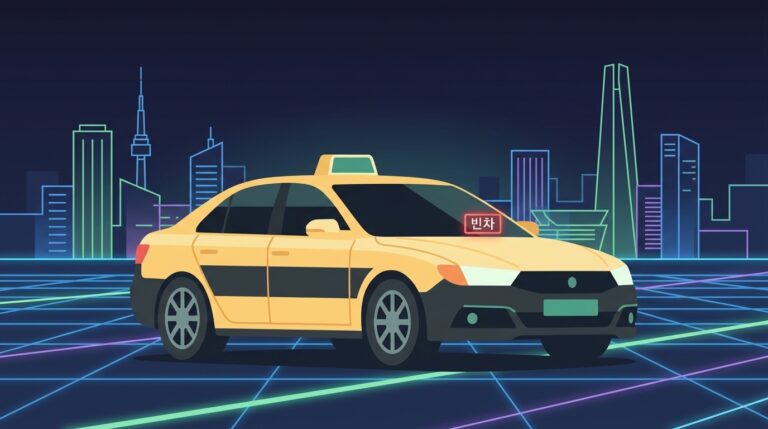
- The “Empty Car” (빈차) Glow: If you are flagging down a physical taxi, look at the LED indicator on the windshield. Red light saying 빈차 (Bin-cha) means empty and available. Red light saying 예약 (Yeyak) means someone booked it via app—do not wave at it, as they will drive right past you!
4-2. The Digital Hegemony: Kakao T vs. UT vs. Tada
Korea’s taxi ecosystem is dominated by Kakao T. However, foreign travelers often prefer UT (a joint venture with Uber) because it seamlessly integrates with international Uber accounts and accepts foreign credit cards without requiring a local Korean phone number. Knowing when to pivot between apps depending on your payment setup is a crucial C1 travel skill.
Phase 5: Real-Life Roleplay Scenario
Characters & Setting
- Julian (C1 Learner): An expat trying to catch a taxi home from a crowded spot in Itaewon.
- Mr. Kim (NPC Taxi Driver): A seasoned, friendly but busy Seoul driver handling late-night routes.
[Scene: Inside a Kakao T Blue taxi that Julian managed to hail near Itaewon Station.]

Julian: 🎭 [Entering the car with a polite bow] 안녕하세요, 기사님!

Mr. Kim: 네, 반갑습니다. 목적지가 마포역 3번 출구 맞으시죠?

Julian: 🎭 [Nodding slightly] 네, 맞아요. 그쪽으로 가주시면 됩니다.

Mr. Kim: 이 시간에는 이태원 뒤쪽 길이 많이 막히는데, 강변북로 쪽으로 돌아서 가도 괜찮을까요?

Julian: 🎭 [Checking the navigation map on his phone] 아, 강변북로가 훨씬 빠르겠네요. 그렇게 해주세요!

Mr. Kim: 네, 알겠습니다. 결제는 카드 자동 결제로 등록해 놓으셨네요?

Julian: 🎭 [Smiling confidently] 네, 자동 결제예요. 따로 카드 안 드려도 되죠?

Mr. Kim: 맞아요. 도착하면 그냥 내리시면 됩니다. 참 편리하죠?

Julian: 그러게요! 매번 지갑 안 꺼내도 되니까 정말 편해요. 안전 운전 부탁드립니다!
🔀 Interactive Choice Point
You realize the driver is taking a route that seems different from your GPS. What do you do?
- Option A: “기사님, 왜 이 길로 가세요? 제 지도가 틀렸나요?” (Direct confrontational style)
- Option B: “기사님, 혹시 어떤 경로로 가시는지 여쭤봐도 될까요?” (Polite, indirect inquiry – BEST)
- Option C: Say nothing and get anxious while staring at your phone. (Sinks communication)
Choice Feedback:
- Option A (Risk): Might sound overly accusatory to the driver, causing a defensive reaction.
- Option B (Best): Uses honorifics (
여쭤봐도 될까요) to politely inquire about the route choice. The driver will likely explain traffic conditions. - Option C (Bad): Resolves nothing and ruins your travel experience with unnecessary stress.
Phase 6: 10-Second Emotional Shadowing Drill
Practice reading these aloud with the correct pause points (/) and emotional tone!
[😊 Conversational & Friendly]- Korean: 기사님, / 카카오페이 / 자동 결제로 / 등록되어 있어요!
- Romanization: Gisanim, / Kakao-pei / jadong gyeoljeri / deungnokdoeo isseoyo!
- English: Driver, it’s registered for KakaoPay automatic payment!
[🤔 Polite Inquiry]- Korean: 혹시 / 다른 빠른 경로가 / 있을까요?
- Romanization: Hoksi / dareun ppareun gyeongnoga / isseulkkayo?
- English: By any chance, is there another fast route?
Phase 7: K-Culture Mini Dictionary
- 빈차 (Bin-cha) | Empty Car: The red glowing sign indicating the taxi is free to be flagged down.
- 예약 (Yeyak) | Reserved: The orange/red sign showing the taxi is on its way to pick up an app user.
- 할증 (Haljeung) | Surcharge: The late-night surcharge applied usually between 10 PM and 4 AM (rates vary by hour).
- 티머니 (T-money) | T-money: The ubiquitous transit card that can also be used to pay for physical taxi rides.
Phase 8: Traveler’s Survival Kit
Survival Phrases TOP 3
- “마포역으로 가주세요.” (Please take me to Mapo Station.) – Mapo-yeog-euro ga-ju-se-yo.
- “여기서 세워주세요.” (Please pull over here.) – Yeogi-seo se-wo-ju-se-yo.
- “영수증 끊어주실 수 있나요?” (Could you print a receipt for me?) – Yeongsujeung kkeuneo-jusil su innayo?
Editor’s Travel Note 📝
Before leaving for Korea, make sure you download the Kakao T App on Google Play/App Store or set up Naver Map to track your route in real-time. This prevents any path disputes and ensures peace of mind.
Phase 9: One Step Deeper (Reflection)
Korea’s rapid transition into a fully mobile-app-driven taxi ecosystem represents its cultural pursuit of Ppalli-Ppalli (fast-paced lifestyle) and high efficiency. However, this digitalization has sparked debates regarding digital exclusion, as the elderly sometimes struggle to catch taxis without apps during freezing winter nights.
💬 Your Turn: How does digital ride-hailing compare to flagging down taxis in your hometown? Drop your thoughts in the comments below!
Phase 10: FAQ & Avoiding Common Mistakes
Q: Can I use Uber in Korea?
A: Yes! Uber operates under the name UT (or rebranded back to Uber in some interfaces) in partnership with local companies. It uses the same app you have installed on your phone, mapping international cards smoothly.
Q: Is there an extra fee for Kakao Blue or Kakao Black?
A: Yes. General taxis charge the base fare. Blue charges an additional dispatch fee for immediate matching. Black is premium high-end luxury service with significantly higher base and distance rates.
Q: Why did the taxi driver pass me by when I waved?
A: Most likely, the taxi’s windshield indicator displayed 예약 (Reserved) or the driver was already dispatched to an app caller.
🚨 Common Mistakes Alert!
- Mistake 1: Handing over cash when you booked via “Automatic Payment”. (You will end up paying twice!)
- Mistake 2: Slamming the doors of clean, well-maintained electric taxis.
- Mistake 3: Not specifying the exact exit of a subway station when setting destination (e.g., say “Gangnam Station Exit 10” instead of just “Gangnam Station”).
Phase 11: Action Missions
- Bronze Medal: Download Kakao T or UT and register a working payment method.
- Silver Medal: Learn to read the red windshield signs (
빈차vs예약) in less than 2 seconds. - Gold Medal: Board a Korean taxi and confirm your route/payment status entirely in Korean using the shadowing sentences!
Phase 12: Interactive Quiz Challenge
Test your real-world Korean taxi IQ!
- What does the red light saying 예약 on a taxi windshield mean?
- Which verb do you use when summoning a taxi via an app interface?
🔍 Click here to reveal the answers!
- Answer 1: It means “Reserved” for someone who booked through an app. Do not flag it down!
- Answer 2: 호출하다 (hochulhada).







