

Master Korean Online Shopping: How to Handle Size Exchanges and Returns Like a Local
Phase 1: Empathy (Your Korean Shopping Lifeline)
안녕하세요! (An-nyeong-ha-se-yo!) Your friendly neighborhood editor from Daily Hangul is here!
Imagine this: You finally ordered that gorgeous, oversized wool knit sweater you saw your favorite K-drama lead wearing on Musinsa. You wait eagerly for that glorious kakao message saying your package has arrived at your door. You tear open the box, slip it on, and… oh no. It doesn’t look “effortlessly oversized.” It looks like you’re wearing a literal camping tent.
Your heart sinks. Navigating a return or a size exchange in your home country is annoying enough, but doing it in Korean? The thought of dealing with customer service chatbots, selecting the right options, and packaging the item back up makes you want to just tuck the giant sweater away in your closet forever.
Don’t let your money go to waste! This guide was built based on real feedback from intermediate learners just like you who felt intimidated by Korean shopping platforms. Today, we are going to unlock the exact, high-utility phrases and cultural nuances you need to effortlessly swap or return your purchases. By the end of this post, you’ll feel like a seasoned Seoulite shopping on Coupang!
Phase 2: Deep Dive into 3 Core Expressions
Let’s break down the three most crucial phrases you will encounter when initiating an exchange or return.
1. 사이즈 교환하고 싶어요 (sa-i-jeu gyo-hwan-ha-go sip-eo-yo)
- Pronunciation: “sigh-jeu gyoh-hwan-hah-goh sheep-uh-yo”
- Meaning: I would like to exchange the size.
- K-Culture Moment: This is the magic phrase you type into a Customer Service (CS) chatbot or select on your mobile shopping app’s order history page.
- Editor’s Insight: “교환” (gyo-hwan) means exchange. While you can exchange for different colors, “사이즈 교환” (size exchange) is the most common request. If you want to change the color instead, simply swap “사이즈” with “색상” (saek-sang) to say “색상 교환하고 싶어요.”
- Situation Spectrum:
- Casual: 사이즈 교환하고 싶어 (⚠️ Only for close friends)
- Semi-formal: 사이즈 교환하고 싶어요 (✅ Perfect for CS chats and emails)
- Formal: 사이즈 교환을 요청합니다 (✅ Formal submission forms)
- 🤔 Think About It: In many Western countries, people often return an item and just buy a new one. In Korea, the “교환” (exchange) system is incredibly streamlined directly within the original order. Why do you think Korean e-commerce systems favor direct swaps over full refunds?
2. 단순 변심 반품 (dan-sun byeon-sim ban-pum)
- Pronunciation: “dan-soon byun-shim ban-poom”
- Meaning: Return due to a simple change of mind (literal: simple heart-change return).
- K-Culture Moment: When selecting a reason for your return on apps like Coupang, ZigZag, or Naver Shopping, you will almost always see this option.
- Editor’s Insight: This is a crucial legal and cultural term. “단순 변심” means you changed your mind (the item is fine, but you just don’t want it anymore). Choosing this means you, the buyer, must pay for the return shipping. If the item is defective, you must choose “상품 불량” (sang-pum bul-ryang) so the seller pays.
- Situation Spectrum:
- Casual: 그냥 맘에 안 들어서 반품할래 (🚫 Too informal for systems)
- Semi-formal: 단순 변심으로 반품할게요 (✅ Polishing up your reason to a CS rep)
- Formal: 단순 변심 반품 (✅ Standard option on all Korean shopping apps)
- 🤔 Think About It: Does your native language have a specific, formal-sounding phrase for “simply changing your mind” on a purchase, or do you just say “it didn’t fit” or “didn’t like it”?
3. 왕복 배송비 (wang-bok bae-song-bi)
- Pronunciation: “wang-bohk bae-song-bee”
- Meaning: Round-trip shipping fee.
- K-Culture Moment: When you do a “사이즈 교환” (size exchange), you have to send the old item back and get the new one shipped to you. E-commerce sites will ask you to pay or deposit the “왕복 배송비” (usually 5,000 to 6,000 KRW).
- Editor’s Insight: “왕복” means round-trip, and “배송비” means shipping fee. Sometimes sellers will ask you to put the cash directly inside the returning package (택배 상자 안에 동봉). While this is becoming less common due to digital payments, it still happens!
- Situation Spectrum:
- Casual: 왕복 택배비 얼마야? (⚠️ For casual messaging with a seller on Karrot Market)
- Semi-formal: 왕복 배송비는 어떻게 입금하나요? (✅ Asking CS how to pay the round-trip fee)
- Formal: 왕복 배송비 동봉/입금 (✅ Official policy terminology)
Phase 3: Textbook Korean vs. Real Korean
When you learn Korean from a standard textbook, the vocabulary can sound incredibly stiff, like a 1990s business contract. Let’s look at how native Koreans actually express these situations today.
Situation 1: Explaining you ordered the wrong size
- 📖 Textbook Korean: “제가 치수를 잘못 선택하였습니다.” (je-ga chi-su-reul jal-mot seon-taek-ha-yeot-seup-ni-da.)
- Translation: “I have selected the dimensions incorrectly.”
- 🗣️ 진짜 Korean: “사이즈 미스로 교환 신청할게요.” (sai-jeu mi-seu-ro gyo-hwan sin-cheong-hal-ge-yo.)
- Translation: “I’ll apply for an exchange due to a size miss (mistake).”
- 💡 Why the difference? Modern Koreans heavily use the Konglish term “미스” (miss) for mistakes. Saying “사이즈 미스” is extremely natural, casual, and instantly understood by customer service agents.
Situation 2: Inquiring about defective items
- 📖 Textbook Korean: “제품에 하자가 존재합니다.” (je-pum-e ha-ja-ga jon-jae-hap-ni-da.)
- Translation: “Defects exist within the product.”
- 🗣️ 진짜 Korean: “실밥이 풀려 있어서 불량인 것 같아요.” (sil-bap-i pul-ryeo is-seo-seo bul-ryang-in geot gat-a-yo.)
- Translation: “The stitching is coming undone, so I think it’s defective.”
- 💡 Why the difference? Instead of using the heavy legal word “하자” (defect), native speakers point out the specific issue (like loose threads/stitching: “실밥”) and use the word “불량” (defective/bad quality) in a softened tone (“~인 것 같아요” – “I think it is”).
Phase 4: K-Culture Deep Dive & Non-verbal Manners
4-1. Nunchi & Gestures: Packaging Etiquette
In Korea, “눈치” (Nunchi – situational quick-wittedness) extends even to how you return packages. When returning a box, it is considered highly polite to:
1. Re-tape it cleanly: Do not just slap some tape over a heavily torn box. If the box is ripped, find a new one or seal it securely. CS workers inspect these, and a neatly taped package ensures your refund is processed faster!
2. Keep the tags intact: Never cut off the “택” (tag) if you want an exchange. Trying to return an item without a tag is a major cultural “no-no” and will likely get your request rejected.
4-2. The “Front Door” Culture (문앞 문화)
Korea has one of the safest delivery ecosystems in the world. Packages are almost exclusively left right outside your apartment door (“문앞”).
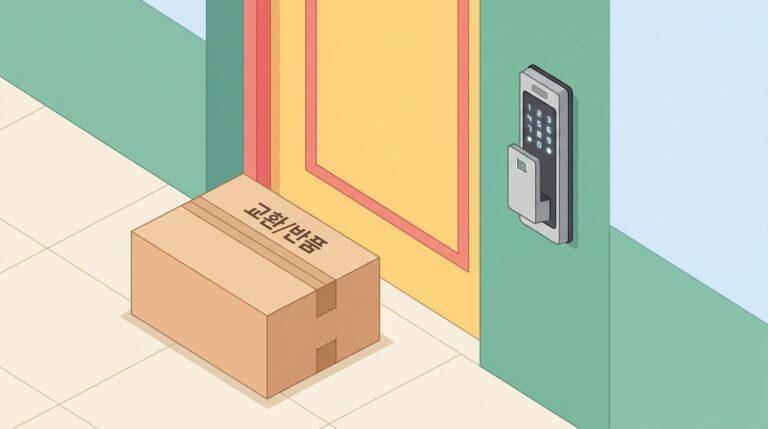
When exchanging an item, you will often perform a “맞교환” (simultaneous exchange) or “수거” (collection). The courier will come to your door, pick up the return box, and leave. You do not even need to meet them! You simply write “반품” (Return) or “교환” (Exchange) in big letters on the box, leave it outside your door, and the courier sweeps it away. This high-trust culture is a cornerstone of daily Korean convenience.
Phase 5: Real-life Roleplay Scenario
Let’s put you in the shoes of Alex, an intermediate Korean learner living in Seoul. Alex ordered a pair of shoes online but they are too tight. He is chatting with Min-ji, a customer service representative for a trendy online shopping brand.
Character Profiles:
- Alex (B2 Learner): Polite, uses natural Korean but gets slightly nervous about shipping policies.
- Min-ji (CS Representative): Extremely polite, typical friendly and professional CS tone.
Min-ji: 안녕하세요! 고객님, 무엇을 도와드릴까요?
        (Hello, valued customer! How can I help you today?)

Alex: 🎭 [Slightly hesitant but polite]
      저, 혹시 몇 일 전에 산 스니커즈 사이즈 교환이 가능할까요?
      (Excuse me, by any chance, is it possible to exchange the size of the sneakers I bought a few days ago?)

Min-ji: 네, 당연히 가능합니다! 혹시 어떤 사이즈로 변경하고 싶으신가요?
        (Yes, of course it is possible! What size would you like to change them to?)

Alex: 🎭 [Checking the shoe size]
      지금 240인데, 발볼이 좁아서 245로 교환하고 싶어요.
      (It's currently 240, but the width is narrow, so I want to exchange it for a 245.)

Min-ji: 아, 발볼 때문에 그러시군요. 245 사이즈 재고가 다행히 있네요!
        왕복 배송비 5,000원을 동봉해서 문 앞에 두시면 택배 기사님이 수거해 가실 거예요.
        (Ah, because of the width. Luckily, we have 245 in stock! If you enclose the 5,000 KRW round-trip shipping fee and leave it at your door, the courier will collect it.)

Alex: 🎭 [Relieved]
      아, 현금을 상자 안에 넣어서 문 앞에 두면 되는 거죠?
      (Ah, so I just put the cash inside the box and leave it at my door, right?)

Min-ji: 네, 맞습니다! 상자에 꼭 '교환 반품'이라고 적어주세요. 저희가 수거 확인 후 새 제품 보내드릴게요.
        (Yes, that's correct! Please write 'Exchange/Return' on the box. Once we confirm the collection, we will send the new product.)

Alex: 🎭 [Gratefully]
      친절하게 안내해 주셔서 감사합니다! 오늘 바로 문 앞에 놓아둘게요.
      (Thank you for the kind guidance! I'll put it outside my door today.)
🔀 Interactive Branch Point: What should Alex do next?
If you were Alex, how would you proceed with the return? Choose your path:
- Option A: Pack the shoes back in the original box with the 5,000 KRW cash inside, write “교환 반품” on it, and place it outside your apartment door immediately.
- Option B: Leave the shoes loose on the floor outside the door with five 1,000 KRW coins scattered on top so the courier can count them easily.
- Option C: Put the shoes in a plastic bag, don’t pay the 5,000 KRW, and hope they don’t notice.
💡 Feedback on Your Choice:
- Option A (Best): 🌟 Perfect! You kept the original box, secured the cash inside, clearly labeled it, and put it in the designated “문앞” (front door) spot. This is the gold standard of Korean e-commerce manners!
- Option B (Bad): ❌ Oh no! Leaving loose shoes and coins outside is a recipe for lost items. Couriers are in an extreme rush; they won’t pick up loose items.
- Option C (Risk): ⚠️ Danger! If you don’t pay the shipping fee, your exchange will be locked in “pending” status forever, and the brand might charge your registered card automatically anyway.
Phase 6: 10-Second Emotion Shadowing Drill
When speaking with CS agents or writing inquiries, adding natural emotional pauses and soft endings makes you sound incredibly fluent. Practice these sentences aloud, pausing at the / marks!
- [🥺 Softly apologetic and hopeful]
저… / 사이즈가 생각보다 좀 작아서요… / 혹시 교환 가능할까요?
(Jeo… / sai-jeu-ga saeng-gak-bo-da jom jak-ah-seo-yo… / hok-si gyo-hwan ga-neung-hal-ka-yo?)
“Excuse me… the size is a bit smaller than I thought… is an exchange possible by any chance?” -
[😊 Friendly and cooperative]
왕복 배송비는 / 말씀하신 계좌로 / 지금 바로 입금할게요!
(Wang-bok bae-song-bi-neun / mal-sseum-ha-sin gye-jwa-ro / ji-geum ba-ro ip-geum-hal-ge-yo!)
“The round-trip shipping fee… to the account you mentioned… I will deposit it right now!”
Phase 7: K-Culture Mini Dictionary
| Word (Hangul + Romanization) | English Translation | Real-Life Usage & Context |
|---|---|---|
| 반값택배 (ban-gap-taek-bae) | Half-price delivery | A genius Korean system where you send/receive packages from one convenience store to another at half the price of standard shipping. |
| 맞교환 (mat-gyo-hwan) | Simultaneous exchange | The courier arrives with your new item and takes your old return item at the exact same moment. |
| 송장 번호 (song-jang beon-ho) | Tracking number | The magical digits you need to track your returns on apps like CJ Logistics or Post Office (우체국). |
| 착불 (chak-bul) | Cash on delivery (shipping) | Paying for shipping upon arrival. Avoid this unless instructed by the seller! |
Phase 8: Survival Kit for Travelers
If you are traveling in Korea or staying short-term, here is your quick-access cheat sheet!
Survival Phrases TOP 3
- “이거 반품해 주세요.” (i-geo ban-pum-hae ju-se-yo.)
- Please return this for me. (Great for physical stores too!)
- “기사님, 택배는 문 앞에 놓아주세요.” (gi-sa-nim, taek-bae-neun mun ap-e noh-ah-ju-se-yo.)
- Courier, please leave the delivery in front of the door. (The ultimate text message to send to your delivery driver.)
- “수거 언제 오시나요?” (su-geo eon-je o-si-na-yo?)
- When are you coming to collect the return package?
📌 Editor’s Travel Note:
If you need to ship a return box yourself, do not drag it all the way to a post office! Download the GS25 Convenience Store Delivery App (GS25 편의점택배) or CU Convenience Store Delivery App. You can register your return on your phone and drop it off at any 24-hour convenience store corner kiosk. It’s incredibly cheap and fast!
Phase 9: “One Step Deeper” (Cultural Reflection)
Have you ever wondered why Korean e-commerce and delivery systems are so blisteringly fast and stress-free? It all ties back to two deeply rooted aspects of Korean society: the “빨리빨리” (Palli-palli – Hurry, hurry!) mindset and high social trust.
Leaving high-value packages, cash, or electronics outside the front door of apartment buildings without them being stolen is shocking to many international visitors. This is because apartments in Korea are viewed as semi-private, highly monitored community spaces where communal trust is paramount. It creates a seamless loop of convenience that makes things like “맞교환” (simultaneous door-to-door exchanges) possible.
💬 Your Turn: How does the delivery and return culture in Korea compare to your home country? Would you feel safe leaving a package with cash inside outside your front door? Let us know in the comments below!
Phase 10: FAQ & Common Mistakes
Q: I chose “단순 변심” (change of mind) for my return. Who pays the shipping fee?
A: You do! When returning an item because you simply changed your mind, you are responsible for paying the return shipping fee (usually deducted from your refund). If the seller made a mistake or the item is broken, they cover it.
Q: Can I return cosmetics or skincare if I have opened the box?
A: Generally, no. Under Korean consumer protection law, if you open the protective seal of cosmetic items, it cannot be returned unless you experienced a proven skin reaction (which requires a dermatologist’s note, or “진단서”).
Q: What is the standard timeframe for requesting an exchange or return?
A: On most Korean platforms, you must request it within 7 days of receiving the product. Always check the app immediately upon delivery!
🚨 Common Mistakes Scoreboard
- Mistake 1: Writing “반대” (ban-dae – opposite/against) instead of “반품” (ban-pum – return).
- Correct Action: Always use 반품 when requesting a refund/return!
- Mistake 2: Taping up the shoe box directly without putting it inside an outer cardboard shipping box.
- Correct Action: The original brand box is part of the product. Never put packaging tape directly on the shoe box! Always place it inside a shipping box.
- Mistake 3: Forgetting to write your tracking number or order name on the return box.
- Correct Action: Scribble “[Your Name] 교환 건” (Exchange for [Name]) on the outside to prevent your box from getting lost in the warehouse pile.
Phase 11: Action Mission & Engagement
Let’s put your new knowledge into action! Complete these 3 levels to become a Korean shopping expert:
- 🥉 Bronze Mission: Open a Korean shopping app (like Musinsa, ZigZag, or even Coupang) and find the button that says “교환/반품 신청” (Request Exchange/Return). Take a screenshot to familiarize yourself with the layout!
- 🥈 Silver Mission: Write down a mock message to a CS agent explaining that your jacket is too big and you want to swap it for a medium. Use the phrase “사이즈 미스로 교환하고 싶어요.”
- 🥇 Gold Mission: Next time you receive a package in Korea, send a polite SMS to your courier using our survival phrase: “문 앞에 놓아주세요! 감사합니다.”
🎮 K-Culture Mission:
The next time you watch a modern K-drama (like Crash Landing on You or Business Proposal), look out for a scene where a character receives a delivery outside their door. Notice how the boxes are stacked and labeled!
Phase 12: Interactive Quiz Challenge
Test your intermediate Korean shopping skills! Select your answers, then click the toggle to reveal the explanations.
1. Which option should you choose if you received a shirt with a torn sleeve and want a free return?
- A) 단순 변심 반품 (dan-sun byeon-sim ban-pum)
- B) 상품 불량 반품 (sang-pum bul-ryang ban-pum)
- C) 그냥 반품 (geu-nyang ban-pum)
🔍 Click to see the answer and explanation
Correct Answer: B
“상품 불량” (sang-pum bul-ryang) means “defective product.” Choosing this ensures the seller pays for the return shipping. Choosing A (simple change of mind) would make you pay for the return fee!
2. Fill in the blank: “발볼이 좁아서 사이즈 _________ 싶어요.”
- A) 교체하고 (gyo-che-ha-go)
- B) 반품하고 (ban-pum-ha-go)
- C) 교환하고 (gyo-hwan-ha-go)
🔍 Click to see the answer and explanation
Correct Answer: C
“교환하고” (gyo-hwan-ha-go) means “to exchange.” While “교체” (gyo-che) means replacement/substitution, it is used for parts or players, not product sizes. The complete sentence is: “The width is narrow, so I want to exchange the size.”
3. True or False: In Korea, it is common and acceptable to put cash for return shipping inside the package if requested by the seller.
- A) True
- B) False
🔍 Click to see the answer and explanation
Correct Answer: A (True)
Yes! While online transfers are growing, many traditional Korean malls still ask customers to securely tape cash (usually 5,000 KRW for “왕복 배송비”) inside the returning box. It’s a unique aspect of Korea’s high-trust society!
Keep shopping confidently, and don’t let size mismatches get you down. You’ve got the linguistic tools to handle it now! See you in the next lesson of Daily Hangul! 다음에 또 만나요! (Dae-eum-e tto man-na-yo!)







