

Deep Dive: The Invisible Web of Honorifics and Korean Social Hierarchy
안녕하세요! Welcome back to another Masterclass with Daily Hangul. If you have reached the C2 (Advanced) level of Korean, you already know how to conjugate verbs into the formal 하십시오체 (hasipsio-che) and the polite 해요체 (haeyo-che). But here is the real question: Do you know how to dance within the unspoken social architecture of Korea without stepping on anyone’s toes?
We have all watched K-dramas where a single, sudden drop in honorifics (반말, banmal) caused an absolute freeze in the room. Or perhaps you’ve felt the palpable tension during a corporate dinner (회식, hoesik) when a junior employee accidentally used a term slightly too familiar. Today, we are going deep. This is not just about grammar; it is about sociolinguistic cartography—navigating the invisible lines of power, age, status, and intimacy that define modern Korean society.
Phase 2: Key Masterclass Expressions
1. 말씀 낮추세요 (Mal-sseum na-chu-se-yo)
- Pronunciation: [Mahl-sseum nah-choo-seh-yo]
- Meaning: Literally “Please lower your words,” but contextually translates to “Please speak comfortably (informally) with me.“
- K-Culture Moment: Seen in corporate dramas like Misaeng (미생) or Doctor Slump (닥터슬럼프), when a senior colleague wants to establish a warmer, mentor-like relationship with a trusted junior without completely shattering professional boundaries.
- Editor’s Insight: This is a crucial tool of social humility. When you are the senior or host, proactively offering this phrase shows magnanimity. If you are the junior, you should never initiate this drop in formality; you must wait for the senior to invite you with this phrase.
- Situation Spectrum: Casual (🚫) | Semi-formal (✅) | Formal (✅)
- 🤔 Think About It: In your culture, does a boss or senior explicitly invite you to drop formal titles, or does it happen organically over time?
2. 존함이 어떻게 되십니까? (Jon-ham-i eo-tteo-ke doe-sim-ni-kka?)
- Pronunciation: [John-hahm-ee uh-ttuh-keh dweh-shim-nee-kka?]
- Meaning: “May I ask your honorable name?“
- K-Culture Moment: Found in high-stakes historical dramas (사극, sageuk) or when a young professional meets a high-ranking VIP or a senior family member for the first time.
- Editor’s Insight: While textbook Korean teaches 이름이 뭐예요? (i-reum-i mwo-ye-yo?), using that at a executive board level or with a senior partner is a major faux pas. 존함 (jon-ham) is the ultimate honorific substitute for 이름 (name), elevating the listener immediately.
- Situation Spectrum: Casual (🚫) | Semi-formal (⚠️) | Formal (✅)
- 🤔 Think About It: How does your native tongue express deference when asking for someone’s identity without sounding clinical?
3. 편하게 말씀하세요 (Pyeon-ha-ge mal-sseum-ha-se-yo)
- Pronunciation: [Pyuhn-hah-geh mahl-sseum-hah-seh-yo]
- Meaning: “Please speak freely/comfortably.“
- K-Culture Moment: Often uttered during late-night street food (포장마차, pojangmacha) scenes when two leads, initially bound by strict professional distance, decide to cross the bridge into emotional intimacy.
- Editor’s Insight: This phrase is the ultimate olive branch. However, as an advanced learner, do not mistake “speak comfortably” for “drop all manners.” Even when speaking 반말 (banmal), a fundamental baseline of respect remains.
- Situation Spectrum: Casual (✅) | Semi-formal (✅) | Formal (⚠️)
- 🤔 Think About It: Why does linguistic “comfort” in Korea require an explicit verbal contract rather than just happening naturally?
Phase 3: Textbook Korean vs. Native Linguistic Chess
| 📖 Textbook Korean | 🗣️ Real Native Korean (C2 Level) |
|---|---|
| 실례지만 연세가 어떻게 되십니까? (Excuse me, but what is your age?) |
혹시 실례가 안 된다면, 저보다 위이신가 해서요… (If you don’t mind, I was wondering if you might be my senior…) |
| 💡 Why the difference? Directly asking for age, even using the honorific 연세 (yeon-se), can sometimes feel transactional. Softening the inquiry by framing it as a humble guess at their seniority is far more socially elegant. | |
| 알겠습니다. (I understand.) |
아, 무슨 말씀이신지 충분히 이해했습니다. (Ah, I completely understand the weight of what you are saying.) |
| 💡 Why the difference? “알겠습니다” is clean but functional. By replacing it with “무슨 말씀이신지…” you validate the wisdom and perspective of the speaker, elevating their input. |
Phase 4: K-Culture Deep Dive & Non-Verbal Hierarchies
4-1. The Choreography of Respect: Nunchi & Gestures
Korean honorifics are not merely spoken; they are performed physically. To master C2 Korean, you must master the somatic layer:
1. The Double-Hand Handshake: When shaking hands with a senior, always extend your right hand while gently placing your left hand under your right forearm or elbow. This historically proved you weren’t hiding any weapons, but today it represents supporting the weight of your respect.
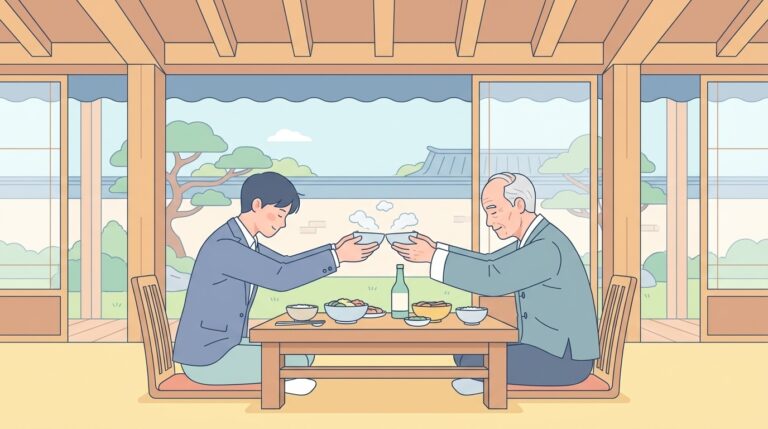
2. The Turn-Away Drink: During a 회식 (corporate dinner), when clinking glasses, make sure your glass hits below the rim of the senior’s glass. When consuming the drink, turn your head slightly away from the senior and cover your glass with your hand as you drink. To drink directly facing a senior is considered aggressive.
4-2. The “Nunchi” (눈치) Ecosystem
In Korea, Nunchi (the art of reading the room) is the engine that drives honorific choice. Before speaking, your brain must calculate three variables within milliseconds:
* 나이 (Age): Even a one-year difference can dictate who drops formalities first.
* 직급 (Corporate Rank): Rank always trumps age in professional environments. A 30-year-old manager (과장님, gwajang-nim) will receive honorifics from a 45-year-old clerk (대리님, daeri-nim).
* 친밀도 (Intimacy Level): The speed at which you close the gap between 존댓말 (honorifics) and 반말 (informal speech) is a delicate dance. Push too fast, and you are rude (버릇없다); stay formal too long, and you are cold (선긋기).
Phase 5: Live Corporate Roleplay: The Hanok Business Dinner
Scenario: You are the Regional Director for a global firm visiting the Seoul headquarters. You are dining with Executive Director Park (50s, conservative) and Senior Manager Min-ji (30s, progressive) in a premium traditional Hanok restaurant in Insadong.
[Scene: Soft traditional gayageum music plays. Exquisite dishes of Hanjeongsik are placed on the table. Executive Director Park pours you a glass of premium Makgeolli.]

Director Park: "글로벌 사업부에서 고생이 많으십니다. 한국 생활은 좀 지낼 만하신가요?"
(You are working hard in the global division. Is Korean life manageable for you?)

You (🎭 Smiling warmly, accepting the glass with two hands): "아닙니다, 상무님. 배려해 주신 덕분에 아주 잘 적응하고 있습니다. 이 술도 정말 훌륭하네요."
(Not at all, Executive Director. Thanks to your consideration, I am adapting very well. This alcohol is truly excellent too.)

Min-ji (🎭 Bowing slightly as she pours water for you): "디렉터님, 오늘 회의 자료 준비하시느라 너무 애쓰셨어요. 상무님께서도 칭찬을 많이 하셨답니다."
(Director, you worked so hard preparing the meeting materials today. The Executive Director praised them highly.)

You (🎭 Shifting gaze respectfully between both): "민-지 선배님이 초안을 잘 잡아주셔서 가능했습니다. 저는 그저 숟가락만 얹었을 뿐입니다."
(It was only possible because Min-ji Sunbae drafted it so well. I merely placed my spoon on a fully set table.)

Director Park (🎭 Laughing heartily, pleased with your humility): "허허, 한국어 솜씨뿐만 아니라 사회생활 수준도 최고시네요! 편하게 말씀 낮추셔도 됩니다."
(Haha, not only your Korean skills, but your corporate social survival skills are top-tier! You may lower your words comfortably.)

You (🎭 Maintaining a humble posture): "과찬이십니다, 상무님. 아직 배울 것이 한참 멀었습니다. 말씀은 상무님께서 편하게 해 주십시오."
(You flatter me too much, Executive Director. I still have a long way to go. Please feel free to speak comfortably to me first.)

Director Park: "그래요, 그럼 우리 오늘 벽 없이 편하게 이야기해 봅시다!"
(Alright, let's talk comfortably without walls today!)

Min-ji (🎭 Winking quietly at you): "상무님 기분이 아주 좋으신데요? 오늘 프로젝트 건은 순조롭겠어요."
(The Executive Director is in a great mood. Today's project is going to go smoothly.)
🔀 Your Critical Choice: How do you seal this business alliance?
- Choice A: “그래, 오늘 끝까지 마시고 달려보자!” (Drop down to heavy informal slang immediately to show camaraderie)
- Choice B: “상무님께서 편하게 대해 주시니 정말 감사할 따름입니다. 잔 받으십시오.” (Accept the invitation of comfort while maintaining a baseline of professional honorifics)
- Choice C: “아닙니다. 저는 계속 존댓말을 쓰겠습니다.” (Rigidly reject his offer to keep professional distance)
💡 Feedback:
- Best Choice – Choice B: Absolute gold. You acknowledged the elder’s permission to drop formalities but chose to remain polite, displaying the peak of “C2-level social grace” (사회생활 만렙).
- Bad Choice – Choice A: A total disaster. “말씀 낮추세요” is an invitation for them to drop honorifics to you, or to ease the atmosphere, not a green light for you to treat a Director like a high school classmate.
- Risk Choice – Choice C: Extremely cold. It creates a linguistic wall (선긋기) that rejects their attempt to build rapport, potentially ruining the business relationship.
Phase 6: 10-Second Emotion Shadowing Drill
To sound truly native, your pitch must match your social role. Practice these pauses (/) and emotional cues:
- [😊 Softly, showing humble gratitude]
“아닙니다, 상무님… / 제가 한 일은 / 정말 보잘것없습니다.”
(No, Director… what I did is truly insignificant.) -
[🤝 Respectful, declining a premature drop in honorifics]
“아이구, 말씀은 / 상무님께서 / 편하게 해 주십시오.”
(Oh, please, feel free to speak comfortably to me first.)
Phase 7: K-Culture Mini Dictionary
- 야자타임 (Yaja Time): A structured game/period (often during retreats or team buildings) where social ranks and ages are temporarily reversed. A highly strategic tool used to vent built-up corporate frustrations under the safety of play.
- 꼰대 (Kkondae): Originally slang for an elderly person, now used universally to describe someone who imposes their outdated, hierarchical ideas on younger people. (e.g., “라떼는 말이야…” / “Back in my day…”)
- 사회생활 (Sahoesaenghwal): Literally “social life,” but practically refers to the art of corporate survival—flattering bosses, keeping quiet, and laughing at dry jokes.
- 서열 (Seoyeol): The rigid ranking or pecking order within any Korean group. Even within K-pop groups, the Seoyeol based on age or debut date dictates who speaks in interviews.
Phase 8: The Executive’s Survival Kit
Survival Phrases
- 과찬이십니다. (Gwa-chan-i-sim-ni-da) | “You flatter me too much.” -> The absolute shield against praise.
- 혹시 입에 맞으실지 모르겠습니다. (Hok-si ib-e ma-jeu-sil-ji mo-reu-gess-seum-ni-da) | “I don’t know if this will suit your honorable palate.” -> Use when presenting a gift or food to a senior.
- 여러모로 많이 가르쳐 주십시오. (Yeo-reo-mo-ro ma-ni ga-reu-chyeo ju-sip-si-o) | “Please teach me much in many aspects.” -> The perfect closer for a first-time meeting.
🗺️ Editor’s Travel Note
When booking high-level cultural meetings in places like Insadong or Samcheong-dong, always double-check restaurant ratings and visual layouts beforehand. To find the most elegant traditional tea houses and private dining Hanoks, bypass generic global search engines and head straight to Naver Map (네이버 지도) or download the KakaoMap app. Searching with advanced queries like 한정식 룸 (Hanjeongsik private room) will elevate your hosting game significantly.
Phase 9: “한 발 더 깊이” (Thinking Deeper)
Historically, the Korean honorific system (경어법) was deeply rooted in Neo-Confucian social stratifications during the Joseon Dynasty. While modern Korea has transitioned into an egalitarian democracy, the linguistic skeletal structure remains remarkably intact. Today, this manifests as a hybrid: modern corporate environments try to implement “English name cultures” (e.g., calling the CEO “Steve” instead of “사장님”) to foster innovation, yet the subconscious pressure of age and tenure (짬에서 나오는 바이브) still heavily influences decision-making processes. As a global citizen, understanding this tension allows you to bridge cultures rather than just translate words.
💬 Your Turn: Have you ever experienced a moment where you felt the invisible walls of hierarchy while communicating in Korea? Share your story in the comments below!
Phase 10: FAQ & Common Pitfalls
Q: Can I use Banmal (반말) if someone is just one year younger than me?
A: Absolutely not. In Korea, a single year of age gap can establish a Hyeong/Nuna (older brother/sister) relationship. Until you both mutually agree to drop formalities, keep using polite language (해요체).
Q: What should I do if a Korean senior keeps telling me to “speak comfortably” but I still feel awkward doing so?
A: You can compromise by using “존댓말” (polite language) but with a warmer, less rigid sentence structure. For example, instead of the heavy “~하셨습니까”, transition to the softer “~하셨어요?”.
Q: How do I address my boss’s wife in a formal setting?
A: Address her as 사모님 (sa-mo-nim), which is the highly respectful term for the wife of a teacher, boss, or superior.
🚨 Common Mistakes Alert!
- The “Crying Boss” Mistake: Saying “사장님이 아프십니다” (The boss is sick) to the CEO’s boss. Rule of thumb (Apsupbeop / 압존법): When speaking to a higher rank, you must lower the person of intermediate rank, even if they are higher than you.
- The Direct Over-Honorific: Saying “커피 나오셨습니다” (The coffee has honorably arrived). You cannot elevate inanimate objects! The correct form is “커피 나왔습니다.”
Phase 11: Action Missions
- Bronze Medal: Next time you watch a K-drama, identify the exact moment a character transitions from 존댓말 to 반말. Note what triggered the shift.
- Silver Medal: Draft a hypothetical formal email to a Korean senior partner asking for a meeting, employing at least two expressions learned today, and share it with your language exchange partner.
- Gold Medal: During your next real-life interaction with a Korean senior, successfully navigate a compliment by using “과찬이십니다” with proper posture.
Phase 12: Interactive Quiz Challenge
1. Situational Judgment
You are introduced to a new colleague who is 5 years older than you but has a lower job title. How do you address them?
View Answer & Explanation
Answer: Address them by their name/title combined with polite honorifics (e.g., “민지 씨” or “대리님”). Never drop your honorifics to them because they are older, but do not treat them like a superior either. This is the ultimate test of Nunchi!
2. Fill-in-the-Blank
To politely ask an elder to drop their formal tone with you, you can say: “말씀 ________.”
View Answer & Explanation
Answer: 낮추세요 (na-chu-se-yo)
3. True or False?
In a business meeting, it is perfectly fine to address the CEO of another company as “이름 + 씨” (e.g.,







