

How to Greet Your Korean Apartment Security Guard Without Feeling Awkward
Phase 1: Empathy (Welcome to the Neighborhood!)
안녕하세요! (An-nyeong-ha-se-yo!) Welcome back to Daily Hangul, your favorite space for unlocking real-life Korean culture and language. I’m your senior editor and cultural navigator!
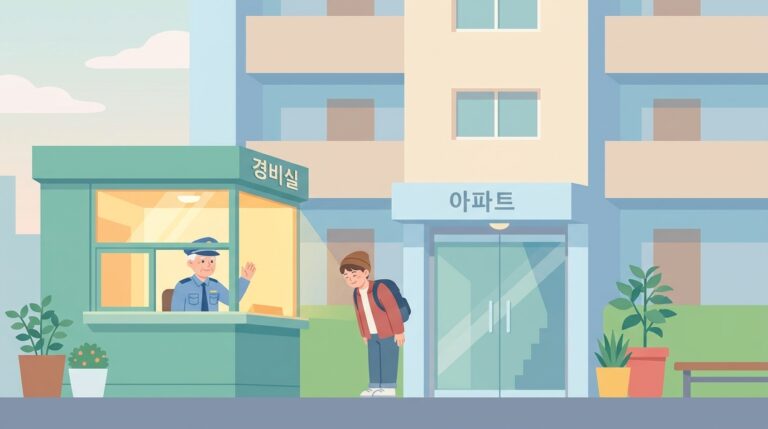
Picture this: You just moved into a beautiful high-rise apartment (아파트 – a-pa-teu) in Seoul. As you walk through the main entrance, you pass by the glass security booth (Gyeong-bi-sil). Inside sits the 경비 아저씨 (Gyeongbi-ajeossi – the apartment security guard). He looks up. You make eye contact.
Suddenly, your mind goes blank. Do I bow? Do I wave? Should I say ‘Annyeonghaseyo’ or is that too casual? Or maybe ‘Annyeonghi gyeseyo’ when leaving?
If you have ever felt that sudden jolt of awkwardness, you are not alone! Many of our B1 learners tell us that interacting with the Gyeongbi-ajeossi feels like a daily cultural test. But don’t worry. Greeting the security guard is actually the ultimate cheat code to feeling like a true local. Today, we’ll teach you how to master this daily interaction with warmth, respect, and absolute confidence!
Phase 2: Core 3 Expressions Deep-Dive
Let’s learn the top three expressions that will instantly make you the favorite resident in your building.
1. 안녕하세요, 수고하십니다! (An-nyeong-ha-se-yo, su-go-hap-ni-da!)
- Pronunciation: An-nyung-ha-seh-yo, soo-go-ham-nee-da! (Sounds like “soo-go-ham-nee-da” due to Korean pronunciation rules where ‘p’ meets ‘n’).
- Meaning: “Hello, thank you for your hard work!”
- K-Culture Moment: You will see this expression in slice-of-life K-dramas whenever a character returns home from work and passes the security office.
- Editor’s Insight: Su-go-hap-ni-da comes from the verb su-go-ha-da (to put in effort/labor). It’s the perfect way to acknowledge that the guard is actively keeping the building safe, clean, and organized.
- Situation Spectrum: Casual 🚫 | Semi-formal ✅ | Formal ✅
- 🤔 Think About It: Why does Korean culture place such a high value on recognizing someone’s physical labor in daily greetings? How does this compare to how you greet building staff in your home country?
2. 감사합니다, 좋은 하루 보내세요! (Gam-sa-hap-ni-da, jo-eun ha-ru bo-nae-se-yo!)
- Pronunciation: Gam-sah-ham-nee-da, joh-eun ha-roo bo-neh-seh-yo!
- Meaning: “Thank you, have a great day!”
- K-Culture Moment: Used in morning rush-hour scenes when residents hurry past the lobby to catch the subway.
- Editor’s Insight: This is a warm, energetic greeting. Use this in the morning when you head out. It shows you wish them well during their long shift.
- Situation Spectrum: Casual ⚠️ (Only if you are very close) | Semi-formal ✅ | Formal ✅
- 🤔 Think About It: Wishing someone a “good day” is universal, but pairing it with “thank you” in Korean shows you appreciate their constant presence.
3. 날씨가 많이 춥죠? 고생 많으십니다. (Nal-ssi-ga ma-ni chup-jyo? Go-saeng man-eu-sip-ni-da.)
- Pronunciation: Nal-shee-gah mah-nee choop-jyo? Go-saeng mahn-oo-ship-nee-da.
- Meaning: “The weather is quite cold, isn’t it? Thank you for enduring this hard work.”
- K-Culture Moment: Imagine a snowy winter day in Seoul where the guard is outside shoveling snow. A resident hands him a hot beverage and says this phrase.
- Editor’s Insight: Go-saeng means “hardship.” By saying Go-saeng man-eu-sip-ni-da, you are directly empathizing with their physical discomfort, whether it is freezing winter or humid summer. This is the ultimate expression of Jeong (정 – warm affection).
- Situation Spectrum: Casual 🚫 | Semi-formal ✅ | Formal ✅
- 🤔 Think About It: Empathy is a cornerstone of Korean communication. How does acknowledging shared hardships (like bad weather) build a closer community?
Phase 3: Textbook Korean vs. Real-Life Korean
Let’s compare what dry textbooks teach you versus how real Koreans actually talk in modern apartment complexes.
Situation 1: Coming home in the evening
- 📖 Textbook Korean: “안녕하십니까. 노고가 많으십니다.” (An-nyeong-ha-sip-ni-da. No-go-ga man-eu-sip-ni-da.)
- Why it’s stiff: This sounds like a military report or a formal business email from the 1990s!
- 🗣️ Real-Life Korean: “안녕하세요! 수고 많으셨습니다~” (An-nyeong-ha-se-yo! Su-go man-eu-syeot-seop-ni-da~)
- 💡 Why it’s better: It is polite, incredibly warm, and acknowledges that they have been working hard all day. The natural soft ending (~syeot-seop-ni-da) sounds much friendlier.
Situation 2: Asking for help with a delivery package (Taek-bae)
- 📖 Textbook Korean: “제 택배를 보관해 주셔서 대단히 감사합니다.” (Je taek-bae-reul bo-gwan-hae ju-syeo-seo dae-dan-hi gam-sa-hap-ni-da.)
- Why it’s stiff: This sounds like you are reading a formal contract out loud.
- 🗣️ Real-Life Korean: “아저씨, 택배 찾으러 왔어요! 늘 감사합니다.” (A-jeos-si, taek-bae cha-jeu-reo wass-eo-yo! Neul gam-sa-hap-ni-da.)
- 💡 Why it’s better: Calling them “아저씨” (A-jeos-si – uncle/middle-aged man) respectfully and saying “I’m here to pick up my package, thank you always!” is much more natural and personal.
Phase 4: K-Culture Deep-Dive & Non-Verbal Manners
4-1. The Art of the “Nunchi Bow”
In Korea, communication is 50% verbal and 50% non-verbal. When greeting a Gyeongbi-ajeossi, follow these steps:
1. Eye Contact (Nunchi): As you walk towards the security office, look towards the window. If they look up, make gentle eye contact.
2. The 15-Degree Bow: Do not do a dramatic 90-degree bow! A simple, respectful 15-degree bend of your neck and shoulders while saying your greeting is perfect.
3. The Soft Wave: If they are far away (e.g., sweeping the parking lot), do not shout. Make eye contact, nod your head deeply, and give a polite, small hand wave near your chest.
4-2. The “Jeong” (정) Ecosystem of Korean Apartments
Korean security guards do so much more than watch security cameras. They sort recycling, manage parking disputes, keep the garden beautiful, and receive packages. Traditionally, Koreans show Jeong (social warmth) by giving small gifts. During hot summer days, residents often buy an extra cold can of sweet coffee from a convenience store and slide it through the guard’s window saying, “드시고 하세요” (Deu-si-go ha-se-yo – “Please drink this while working”). Try this, and you will instantly become the block’s favorite resident!
Phase 5: Real-Life Roleplay Scenario
Setting: A cold, windy autumn morning at the entrance of the “Daily Hangul Apartments”.
Characters:
* 민우 (Min-woo): A friendly B1 Korean learner living on the 5th floor.
* 김 아저씨 (Mr. Kim): The veteran security guard who loves plants and knows everyone in the building.
1. 민우: (With a bright smile, bowing slightly) 안녕하세요, 아저씨! 오늘도 일찍 나오셨네요.
   [An-nyeong-ha-se-yo, a-jeos-si! O-neul-do il-jjik na-o-syeot-nae-yo.]
   (Hello, mister! You came out early today as well.)

2. 김 아저씨: (Smiles warmly, adjusting his vest) 오, 민우 씨! 좋은 아침이에요. 출근해요?
   [O, Min-woo ssi! Jo-eun a-chim-i-e-yo. Chul-geun-hae-yo?]
   (Oh, Min-woo! Good morning. Heading to work?)

3. 민우: (Nodding) 네, 날씨가 갑자기 많이 추워졌어요. 감기 조심하세요!
   [Ne, nal-ssi-ga gap-ja-gi ma-ni chu-weo-jyeot-eo-yo. Gam-gi jo-sim-ha-se-yo!]
   (Yes, the weather suddenly got very cold. Please watch out for a cold!)

4. 김 아저씨: (Touched) 고마워요. 502호 맞죠? 어제 밤에 택배 큰 거 왔던데, 이따 저녁에 찾아가요.
   [Go-ma-wo-yo. O-baek-i-ho mat-jyo? Eo-je bam-e taek-bae keun geo wat-deon-de, i-tta jeo-nyeok-e cha-ja-ga-yo.]
   (Thank you. You live in 502, right? A big package came last night, pick it up this evening.)

5. 민우: (Slightly bowing) 아, 정말요? 감사합니다! 오늘도 수고하세요.
   [Ah, jeong-mal-yo? Gam-sa-hap-ni-da! O-neul-do su-go-ha-se-yo.]
   (Ah, really? Thank you! Have a good day of work today.)

6. 김 아저씨: (Waving) 네, 조심히 가요! 오늘 하루도 화이팅!
   [Ne, jo-sim-hi ga-yo! O-neul-do hwai-ting!]
   (Yes, go safely! Fighting today as well!)
🔀 Choose Your Adventure!
What would you do next if Mr. Kim helps you carry a heavy recycling bin?
- A) Say “어, 고마워” (Eo, go-ma-wo) and walk away quickly.
- 🚫 Feedback: Oh no! “고마워” is casual Banmal. Even if you are friendly, saying Banmal to a senior security guard is considered highly rude in Korea.
- B) Bow 15 degrees, say “아저씨, 정말 감사합니다! 덕분에 살았어요.” and offer him a warm can of coffee later.
- ✅ Feedback (Best!): Perfect! You used respectful language, showed genuine gratitude, and demonstrated Korean Jeong.
- C) Do a deep 90-degree formal bow and say nothing.
- ⚠️ Feedback (Risk): It is polite, but silence can make things feel rigid and cold. Adding a warm verbal thank you makes a world of difference.
Phase 6: 10-Second Emotion Shadowing Drill
Speak with feeling! Pay attention to the pauses (/) and try to mimic the emotions in the brackets.
- [😊 Bright and energetic]
“안녕하세요! / 오늘도 / 수고하십니다!”
(An-nyeong-ha-se-yo! / O-neul-do / su-go-hap-ni-da!) -
[🥺 Warmly caring]
“날씨가 / 많이 춥죠? / 감기 조심하세요.”
(Nal-ssi-ga / ma-ni chup-jyo? / Gam-gi jo-sim-ha-se-yo.) -
[🙏 Heartfelt gratitude]
“도와주셔서 / 정말 / 감사합니다!”
(Do-wa-ju-syeo-seo / jeong-mal / gam-sa-hap-ni-da!)
Phase 7: K-Culture Mini Dictionary
- 경비실 (Gyeong-bi-sil) | Security/Guard Office | The small office at the entrance of Korean apartments where guards stay and manage building issues.
- 분리수거 (Bun-ri-su-geo) | Recycling Separation | A highly organized system in Korea where residents separate plastic, paper, glass, and food waste. Guards often supervise this.
- 택배 (Taek-bae) | Courier Delivery | Fast delivery packages. In older apartments without automatic lockers, guards keep packages safe for residents.
- 정 (Jeong) | Warm Emotional Bond | A unique Korean concept of warmth, empathy, and collective attachment that binds neighbors together.
Phase 8: Travel Survival Kit
If you are renting an Airbnb in Korea, keep these expressions in your pocket:
- 1. 쓰레기 어디에 버려요? (Sseu-re-gi eo-di-e beo-ryeo-yo?)
- Meaning: “Where do I throw away the trash?”
- Pro Tip: Ask the guard this when you are confused about recycling rules.
- 2. 죄송한데, 다시 한번 말씀해 주세요. (Joe-song-han-de, da-si han-beon mal-sseum-hae ju-se-yo.)
- Meaning: “I’m sorry, but could you please say that one more time?”
- Pro Tip: Guards might speak fast with local accents. This is a very polite way to ask for clarification.
- 3. 비밀번호가 안 돼요. (Bi-mil-beon-ho-ga an dwae-yo.)
- Meaning: “The password lock isn’t working.”
- Pro Tip: If your building lobby door passcode glitches, run to the Gyeongbisil and say this!
✈️ Editor’s Travel Note: If you are navigating around your new neighborhood, make sure to download the Naver Map App for real-time walking and subway routes, as global maps are often inaccurate in Korea.
Phase 9: “한 발 더 깊이” (A Step Deeper)
Korean apartments are not just buildings; they are tiny, self-contained micro-communities. In the past, Korean neighborhoods (Maeul) operated like big families. When modern apartments were built, this sense of community transitioned into high-rises. The Gyeongbi-ajeossi became the modern guardians of this village. While technology is replacing many of their duties with automated gates and CCTV, the human connection of exchanging a warm greeting keeps the traditional spirit of Korean Jeong alive.
💬 Your Turn: Have you ever experienced a unique neighborhood greeting culture in your country? Let us know in the comments below!
Phase 10: FAQ & Avoiding Common Mistakes
Q: Can I use “수고하세요” (Su-go-ha-se-yo) to people who are older than me?
A: This is a brilliant question! Technically, telling someone older “to do labor” (su-go) can sometimes sound patronizing if used incorrectly. However, in modern daily life, saying “수고하세요” or “수고하십니다” to service workers, delivery drivers, and apartment security guards is widely accepted and viewed as warm and polite, as long as you use polite verb endings (요/니다).
Q: What if they don’t respond to my greeting?
A: Don’t worry! Sometimes guards are listening to radios, answering phone calls, or simply tired from working a 24-hour shift. Just a polite nod as you walk past is enough to show your respect without pressuring them to answer.
Q: Should I call him “할아버지” (Grandpa) if he looks very old?
A: It is safer to use 아저씨 (A-jeos-si) or 경비 아저씨 (Gyeongbi-ajeossi). Calling someone Hal-a-beo-ji might make them feel older than they feel, whereas A-jeos-si is the standard, polite social term for middle-aged to older men.
🚨 Common Mistakes Alert!
- Mistake: Saying “안녕” (An-nyeong) casually.
- Correct Action: Always use polite speech: “안녕하세요!” (An-nyeong-ha-se-yo!).
- Mistake: Throwing trash in the wrong bin while ignoring the guard’s guidance.
- Correct Action: Apologize and ask “어떻게 해요?” (Eo-tteoh-ge hae-yo? – “How do I do this?”).
- Mistake: Avoiding eye contact completely because you are shy about your Korean.
- Correct Action: Even if you don’t speak, a warm 15-degree bow and a smile speak a thousand words!
Phase 11: Action Mission!
- 🥉 Bronze Mission: Practice bowing 15 degrees in front of your mirror while saying “안녕하세요, 수고하십니다!” three times.
- 🥈 Silver Mission: Film a quick voice note of yourself saying “오늘도 수고 많으셨습니다!” and listen to check your intonation.
- 🥇 Gold Mission: Next time you see a security guard, delivery driver, or store clerk, look them in the eyes, smile, and say “감사합니다, 좋은 하루 보내세요!”
🎮 K-Culture Bonus Mission: Watch an episode of a slice-of-life K-drama (like Hospital Playlist or My Mister) and count how many times characters greet building staff or guards. Listen to their tone!
Phase 12: Interactive Quiz Challenge
1. Which expression is the most natural way to say “Thank you for your hard work” to a guard actively sweeping the leaves?
- A) 안녕히 계세요 (An-nyeong-hi gye-se-yo)
- B) 수고하십니다! (Su-go-hap-ni-da!)
- C) 반갑습니다 (Ban-gap-seop-ni-da)
🔍 Click to see the answer and explanation!
Correct Answer: B
Explanation: “수고하십니다!” directly recognizes and respects their ongoing hard work. “안녕히 계세요” is used when you are leaving a physical room, and “반갑습니다” is for meeting someone for the first time.
2. True or False: It is polite to bow a full 90 degrees to show ultimate respect to your apartment guard.
- True
- False
🔍 Click to see the answer and explanation!
Correct Answer: False
Explanation: A 90-degree bow is reserved for formal apologies, national holidays, or extremely formal ceremonies. A light, warm 15-degree bow with a friendly smile is the perfect daily etiquette!







