

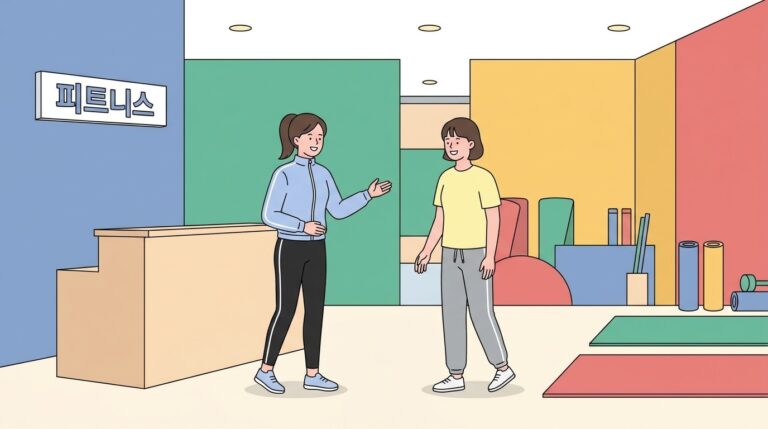
Walk Into a Korean Gym with Confidence: How to Ask for PT (Personal Training) Like a Local
Phase 1: 안녕하세요! (Hello!) Let’s Conquer Your Korean Gym Fear!
Have you ever walked past a sleek, modern Korean gym (called a 헬스장 – hel-seu-jang) with its bright neon lights, upbeat K-pop blasting, and thought, “I really want to sign up for Personal Training (PT), but my Korean isn’t good enough”?
You might have seen your favorite K-drama leads sweating it out with a personal trainer—like the funny workout scenes in Weightlifting Fairy Kim Bok-joo—and wished you could experience that high-energy Korean gym culture yourself.
It is totally natural to feel intimidated! Asking about prices, schedules, and explaining your fitness goals in a foreign language is a big step. But don’t worry. Today, your Korean best friend and editor is here to give you the ultimate cheat sheet. Real students of our “Daily Hangul” program have used these exact phrases to sign up for PT sessions in Seoul, and so can you. Let’s get you ready to crush your fitness goals in Korea!
Phase 2: The Big Three: Core PT Expressions to Memorize
Here are the three most important phrases you need the moment you walk through those gym doors.
1. PT 상담받으러 왔어요. (I’m here to get a PT consultation.)
- Pronunciation: PT sang-dam-bat-eu-reo-was-seo-yo. (Sounds like: “P-Tee sahng-dahm-bah-deuh-ruh-wah-suh-yo”)
- Meaning: I came here to receive a PT consultation.
- K-Culture Moment: Imagine walking into a high-end gym in Gangnam. The receptionist smiles warmly. Instead of freezing, you confidently deliver this line. They will immediately guide you to a consultation table and offer you a cup of iced green tea!
- Editor’s Insight: 상담 (sang-dam) means “consultation” or “counseling.” In Korea, you rarely start working out immediately; you always sit down for a quick chat about your body type and goals first.
- Situation Spectrum:
- Casual (with friends): PT 상담받으러 왔어. (⚠️)
- Semi-formal (to staff): PT 상담받으러 왔어요. (✅ – Perfect!)
- Formal (business-like): PT 상담받으러 왔습니다. (⚠️ – Too stiff)
- 🤔 Think About It: In your home country, do you usually have a formal sit-down consultation before starting a gym membership, or do you just sign up online?
2. 가격이 어떻게 돼요? (How much is the price?)
- Pronunciation: Ga-gyeok-i eo-tteok-hae dwae-yo? (Sounds like: “Gah-gyuhg-ee uh-ttuk-heh dweh-yo?”)
- Meaning: What is the price? (Literally: “How does the price become?”)
- K-Culture Moment: In Korea, gym prices are rarely posted publicly on the walls. You have to ask directly. This phrase is polite, natural, and gets straight to the point without sounding rude.
- Editor’s Insight: While “얼마예요? (eol-ma-ye-yo? – How much is it?)” is grammatically correct, using “어떻게 돼요? (eo-tteok-hae dwae-yo?)” is much softer, more polite, and sounds incredibly native.
- Situation Spectrum:
- Casual: 가격이 어떻게 돼? (⚠️)
- Semi-formal: 가격이 어떻게 돼요? (✅ – Best!)
- Formal: 가격이 어떻게 됩니까? (⚠️)
- 🤔 Think About It: Why do you think Korean culture prefers indirect questions like “How does it become?” instead of a direct “How much is it?”
3. 초보자도 할 수 있을까요? (Can a beginner do it, too?)
- Pronunciation: Cho-bo-ja-do hal su is-seul-kka-yo? (Sounds like: “Cho-bo-jah-doh hahl soo eet-seuhl-kah-yo?”)
- Meaning: Can a beginner do it as well?
- K-Culture Moment: If you feel shy about your fitness level, this is your magic phrase. It immediately signals to the trainer that you need gentle, step-by-step guidance.
- Editor’s Insight: 초보자 (cho-bo-ja) means “beginner.” Adding “~도 (~do)” means “also/too.” It shows vulnerability in a polite way, which makes Korean trainers super eager to support and encourage you!
- Situation Spectrum:
- Casual: 초보자도 할 수 있을까? (🚫)
- Semi-formal: 초보자도 할 수 있을까요? (✅ – Highly Recommended!)
- Formal: 초보자도 가능합니까? (⚠️)
Phase 3: Textbook Korean vs. Real-Life Korean
Let’s compare what dry textbooks teach you versus how real Koreans actually speak at the gym!
Situation 1: Asking about the cost
- 📖 Textbook style: “개인 트레이닝 비용을 알고 싶습니다.” (I would like to know the cost of personal training.)
- 🗣️ Real-Life style: “PT 가격이 어떻게 돼요?” (How much is PT?)
- 💡 Why the difference? No one says “개인 트레이닝 (gae-in teu-rei-ning)” in real life. Everyone simply uses the abbreviation “PT” (pronounced Pee-Tee).
Situation 2: Explaining that you are a beginner
- 📖 Textbook style: “저는 운동을 처음 해봅니다.” (I am exercising for the first time.)
- 🗣️ Real-Life style: “저 완전 ‘헬린이’예요!” (I’m a total gym baby!)
- 💡 Why the difference? “헬린이 (hel-rin-i)” is a super popular slang combining “헬스 (hel-seuh – gym)” and “어린이 (eo-rin-i – child)”. Saying this with a smile instantly breaks the ice and makes you sound incredibly trendy!
Phase 4: K-Culture Deep Dive & Gym Manners
4-1. Nunchi (눈치) & Gym Etiquette
- The Silent Bow: When you enter the gym or sit down with a trainer, always do a small, polite 15-degree bow with your head. It shows respect and instantly builds a friendly atmosphere.
- Eye Contact: During the consultation, make soft eye contact and nod your head while saying “아, 네~ (Ah, ne~ / Oh, yes~)”. This active listening is highly valued in Korean culture.
4-2. The Korean “Body Profile” (바디프로필) Craze
In Korea, there is a massive cultural trend called “바디프로필” (Body Profile). Ordinary office workers, students, and expats train intensely for 3 to 6 months just to take professional, high-concept fitness photos at a specialized studio. When you ask for PT, your trainer might ask, “혹시 바디프로필 준비하세요? (Are you preparing for a Body Profile?)”
Now you know what they mean! Another popular term is 오운완 (O-Un-Wan), which stands for “오늘 운동 완료” (Today’s workout completed)—a hashtag Koreans post daily on Instagram along with a gym mirror selfie.
Phase 5: Live Roleplay Challenge
Let’s practice! You have just walked into “Seoul Fitness,” a beautiful gym with sparkling city views. You are talking to Minsu (민수), a friendly and energetic personal trainer.
- Minsu: 안녕하세요! 어떤 일로 오셨어요?
(An-nyeong-ha-se-yo! Eo-tteon il-lo o-syeot-eo-yo?)
“Hello! What brings you in today?” - You: 🎭 [Smile politely] 안녕하세요. 저, PT 상담받으러 왔어요.
(An-nyeong-ha-se-yo. Jeo, PT sang-dam-bat-eu-reo was-seo-yo.)
“Hello. I came to get a PT consultation.” - Minsu: 아, 네! 이쪽으로 앉으세요. 운동해보신 적 있으세요?
(Ah, ne! I-jjok-eu-ro an-jeu-se-yo. Un-dong-hae-bo-sin jeok is-seu-se-yo?)
“Ah, great! Please sit over here. Have you ever worked out before?” - You: 🎭 [Scratch your head shyly] 아니요, 저 완전 헬린이예요. 초보자도 할 수 있을까요?
(An-i-yo, jeo wan-jeon hel-rin-i-yeo-yo. Cho-bo-ja-do hal su is-seul-kka-yo?)
“No, I am a total gym baby. Can a beginner do it, too?” - Minsu: 당연하죠! 기초부터 다 알려드려요. 혹시 원하는 목표가 있으세요?
(Dang-yeon-ha-jo! Gi-cho-bu-teo da al-lyeo-deu-ryeo-yo. Hok-si won-ha-neun mop-pyo-ga is-seu-se-yo?)
“Of course! We teach everything from the basics. Do you have a specific goal?” - You: 다이어트랑 체력 키우기요! PT 가격이 어떻게 돼요?
(Da-i-eo-teu-rang che-ryeok ki-u-gi-yo! PT ga-gyeok-i eo-tteok-hae dwae-yo?)
“Dieting and building stamina! How much is the PT price?” - Minsu: 10회에 60만 원인데, 오늘 등록하시면 회원권은 서비스로 드릴게요!
(Sip-hoe-e yuk-sip-man won-in-de, o-neul deung-rok-ha-si-myeon hoe-won-gwon-eun seo-bi-seu-ro deu-ril-ge-yo!)
“It’s 600,000 KRW for 10 sessions, but if you sign up today, I’ll give you the gym membership for free!” - You: 우와, 정말요? 감사합니다!
(U-wa, jeong-mal-yo? Gam-sa-ham-ni-da!)
“Wow, really? Thank you!”
🔀 Your Turn: Choose Your Path!
Minsu offers you a free gym membership if you sign up today. What do you say?
* Option A: “지금 바로 결제할게요!” (I will pay right now!)
* Option B: “생각해보고 연락드릴게요.” (I’ll think about it and contact you.)
* Option C: “너무 비싸요. 깎아주세요!” (It’s too expensive. Give me a discount!)
💡 Feedback on Your Choice:
- Option A (Best!): You get the free perk and show great enthusiasm! Trainers love motivated students.
- Option B (Safe & Smart): Very polite way to step back and think without feeling pressured.
- Option C (Risk!): While bargaining is common in traditional markets, asking to cut prices directly at a modern corporate gym can feel a bit awkward.
Phase 6: 10-Second Emotional Shadowing Drill
Let’s practice your pronunciation with real emotion! Follow the pauses (/) and speak like a native.
- [😊 Polite and friendly]
저 / PT 상담받으러 / 왔어요.
(Jeo / PT sang-dam-bat-eu-reo / was-seo-yo.) -
[🥺 Cute and humble]
저 / 완전 / 헬린이예요!
(Jeo / wan-jeon / hel-rin-i-ye-yo!) -
[💡 Curious and soft]
PT 가격이 / 어떻게 돼요?
(PT ga-gyeok-i / eo-tteok-hae dwae-yo?)
Phase 7: K-Culture Gym Mini-Dictionary
- 헬스장 (Helseu-jang) | Gym / Fitness Center. (Literally: “Health Club”)
- PT (Pee-Tee) | Personal Training. Always used instead of the full English term.
- 오운완 (O-un-wan) | “Today’s Workout Complete.” The ultimate fitness hashtag in Korea.
- 득근 (Deuk-geun) | “Gain muscle!” A fun slang used to wish someone a successful workout. (e.g., “오늘도 득근하세요!” – Gain muscle today, too!)
Phase 8: The Traveler’s Survival Kit
If you are only visiting Korea for a short time but still want to visit a gym, keep these three phrases handy!
- 일일권 있어요? (Il-il-gwon is-seo-yo?)
- “Do you have a 1-day pass?”
- 운동복 빌려줘요? (Un-dong-bok bil-lyeo-jwo-yo?)
- “Do you rent workout clothes?” (Many Korean gyms provide t-shirts and shorts for free or a small fee!)
- 수건은 어디에 있어요? (Su-geon-eun eo-di-e is-seo-yo?)
- “Where are the towels?”
🗺️ Editor’s Travel Note
To find the best local gyms near you, do not use Google Maps (which isn’t fully updated in Korea). Instead, search “헬스장” on Naver Map (네이버 지도). You can see real reviews, photos, and even check if they have foreigner-friendly trainers!
Phase 9: One Step Deeper: The Korean Passion for Self-Improvement
In Korea, taking care of your body isn’t just about health; it’s considered a key part of self-development and respect for others. This is why you see people of all ages—from busy university students to older grandmothers (often affectionately called 할머니 – hal-meo-ni)—working out hard early in the morning. Joining a gym in Korea is one of the fastest ways to feel the intense, positive “K-energy” and integrate into local life.
💬 Your Turn: What is your main fitness goal? Is it building strength, losing weight, or just staying active? Let me know in the comments below!
Phase 10: FAQ & Avoiding Common Mistakes
Q: Can I pay with a foreign credit card at Korean gyms?
A: Yes! Most modern Korean gyms accept foreign credit cards (Visa, Mastercard). However, some smaller gyms might offer a special discount if you pay via domestic bank transfer or cash (현금 – hyeon-geum).
Q: Do I need to bring my own indoor shoes?
A: Yes, absolutely! This is a major rule in Korea. You cannot wear the shoes you wore outside onto the gym floor. You must bring a clean pair of sneakers to change into.
Q: Are trainers okay with English?
A: Many younger trainers in Korea know basic fitness terms in English, but using the Korean phrases in this guide will make them feel much more comfortable and excited to help you!
🚨 The Gym Mistakes Board: Top 3 Mistakes to Avoid
- Wearing outdoor shoes inside: ❌ Wearing dirty street shoes on the gym floor. | Correct Action: Bring a separate clean pair of sneakers in your bag.
- Not returning weights: ❌ Leaving dumbbells on the floor. | Correct Action: Always return equipment to its designated spot. Respect is key!
- Forgetting to check the holiday schedule: ❌ Showing up on the 2nd or 4th Sunday of the month. | Correct Action: Many Korean gyms close on designated Sundays. Always check their schedule on Naver Map first.
Phase 11: Action Mission!
- 🥉 Bronze Mission: Say “PT 상담받으러 왔어요” out loud 5 times in front of your mirror with a big smile.
- 🥈 Silver Mission: Go to Instagram, search the hashtag #오운완, and leave a supportive comment like “오늘도 득근하세요!” on a Korean fitness post.
- 🥇 Gold Mission: Walk into a local gym in Korea (or call one) and ask, “PT 가격이 어떻게 돼요?”
Phase 12: Interactive Quiz Challenge
Test your knowledge before you hit the gym!
1. What does “헬린이” (Hel-rin-i) mean?
- A) A professional fitness trainer
- B) A beginner at the gym (gym baby)
- C) Gym equipment
2. Fill in the blank: “PT 상담_______ 왔어요.”
- A) 받으러 (bat-eu-reo)
- B) 하러 (ha-reo)
- C) 보러 (bo-reo)
3. True or False: You can wear your outdoor shoes on the Korean gym floor.
- A) True
- B) False
🎉 Click here to see the Answers & Explanations!
- Answer: B
Explanation: “헬린이” combines “헬스” (gym) and “어린이” (child) to mean a gym beginner! - Answer: A
Explanation: “상담받으러 왔어요” means “I came to receive a consultation,” which is the correct and natural way to say it. - Answer: B (False)
Explanation: You must always bring a separate pair of clean indoor sneakers to keep the gym floor clean!







