

Master the Korean Photo Booth: Natural Phrases for Your Perfect “Ne-Cut” (네컷) Shots!
안녕하세요! Hello there, my stylish language learners! I’m your Daily Hangul Senior Editor and local culture navigator. If you’ve ever walked down the vibrant streets of Hongdae, Gangnam, or Myeongdong, you’ve definitely seen them: bright, neon-lit studios packed with cute props, hair straighteners, and groups of friends laughing.
Yes, we are talking about “인생네컷” (Insaeng-ne-cut – Life Four Cuts)! Taking these four-frame sticker photos is practically a national sport in Korea. But let’s be honest—when that 10-second timer starts ticking down inside the booth, panic can set in. What filter do we use? Which pose next?
Don’t worry! Today, we’re leveling up your intermediate (B2) Korean so you can lead the photo session like a true Seoulite. Let’s dive in!
Phase 2: Deep Dive into 3 Core Expressions
1. 필터 뭐로 할까? (Pil-teo mwo-ro hal-kka?)
- Pronunciation: pil-teo mwo-ro hal-kka? (Sounds like “peel-tuh moh-roh hal-kah?”)
- Meaning: Which filter should we use?
- K-Culture Moment: You are standing in front of the touchscreen inside a trendy booth like Haru Film or Photo Gray. The screen displays options: Bright (밝은), Cool Tone (쿨톤), Warm Tone (웜톤), or Retro Black & White (흑백). You turn to your friend to make a quick decision before the timer runs out.
- Editor’s Insight: For B2 learners, notice the grammar structure “N-으로/로 할까?” (Shall we go with N?). It is highly natural and collaborative, much more friendly than the textbook “어떤 필터를 선택하겠습니까?”. You can easily swap “필터” with “프레임” (frame) to ask: “프레임 뭐로 할까?”
- Situation Spectrum: Casual ✅ | Semi-formal ⚠️ (필터 뭐로 할까요?) | Formal 🚫
- 🤔 Think About It: Why is personal color (쿨톤/웜톤) such a massive trend in Korea? How does matching your photo background color to your skin tone reflect the Korean pursuit of aesthetic perfection?
2. 머리띠 골라주라! (Meo-ri-tti gol-ra-ju-ra!)
- Pronunciation: muh-ree-thee gol-lah-joo-rah! (Sounds like “muh-ree-tee gohl-rah-joo-rah”)
- Meaning: Pick a headband for me!
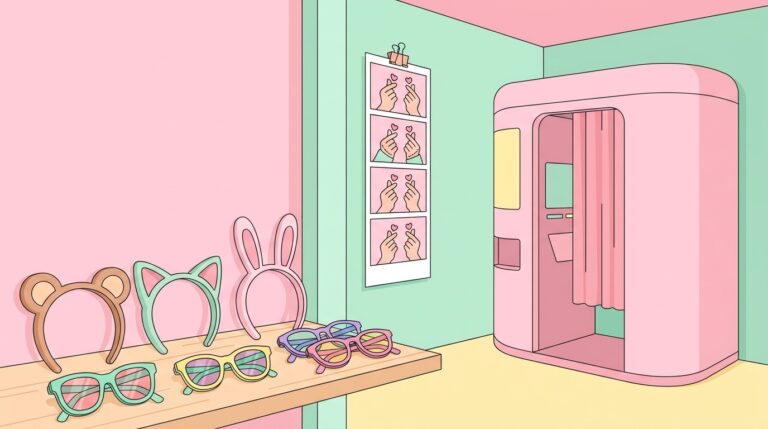
- K-Culture Moment: You enter the prop zone and see a wall full of fluffy animal headbands, quirky sunglasses, and giant plush hats. Feeling overwhelmed by choices, you look at your friend for help.
- Editor’s Insight: The ending “-어/아 주라” is a playful, casual variant of “-어/아 줘” (do it for me) commonly used among close friends. It adds a cute, slightly whiny (애교) nuance that softens commands.
- Situation Spectrum: Casual ✅ | Semi-formal ⚠️ (머리띠 골라주세요) | Formal 🚫
- 🤔 Think About It: Sharing props and picking them for each other is a bonding ritual. How does this collective playful behavior compare to taking photos in your home country?
3. 소품 챙겨서 들어가자. (So-pum chaeng-gyeo-seo deul-eo-ga-ja.)
- Pronunciation: so-poom chaeng-gyuh-suh deul-uh-gah-jah.
- Meaning: Let’s grab our props and head in.
- K-Culture Moment: You’ve touched up your hair with the free straightener in the lobby, selected your cute plush hats, and now it’s time to claim an empty booth.
- Editor’s Insight: The verb 챙기다 (chaeng-gi-da) is incredibly versatile in daily life. It means to pack, grab, look after, or make sure not to forget something. Here, “소품 챙겨서” means securing your chosen props before entering the room.
- Situation Spectrum: Casual ✅ | Semi-formal ⚠️ (소품 챙겨서 들어가요) | Formal 🚫
- 🤔 Think About It: In Korean culture, taking care of details and “packing” things for the group is seen as thoughtful and warm-hearted. Who is the designated “prop organizer” in your friend group?
Phase 3: Textbook Korean vs. Real Korean
Situation 1: Deciding on a photo pose
- 📖 Textbook: “어떤 자세를 취할까요?” (What posture shall we assume?)
- 🗣️ Real Korean: “우리 포즈 뭐 하지? 갸루피스 할까?” (What pose should we do? Shall we do the Gyaru Peace?)
- 💡 Why? Textbook Korean uses formal, rigid words like 자세 (posture) and 취하다 (to assume). Real young Koreans use the loanword 포즈 (pose) and simply ask “뭐 하지?” to keep the mood fun and breezy.
Situation 2: Asking for a retake
- 📖 Textbook: “사진을 다시 촬영하고 싶습니다.” (I would like to film the photos again.)
- 🗣️ Real Korean: “아, 망했다! 우리 다시 찍자!” (Ah, we ruined it! Let’s retake!)
- 💡 Why? Most modern photo booths in Korea offer a “retake” option (usually you take 8 or 10 cuts and choose 4, or you get one chance to redo). Reacting with a playful “망했다” (I failed/ruined it) is how natives express lighthearted disappointment before hitting the redo button.
Phase 4: K-Culture Deep Dive & Non-verbal Manners
4-1. Nunchi & Gestures
Inside the booth, space is tight! Here are the unwritten rules of Korean photobooth etiquette:
* The “Manner Legs” (매너다리): If you are taller than your friends, bend your knees slightly so you don’t block the camera or cut off the shorter person standing behind you.
* Heart Evolution: Don’t just stand there with a basic V-sign. Try the 볼하트 (cheek heart – putting a half-heart against your cheek) or the 깨물하트 (bite heart – making a circle with your hands and pretending to bite it into a heart).
4-2. Culture Code: 소확행 (Small but Certain Happiness)
“인생네컷” is more than a photo; it’s a physical memory of a good day. After dining or visiting a trendy cafe, heading to a photobooth is a mandatory course. It reflects Korea’s fast-paced trend-sensitive lifestyle, combining high-tech digital convenience with a physical, analog keepsake to decorate your desk or phone case.
Phase 5: Real-Life Roleplay Scenario
Setting: A bustling, aesthetic photo studio in Yeonnam-dong on a Friday evening.
Character: Minji (민지), your energetic, trend-savvy Korean bestie.
- 민지: 야, 여기 새로 오픈했나 봐! 우리 인생네컷 찍고 가자.
(Hey, looks like this place newly opened! Let’s take a four-cut photo before we go.) - Me: 오, 좋아! 근데 나 오늘 머리 완전 엉망이야.
(Oh, sounds good! But my hair is a complete mess today.) - 민지: 🎭 (pointing to the vanity station) 걱정 마! 저기 고데기랑 빗 다 있어. 머리 좀 만지고 소품 고르자.
(Don’t worry! They have straighteners and combs over there. Fix your hair a bit and let’s choose props.) - Me: 휴, 다행이다. 나 저 귀여운 루피 머리띠 쓸래! 너는?
(Phew, what a relief. I want to wear that cute Loopy headband! What about you?) - 민지: 🎭 (giggling while wearing giant sunglasses) 나는 이 외계인 안경! 우리 들어가기 전에 포즈 미리 정하자.
(I’ll wear these alien sunglasses! Let’s decide on the poses before we go inside.) - Me: 좋은 생각이야! 첫 번째는 볼콕 하고, 두 번째는 볼하트 할까?
(Great idea! Shall we do cheek-pokes for the first one, and cheek-hearts for the second?) - 민지: 완벽해! 기계 화면에서 필터는 뭐로 할까? 뽀샤시한 게 예쁘게 나와.
(Perfect! Which filter should we use on the screen? The bright, soft-focused one makes us look pretty.) - Me: 그럼 밝은 필터로 하자. 야, 카운트다운 시작한다! 준비해!
(Let’s go with the bright filter then. Hey, the countdown is starting! Get ready!)
🔀 Your Turn! How do you react to the countdown?
- Option A: “나 완전 준비됐어! 하트 포즈 발사!” (I’m totally ready! Heart pose, fire!)
👉 Best! Matches Minji’s high energy perfectly. Highly natural and fun! - Option B: “예, 저도 촬영할 준비가 완료되었습니다.” (Yes, I have also completed preparations for filming.)
👉 Bad. Way too formal and robotic for a fun photobooth hang-out. - Option C: “어떡해, 나 눈 감았어! 어떡해!” (What do I do, I closed my eyes! Oh no!)
👉 Risk! A very realistic scenario! Minji will laugh and immediately show you how to click the “다시 찍기” (retake) button.
Phase 6: 10-Second Emotion Shadowing Drill
Practice saying these out loud with natural rhythm and feeling! / indicates a natural pause.
- “필터 / 뭐로 할까? / 흑백도 예쁜데!”
[😊 Excited & Collaborative]
(pil-teo / mwo-ro hal-kka? / heuk-baek-do ye-ppeun-de!) -
“아, 망했다! / 우리 / 다시 찍자!”
[🥺 Playfully panicked]
(ah, mang-haet-da! / u-ri / da-si jjik-ja!) -
“네가 / 소품 / 좀 골라주라~”
[🥰 Cute, whining tone to a friend]
(ne-ga / so-pum / jom gol-ra-ju-ra~)
Phase 7: K-Culture Mini Dictionary
- 인생네컷 (Insaeng-ne-cut): Lit. “Life’s Four Cuts.” Originally a brand name, but now used as a generic term for all automatic four-frame photo booths in Korea.
- 뽀샤시하다 (Bbosyasi-hada): To look bright, glowing, and beautifully soft-focused (usually referring to photo filters or great lighting).
- 볼콕 (Bol-kok): A classic cute photo pose where you poke your index finger into your puffed-up cheek.
- 소품 (So-pum): Props or accessories (headbands, glasses, hats) provided in the photo studio.
Phase 8: Traveler’s Survival Kit
Survival Vocab TOP 3
- “지폐 교환기 어디 있어요?” (ji-pye gyo-hwan-gi eo-di isseo-yo?) – Where is the bill changer?
- “카드 결제 돼요?” (ka-deu gyeol-je dwae-yo?) – Can I pay by card?
- “큐알코드 꼭 인쇄해 주세요.” (kyu-al-ko-deu kkok in-swae-hae ju-se-yo.) – Please make sure to print the QR code.
💡 Editor’s Travel Note:
Almost all modern studios in Seoul accept credit/debit cards (including international ones like Visa/Mastercard). Crucial Tip: Before printing, the screen will ask if you want to include a QR code. Always check YES! This lets you scan the printed code with your phone to download the high-resolution digital image and a cute time-lapse video of you posing! Search for “인생네컷” or “하루필름” on the 네이버 지도 (Naver Map App) to find the highest-rated ones nearby!
Phase 9: “한 발 더 깊이” (One Step Deeper)
In a highly digitalized society where photos live on Instagram feeds, “인생네컷” offers young Koreans a tangible, analog piece of memory. The physical strip of photo paper is pinned to bedroom walls, tucked behind clear phone cases, or placed on office desks. It represents “우리” (uri – we/us)—the tight-knit community culture of Korea. Sharing this physical space and physical print is a testament to true friendship.
💬 Your Turn: Have you ever taken a “Ne-cut” photo in Korea? What is your ultimate go-to pose? Leave a comment below and let’s chat!
Phase 10: FAQ & Common Mistakes
Q: Can we take photos alone, or does it have to be a group?
A: You can absolutely take them alone! It’s called “혼네컷” (Hon-ne-cut – solo four cuts) and is very popular for checking out a new outfit or hairstyle.
Q: How much does it cost?
A: Typically, it costs between 4,000 KRW to 5,000 KRW (approx. $3 to $4 USD) for two identical copies of a 4-cut strip.
Q: What happens if I forget to save the QR code photo in time?
A: The QR link usually expires within 24 to 72 hours, so download the digital photo and video immediately to your phone after printing!
🚨 Common Mistakes Alert!
- Forgetting to check the QR code box: If you miss this option on the screen before printing, you cannot get the digital file later!
- Taking too long in the prop area: Entering a booth with too many props might block other waiting guests. Be quick and respect the queue!
- Looking at the screen instead of the camera lens: When the camera shutter actually clicks, look directly at the physical lens (usually at the top), not at the screen display below it. Otherwise, you’ll look like you’re looking down!
Phase 11: Action Mission
- Bronze Medal: Next time you take a selfie, try the 볼콕 (cheek poke) or 볼하트 (cheek heart) pose!
- Silver Medal: Take a photo at a local Korean-style photo booth and post it on your SNS using the hashtags
#인생네컷and#매일한글. - Gold Medal: Go into a booth and complete a full photo-taking session with a friend, using only the Korean menu selections and coordinating using “우리 필터 뭐로 할까?”!
🎬 K-Culture Hunt: Watch a romantic K-Drama (like Lovely Runner or Our Beloved Summer). Can you spot the scene where the main couple goes into a tiny booth and takes silly photos together? Note down what props they wore!
Phase 12: Interactive Quiz Challenge
Test your knowledge to see if you’re ready for the booth!
Q1. What is the most natural way to ask your friend to choose a headband for you?
- Answer: “머리띠 골라주라!”
- Explanation: “-어/아 주라” is the perfect casual, friendly way to ask a close friend for a favor inside the photo booth.
Q2. True or False: If you look at the screen while the camera clicks, your eyes will look perfect.
- Answer: False!
- Explanation: You must look directly at the camera lens (usually located near the top of the booth) to get the perfect eye contact in your final printed photo.
Q3. What does “뽀샤시하다” mean when choosing a filter?
- Answer: It means the filter is bright, glowing, and soft-focused.
- Explanation: It is a slangy but widely used adjective to describe highly flattering, glowing skin aesthetics.







