

Master Korea’s Green Standard: The Ultimate Guide to Sorting Ice Packs Like a Local
Phase 1: Empathy (Welcome to the Eco-Conscious Life in Korea!)
안녕하세요! It’s your trusty Korean best friend and Daily Hangul’s chief editor here!
Imagine this: You’ve just ordered a fresh batch of 새벽배송 (dawn delivery) from Market Kurly or some delicious meal kits via Coupang Eats. Everything is perfectly fresh, but as you unpack, you are left with a mountain of cardboard boxes, bubble wrap, and—the ultimate boss of Korean recycling anxiety—ice packs (아이스팩).
If you’ve ever stood in an apartment 분리수거장 (recycling area) on a Sunday morning, holding a heavy gel pack, feeling the intense gaze of the 경비 아저씨 (security guard/apartment manager) burning into your back, you are not alone. Many C1-level learners can read the labels, but when it comes to the real-life 눈치 (nunchi/social wit) of Korean environmental systems, things get tricky. Today, we’ll transition you from “confused expat” to “neighborhood recycling champion.”
Phase 2: Deep Dive into 3 Key Expressions
Let’s dissect the heavy-hitting terminology you’ll need when dealing with these chilly blocks.
1. 종량제 봉투에 버리다 (jong-ryang-je bong-tu-e beo-ri-da)
- Pronunciation: Jong-ryang-jeh bong-too-eh buh-ri-dah (Think of “jong” like “song” with a J, and “ryang” like “yang” with an R)
- Meaning: To throw away in a pay-as-you-go (volume-rate) general garbage bag.
- K-Culture Moment: You will hear this constantly when moving into a new officetel or apartment. Neighbors will warn you: “그거 재활용 안 되니까 종량제 봉투에 버리셔야 해요!” (That’s not recyclable, so you must throw it in the general trash bag!)
- Editor’s Insight: Gel-type ice packs contain Superabsorbent Polymers (SAP, 고흡수성 수지), which are essentially microplastics. They cannot be recycled normally. Thus, they must go into the general waste (종량제).
- Situation Spectrum: Casual ✅ | Semi-formal ✅ | Formal ✅
- 🤔 Think About It: How does your home country manage non-recyclable household items compared to Korea’s pay-as-you-go bag system?
2. 전용 수거함에 배출하다 (jeon-yong su-geo-ham-e bae-chul-ha-da)
- Pronunciation: Jun-yong soo-guh-hahm-eh bae-chool-hah-dah
- Meaning: To dispose of/discharge in a dedicated collection bin.
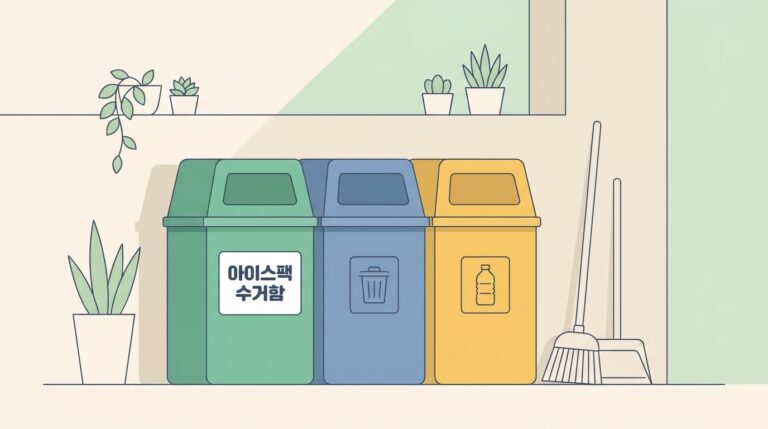
- K-Culture Moment: Many local community centers (주민센터) or major apartment complexes have specific green bins labeled “아이스팩 수거함” to collect intact gel packs for local merchants to reuse.
- Editor’s Insight: 배출하다 is a formal, highly eco-literate C1 verb for “discharging” or “disposing of” waste. Using 버리다 is fine, but 배출하다 shows supreme command of the language.
- Situation Spectrum: Casual ⚠️ | Semi-formal ✅ | Formal ✅
- 🤔 Think About It: Korea prioritizes community-level resource circularity. Does your community have localized reuse systems like this?
3. 가위로 째서 물만 비우다 (ga-wi-ro jjae-seo mul-man bi-u-da)
- Pronunciation: Gah-wee-roh jjae-suh mool-mahn bee-oo-dah
- Meaning: To cut open with scissors and only pour out the water.
- K-Culture Moment: Modern Korean brands are shifting to eco-friendly ice packs. You’ll see text on the pack: “가위로 잘라 물은 버리고 비닐은 재활용해 주세요.”
- Editor’s Insight: 째다 means to rip or slit open. It’s much more colloquial and vivid than 자르다 (to cut).
- Situation Spectrum: Casual ✅ | Semi-formal ✅ | Formal 🚫
- 🤔 Think About It: Why do you think Korean e-commerce companies made the rapid transition to water-based ice packs despite gel being more effective at cooling?
Phase 3: Textbook Korean vs. Real Korean
Let’s compare the sterile sentences of standard textbooks with the dynamic, living Korean used on the streets of Seoul.
Situation 1: Explaining what to do with a gel-type ice pack
- 📖 Textbook Korean: “아이스팩의 내용물은 싱크대에 버리지 말고 쓰레기통에 버리십시오.”
(Do not discard the contents of the ice pack in the sink; discard them in the trash can.) - 🗣️ Real Korean: “이거 젤타입이라 그냥 싱크대에 짜버리면 배수구 다 막히고 난리 나요. 일반 쓰레기로 버려야 돼요.”
(This is gel-type, so if you squeeze it down the sink, the drain will clog up completely and cause chaos. It has to go in the general trash.) - 💡 Why the difference? Real Koreans use warnings like “난리 나요” (chaos will ensue/it will be a mess) to emphasize the practical consequences of clogging drains with microplastics.
Situation 2: Inquiring where to put reusable water ice packs
- 📖 Textbook Korean: “이 아이스팩을 어디에 버려야 합니까?”
(Where should I throw away this ice pack?) - 🗣️ Real Korean: “이거 물로 된 건데, 그냥 물 비우고 비닐만 따로 분리수거하면 되죠?”
(This one is water-based, so I can just empty the water and recycle the plastic separately, right?) - 💡 Why the difference? C1 speakers use “-로 된 건데” (since it is made of…) to establish context, and end with “-면 되죠?” to seek confirmation politely while showing they already know the basic rule.
Phase 4: K-Culture Deep Dive & Non-verbal Manners
4-1. 눈치 (Nunchi) & Gestures at the Recycling Station
When you carry waste to the 분리수거장, physical etiquette says a lot.
* The Double-Handed Handover: If the 경비 아저씨 offers to help, or if you ask him where the ice pack bin is, always point or hand things over with both hands (or with your left hand supporting your right forearm).
* The Slight Bow: A 15-degree head tilt while saying “안녕하세요” or “감사합니다” instantly melts away any initial coldness. If you show that you are trying hard to follow the complex rules, they will gladly guide you.
4-2. Cultural Code: 배달의 민족 (The Delivery Nation)
Korea’s delivery infrastructure is unparalleled. From fresh sashimi to frozen meat, everything arrives with ice packs. However, this convenience birthed “eco-guilt.” As a result, the trend has rapidly shifted from “Gel packs” (화학성분) to “Water packs” (친환경 워터백). Knowing the difference and disposing of them appropriately is considered a mark of a highly civilized, respectful resident (시민의식).
Phase 5: Real-Life Roleplay Scenario
Setting: A crisp Sunday morning at the apartment recycling station (분리수거장).
Characters:
* 지수 (Ji-su): Your friendly, eco-conscious neighbor who has lived in the building for 5 years.
* Tom (You): A C1-level learner trying to dispose of a mix of ice packs.
- 지수: 어! 톰 씨, 일찍 나오셨네요? 분리수거 양이 어마어마하네요!
(Oh! Tom, you’re out early? That’s a massive amount of recycling!) - Tom: (긁적이며) 네, 이번 주에 밀키트를 좀 많이 시켰더니… 근데 지수 씨, 이 아이스팩들은 어떻게 처리해야 할지 애매해서요.
(Scratching head) Yeah, I ordered quite a few meal kits this week… But Ji-su, I’m a bit unsure of how to process these ice packs. - 지수: 아, 그거요! 은근히 헷갈리죠. 여기 팩 겉면 한 번 봐봐요. 글씨 써져 있죠?
(Ah, those! They are sneaky confusing. Take a look at the surface of this pack. See the text?) - Tom: 아, 이건 ‘친환경 100% 물’이라고 적혀 있네요.
(Ah, this one has “Eco-friendly 100% Water” written on it.) - 지수: 걔는 그냥 가위로 모퉁이 째서 물은 하수구에 버리고, 비닐만 깨끗이 말려서 비닐 수거함에 던지면 끝이에요!
(That one, you just cut the corner with scissors, pour the water down the drain, and toss the dry plastic into the plastic bin, and you’re done!) - Tom: 아하, 간단하네요! 그럼 이 통통하고 말랑말랑한 녀석은요? 얜 물이 아닌 것 같은데요.
(Aha, simple! Then what about this plump, squishy fellow? This doesn’t seem to be water.) - 지수: ⚠️ 그건 절대 째면 안 돼요! 고흡수성 젤이라 하수구 다 막히거든요. 그건 그냥 통째로 종량제 봉투에 넣어 버리거나, 저기 경비실 옆에 ‘아이스팩 수거함’ 보이시죠? 거기 넣으시면 돼요.
(You must absolutely never rip that open! It’s superabsorbent gel, so it will clog the entire drain system. You should either put it whole into the general waste bag, or see that “Ice Pack Collection Bin” next to the security office? Put it in there.) - Tom: 와, 하마터면 하수구에 다 짜낼 뻔했네요. 진짜 큰일 날 뻔했어요. 고마워요, 지수 씨!
(Wow, I almost squeezed it all into the drain. That would have been disastrous. Thanks, Ji-su!)
🔀 Interactive Choice Points
What would you say next to show your advanced cultural integration?
- Option A: “그럼 젤타입은 무조건 쓰레기네요. 그냥 버릴게요.”
- Option B: “아하, 주민센터에서도 수거해 간다고 듣긴 했는데, 아파트 단지 안에 수거함이 있으니 훨씬 편하네요!”
- Option C: “이거 대충 물이랑 섞어서 하수구에 흘려보내면 안 돼요?”
Feedback on Your Choice:
- Option A (Risk): Too blunt and ignores the recycling effort. While grammatically correct, it sounds unenthusiastic about the eco-friendly efforts Ji-su just explained.
- Option B (Best – C1 Level): Brilliant! Mentioning “주민센터” (community center) shows high cultural knowledge about public systems, and utilizing “-다 하니/듣긴 했는데” shows excellent command of connective endings.
- Option C (Bad): Disaster! Squeezing microplastic gel down the drain is an environmental hazard in Korea. Saying this might earn you a severe lecture from Ji-su or the security guard!
Phase 6: 10-Second Emotion Shadowing Drill
Practice these high-frequency phrases with native-like emotional inflection. Use the / marks to pause and match the emotional cues.
- [😱 Shocked & Warned]
이건 젤타입이라 / 그냥 싱크대에 버리면 / 진짜 큰일 나요!
(I-geon gel-ta-ip-i-ra / geu-nyang sing-keu-dae-e beo-ri-myeon / jin-jja keun-il na-yo!) -
[💡 Relieved & Realized]
아하, / 물로 된 건 / 그냥 가위로 째서 / 물만 비우면 되는군요!
(A-ha, / mul-lo doen geon / geu-nyang ga-wi-ro jjae-seo / mul-man bi-u-myeon doe-neun-gun-yo!) -
[😊 Expressing Gratitude politely]
알려주셔서 감사해요. / 안 그랬으면 / 종량제 봉투 낭비할 뻔했네요.
(Al-ryeo-ju-sheo-seo gam-sa-hae-yo. / An geu-raet-seu-myeon / jong-ryang-je bong-tu nang-bi-hal ppeon-haet-neyeo.)
Phase 7: K-Culture Mini Dictionary
| Word | Romanization | Meaning & Real-world Usage |
|---|---|---|
| 분리배출 | Bun-ri-bae-chul | Separate disposal. Used on official signs and bin labels instead of just “분리수거”. |
| 고흡수성 수지 | Go-heup-su-seong su-ji | Superabsorbent polymer (SAP). The scientific name for the gel inside old ice packs. |
| 수거함 | Su-geo-ham | Collection bin. Usually paired with items: 의류 수거함 (clothing), 폐건전지 수거함 (batteries). |
| 친환경 | Chin-hwan-gyeong | Eco-friendly. Look for this label to know if you can simply drain the water inside. |
Phase 8: Survival Kit for Travelers & Expats
Survival Expressions TOP 3
- “아이스팩 수거함 어디에 있어요?” (Where is the ice pack collection bin?)
- “이거 일반 쓰레기로 분류하나요?” (Do I classify this as general waste?)
- “물 아이스팩은 그냥 싱크대에 버려도 되죠?” (I can just empty water ice packs in the sink, right?)
📝 Editor’s Travel Note:
To find your nearest community center with dedicated ice pack bins, download the Naver Map App and search for “주민센터” or “행정복지센터”. Many local governments run reward systems where exchanging 10 gel packs yields free 종량제 bags or toilet paper! (Note: Policies subject to change per district; verify with your local office.)
Phase 9: “One Step Deeper” (Deep Reflection)
Korea’s strict recycling culture stems from a collectivist mindset (공동체 의식) combined with high-density apartment living. Because land is highly limited, efficient waste management is treated as a communal responsibility. In Korea, failing to sort waste correctly isn’t just a minor error—it directly inconveniences your neighbors and the 경비 아저씨 who has to resort them by hand. It’s an unspoken social contract of respect.
💬 Your Turn: How does your home country handle the massive influx of packaging waste from online shopping? Do you think Korea’s strict separation system is effective?
Phase 10: FAQ & Common Mistakes
Q: Can I reuse the gel ice packs at home?
A: Absolutely! If you keep them in your freezer, they are perfect for home therapy, keeping picnics cold, or even putting in a cloth wrap around your neck during Korea’s sweltering humid summer (삼복더위).
Q: What happens if I accidentally throw a gel pack in the plastic recycling bin?
A: It will be filtered out as non-recyclable contaminant waste at the sorting center, which increases municipal costs. Worse, if your apartment CCTV catches you, you might get a polite but firm warning from the management office!
Q: Can I put food-contact water packs into garden soil?
A: If it is 100% pure water, yes. However, read the back carefully. Some eco-friendly brands use water mixed with natural plant nutrients. Those are highly beneficial for house plants!
🚨 Common Mistakes Alert! (Avoid These!)
- Mistake 1: Cutting open a gel ice pack and flushing it down the toilet.
- Correct Action: Never! It expands and blocks pipes, costing thousands of dollars to repair.
- Mistake 2: Putting water-based ice packs into the gel collection bin.
- Correct Action: Water packs should be emptied and the plastic recycled. The collection bin is strictly for re-sterilizing and reusing gel packs.
- Mistake 3: Throwing wet plastic sleeves into the recycling pile.
- Correct Action: Ensure the plastic wrapper is completely dry before discarding, or it will mold and ruin other papers/plastics.
Phase 11: Action Mission & Engagement
- Bronze Medal: Check your freezer right now. Separate your gel packs from your water packs.
- Silver Medal: Find out if your apartment complex or local 주민센터 has an “아이스팩 수거함” (dedicated collection bin).
- Gold Medal: Next time you order delivery, empty a water pack, dry it, and successfully sort it while saying out loud: “가위로 째서 물만 비우자!”
🎮 K-Culture Mission: Watch a modern slice-of-life K-drama (like Because This Is My First Life or Our Blues). Spot a scene where characters are sorting trash at the recycling area. Observe their facial expressions and body language!
Phase 12: Interactive Quiz Challenge
Test your C1 Korean green citizenship below!
1. Which of the following is the CORRECT disposal method?
- A) Flush gel-type SAP down the toilet to save trash bag space.
- B) Toss water-filled packs directly into the plastic recycling bin.
- C) Squeeze out the water-based packs into the sink and recycle the dry film.
2. Fill in the blank:
“이건 젤타입이라 그냥 버리면 안 되고, 꼭 ( ) 봉투에 넣으셔야 해요.”
3. True or False?
In Korea, you can get rewarded with trash bags or household items by bringing clean gel ice packs to certain local administrative centers.
🔍 Click here to reveal Answers & Explanations!
- Correct Answer: C
- Explanation: Gel should never be flushed (A is illegal!), and water packs must be emptied before plastic recycling (B is incorrect because wet/filled plastic contaminated recycling streams).
- Correct Answer: 종량제
- Explanation: General garbage bags in Korea are called 종량제 봉투 (volume-rate bags).
- Correct Answer: True
- Explanation: Many local districts run an eco-reward program to promote circular usage of heavy-duty gel packs. It’s a great local hack!
- Explanation: Many local districts run an eco-reward program to promote circular usage of heavy-duty gel packs. It’s a great local hack!







