

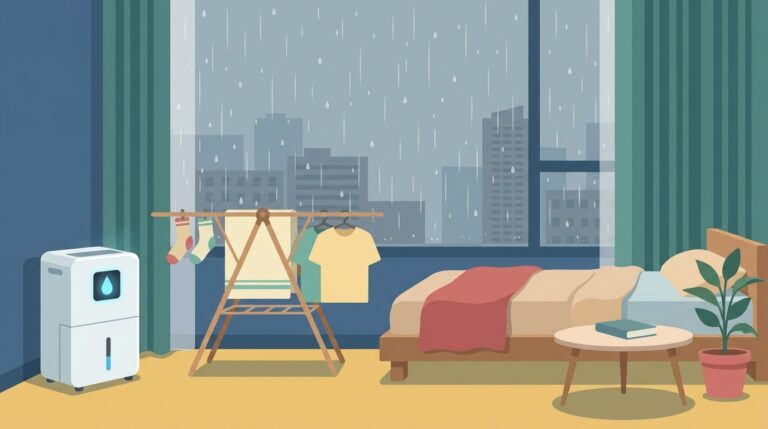
Beat the Sticky Korean Monsoon: How to Master Dehumidifier Talk and Stay Fresh
Phase 1: Empathy (Welcome to the Rainy Season!)
안녕하세요! Welcome back to Daily Hangul, your cozy corner for mastering real, lived-in Korean culture and conversation. I’m your host and senior editor, and today we are diving headfirst into one of Korea’s most notorious seasonal battles: 장마철 (jang-ma-cheol – the Monsoon/Rainy Season).
Imagine this: It is mid-July in Seoul. You’ve just come home from a delicious dinner of jeon (savory pancakes) and makgeolli (rice wine)—the ultimate rainy day soul food. As you open your apartment door, a wall of thick, warm, humid air hits you. It feels like you’ve walked into a sauna, and your floor feels slightly sticky under your bare feet.
You look at your sleek 제습기 (dehumidifier) sitting in the corner. You want to turn it on, ask your Korean roommate if they mind, or explain to your landlord why you need to keep it running to prevent mold. Suddenly, textbook phrases like “비가 옵니다” (It is raining) feel completely useless.
Don’t sweat it (literally)! Today, we’re going to learn the exact, natural Korean expressions used during the sticky monsoon season, how to talk about your dehumidifier like a local, and the unspoken cultural rules of surviving jangma with your sanity—and your laundry—intact.
Phase 2: Core Expressions Deep Dive
Let’s look at three essential expressions that will immediately elevate your B1 Korean. These are the phrases you’ll hear on lifestyle vlogs, in K-Dramas, and among friends.
1. 눅눅하다 (nung-nuk-ha-da)
- Pronunciation: [Nung-nuk-ha-da] (Think of “nung” like the English “hung” but with an ‘N’, and “nuk” like “nook” but shorter.)
- Meaning: Damp / Soggy / Humid (specifically describing objects or the atmosphere)
- K-Culture Moment: In K-Dramas, you’ll often see characters sighing while touching their half-dried laundry hanging inside the living room, complaining that it feels 눅눅하다.
- Editor’s Insight: While 습하다 (seup-ha-da) means “humid” (referring to the weather/air), 눅눅하다 is used when that humidity has actually penetrated your clothes, bedsheets, or even potato chips left open.
- Situation Spectrum:
- Casual: 옷이 덜 말라서 눅눅해. (My clothes are damp because they didn’t dry fully.) ✅
- Semi-formal: 방이 좀 눅눅한데 제습기 좀 틀까요? (The room is a bit damp, shall we turn on the dehumidifier?) ✅
- Formal: 습도가 높아 침구가 눅눅해질 수 있습니다. (Due to high humidity, bedding may become damp.) ⚠️
- 🤔 Think About It: In English, we use “damp” or “humid” broadly. Why do you think Korean has highly specific sensory words like 눅눅하다 (damp/sticky to touch) vs. 습하다 (humid air)?
2. 제습기 좀 틀어 놓을게 (je-seup-gi jom teul-eo no-eul-ge)
- Pronunciation: [Je-seup-gi jom teul-eo no-eul-ge] (Focus on “teul-eo” which sounds like “tuhl-uh”.)
- Meaning: “I’ll leave the dehumidifier running for a bit.”
- K-Culture Moment: roommates in a bustling Seoul share-house discussing electricity bills and room comfort during summer.
- Editor’s Insight: The helper verb pattern
-어/아 놓다(to do something and leave it in that state) is crucial here. You aren’t just turning it on and off; you are turning it on to leave it running while you hang out or go buy a convenience store iced coffee. - Situation Spectrum:
- Casual: 제습기 좀 틀어 놓을게. ✅
- Semi-formal: 제습기 좀 틀어 놓을게요. ✅
- Formal: 제습기를 가동해 두겠습니다. ✅
- 🤔 Think About It: How does adding “놓다” (to place/leave) soften the command and make it sound more considerate to those sharing the space with you?
3. 물 비워야 돼 (mul bi-wo-ya dwae)
- Pronunciation: [Mul bee-wo-ya dwae] (“Bee-wo” sounds like “B.O.” but blended smoothly.)
- Meaning: “Need to empty the water tank/bucket.”
- K-Culture Moment: You hear the dehumidifier beep loudly, signaling its tank is full, and your partner yells from the kitchen to empty it.
- Editor’s Insight: A dehumidifier collects water from the air. In Korea’s intense jangma, a tank can fill up in just a few hours! 비우다 means “to empty.”
- Situation Spectrum:
- Casual: 제습기 물 비워야 돼. ✅
- Semi-formal: 제습기 물 비워야 돼요. ✅
- Formal: 제습기 물통을 비워 주시기 바랍니다. ⚠️
Phase 3: Textbook Korean vs. Real Korean
Let’s compare the stiff sentences you find in classic grammar books with what Koreans actually say when they are struggling with monsoon humidity.
Scenario A: Complaining about the indoor humidity
- 📖 Textbook Korean: “방 안의 습도가 아주 높습니다.” (The humidity inside the room is very high.)
- 🗣️ Real Korean: “방이 너무 꿉꿉해 죽겠어!” (The room is so sticky/humid I could die!)
- 💡 Why the difference? 꿉꿉하다 (kkup-kkup-ha-da) is the ultimate colloquial word for that sticky, unpleasant dampness on your skin and floors during summer. Adding
-어/아 죽겠다(to die of…) is the go-to Korean exaggeration for any minor physical discomfort!
Scenario B: Requesting to turn on the machine
- 📖 Textbook Korean: “제습기를 작동시켜 주십시오.” (Please operate the dehumidifier.)
- 🗣️ Real Korean: “제습기 좀 쌩쌩 돌려줘.” (Run the dehumidifier on high/generously.)
- 💡 Why the difference? 돌리다 (to spin/run a machine) is casually used for appliances like washing machines, microwaves, and dehumidifiers. 쌩쌩 (ssang-ssang) is an onomatopoeia for a cool breeze or a machine running powerfully.
Phase 4: K-Culture Deep Dive & Non-Verbal Manners
4-1. The Art of “Nunchi” (눈치) During Monsoon Season
Living with others during the Korean summer requires high-level Nunchi (situational awareness).
* The Laundry Etiquette: Because apartments in Korea often dry laundry indoors, a dehumidifier is a shared lifeline. If you see your roommate’s clothes on the drying rack (빨래 건조대), turning on the dehumidifier next to it without being asked is a major green flag!
* Close the Windows! If you run a dehumidifier with the window open, you are essentially trying to dehumidify the entire Korean peninsula. It wastes energy and earns you annoyed looks. Always check and close the windows before turning it on.
4-2. The Cozy Monsoon Food Code
Why do Koreans eat Jeon (pancakes) on rainy days? There’s a popular cultural theory that the sound of rain sizzling down matches the sound of oil frying on a hot pan. When the humidity is high, the smell of savory oil cuts through the dampness, making a rainy evening at home with a hum of a dehumidifier and a hot plate of jeon incredibly romantic.
Phase 5: Real-Life Roleplay Scenario
Meet Min-jun (민준): Your warm-hearted but incredibly neat Korean roommate who is sensitive to damp house smells.
[Scene: The living room of a shared apartment in Mapo-gu, Seoul. Rain is pouring heavily outside.]

민준: (wiping sweat from his forehead) 아, 오늘 진짜 습도가 장난 아니네. 바닥이 끈적거려.
      (Ah, today's humidity is no joke. The floor is sticky.)

유진 (You): 🎭 [Nodding in agreement, fanning yourself] 맞아요. 방도 너무 눅눅해서 옷들이 안 마를 것 같아요.
           (I agree. The room is so damp, I don't think the clothes will dry.)

민준: 그러니까요. 베란다에 있는 빨래에서 냄새날까 봐 걱정이에요.
      (Exactly. I'm worried the laundry on the veranda might start to smell.)

유진 (You): 🎭 [Pointing toward the corner] 그럼 거실에 제습기 좀 틀어 놓을까요?
           (Then, shall we turn on the dehumidifier in the living room and leave it running?)

민준: 오, 좋은 생각이에요! 당장 틀어주세요. 강풍으로 돌려요.
      (Oh, great idea! Please turn it on right away. Run it on high.)

유진 (You): 🎭 [Walking to the dehumidifier and pressing the button] 네, 켰어요! 어? 그런데 물통이 거의 찬 것 같은데요?
           (Okay, turned it on! Huh? But I think the water tank is almost full?)

민준: 아, 진짜요? 어제 내가 비웠는데 벌써 다 찼나 보네요.
      (Oh, really? I emptied it yesterday, but I guess it's already full.)

유진 (You): 🎭 [Lifting the tank carefully] 제가 화장실에 가서 물 비우고 올게요!
           (I'll go to the bathroom and empty the water!)
🔀 Choose Your Path
Min-jun says: “고마워요! 물 비운 김에 거실 창문 다 닫혀 있는지 확인해 줄래요?” (Thanks! Since you are emptying the water, could you check if all the living room windows are closed?)
- Option A: “귀찮은데 그냥 열어두면 안 돼요?” (It’s a hassle, can’t we just leave them open?)
- Feedback (Bad): Min-jun looks horrified. Running a dehumidifier with open windows during monsoon is highly inefficient and wastes electricity.
- Option B: “아 맞다! 바로 닫을게요. 제습기 틀 때는 닫아야 효과가 있죠!” (Ah, right! I’ll close them immediately. You have to close them for the dehumidifier to work!)
- Feedback (Best!): Perfect! You showed respect for house energy efficiency and demonstrated cultural understanding of appliance use.
- Option C: “창문 다 닫았는데 에어컨도 같이 틀까요?” (I closed all the windows, should we turn on the air conditioner too?)
- Feedback (Risk): Good, but be careful! Running both on high might spike the electricity bill. Best to discuss with roommates first.
Phase 6: 10-Second Emotional Shadowing Drill
Let’s practice speaking with real-life emotion. Pay attention to the pauses (/) and tone cues!
- [😩 Annoyed and Sticky]
- 아, / 너무 꿉꿉해서 / 못 참겠어!
- [Ah, / neo-mu kkup-kkup-hae-seo / mot cham-get-seo!]
- (Ugh, it’s so sticky I can’t stand it!)
- [😊 Helpful and Sweet]
- 제가 / 제습기 물 / 비워 올게요!
- [Je-ga / je-seup-gi mul / bi-wo ol-ge-yo!]
- (I will go empty the dehumidifier water!)
Phase 7: K-Culture Mini-Dictionary
- 장마철 (Jang-ma-cheol) | Monsoon Season | Usually starts late June and ends late July. Characterized by relentless rain and high humidity.
- 끈적거리다 (Kkeun-jeok-geo-ri-da) | To feel sticky | Describing skin, floors, or leather sofas sticking to you because of high moisture.
- 제습 모드 (Je-seup mo-deu) | Dehumidify Mode | A setting found on almost all Korean air conditioners, represented by a water drop icon (💧).
- 빨래 쉰내 (Ppal-rae swin-nae) | Sour laundry smell | The infamous musty odor laundry gets when dried in a humid environment without proper ventilation or a dehumidifier.
Phase 8: Traveler’s Survival Kit
Survival Phrases TOP 3
- “에어컨 제습으로 틀어 주세요.” (Please run the air conditioner on dehumidify mode.)
- Pronunciation: [E-eo-keon je-seup-eu-ro teul-eo ju-se-yo.]
- “방이 너무 습해서 곰팡이 필 것 같아요.” (The room is so damp, I think mold might grow.)
- Pronunciation: [Bang-i neo-mu seup-hae-seo gom-pang-i pil geot gat-a-yo.]
- “물먹는 하마 어디 있어요?” (Where is the ‘Water-eating Hippo’?) Note: This is the most famous brand of closet moisture absorbers in Korea.
- Pronunciation: [Mul-meok-neun ha-ma eo-di is-seo-yo?]
Editor’s Travel Note
If you are traveling in Korea during July, your best friend is the nearest convenience store or Olive Young. Ask for a 물먹는 하마 (Moisture Absorber) to put inside your suitcase or closet to keep your clothes fresh. To navigate subway stations without getting drenched, use the Naver Map App to find underground passageways (지하도) that link major buildings in areas like Gangnam or Gwanghwamun.
Phase 9: “A Step Deeper” (Cultural Insight)
In Korea, summer survival is not just an individual chore; it’s a shared neighborhood struggle. You will often see apartment complexes broadcasting community announcements warning residents to close balcony windows before sudden heavy downpours (게릴라성 호우). The culture of living in close proximity (like apartments or officetels) makes keeping your immediate environment clean and dry an act of consideration for your neighbors, as mold easily spreads across shared walls.
💬 Your Turn: How do you handle intense humidity in your home country? Do you use dehumidifiers, or is there a different local secret? Let us know in the comments below!
Phase 10: FAQ & Common Mistakes
Q: Can I leave the dehumidifier on all day while I am out?
A: Yes, but ensure the automatic shut-off feature is active so it stops running when the water tank is full. Also, keep it away from curtains or walls to prevent overheating.
Q: What is the difference between 제습 (Dehumidification) and 송풍 (Fan mode)?
A: 제습 (je-seup) actively pulls water from the air, cooling the room slightly as a byproduct. 송풍 (song-pung) just circulates the air like a regular fan, using very little electricity but not reducing humidity.
Q: Can I use the dehumidifier water to water my plants?
A: It is not recommended. The water collected in a dehumidifier can contain heavy metals or bacteria from the machine’s internal coils.
🚨 Common Mistakes Alert!
- Mistake 1: Saying “습기가 많아요” to describe wet laundry.
- Correction: Use 눅눅하다 (damp to touch) for objects, and 습하다 (humid) for the atmospheric weather.
- Mistake 2: Keeping the machine directly against the wall.
- Correction: Dehumidifiers need breathing room. Place it at least 20-30cm away from walls.
Phase 11: Action Mission
- 🥉 Bronze: Say “오늘 너무 꿉꿉해!” out loud next time it rains in your area.
- 🥈 Silver: Take a picture of your laundry or your room during a rainy day, post it on Instagram, and tag us with the caption: “방이 눅눅해서 제습기 돌리는 중!”
- 🥇 Gold: Walk into a Korean mart or store (or do it online) and successfully ask for a closet dehumidifier: “혹시 옷장용 제습제 어디 있어요?”
Phase 12: Interactive Quiz Challenge
1. Situational Judgment
Your roommate hung up washed towels in the living room and went out, but the air feels incredibly heavy. What is the most polite action?
* A) Leave it alone; it’s not your laundry.
* B) Turn on the dehumidifier and close the windows to help them dry.
* C) Open all the balcony windows wide so the rain air can blow in.
Reveal Answer & Explanation
Correct Answer: B
Turning on the dehumidifier next to wet laundry inside a closed room is the ultimate Korean roommate ‘Nunchi’ power move. Option C would make the towels smell musty (빨래 쉰내) due to the outdoor monsoon humidity.
2. Fill in the Blank
“바닥이 너무 ( )거려서 양말을 신었어요.”
(The floor is so sticky I put on socks.)
Reveal Answer & Explanation
Correct Answer: 끈적 (making the full word: 끈적거려서)







