

Survived the Company Dinner? Now Welcome to Round 2 & 3: The Ultimate Korean Noraebang Guide!
Phase 1: Empathy (Welcome to the Real Korean Nightlife!)
안녕하세요! It’s your favorite Korean study bestie and senior editor at Daily Hangul.
Picture this: You’ve just finished a hearty Korean BBQ dinner with your team. You’re full, a bit tipsy, and thinking, “Ah, time to go home and watch Netflix.” But suddenly, your manager stands up and yells, “우리에겐 아직 2차가 남아있습니다!” (We still have Round 2 left!)
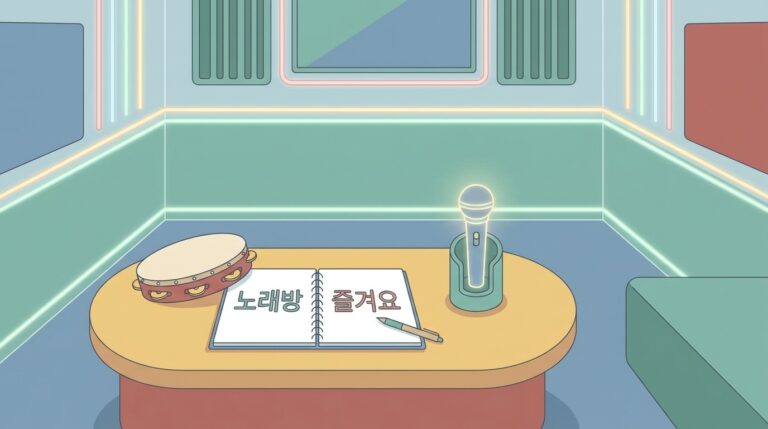
Before you know it, you are swept away into a neon-lit, tambourine-shaking, echo-chambered world: The Korean Noraebang (노래방 – Karaoke).
If you’ve felt your heart race at the thought of singing in front of your boss, or wondered how to politely say “I need to go home” without ruining the vibe (분위기 – bun-wi-gi), you are not alone! Many of our intermediate learners have shared how intimidating the transition from a formal dinner (1차 – il-cha) to the wild energy of Round 2 (2차 – i-cha) and Round 3 (3차 – sam-cha) can be.
Don’t worry. Today, we are unlocking the secret cultural codes of Korean after-parties so you can navigate them like a true Seoulite!
Phase 2: Deep Dive into 3 Essential Expressions
1. 달립시다! (Dallipsida!)
- Pronunciation: Dal-lip-si-da! (Sounds like “Dar-lip-see-da!”)
- Meaning: “Let’s run!” / “Let’s go all out!”
- K-Culture Moment: Usually shouted by the mood-maker of the team right before moving to the next venue (Round 2 or 3). It signals that the night is far from over.
- Editor’s Insight: This doesn’t mean physical running. It’s a metaphorical expression of running toward peak excitement. Use this to show enthusiasm!
- Situation Spectrum: Casual ✅ | Semi-formal ✅ | Formal ⚠️
- 🤔 Think About It: In many Western cultures, leaving after the first round of drinks is completely normal. In Korea, “running together” symbolizes team unity. How does your culture view staying out late with coworkers?
2. 분위기 띄우다 (Bunwigi ttiuda)
- Pronunciation: Bun-wi-gi tti-u-da (Sounds like “Boon-we-gee tthee-oo-da”)
- Meaning: “To liven up the atmosphere” / “To break the ice”
- K-Culture Moment: In K-Dramas, you often see the rookie employee grab the tambourine and put on a funny hat at Noraebang. They are doing this to “분위기를 띄우다.”
- Editor’s Insight: You don’t need to sing like a K-Pop idol. In Korea, effort and enthusiasm (열정 – yeol-jeong) are valued way more than vocal talent. Choosing an upbeat song is the best way to do this.
- Situation Spectrum: Casual ✅ | Semi-formal ✅ | Formal ✅
- 🤔 Think About It: Why do you think showing vulnerability (like singing badly but enthusiastically) helps build trust in Korean business culture?
3. 저는 이만 들어가 보겠습니다 (Jeoneun iman deureoga bogessimnida)
- Pronunciation: Jeo-neun i-man deu-reo-ga bo-get-sim-ni-da (Sounds like “Juh-neun ee-man deu-ruh-gah bo-get-seem-nee-dah”)
- Meaning: “I will head home now.” (Literal: “I will attempt to enter inside now.”)
- K-Culture Moment: The clock strikes 11:30 PM. The team is heading to Round 3, but you have an early morning. You bow slightly and say this phrase to slip away gracefully.
- Editor’s Insight: This is the ultimate polite escape phrase. It sounds incredibly respectful and gentle, making it hard for anyone to pressure you to stay.
- Situation Spectrum: Casual ⚠️ | Semi-formal ✅ | Formal ✅
- 🤔 Think About It: Why does saying “I’m going home” sound softer when framed as “attempting to go home” in Korean?
Phase 3: Textbook Korean vs. Real Korean
Situation 1: Declining another drink politely
- 📖 Textbook Korean: “더 마실 수 없습니다.” (Deo masil su eopseumnida. – I cannot drink more.)
- 🗣️ Real Korean: “아, 저 진짜 오늘 필름 끊길 것 같아요!” (Ah, jeo jin-jja o-neul pil-reum kkeun-gil geot ga-ta-yo! – Oh, I really think my ‘film’ (memory) is going to cut out tonight!)
- 💡 Why the difference? Saying “I cannot” sounds like a cold refusal. Joking about “your film cutting” (blacking out) uses humor to convey your limit without sounding like a party pooper.
Situation 2: Asking someone else to sing first at Noraebang
- 📖 Textbook Korean: “당신이 먼저 노래하세요.” (Dang-sini meon-jeo norae-haseyo. – You sing first.)
- 🗣️ Real Korean: “부장님 마이크 먼저 잡으시죠!” (Bu-jang-nim ma-i-keu meon-jeo ja-beu-si-jyo! – Manager, you should grab the mic first!)
- 💡 Why the difference? Using “당신” (you) can sound aggressive. Offering the microphone (마이크 – ma-i-keu) to the highest-ranking person first is a classic sign of respect in a Korean Noraebang.
Phase 4: K-Culture Deep Dive & Non-Verbal Manners
4-1. The Tambourine & Clapping Etiquette (눈치 – Nunchi)
In a Korean Noraebang, you are rarely just sitting and listening. Your non-verbal participation is key!
* The Tambourine Duty: If you are the junior member, keep the tambourine nearby. Shake it to the rhythm of other people’s songs.
* The Echo Applaud: Even if someone sings terribly out of tune, you must clap enthusiastically when the score pops up on the screen.
4-2. The “Service” (서비스) Phenomenon
Don’t be surprised if your 60-minute Noraebang session suddenly displays “+30 mins” on the screen when the time runs out. This is 서비스 (Service)—free extra time given by the generous owner. Accepting it with a bright smile is part of the fun!
Phase 5: Real-Life Roleplay Scenario
Setting: A vibrant Noraebang in Hongdae. Round 2 is in full swing.
Characters:
* Minho (민호): Your energetic Korean coworker who loves pop ballads.
* You (B2 Learner): Trying to keep up the energy but also planning your escape strategy.
Dialogue
- Minho: “자, 2차 노래방 왔으니까 오늘 밤 끝까지 달리는 겁니다!”
(Ja, i-cha noraebang wasseunikka oneul bam kkeut-kkaji dallineun geomnida!)
(🎭 Shaking a tambourine with a wide grin) - You: “와, 진짜 분위기 대박이네요! 다들 지치지도 않으시나 봐요.”
(Wa, jin-jja bun-wi-gi dae-bak-i-ne-yo! Da-deul ji-chi-ji-do an-eu-si-na bwa-yo.)
(🎭 Laughing, clapping along to the beat) - Minho: “에이, 우리 OOO 씨도 마이크 잡아야죠! 예약곡 뭐로 할래요?”
(E-i, u-ri OOO ssi-do ma-i-keu ja-ba-ya-jyo! Ye-yak-gok mwo-ro hal-lae-yo?)
(🎭 Handing you the wireless microphone) - You: “아, 저는 우선 분위기 띄우는 신나는 노래로 시작할게요!”
(Ah, jeo-neun u-seon bun-wi-gi tti-u-neun sin-na-neun no-rae-ro si-jak-hal-gae-yo!)
(🎭 Smiling confidently while looking at the remote control) - Minho: “역시 센스쟁이! 부장님, 탬버린 준비하세요!”
(Yeok-si sen-seu-jaeng-i! Bu-jang-nim, taem-beo-rin jun-bi-ha-se-yo!)
(🎭 Waving to the manager to get ready) - You: “(After singing your song) 휴, 목이 쉬겠어요! 이제 발라드 타임 가시죠!”
(Hyu, mok-i swi-ges-seo-yo! I-je bal-la-deu ta-im ga-si-jyo!)
(🎭 Handing the mic back to Minho with a sigh of relief) - Minho: “좋습니다! 자, 이제 슬슬 3차 맥주 창고로 이동할까요?”
(Jo-seum-ni-da! Ja, i-je seul-seul sam-cha maek-ju chang-go-ro i-dong-hal-kka-yo?)
(🎭 Standing up and looking at everyone) - You: “어머, 벌써 12시네요! 저는 내일 아침 회의가 있어서 이만 들어가 보겠습니다.”
(Eo-meo, beol-sseo yeol-du-si-ne-yo! Jeo-neun nae-il a-chim hoe-ui-ga is-seo-seo i-man deu-reo-ga bo-get-seum-ni-da.)
(🎭 Gathering your coat and bowing politely with an apologetic smile)
🔀 Interactive Choice Point
At Step 8, instead of saying you need to go home, how would you respond if you wanted to stay but avoid drinking more?
- A) “저 3차도 무조건 갈래요! 밤새 마셔요!” (I’m definitely going to Round 3 too! Let’s drink all night!)
- B) “3차는 가고 싶은데, 술 대신 사이다 마셔도 되죠?” (I want to go to Round 3, but is it okay if I drink Sprite instead of alcohol?)
- C) “전 이제 피곤해서 그냥 갈래요. 안녕히 계세요.” (I’m tired now so I’m just going. Goodbye.)
Feedback:
- Best Choice: B! It shows your willingness to participate in the social bonding (3차) while setting a healthy boundary about drinking.
- Risk Choice: A! While enthusiastic, promising to “drink all night” might lead to a rough morning and a broken promise if you pass out early.
- Bad Choice: C! Too direct and blunt. It abruptly cuts off the warm social energy built during the dinner.
Phase 6: 10-Second Emotion Shadowing Drill
Practice saying these out loud with the correct emotional rhythm. / represents a natural pause.
- [🥳 With high energy and excitement]
- “오늘 분위기 / 진짜 대박이네요! / 우리 달리시죠!”
- O-neul bun-wi-gi / jin-jja dae-bak-i-ne-yo! / U-ri dal-li-si-jyo!
- [🥺 Apologetic and respectful]
- “아쉽지만 / 저는 내일 일찍 일이 있어서 / 이만 들어가 보겠습니다.”
- A-swip-ji-man / jeo-neun nae-il il-jji-gi / i-man deu-reo-ga bo-get-seum-ni-da.
Phase 7: K-Culture Mini Dictionary
- 차 (Cha | Round): Used to count the rounds of a night out. 1차 (dinner), 2차 (karaoke/pub), 3차 (light beers/street food).
- 예약곡 (Yeyak-gok | Reserved Song): A song you register in the Noraebang machine queue. Use the big remote control to do this!
- 취향 저격 (Chwihyang Jeogyeok | Taste Sniper / Right up my alley): When someone sings a song you absolutely love.
- 막곡 (Mak-gok | Last Song): The grand finale song of the Noraebang session before everyone leaves.
Phase 8: Traveler’s Survival Kit
Survival Expressions TOP 3
- “템버린 하나만 더 주세요!” (Taem-beo-rin ha-na-man deo ju-se-yo! – Please give us one more tambourine!)
- “서비스 주셔서 감사합니다!” (Seo-bi-seu ju-syeo-seo gam-sa-hap-ni-da! – Thank you for the free extra time!)
- “맥주 세 병이랑 물 주세요.” (Maek-ju se byeong-i-rang mul ju-se-yo. – Three bottles of beer and water, please.)
💡 Editor’s Travel Note:
To find the best coin-operated Noraebangs (코인노래방 – cheaper, pay-per-song style perfect for 1-2 people), search “코인노래방” directly on the Naver Map App. Note: Public transit in Seoul mostly shuts down around midnight, so download the Kakao T Taxi App beforehand if you plan to stay past 12 AM!
Phase 9: Going Deeper (A Cultural Reflection)
In many parts of the world, business is business, and personal life is personal. However, Korea’s Heoisik (회식) culture historically bridged this gap. Singing together at a Noraebang is a form of “musical leveling.” When the boss takes off their tie and sings a silly 90s trot song, and the intern leads the backup dance, the hierarchical walls temporarily melt away.
💬 Your Turn: Have you ever experienced a similar group-bonding activity in your culture? Drop a comment below and share your story!
Phase 10: FAQ & Common Mistakes
Q: Is it rude to decline going to Round 2 (2차)?
A: It is not rude if you decline politely using soft expressions like “저는 이만 들어가 보겠습니다” (I will head home now). However, leaving immediately without saying goodbye, or leaving during the middle of a song, can be seen as slightly discourteous.
Q: I cannot sing Korean songs. What should I do?
A: No worries at all! International pop songs (like Queen, ABBA, or Bruno Mars) are wildly popular in Korean Noraebangs. Choose an upbeat English song that everyone knows, and the whole room will sing along with you!
Q: Can I book multiple songs in a row?
A: Avoid “double booking” (연속 예약) your own songs back-to-back. This is considered bad manners. Let others have a turn before you register another song.
🚨 Common Mistakes Alert!
- The Mic Hogger (독점): Keeping the microphone for yourself and singing 3 songs in a row. Correction: Pass the mic around! Noraebang is a team sport.
- The Quiet Phone Scroll (핸드폰 보기): Ignoring your coworker’s performance to look at Instagram. Correction: Even if you don’t know the song, nod your head and clap along! Use your Nunchi (눈치).
- The Loud Cancellation (취소 버튼 누르기): Accidentally pressing “Cancel” (취소) while someone else is singing. Correction: Never touch the remote control buttons unless it’s your song!
Phase 11: Action Mission
- 🥉 Bronze: Practice saying “저는 이만 들어가 보겠습니다” 5 times in front of the mirror with a polite bow.
- 🥈 Silver: Pick one English pop song that you would sing to “liven up the atmosphere” (분위기 띄우다) and write its name in the comments!
- 🥇 Gold: Next time you watch a K-Drama scene featuring a company dinner, try to identify the physical tambourine shakes or the moment someone says “달립시다!”.
Phase 12: Interactive Quiz Challenge
Test your Korean Nightlife IQ!
- What is the most polite way to say you are heading home?
- What is the term for the free extra minutes given at a Noraebang?
🎉 Click here to reveal the Answers & Explanations!
- Answer: “저는 이만 들어가 보겠습니다” (Jeoneun iman deureoga bogessimnida). It sounds gentle and highly respectful!
- Answer: 서비스 (Service). Always accept it with a big thank you!







