

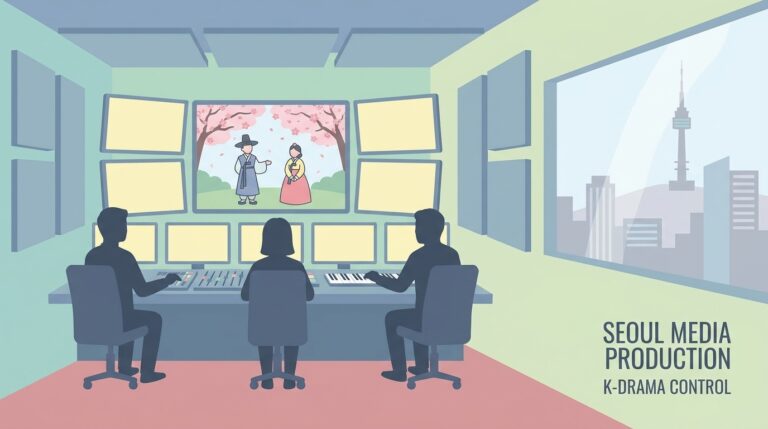
Master K-Drama Industry Talk: Pre-produced Series (사전 제작 드라마) and the Risk of Flopping
안녕하세요! Your favorite daily Korean culture navigator from Daily Hangul (매일한글) is here!
Have you ever sat down with your Korean friends, passionately dissecting why a highly anticipated, multi-million dollar star-studded K-Drama ended up being an absolute trainwreck? You wanted to say, “Well, because they pre-produced the whole thing, they couldn’t pivot when the audience started hating the main couple’s chemistry!”—but you lacked the highly sophisticated, industry-specific Korean vocabulary to back up your brilliant analysis.
Today, we are diving deep into the high-stakes world of 사전 제작 드라마 (Pre-produced K-Dramas), their creative merits, and the terrifying box-office risks (흥행 리스크) they carry. This is C2-level, native-standard industry discourse that will make you sound like an elite Yeouido broadcasting executive. Let’s get started!
Phase 1: Empathy & Industry Insight
In the early days of the Hallyu wave, K-Dramas were infamous for their “live-shoot” format (쪽대본 – literally “page-by-page scripts” delivered hot off the printer on the day of filming). Actors were practically living on set, and writers wrote based on real-time viewer feedback.
Then came the revolution: fully pre-produced dramas (100% 사전 제작). Shows like Descendants of the Sun and Kingdom proved that high production value, cinematic CGI, and humane working conditions were possible. But as a C2 learner, you know the Korean entertainment industry is never that simple. Without real-time viewer feedback, a pre-produced show runs the risk of becoming a massive, unfixable flop if the public’s taste shifts or if a controversy erupts during the long hiatus between filming and airing. Let’s master the language used to dissect this high-risk, high-reward phenomenon.
Phase 2: Core Expressions for Industry Analysis
1. 양날의 검 (Yang-nal-ui geom)
- Pronunciation: YAHNG-nal-ui geom (Think of “yang” as in yin-yang, “nal” like the blade of a knife, “geom” like the ‘gum’ in chewing gum)
- Meaning: Double-edged sword
- K-Culture Moment: Used by media critics on broadcast review panels when evaluating whether a 50-billion-won pre-production budget is a blessing or a curse.
- Editor’s Insight: While common in English, Koreans use this heavily in business and entertainment debates to emphasize that the very factor driving success (e.g., perfect cinematography) could lead to ruin (e.g., inability to edit out a problematic lead actor).
- Situation Spectrum: Casual ⚠️ | Semi-formal ✅ | Formal ✅
- 🤔 Think About It: How does your culture view high-budget investments that cannot be modified mid-way? Is flexibility preferred over perfection?
2. 피드백 수용이 불가능하다 (Pideubaek su-yong-i bul-gan-eung-hada)
- Pronunciation: PEE-deu-baek soo-yong-ee bool-gahn-eung-hah-dah
- Meaning: Incapable of incorporating viewer feedback
- K-Culture Moment: Fans complaining on online forums (like DC Inside or TheQoo) when the second-lead syndrome is strong, but the show was finished filming six months ago, making a change in the romantic pairing impossible.
- Editor’s Insight: “수용 (acceptance/incorporation)” is a high-level Hanja word. Saying this shows you understand the unique power dynamics of the Korean audience-creator relationship.
- Situation Spectrum: Casual ⚠️ | Semi-formal ✅ | Formal ✅
- 🤔 Think About It: Why do you think Korean viewers expect writers to change the plot based on their real-time reactions compared to Western TV audiences?
3. 트렌드의 변화를 제때 반영하지 못하다 (Teurendeu-ui byeon-hwa-reul jet-ttae ban-yeong-haji mot-hada)
- Pronunciation: teu-REN-deu-ui byeon-hwa-reul jet-ttae bahn-young-hah-jee mot-hah-dah
- Meaning: Failing to reflect shifting trends in a timely manner
- K-Culture Moment: When a drama filmed in 2022 airs in late 2024, and the slang, fashion, or social issues depicted feel incredibly outdated and cringey.
- Editor’s Insight: “제때” means “at the right time/in a timely fashion.” Coupled with “반영하다” (to reflect), this is a textbook C2 phrase used in executive summaries and industry reports.
- Situation Spectrum: Casual 🚫 | Semi-formal ✅ | Formal ✅
- 🤔 Think About It: How quickly do trends cycle in your home country’s media landscape?
Phase 3: Textbook Korean vs. Real Native Korean
Let’s upgrade your textbook phrases to industry-insider lingo.
Situation 1: Describing a drama that was completely filmed beforehand
- 📖 Textbook: 이 드라마는 방영 전에 모두 촬영했습니다. (This drama was all filmed before airing.)
- 🗣️ Real Native: 이 작품은 100% 사전 제작이라 작화나 영상미 퀄리티가 남다르네요. (This piece is 100% pre-produced, so the visual art and cinematography quality are on another level.)
- 💡 Why it’s different: Natives use “작품” (work of art) instead of just “드라마” to show respect for high-budget productions, and “남다르다” (to be extraordinary) instead of “좋다”.
Situation 2: Explaining why a pre-produced drama failed
- 📖 Textbook: 미리 만들어서 인기가 없어도 내용을 바꿀 수 없었습니다. (Because they made it early, they couldn’t change the content even if it wasn’t popular.)
- 🗣️ Real Native: 시청자 피드백을 실시간으로 반영 못 하니까, 중반부 캐붕(캐릭터 붕괴)에도 피드백 수용이 안 돼서 결국 조기 종영 수순을 밟았죠. (Since they couldn’t reflect viewer feedback in real-time, they couldn’t adapt even when the characters collapsed midway, leading to an early cancellation.)
- 💡 Why it’s different: “캐붕” (Character Collapse) is a crucial industry/fandom slang, and “수순을 밟다” (to go through the steps of) is a highly sophisticated idiomatic expression.
Phase 4: K-Culture Deep Dive & Non-Verbal Manners
4-1. The “Anxious Nod” and the Media Debate Gesture
When discussing sensitive industry topics like a show failing (흥행 참패), Koreans rarely point fingers directly. Instead, they use the “Anxious Half-Nod”—tasting their words carefully, tilting their head about 15 degrees, and saying “아무리 그래도…” (Even so…) before delivering a critique. To sound natural, gesture with open palms facing upward when explaining the “double-edged sword” nature of pre-production, mimicking a scale weighing both sides.
4-2. The Cultural Paradox of K-Drama Audiences
Korean viewers are incredibly active participants. They don’t just consume; they co-create. The “live-shoot” format survived so long because it fed on the dopamine of this parasocial relationship between creators and fans. Pre-production breaks this feedback loop. Thus, when analyzing K-Dramas, you must understand that “흥행 리스크” (box-office/ratings risk) in Korea is deeply tied to how much the audience feels “ignored” if a pre-written story goes against the public sentiment.
Phase 5: Real-Life Roleplay Scenario
Setting: A trendy cafe in Sangam-dong (the media hub of Seoul). You (Ji-ho) are having coffee with Min-woo, a seasoned TV drama producer (PD).
- Character Min-woo: A stressed-out 30-something producer who just had his pre-produced sci-fi drama flop in ratings.
Dialogue
- 민우 (Min-woo):
🎭 (sighs heavily, holding a cold Americano)아, 지호 씨. 이번에 우리 백억짜리 사전 제작 드라마, 시청률 2% 찍고 폭망했어요. 진짜 멘붕이네요. - 지호 (You):
🎭 (comforting, nodding slowly)아이고, 민우 씨… 고생 많으셨을 텐데 마음이 안 좋으시겠어요. 사실 사전 제작이 양날의 검이긴 하잖아요. - 민우 (Min-woo):
🎭 (frustrated, gesturing with hands)맞아요. 완성도를 높이려고 100% 사전 제작을 고집했는데, 중반부에 여주인공 캐릭터 설정 논란이 터졌을 때 아무것도 수정할 수가 없더라고요. - 지호 (You):
🎭 (analyzing intellectually)그렇죠. 실시간으로 방영하는 시스템이 아니면, 시청자들의 차가운 반응을 보고도 피드백 수용이 원천적으로 불가능하니까요. - 민우 (Min-woo):
🎭 (nodding in agreement)정확해요. 촬영해 둔 분량이 이미 편집까지 끝난 상태라, 스토리 라인을 틀어버릴 물리적인 시간이 전혀 없었어요. - 지호 (You):
🎭 (pointing out the industry trend)게다가 요즘은 트렌드가 워낙 광속으로 변하니까, 제작 기간이 길어지면 트렌드 변화를 제때 반영하지 못하는 리스크도 커지는 것 같아요. - 민우 (Min-woo):
🎭 (impressed by your insight)와, 지호 씨 방송국 사람 다 되셨네요. 예리해요. 다음엔 무조건 반(半)사전 제작으로 가야 할까 봐요. - 지호 (You):
🎭 (smiling warmly)하하, 다음 작품은 분명 대박 날 겁니다. 맛있는 거 먹으러 가요, 제가 살게요!
🔀 Interactive Choice Point
How would you respond to Min-woo’s complaint in turn 4 to show different levels of empathy or professional critique?
* [A] Best Action (Professional & Empathetic): “아무리 사전 제작이 영상미는 좋아도, 시청자와 호흡하지 못하면 대중 예술로서는 치명적인 한계가 있는 것 같아요.” (Even if pre-production offers great visuals, if it doesn’t breathe with the audience, it has fatal limitations as a popular art form.)
* [B] Bad Action (Too Cold/Academic): “그것은 제작자가 트렌드 예측에 실패했기 때문이며, 사전 제작 자체의 잘못은 아닙니다.” (That is because the producer failed to predict trends, it is not the fault of pre-production itself.) — Too blunt and robotic; destroys the comforting vibe.
* [C] Risk Action (Slightly Outdated Slang): “요즘 애들은 그런 구닥다리 스토리 안 봐요! 대박 나려면 막장 요소를 넣었어야죠!” (Kids these days don’t watch those outdated stories! To hit daebak, you should have put in makjang elements!) — A bit too aggressive and informal for a professional colleague.
Phase 6: 10-Second Emotion Shadowing Drill
Practice saying this high-level analysis with a tone of intellectual concern.
“사전 제작은 / 완성도를 담보하지만 / 동시에 대중의 피드백을 수용할 수 없다는 점에서 / 치명적인 양날의 검입니다.”
- Romanization: Sajeon jejageun / wanseongdoreul dambohajiman / dongsie daejungui pideubaegi suyonghal su eopdaneun jeomeseo / chimyeongjeogin yangnalui geomimnida.
- Emotion Guide:
[🧐 Serious, professional, analyzing with clinical precision]Pause slightly at the slashes/to mimic a sophisticated media commentator on TV.
Phase 7: K-Culture Mini-Dictionary
- 사전 제작 (Sajeon Jejag) | Pre-production | Filming the entire series before a single episode airs.
- 쪽대본 (Jjok-daebon) | Live-shoot scripts | Extremely rushed, page-by-page scripts given to actors on the day of filming.
- 캐붕 (Kae-bung) | Character Collapse | When a character’s actions suddenly contradict their established personality, ruining viewer immersion.
- 조기 종영 (Jogi Jong-yeong) | Early Cancellation | Cutting a series short due to disastrously low viewership ratings.
Phase 8: Traveler’s Survival Kit for Media Fans
If you are visiting Seoul to tour broadcasting stations like MBC or SBS in Sangam-dong, keep these in mind!
- Survival Phrase 1: “이 근처에 드라마 촬영지나 방송국 투어 할 수 있는 곳이 어디인가요?” (Where is a place around here where I can tour drama filming locations or broadcasting stations?)
- Survival Phrase 2: “오늘 공개홀 방청 줄은 어디로 서야 해요?” (Where should I line up for the open studio audience today?)
- Survival Phrase 3: “사전 녹화 참여권은 어떻게 신청하나요?” (How do I apply for the pre-recording attendance ticket?)
📌 Editor’s Travel Note:
To navigate Sangam-dong’s massive media complexes smoothly, bypass global maps which often lag in Korea. Use Naver Map (네이버 지도 App) to find transit paths to the Digital Media City (DMC) station, and check the official MBC/SBS websites for weekly public audience schedules.
Phase 9: A Step Deeper (한 발 더 깊이)
The shift toward 사전 제작 (pre-production) in Korea is not just a technological transition; it represents a clash between traditional collectivist flexibility and modernized global standards. Historically, Koreans loved the chaotic energy of interactive storytelling, where public petitions could literally save a dying character. However, as global platforms like Netflix and Disney+ dominate the funding landscape, the industry is forced to adopt strict pre-production schedules to comply with labor laws and foreign dubbing/censorship timelines. Thus, discussing this topic is actually discussing the globalization pains of modern Korean society.
💬 Your Turn: What do you prefer? The polished perfection of a pre-produced show, or the unpredictable, chaotic energy of a live-shoot drama? Let us know in the comments below!
Phase 10: FAQ & Common Mistakes
Q: Is “사전 제작” only used for dramas?
A: While most commonly discussed in relation to K-Dramas, it can also apply to variety shows (예능) or documentaries that are entirely filmed and edited before their premiere, though variety shows rarely use the term as they naturally rely on weekly topical events.
Q: Can I use “양날의 검” in casual daily life?
A: Yes! For instance, if your friend is debating whether to buy a very fast but expensive sports car, you can say, “그 차는 진짜 양날의 검이야.” (That car is truly a double-edged sword.)
Q: What is the opposite of “사전 제작”?
A: It is called 생방 촬영 (live-shoot / raw broadcast filming) or 쪽대본 제작.
🚨 Common Mistakes Warning Board
- Using “사전 준비” instead of “사전 제작”: “사전 준비” means preparation/pre-production planning, not the actual complete filming of the show. Use 사전 제작.
- Confusing “피드백을 받다” and “피드백을 수용하다”: Receiving feedback is “받다”. Implementing and accepting it structurally is 수용하다.
- Saying “드라마가 죽었다”: To say a drama failed, do not translate “died” literally. Use 망했다 (informal) or 흥행에 실패했다 (formal).
Phase 11: Action Mission
- Bronze Medal: Write a 2-sentence review of your favorite K-drama on social media using the term 양날의 검.
- Silver Medal: Find a recent news article about a failed Korean drama on Naver News and identify if they mention 피드백 or 시청률 (ratings).
- Gold Medal: Record a voice note of yourself speaking the Phase 6 Shadowing Drill fluently without stumbling, and share it with your Korean study group!
Phase 12: Interactive Quiz Challenge
Test your high-level entertainment industry knowledge!
1. Which word refers to “the sudden collapse of a character’s core traits” in a drama?
- A) 조기 종영
- B) 캐붕
- C) 쪽대본
Reveal Answer
Correct Answer: B) 캐붕
Explanation: “캐붕” is short for 캐릭터 붕괴 (Character Collapse). A is early cancellation, and C is live-shoot script.
2. Fill in the blank: “사전 제작 드라마는 시청자의 실시간 반응을 ________ 수용하기 어렵다는 리스크가 있다.”
- A) 제때 (in a timely manner)
- B) 절대로 (absolutely)
- C) 무조건 (unconditionally)
Reveal Answer
Correct Answer: A) 제때
Explanation: “제때 반영/수용하다” is the natural collocation meaning “to reflect/accept in a timely fashion.”
3. True or False: All pre-produced K-dramas are guaranteed to have high viewership ratings in Korea because of their high budget.
- True / False
Reveal Answer
Correct Answer: False
Explanation: As we learned, pre-produced dramas carry massive 흥행 리스크 (ratings risks) because they cannot pivot if trends change or if chemistry fails.






