

Navigating Seoul’s Late-Night Arteries: The Ultimate Guide to the Owl Bus (올빼미 버스)
Phase 1: Empathy (An Open Letter to Late-Night Explorers in Seoul)
안녕하세요! It’s your Daily Hangul editor and your personal late-night cultural navigator.
Picture this: You’ve just finished an epic, multi-round dinner with friends in Hongdae. It’s 1:30 AM. You feel that perfect mix of social exhaustion and culinary bliss. But as you step outside, reality hits—the subways have shut down, and the taxi queue stretches around the block with surge prices skyrocketing. Your heart sinks.
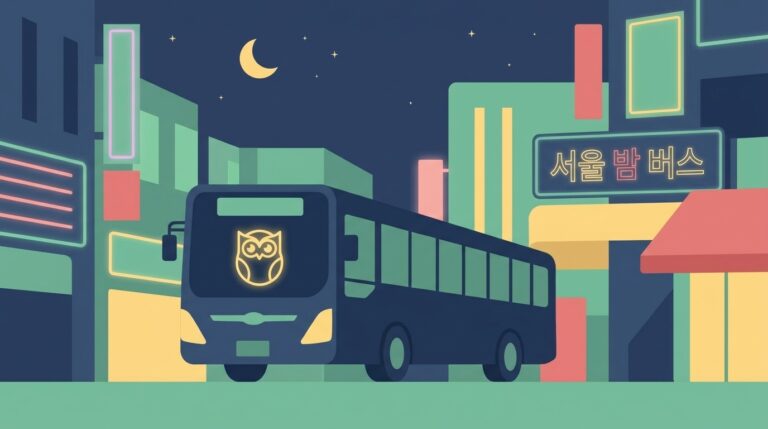
Then, like a beacon of hope through the neon haze, a dark blue bus with a glowing cartoon owl on the front pulls up. Welcome to Seoul’s legendary Owl Bus (올빼미 버스 – Olppaemi Beoseu).
Many of our C1-level learners have shared their anxiety about using these late-night routes. “What if I miss my transfer in the middle of the night?” “How do I ask the driver if this bus goes to my neighborhood?” Today, we are moving beyond textbook transport phrases to master the nuanced, high-level Korean you need to conquer Seoul’s night-owl transit system like a born-and-bred local.
Phase 2: Deep-Dive into 3 Essential Late-Night Transit Phrases
1. 차가 끊기다 (Cha-ga kkeun-ki-da)
- Pronunciation: [Cha-ga kkeun-ki-da] (Sounds like ‘cha-gah kkoon-ki-dah’, mimicking the sharp, sudden sound of a string snapping: kkeun).
- Meaning: Literally “the car/train is cut off,” meaning “the last transit service of the night has ended.”
- K-Culture Moment: You will hear this in almost every realistic K-Drama romance. Two leads are walking, and one looks at their watch with a mix of panic (or secret delight) and says: “어떡해, 지하철 끊겼어.” (Oh no, the subway stopped running.)
- Editor’s Insight: While “마지막 버스” (last bus) is technically correct, locals almost exclusively use the passive verb “끊기다” (to be cut/severed) to express the collective urgency of losing public transport.
- Situation Spectrum: Casual (✅ 끊겼어) | Semi-formal (✅ 끊겼어요) | Formal (⚠️ 끊겼습니다)
- 🤔 Think About It: In Korean, losing public transit is described as a connection being “severed” (끊기다). How does your native language conceptualize the end of transit service?
2. 막차를 놓치다 (Mak-cha-reul not-chi-da)
- Pronunciation: [Mak-cha-reul not-chi-da] (Focus on the double-consonant ‘k’ sound in mak, meaning “the very last”).
- Meaning: To miss the last train/bus.
- K-Culture Moment: The classic late-night sprinting scene down the subway stairs, only to see the screen flash “당역종착” (Terminating at this station).
- Editor’s Insight: “막-” is a powerful prefix meaning “the final” or “the end.” Knowing this helps you understand terms like “막방” (last broadcast) or “막차” (last ride).
- Situation Spectrum: Casual (✅ 놓쳤어) | Semi-formal (✅ 놓쳤어요) | Formal (✅ 놓쳤습니다)
- 🤔 Think About It: Why does Korean have a dedicated single word for “the final vehicle of the day” (막차) while English uses a descriptive phrase? What does this say about the cultural importance of shared schedules?
3. 노선이 겹치다 (No-seon-i gyeop-chi-da)
- Pronunciation: [No-seon-i gyeop-chi-da] (Think of gyeop as folding layers of paper over each other).
- Meaning: For bus/subway routes to overlap.
- K-Culture Moment: Navigating Seoul’s massive public transit network with a friend, figuring out which Owl Bus to transfer to because “N15번이랑 N26번 노선이 여기서 겹쳐요.” (Route N15 and N26 overlap here.)
- Editor’s Insight: For C1 learners, using “겹치다” instead of “비슷하다” (to be similar) instantly elevates your language level. It shows you understand physical layout and planning.
- Situation Spectrum: Casual (✅ 겹쳐) | Semi-formal (✅ 겹쳐요) | Formal (✅ 겹칩니다)
Phase 3: Textbook Korean vs. Real-Deal Korean
Scenario 1: Asking if a bus goes to your destination late at night
- 📖 Textbook Korean: “이 버스는 홍대입구역에 가나요?” (Does this bus go to Hongik University Station?)
- 🗣️ Real-Deal Korean: “기사님, 이 차 홍대 방향 가나요?”
- 💡 Why the difference? Locals drop grammatical particles (
-는,-에) in fast-paced situations. Addressing the driver warmly as “기사님” (driver-nim) and using “방향” (direction) is much more natural and efficient.
Scenario 2: Expressing relief that you caught the late-night bus
- 📖 Textbook Korean: “버스를 탈 수 있어서 다행입니다.” (It is a relief that I could ride the bus.)
- 🗣️ Real-Deal Korean: “와, 진짜 간발의 차로 올빼미 잡았어!”
- 💡 Why the difference? “간발의 차” is a beautiful, high-level idiom meaning “by a hair’s breadth” or “in the nick of time.” Calling the Owl Bus simply “올빼미” (owl) is common slang among young Seoulites.
Phase 4: K-Culture Deep-Dive & Non-Verbal Etiquette
4-1. The Art of
Frequently Asked Questions (FAQ)
Q: What does "차가 끊기다 (Cha-ga kkeun-ki-da)" mean in Korean and how do you pronounce it?
A: In Korean, "차가 끊기다 (Cha-ga kkeun-ki-da)" is pronounced [Cha-ga kkeun-ki-da] and means: Literally "the car/train is cut off," meaning "the last transit service of the night has ended."
Q: What does "막차를 놓치다 (Mak-cha-reul not-chi-da)" mean in Korean and how do you pronounce it?
A: In Korean, "막차를 놓치다 (Mak-cha-reul not-chi-da)" is pronounced [Mak-cha-reul not-chi-da] and means: To miss the last train/bus.
Q: What does "노선이 겹치다 (No-seon-i gyeop-chi-da)" mean in Korean and how do you pronounce it?
A: In Korean, "노선이 겹치다 (No-seon-i gyeop-chi-da)" is pronounced [No-seon-i gyeop-chi-da] and means: For bus/subway routes to overlap.







