

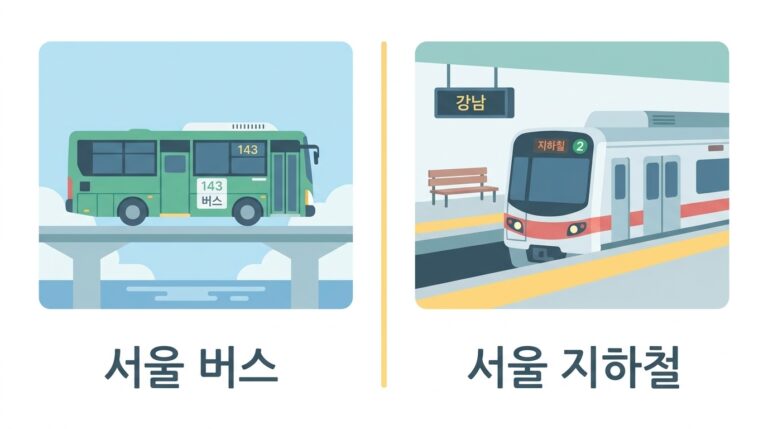
Riding the K-Transit: Bus vs. Subway in Seoul (And How to Express It in Korean!)
Phase 1: Empathy (Welcome to the Great Seoul Transit Debate!)
안녕하세요! (Annyeonghaseyo!) It’s your K-culture navigator and Daily Hangul editor.
Imagine this: You are standing at a bustling Seoul intersection. On one side, there’s a sleek, green bus pulling up. On the other, stairs leading down to the ultra-efficient Seoul Subway. Your K-friend asks: “우리 버스 탈까, 지하철 탈까?” (Should we take the bus or the subway?)
You know which one you prefer, but your tongue gets tied trying to explain why. You want to say, “The subway is faster, but the bus has a better view!” but instead, you just point and say “Uh… subway?”
Don’t worry! Comparing and contrasting choices is a milestone at the B1 level. Today, we are going to master how to talk about the pros and cons of buses and subways in natural, fluid Korean. No textbook stiffness here—just the real talk you hear daily in Seoul!
Phase 2: Deep Dive into 3 Key Comparative Expressions
To compare things like a pro, you need the right tools. Let’s look at three essential B1 comparative structures.
1. ~에 비해 (Compared to…)
- Pronunciation: [ee-bi-hae] (Sounds like “eh bee-hae”)
- Meaning: Compared to [Noun]
- K-Culture Moment: In K-Dramas, characters often use this when choosing a dating spot or comparing two places. “여기 지난번에 간 데에 비해 진짜 조용하다.” (Compared to the place we went last time, this place is really quiet.)
- Editor’s Insight: This is a fantastic, versatile grammar point. It attaches directly to nouns. It immediately elevates your speech from basic “A is good, B is bad” to structured comparison.
- Situation Spectrum: Casual ✅ | Semi-formal ✅ | Formal ✅
- 🤔 Think About It: How often do you make decisions based on comparisons in your own culture? Why do Koreans highly value discussing efficiency and speed in daily travel?
2. ~는 반면에 (~neun ban-myeon-e)
- Pronunciation: [neun bahn-myeon-eh] (Sounds like “noon bahn-mee-on-eh”)
- Meaning: On the other hand / While…
- K-Culture Moment: Often heard on Korean lifestyle vlogs comparing two different neighborhoods. “이 동네는 맛집이 많은 반면에, 주차가 진짜 힘들어요.” (While this neighborhood has many good restaurants, on the other hand, parking is really difficult.)
- Editor’s Insight: Use this to connect two contrasting clauses. Action verb stems take
~는 반면에, while adjectives take~(은)ㄴ 반면에. - Situation Spectrum: Casual ✅ | Semi-formal ✅ | Formal ✅
- 🤔 Think About It: Contrast makes our opinions clearer. Is there a similar phrase in your language that balances both the good and the bad?
3. ~다시피 하다 / ~는 편이다 (tend to / is on the side of…)
- Pronunciation: [~neun pyeon-i-da] (Sounds like “noon pyun-ee-da”)
- Meaning: Tend to be / It’s on the … side
- K-Culture Moment: When celebrities are asked about their lifestyle on talk shows: “저는 밤에 주로 활동하는 편이에요.” (I tend to be active mostly at night.)
- Editor’s Insight: Koreans rarely say things in a highly blunt, absolute way. Instead of saying “The bus is slow,” they say “The bus tends to be a bit slow” (
버스는 좀 느린 편이에요). It sounds much softer and more natural! - Situation Spectrum: Casual ✅ | Semi-formal ✅ | Formal ✅
- 🤔 Think About It: Why do you think indirect expressions like “tends to be” are preferred in Korean social interactions?
Phase 3: Textbook Korean vs. Real Korean
Let’s look at how we transition from stiff “classroom” Korean to the living, breathing language of Seoul.
Situation 1: Explaining why you prefer the subway
- 📖 Textbook: 지하철은 빠릅니다. 하지만 버스는 교통 체증 때문에 느립니다. (The subway is fast. However, the bus is slow due to traffic congestion.)
- 🗣️ Real Korean: 지하철이 막힐 걱정 없어서 훨씬 빨라요. (Subway has no worry of getting stuck in traffic, so it’s way faster.)
- 💡 Why the difference? The textbook sentence uses overly formal literary structures. Real Koreans use words like
막히다(to be clogged/congested) and훨씬(much/way more) to express vivid contrast.
Situation 2: Explaining why you like the bus
- 📖 Textbook: 버스는 밖을 볼 수 있어서 좋습니다. 지하철은 경치가 없습니다. (The bus is good because you can see outside. The subway has no scenery.)
- 🗣️ Real Korean: 버스는 바깥 구경하면서 가기 좋잖아요. 지하철은 답답한데. (With the bus, you can go while enjoying the view outside, you know? Whereas the subway is stuffy.)
- 💡 Why the difference? Adding
~잖아요(you know, right?) invites the listener to agree, and ending with~한데(whereas…) naturally contrasts the two options in casual conversation.
Phase 4: K-Culture Deep Dive & Non-Verbal Manners
4-1. The Transit Etiquette: “Nunchi” (눈치) on the Subways and Buses
When discussing public transport, understanding the non-verbal rules is just as important as the words. In Korea, public transport is a highly shared space where 눈치 (Nunchi – situational awareness/tact) is key.
* The Quiet Rule: You will notice Korean subways are remarkably quiet. Making loud phone calls or playing music without headphones is a major faux pas. When comparing transit, you might say, “지하철은 조용한 반면에, 버스는 가끔 시끄러운 편이에요.” (While the subway is on the quiet side, the bus is sometimes noisy.)
* The Backpack Shift: If you are carrying a large backpack on a crowded subway line (like the notorious Line 9 during rush hour, nicknamed “Hell-subway” or 지옥철), it is polite to wear it on your front or hold it down by your feet to avoid bumping into others.
4-2. The “T-Money” Culture
Korean transit is unified by the seamless card transfer system. You get a discount when transferring from bus to subway (and vice versa) within 30 minutes. This is why you will hear the sound “Ting!” (삑!) at every exit and entrance as people tag their cards.
Phase 5: Real-Life Roleplay Scenario
Setting: Outside Exit 3 of Hongik University (Hongdae) Station. You and your Korean friend, Minji, are deciding how to get to Han River Park (Yeouido) on a Friday evening.
Characters:
- Minji (민지): A fast-paced, practical Seoulite who hates traffic.
- You (학습자): A scenic traveler who wants to see the Han River bridge on the way.
Dialogue (8 Turns):
- Minji: “우리 여의도 한강공원 어떻게 갈까? 지금 퇴근 시간이라 길 막힐 텐데.”
(How should we go to Yeouido Han River Park? It’s rush hour now, so the roads will be congested.) - You: (Thinking of the view) “날씨도 좋은데, 지하철에 비해 버스가 바깥 구경하기에 더 좋지 않아?”
(Since the weather is nice, compared to the subway, isn’t the bus better for looking outside?) - Minji: “그렇긴 한데, 버스는 막히는 반면에 지하철은 제시간에 도착하잖아.”
(That’s true, but while the bus gets stuck in traffic, the subway arrives on time, you know.) - You: “맞아. 지하철이 시간 맞추기에는 훨씬 편하긴 해.”
(True. The subway is definitely way more convenient for keeping time.) - Minji: “응, 금요일 저녁 마포대교는 주차장이나 다름없거든!”
(Yeah, the Mapo Bridge on a Friday evening is basically a parking lot!) - You: “아, 그래? 그러면 답답하더라도 지하철 타고 빨리 가는 게 낫겠다.”
(Ah, really? Then even if it’s stuffy, taking the subway and going quickly would be better.) - Minji: “탁월한 선택! 지하철로 가면 15분밖에 안 걸려.”
(Excellent choice! If we go by subway, it only takes 15 minutes.) - You: “좋아, 그럼 지하철 역으로 내려가자!”
(Great, then let’s head down into the subway station!)
🔀 Interactive Choice Points
At Turn 6, how would you respond to Minji’s warning about the traffic?
* Choice A: “그래도 버스 타고 한강 다리 건너고 싶어!” (But still, I want to take the bus and cross the Han River bridge!)
* Editor’s Feedback: Risk! Minji might sigh. A Friday night Mapo Bridge traffic jam can trap you for an hour. But hey, romantic views have a price!
* Choice B: “지하철은 사람이 너무 많아서 복잡한 편이잖아.” (The subway tends to be too crowded and complicated.)
* Editor’s Feedback: Best B1 Response! You used the grammar ~는 편이다 correctly to gently raise a counter-point about the subway rush hour.
* Choice C: “지하철 싫어. 버스 타자.” (I hate the subway. Let’s take the bus.)
* Editor’s Feedback: Bad. Too blunt! It sounds demanding and lacks the B1-level conversational softening that makes interactions smooth.
Phase 6: 10-Second Emotion Shadowing Drill
Practice speaking like a native by injecting emotion and rhythm. The slash / indicates a slight pause.
- [😊 Convincingly and Brightly]
“지하철에 비해 / 버스가 / 바깥 구경하기에 / 훨씬 좋잖아요!”
(ji-ha-cheol-e bi-hae / beo-seu-ga / ba-kat gu-gyeong-ha-gi-e / hweol-ssin jo-ja-na-yo!) -
[🙄 Slightly Worried & Realistic]
“퇴근 시간에는 / 버스가 / 좀 막히는 편이에요.”
(toe-geun si-gan-e-neun / beo-seu-ga / jom mak-hi-neun pyeon-i-e-yo.) -
[💡 Realizing & Agreeing]
“길 막힐 때는 / 역시 / 지하철이 / 제일 빠르네요!”
(gil mak-hil ttae-neun / yeok-si / ji-ha-cheol-i / je-il bpa-reu-ne-yo!)
Phase 7: K-Culture Mini Dictionary
- 지옥철 (Ji-ok-cheol) | Subway Hell | A compound word of 지옥 (Hell) and 지하철 (Subway). It refers to the extremely crowded subway during rush hours.
- 환승할인 (Hwan-seung-ha-rin) | Transfer Discount | The system where transferring between bus and subway is free or heavily discounted if done within a specific timeframe (usually 30 mins).
- 막차 (Mak-cha) | The Last Bus/Train | The final transit service of the night. Missing the makcha is a common trope in dramas and night-out stories.
- 노선도 (No-seon-do) | Transit Route Map | The colorful, spiderweb-like transit map. Seoul’s subway map is famous for being incredibly detailed yet logical.
Phase 8: Survivor’s Transit Kit
Survival Expressions TOP 3:
- “이거 여의도 가는 버스 맞아요?” (i-geo yeo-ui-do ga-neun beo-seu ma-ja-yo?)
- Pro Tip: Use this to double-check with the driver before tagging your card. “Is this the right bus going to [Destination]?”
- “이번 역에서 내릴게요!” (i-beon yeok-e-seo nae-ril-ge-yo!)
- Pro Tip: Essential when the subway car or bus is packed and you need to push through politely.
- “카드 인식기 오류가 나요.” (ka-deu in-sik-gi o-ryu-ga na-yo.)
- Pro Tip: Use this if your transit card fails to scan and makes an angry beep.
📝 Editor’s Travel Note:
To navigate Korea like a local, skip Google Maps (which isn’t fully optimized due to national security mapping laws). Instead, download KakaoMap or Naver Map. They show live bus locations down to the second and even tell you how crowded each subway car is! (Note: Transport schedules and apps may update, so check the latest versions before traveling.)
Phase 9: “A Step Deeper” (Cultural Reflection)
In many Western cultures, public transport is seen purely as utility. In Korea, however, public transit is a shared communal space designed with high-tech collective comfort in mind—featuring heated seats in winter, fast Wi-Fi, and air-purification systems. Choosing between bus and subway is not just about time; it is about choosing your sensory environment for the next hour. Do you want the lively visual connection to the city streets (bus), or the quiet, hyper-efficient predictability of the underground (subway)?
💬 Your Turn: Which one do you prefer when traveling? Do you value speed over scenery? Tell us in the comments below!
Phase 10: FAQ & Avoiding Common Pitfalls
Q: Can I eat food on Korean buses and subways?
A: No. On Seoul city buses, open food and drinks (like take-out coffee cups without secure lids) are strictly banned to prevent spills. While subways do not have a strict legal ban on eating, it is highly frowned upon due to smells and cleanliness.
Q: What is the main difference between red, blue, and green buses in Seoul?
A: Blue buses travel long distances along main Seoul roads. Green buses are feeder buses connecting neighborhoods to subway stations. Red buses are express buses connecting metropolitan areas (like Gyeonggi-do) to Seoul.
Q: Can I use one T-Money card for multiple people?
A: Yes, but only on the bus! You must tell the bus driver “두 명이요” (Two people) before tagging your card. However, you cannot do this for transfers or on the subway, where each passenger must have their own card.
🚨 Common Mistakes Alert!
- Mistake 1: Saying “지하철을 보다 버스가 좋아요.” for “I like buses more than subways.”
- Correct Action: Use
보다correctly as a post-position. It should be: “지하철보다 버스가 더 좋아요.” (The thing being compared against takes the보다particle).
- Correct Action: Use
- Mistake 2: Assuming “바쁘다” (busy) means traffic is heavy.
- Correct Action: For road traffic, use “길이 막히다” (roads are clogged) or “차가 밀리다” (cars are backed up).
Phase 11: Action Mission!
- Bronze Medal 🥉: Write down one sentence comparing buses and subways in your hometown using
~에 비해. - Silver Medal 🥈: Record a voice note of yourself reading the Phase 6 Shadowing Drill sentences with realistic emotion, and check your pronunciation.
- Gold Medal 🥇: Next time you watch a K-Drama set in Seoul, spot whether the characters are riding a bus or subway, and leave a comment here describing the scene using the words
지옥철or바깥 구경!
Phase 12: Interactive Quiz Challenge
Test your skills! Can you get 3/3?
1. Which particle means “compared to”?
- A) ~하고
- B) ~에 비해
- C) ~에게
2. Fill in the blank: “버스는 바깥 구경을 할 수 있는 ( ) 지하철은 빠르다.”
- A) 반면에 (On the other hand)
- B) 때문에 (Because)
- C) 자마자 (As soon as)
3. True or False: You can take an open cup of hot coffee onto a Seoul city bus.
- A) True
- B) False
🔍 Click here to reveal the answers and explanations!
- Answer: B) ~에 비해
- Explanation:
~에 비해is used to establish the base of comparison (e.g., 지하철에 비해 = compared to the subway).
- Explanation:
- Answer: A) 반면에
- Explanation: We are contrasting the scenery of the bus with the speed of the subway, so “on the other hand” (반면에) is the perfect connector.
- Answer: B) False
- Explanation: Take-out drinks and open food containers are banned on Seoul city buses to ensure safety and cleanliness.







