

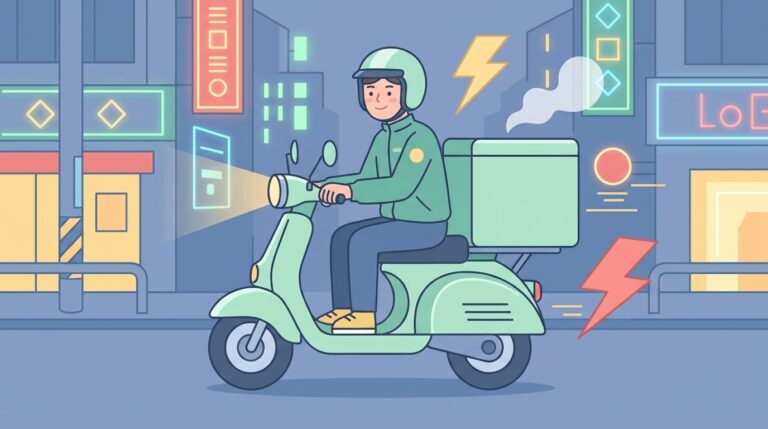
Speeding Up! Celebrating Korea’s Insanely Fast Food Delivery (Pballi-Pballi Style)
Phase 1: Empathy (Welcome to the Fast Lane!)
안녕하세요! (An-nyeong-ha-se-yo!) I am your Chief Editor at Daily Hangul, your native Korean bestie and cultural navigator.
Picture this: You are sitting in your living room or a sunny spot in Han River Park (한강공원) in Seoul. Your stomach rumbles. You open a Korean delivery app, order a warm bowl of Jjajangmyeon (짜장면 – black bean noodles) or crispy Korean fried chicken, and bam! In less than 20 minutes, a friendly rider is knocking on your door with steaming hot food.
For many of my foreign friends, this is a mind-blowing cultural shock. In Korea, we call this the “빨리빨리 (Pballi-Pballi) Culture” (Hurry, Hurry!). It is not just about being impatient; it is a shared lifestyle that values efficiency, speed, and absolute convenience. If you have ever wanted to express your pure joy and amazement at how fast your food arrived, you are in the right place!
Today, we are going to learn real, conversational Korean phrases to celebrate super-fast deliveries like a true local. No more robotic textbook phrases—let’s dive into the living language!
Phase 2: Deep Dive into 3 Essential Expressions
1. 벌써 왔어요? (Beol-sseo wat-eo-yo?)
- Pronunciation: beol-ssuh wat-uh-yo? (Sounds like “bell-suh” followed by “what-uh-yo” with a rising tone)
- Meaning: “Is it already here?” / “Has it arrived already?”
- K-Culture Moment: You see this in almost every Korean reality show (like I Live Alone). The cast members order food, sit down to turn on the TV, and before the intro song finishes, the doorbell rings. They gasp and say: “벌써 왔어?!” (casual version).
- Editor’s Insight: “벌써” (beol-sseo) means “already” and implies pleasant surprise. It carries an energetic vibe of awe.
- Situation Spectrum: Casual (벌써 왔어? ✅) | Semi-formal (벌써 왔어요? ✅) | Formal (벌써 도착했습니까? ⚠️)
- 🤔 Think About It: In your home country, how long does food delivery usually take? How would you react if it took less than 15 minutes?
2. 진짜 번개 같네요! (Jin-jja beon-gae gat-nae-yo!)
- Pronunciation: jin-jja bun-gae gat-nae-yo (Think of “jin-ja” like ginger, and “bun-gae” like bun-get)
- Meaning: “It’s seriously like lightning!”
- K-Culture Moment: Perfect to say when chatting with a delivery driver, or texting a friend to brag about your food delivery speed.
- Editor’s Insight: “번개” (beon-gae) means lightning. Comparing delivery riders to lightning is a very common, friendly compliment in Korea.
- Situation Spectrum: Casual (진짜 번개 같다! ✅) | Semi-formal (진짜 번개 같네요! ✅) | Formal (번개처럼 빠릅니다 ⚠️)
- 🤔 Think About It: Why do you think speed is so highly valued in Korean service culture? How does this connect to Korea’s rapid economic growth after the war?
3. 한국 배달 진짜 대박이에요! (Han-guk bae-dal jin-jja dae-bak-i-e-yo!)
- Pronunciation: han-guk bae-dal jin-jja dae-bahk-ee-eh-yo
- Meaning: “Korean delivery is seriously awesome!”
- K-Culture Moment: You are showing your delivery feast on an Instagram Story or TikTok video, tagging your Korean friends.
- Editor’s Insight: “대박” (dae-bak) means “jackpot” or “awesome.” Combined with “배달” (delivery), it shows you are completely in love with the system.
- Situation Spectrum: Casual (한국 배달 진짜 대박이야! ✅) | Semi-formal (한국 배달 진짜 대박이에요! ✅) | Formal (한국의 배달 시스템은 훌륭합니다 🚫 – too stiff for casual joy!)
- 🤔 Think About It: If you could deliver anything instantly in your country, what would it be?
Phase 3: Textbook Korean vs. Real Korean
Let’s compare what dusty grammar books teach you versus what we actually say in the streets of Seoul!
Situation 1: Expressing that the food arrived quickly
- 📖 Textbook: 배달이 매우 신속합니다. (Bae-dal-i mae-u sin-sok-ham-ni-da. – “The delivery is very prompt/speedy.”)
- 🗣️ Real Korean: 와, 배달 진짜 빨라요! (Wa, bae-dal jin-jja ppal-la-yo! – “Wow, the delivery is seriously fast!”)
- 💡 Why the difference? The textbook uses “신속” (promptness), which is a formal Hanja (Chinese character) word used in news reports or business contracts. On a daily basis, we use the lively and active word “빨라요” (fast) with a bright “와!” (Wow!).
Situation 2: Surprised by the speed
- 📖 Textbook: 음식이 예상보다 일찍 도착했습니다. (Eum-sik-i ye-sang-bo-da il-jjik do-chak-haet-seum-ni-da. – “The food arrived earlier than expected.”)
- 🗣️ Real Korean: 대박, 벌써 왔어요? (Dae-bak, beol-sseo wat-eo-yo? – “Awesome, is it already here?”)
- 💡 Why the difference? Real life is emotional! Using “대박” (awesome) and “벌써” (already) shows your actual joy, whereas the textbook sentence sounds like an automated shipping notification.
Phase 4: K-Culture Deep Dive & Non-Verbal Manners
4-1. The “Fast-Delivery” Body Language
When your food arrives in Korea, the interaction with the delivery rider (배달원 – bae-dal-won) is usually super short—often under 5 seconds!
* The Quick Bow: When receiving the food, do a quick 15-degree head bow and say “감사합니다!” (Gam-sa-ham-ni-da!).
* The Safe Spot: If you ordered via an app (like Baemin or Coupang Eats), it is highly common to request “문 앞에 두고 벨 눌러주세요” (Please leave it at the door and ring the bell). In this case, you don’t even need to meet them face-to-face. Just open the door, grab the food, and whisper a joyful “대박!” to yourself!
4-2. The Han River Delivery Zone (배달존)
Did you know you can order hot food to the middle of a public park? In Seoul’s Yeouido Han River Park, there are designated “Delivery Zones” (배달존 – bae-dal-jon). Hundreds of people order fried chicken directly to these zones while picnicking. It is the ultimate fusion of K-Food, nature, and “Pballi-Pballi” technology!
Phase 5: Real-Life Roleplay Scenario
Setting: You are hanging out at your Korean friend Minji’s apartment in Hongdae. You guys ordered Korean fried chicken just 15 minutes ago, and suddenly the doorbell rings.
Character Cast:
- Minji (민지): Your energetic Korean friend.
- Rider (배달원): The lightning-fast delivery hero.
- You: The hungry, amazed learner.
The 8-Turn Script:
- Minji: 배고프다. 치킨 언제 오지?
(Bae-go-peu-da. Chi-kin eon-je o-ji?)
“I’m hungry. When is the chicken coming?” -
You: 한 30분 걸리지 않을까요?
(Han sam-sip-bun geol-li-ji an-eul-kka-yo?)
“Won’t it take about 30 minutes?” -
(🔔 Doorbell rings: Ding-dong!)
-
Minji: 어? 벌써 벨 소리가 나네?
(Eo? Beol-sseo bel so-ri-ga na-ne?)
“Huh? The bell is ringing already?” -
Rider: 배달 왔습니다!
(Bae-dal wat-seum-ni-da!)
“Delivery is here!” -
You: 🎭 [Opening the door with wide eyes]
와, 진짜 번개 같네요! 감사합니다!
(Wa, jin-jja beon-gae gat-nae-yo! Gam-sa-ham-ni-da!)
“Wow, it’s seriously like lightning! Thank you!” -
Rider: 맛있게 드세요!
(Mas-it-ge deu-se-yo!)
“Enjoy your meal!” -
Minji: 대박, 주문한 지 15분밖에 안 됐어!
(Dae-bak, ju-mun-han ji sip-o-bun-bak-ke an dwaet-eo!)
“Awesome, it’s only been 15 minutes since we ordered!”
🔀 Interactive Choice Point!
What do you say to Minji as you set the table?
* Choice A: “한국 배달 진짜 대박이에요!” (Korean delivery is seriously awesome!)
* Choice B: “배달이 너무 느려요.” (The delivery is too slow.)
* Choice C: “신속한 배달에 감사드립니다.” (Thank you for the prompt delivery.)
💬 Feedback on Your Choice:
- If you chose A (Best): 🌟 Perfect! Minji will smile and say “맞아, 이게 한국의 빨리빨리야!” (Right, this is Korea’s hurry-hurry style!). You sounded 100% natural and local.
- If you chose B (Bad): 😅 Oh no! Saying it’s too slow when it took 15 minutes will make Minji think you live in a sci-fi future!
- If you chose C (Risk): 🤖 Too robotic! Minji might laugh and ask if you are speaking like a corporate email. Stick to A for friendly vibes!
Phase 6: 10-Second Emotion Shadowing Drill
Practice speaking with the true emotion of an excited, hungry person. Pay attention to the / pauses and the emotional cues!
- [😊 Expressing shock and joy]
대박! / 벌써 왔어요?
(Dae-bak! / Beol-sseo wat-eo-yo?)
“Awesome! / Is it already here?” -
[⚡ Speaking fast with high energy]
와, / 진짜 / 번개 같네요!
(Wa, / jin-jja / beon-gae gat-nae-yo!)
“Wow, / seriously, / it’s like lightning!” -
[😍 Fully satisfied and amazed]
한국 배달은 / 진짜 / 대박이에요!
(Han-guk bae-dal-eun / jin-jja / dae-bak-i-e-yo!)
“Korean delivery / is seriously / amazing!”
Phase 7: K-Culture Mini-Dictionary
- 배달 (Bae-dal) | Delivery
- Usage: Not just for food! In Korea, you can get groceries, clothes, and even documents delivered within hours.
- 빨리빨리 (Pballi-Pballi) | Hurry, Hurry
- Usage: The cultural engine of Korea. It drives fast internet, quick service, and instant responses.
- 대박 (Dae-bak) | Awesome / Jackpot
- Usage: Use this whenever you are pleasantly shocked. “대박 맛있다!” (Awesome taste!).
- 번개 (Beon-gae) | Lightning / Flash Mob
- Usage: Can mean literal lightning, super fast speed, or a spontaneous, last-minute meetup with friends (번개 모임).
Phase 8: Survivor Kit for Travelers
Survival Phrases TOP 3
- 문 앞에 두고 벨 눌러주세요. (Mun ap-e du-go bel nul-leo-ju-se-yo.)
- Pro Tip: Leave this in your app delivery notes for a contactless, hassle-free drop-off.
- 젓가락 안 주셔도 돼요. (Jeot-ga-rak an ju-syeo-do dwae-yo.)
- Pro Tip: Use this to say “I don’t need chopsticks” to save the environment if you are eating at home.
- 조심히 오세요. (Jo-sim-hi o-se-yo.)
- Pro Tip: Text this to your rider. It means “Come safely,” showing warm Korean manners (정이 많다).
Editor’s Travel Note
To experience this magical speed yourself, you will need the local apps! Download the Coupang Eats app or the Baemin (Baedal Minjeok) app on your phone. Note: You will typically need a Korean phone number or a local payment card to order, so we recommend using international-friendly helper services like ‘Shuttle’ or asking your hostel host for assistance if you are a short-term tourist.
Phase 9: “A Step Deeper” (Reflective Column)
In many Western cultures, a slow, relaxed meal is seen as the ultimate luxury. In contrast, Korea’s “Pballi-Pballi” culture treats speed as the ultimate form of respect and service. If a business is slow, it is often perceived as uncaring or lazy. However, this high-speed lifestyle also comes with pressure on delivery riders to meet tight deadlines. By saying a warm “조심히 오세요” (Come safely) or “감사합니다” (Thank you), we show appreciation for the human effort behind the lightning speed.
💬 Your Turn: Do you prefer slow, relaxed services, or do you love the thrill of Korean-style instant speed? Let me know in the comments below!
Phase 10: FAQ & Avoiding Mistakes
Q: Can I say “빨리 오세요” (Come quickly) to the delivery rider?
A: It is better not to! While Koreans love speed, telling a rider directly to “hurry up” can sound demanding, impolite, and dangerous for their safety on the road. Instead, use “조심히 오세요” (Come safely)—they will still deliver it as fast as lightning!
Q: What is the difference between “벌써” (beol-sseo) and “이미” (i-mi)?
A: Great question! Both mean “already,” but 벌써 is used when you are surprised by the speed (e.g., “Wow, the food is already here!”). 이미 is used for objective facts without surprise (e.g., “I already finished eating”).
Q: Do I need to tip the delivery rider in Korea?
A: No! Tipping is not a part of Korean culture. The delivery fee is already included in your app payment. A bright smile and a polite “감사합니다!” are the best tips you can give.
🚨 Common Mistakes Warning Board
- Mistake 1: Calling the rider “저기요” (Jeo-gi-yo – Hey you) when they arrive.
- Correct Action: Just say “감사합니다!” (Thank you) or “수고하셨습니다!” (Thank you for your hard work).
- Mistake 2: Pronouncing “벌써” as “볼서” (bol-seo).
- Correct Action: Make sure the first vowel is flat: beol (like the English word ‘bell’ but with a relaxed jaw).
- Mistake 3: Expecting the rider to wait while you check the food.
- Correct Action: They are in a hurry! Just take the bag and let them go immediately.
Phase 11: Action Mission
- 🥉 Bronze Mission: Say “벌써 왔어요?” out loud in your room 3 times with a surprised face!
- 🥈 Silver Mission: Write down “한국 배달 진짜 대박이에요!” in your study notebook and read it in a cheerful, energetic tone.
- 🥇 Gold Mission: Next time you get a fast delivery (even in your own country), post a photo of your food on social media with the caption: “진짜 번개 같네요! ⚡” and tag us!
- 🎮 K-Culture Mission: Watch a modern K-Drama (like Crash Landing on You or Nevertheless) and spot a scene where characters order food to a house or park. Write down what they say when the doorbell rings!
Phase 12: Interactive Quiz Challenge
Test your Pballi-Pballi instincts!
1. Which word means “already” and shows surprise?
- A) 이미 (i-mi)
- B) 벌써 (beol-sseo)
- C) 빨리 (ppal-li)
2. Fill in the blank: “진짜 ______ 같네요!” (It’s seriously like lightning!)
- A) 구름 (cloud)
- B) 바람 (wind)
- C) 번개 (lightning)
3. True or False: You should tip the delivery rider at your door in Seoul.
- A) True
- B) False
👉 Click here for Answers & Explanations!
- Answer: B) 벌써 (beol-sseo). We use “벌써” to express surprise at how fast something happened.
- Answer: C) 번개 (beon-gae). In Korea, we compare super-fast delivery to a lightning strike!
- Answer: B) False. Tipping is not expected or customary in South Korea. Just say thank you!
See you in the next lesson! 다음에 또 만나요! (Da-eum-e tto man-na-yo!)







