

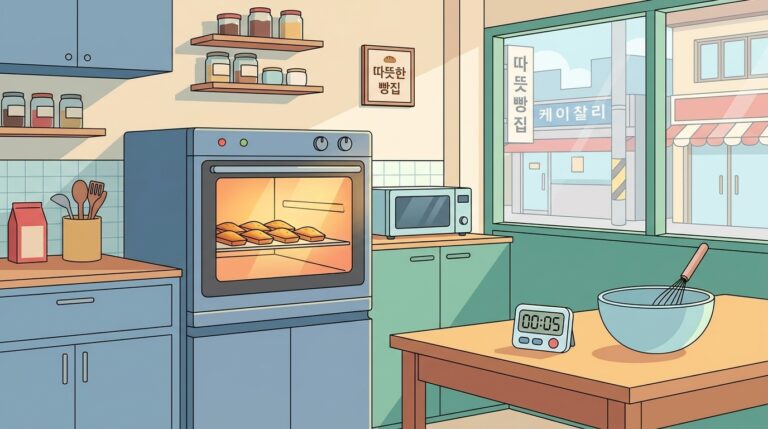
C1 Korean Masterclass: Mastering the ‘Art of Heat’ (불조절) in Korean Baking
Phase 1: Empathy & Storytelling (공감)
안녕하세요! Daily Hangul (매일한글) Editor here, your ultimate K-Culture Navigator!
Imagine this: You’ve meticulously measured your flour, whipped your egg whites to perfect stiff peaks, and popped your delicate K-style strawberry fresh cream cake (딸기 생크림 케이크) into the oven. But half an hour later, you peek through the glass only to find a sad, deflated, or burnt crust. You check the recipe, but it simply says: “불조절을 잘해야 합니다” (You must control the fire well).
Wait, ‘fire control’? My oven is electric!
If you’ve ever felt personally victimized by vague Korean baking terms, you are not alone. Many of our advanced C1 learners who run home bakeries or love baking Korean-style desserts like Yakgwa (약과) or fluffy soufflé pancakes share this exact pain point. In Korean culinary culture, “불조절” (heat regulation) is treated almost like a spiritual craft. Today, we’re unlocking the high-level, nuanced vocabulary of oven temperature control that will make you sound like a seasoned pâtissier at a trendy cafe in Hannam-dong. Ready to turn up the heat?
Phase 2: Deep Dive into 3 Core Expressions (핵심 표현 3선)
1. 불조절 (bul-jo-jeol)
- Pronunciation: bool-joh-jeol (Think of “bull” + “jo” as in journal + “jol” as in jolt)
- Meaning: Heat control / Temperature regulation (Literally: “Fire regulation”)
- K-Culture Moment: You will hear this constantly on popular Korean baking/cooking survival shows. A judge might taste a macaron and sigh, “아, 이 집은 불조절이 조금 아쉽네요.” (Ah, this place’s heat control is slightly disappointing.)
- Editor’s Insight: Although modern ovens use electricity, Koreans still call oven temperature adjustments “불조절” (fire control). At the C1 level, using “온도 조절” (temperature control) sounds too clinical. “불조절” sounds like you have intuitive, chef-like instincts.
- Situation Spectrum: Casual ✅ | Semi-formal ✅ | Formal ✅
- 🤔 Think About It: Why does Korean culinary language still cling to “fire” (불) in the digital age? It reflects a deep respect for traditional hearth cooking (Agungi – 아궁이), where mastery of live fire defined a great cook.
2. 구움색을 내다 (gu-um-saek-eul nae-da)
- Pronunciation: goo-oom-saek-eul nae-da (Think of “goo-um” like a soft sigh + “saek” like second)
- Meaning: To achieve the perfect golden-brown bake / browning
- K-Culture Moment: In high-end Seoul bakeries making salt bread (소금빵), bakers obsess over the perfect crust color. A baker might say, “마지막 3분에 구움색을 확 내줘야 맛있어 보여요.” (You need to draw out that golden bake color in the last 3 minutes to make it look delicious.)
- Editor’s Insight: “구움색” is a beautiful compound word: 구움 (baked/roasting) + 색 (color). It refers to the beautiful Maillard reaction. Don’t just say “갈색으로 만들다” (make it brown)—use “구움색을 내다” to show true C1 sophistication.
- Situation Spectrum: Casual ✅ | Semi-formal ✅ | Formal ✅
- 🤔 Think About It: How does your culture describe the perfect golden-brown color on baked goods? Is there a single poetic word for it like “구움색”?
3. 오븐을 타다 (o-beun-eul ta-da)
- Pronunciation: oh-beun-eul tah-dah (Think of “oven” + “tah” like ta-da!)
- Meaning: For a recipe or batter to be highly sensitive to the specific oven’s quirks.
- K-Culture Moment: On baking forums (like Naver baking cafes), home bakers often complain: “이 레시피는 오븐을 너무 타요.” (This recipe is so finicky depending on the oven you use.)
- Editor’s Insight: Literally translating to “riding the oven,” “타다” here is used in the sense of “being sensitive to/dependent on” (similar to 계절을 타다 – to be sensitive to seasons/get lonely in autumn).
- Situation Spectrum: Casual ✅ | Semi-formal ⚠️ | Formal 🚫
- 🤔 Think About It: Why does Korean use the verb “타다” (to ride/be sensitive) for inanimate objects like ovens? It personifies the appliance as something you must harmonize with.
Phase 3: Textbook Korean vs. Real-Life Korean
Situation 1: Explaining that the oven temperature varies internally.
- 📖 Textbook: “오븐 내부의 온도가 고르지 않습니다.” (The temperature inside the oven is not even.)
- 🗣️ 진짜 한국어: “오븐이 열을 좀 드문드문 받아요 (또는 열이 골고루 안 퍼져요).” (The oven gets hot in random patches / the heat doesn’t spread evenly.)
- 💡 왜 다를까? Textbook Korean uses passive, scientific terms like “고르지 않다” (not even). Locals use organic, descriptive words like “드문드문” (here and there/patchy) to describe heat spots.
Situation 2: Giving advice to lower the heat because the top is burning.
- 📖 Textbook: “온도를 낮추고 더 오래 구우십시오.” (Lower the temperature and bake longer.)
- 🗣️ 진짜 한국어: “윗불이 너무 세니까, 온도 낮추고 은근하게 속까지 익혀야 해요.” (The top heat is too strong, so lower the temp and let the inside cook thoroughly on gentle heat.)
- 💡 왜 다를까? Advanced bakers distinguish between “윗불” (top heat/broiler element) and “아랫불” (bottom heat), and use the word “은근하게” (slowly, gently) to describe the baking process.
Phase 4: K-Culture Deep Dive & Non-Verbal Manners
4-1. The “Nunchi” (눈치) of Baking: Respecting the Oven’s “Personality”
In Korea, machines are often spoken of as having a personality (성격). When you use a new oven, you don’t just set the dial; you “길들이다” (tame/break in) the oven. If a Korean baker tells you, “그 오븐 성격 급해요” (That oven has a hasty personality), they mean it heats up way too fast!
4-2. The “K-Dessert” Craze: Less Sweet, Highly Visual
If you visit the trendy neighborhoods of Seongsu-dong or Yeonnam-dong, you’ll notice Korean desserts prioritize “구움색” (perfect browning) and a texture called “겉바속촉” (crispy on the outside, moist on the inside). To achieve this, Korean bakers use a technique called “우에즈미” (checking the top color and adjusting rack positions)—a jargon term borrowed from Japanese but heavily integrated into high-end Korean baking culture.
Phase 5: Real-Life Roleplay Scenario (실전 롤플레이)
The Setup
- Setting: “솔티 카라멜” (Salty Caramel), a highly competitive boutique bakery in Gangnam.
- Characters:
- 민우 (Min-woo): The meticulous Head Pâtissier who is very particular about bul-jo-jeol.
- You (C1 Foreign Apprentice): An ambitious baker learning the ropes.
- 민우: 🎭 (Peering anxiously into the deck oven) 혹시 마들렌 지금 몇 도로 굽고 있어요?
- You: 🎭 (Checking the digital screen) 지금 180도로 세팅되어 있습니다.
- 민우: 🎭 (Frowning slightly, pointing at the tray) 음, 지금 팬닝한 위치 보니까 안쪽 것만 벌써 색이 올라오네요. 이 오븐이 안쪽 열이 세서 그래요.
- You: 🎭 (Nodding quickly) 아, 오븐이 열을 좀 드문드문 받는군요. 판을 한번 돌려줄까요?
- 민우: 🎭 (Approvingly) 네, 맞아요! 뒤집어서 위아래 판 위치도 한번 바꿔줘요. 안 그러면 구움색이 너무 한쪽만 진해져요.
- You: 🎭 (Carefully rotating the baking sheet) 네, 지금 돌렸습니다. 온도도 10도 정도 낮출까요? 속까지 은근하게 익히는 게 나을 것 같아서요.
- 민우: 🎭 (Smiling warmly) 오, 불조절 감이 아주 좋은데요? 맞아요. 겉만 타기 쉬우니까 170도로 낮춰서 마무리해요.
- You: 🎭 (Adjusting the dial) 넵, 170도로 조절했습니다! 겉바속촉으로 맛있게 구워보겠습니다!
🔀 Interactive Choice Points
Q: Min-woo asks you to check if the Choux pastry (슈) is rising well. The top is browning too fast but the inside is wet. What do you say?
- Choice A: “윗불이 세니까 그냥 문 열고 환기 시킬게요!” (I’ll just open the oven door to ventilate because the top heat is too strong!)
- Feedback (Bad): 🚫 Oh no! Opening the oven door while baking Choux pastry will cause them to collapse instantly. Min-woo will gasp in horror!
- Choice B: “오븐 사양이 예민하니까 그냥 계속 지켜보겠습니다.” (Since the oven specs are sensitive, I will just keep watching.)
- Feedback (Risk): ⚠️ Too passive. Watching them burn won’t save the pastry. You need proactive heat management.
- Choice C: “구움색이 너무 빨리 나니까 위에 유지(또는 테프론 시트)를 한 장 덮어서 속까지 익힐까요?” (Since it’s browning too fast, should we cover it with a Teflon sheet to let the inside cook thoroughly?)
- Feedback (Best): 🏆 Perfect C1 Professional! This shows you understand professional kitchen solutions and used advanced terms seamlessly.
Phase 6: 10-Second Emotion Shadowing Drill (10초 감정 섀도잉)
Let’s practice speaking with the natural cadence, pauses (/), and emotional undertones of a Korean professional baker.
- [🥺 Worried & Urgent]
- “아, / 윗불이 너무 세서 / 벌써 겉만 타기 시작했어요!”
- Ah, / wip-bul-i neo-mu sae-seo / beol-sseo geot-man ta-gi si-jak-hae-sseo-yo!
- (Oh, the top heat is too strong, it’s already starting to burn on the outside!)
- [😊 Relieved & Proud]
- “판을 제때 돌려줬더니 / 구움색이 / 아주 고르게 잘 나왔네요!”
- Pan-eul je-ttae dol-ryeo-jweot-deo-ni / gu-um-saek-i / a-ju go-reu-ge jal na-wat-nae-yo!
- (Because we rotated the tray just in time, the browning came out so beautifully even!)
Phase 7: K-Culture Mini-Dictionary (K-Culture 미니 사전)
- 겉바속촉 (Geot-ba-sok-chok) | Crispy on the outside, moist on the inside | The holy grail of food textures in Korea, applied to everything from fried chicken to canelés.
- 구움과자 (Gu-um-gwa-ja) | Baked confectionery | Refers to small baked goods like Madeleines, Financiers, and cookies that are currently dominating the Korean cafe dessert scene.
- 팬닝 (Panning) | Panning / Placing batter on trays | A Konglish baking term used universally in professional kitchens.
- 열선 (Yeol-seon) | Heating element | The metal coil inside the oven that radiates heat. Critical when discussing hot spots.
Phase 8: Survivor Kit for Travelers & Bakers
Survival Expressions TOP 3
- “오븐 온도계 있어요?” (O-beun on-do-gye is-seo-yo?)
- Pro Tip: Essential if you rent a shared kitchen (공유주방) in Seoul. Built-in oven dials are notoriously inaccurate.
- “이 오븐, 바람 세기 조절 돼요?” (I o-beun, ba-ram sae-gi jo-jeol dwae-yo?)
- Pro Tip: Ask this if you are using a commercial convection oven where strong fan wind might ruin delicate macarons.
- “속까지 덜 익은 것 같아요.” (Sok-kka-ji deol ik-eun geot gat-a-yo.)
- Pro Tip: Use this to tell your baking partner that the center of the cake is still gooey/undercooked.
Editor’s Travel Note ✈️
If you want to buy premium baking supplies and check out state-of-the-art ovens in Seoul, head straight to the Bangsan Market (방산시장) near Euljiro 4-ga station. You can find massive ranges of professional equipment there. To navigate your way, download the Naver Map App for accurate walking directions in Seoul’s winding alleys.
Phase 9: “A Step Deeper” – Cultural Insight (한 발 더 깊이)
In English, baking is often described as a pure science of exact numbers. However, in Korea, even in high-end baking, there is an element of “손맛” (son-mat – hand taste/intuitive touch) and “눈썰미” (nun-sseol-mi – sharp visual intuition).
Korean bakers often look at the steam coming out of the oven door or listen to the sizzling sound of the butter to gauge the temperature, rather than just trusting the digital panel. It’s a holistic sensory experience where the baker harmonizes with the oven’s unique “temperament” (기질).
💬 Your Turn: Do you rely 100% on recipes and digital thermometers, or do you bake using your “sensory intuition” (손맛)? Let us know in the comments below!
Phase 10: FAQ & Common Mistakes (FAQ & 오해 방지)
Q: Why do Korean recipes often have lower baking temperatures than Western ones?
A: Many Korean ovens are compact, countertop convection ovens (like the popular L’equip or Smarf ovens) which circulate hot air rapidly, causing cakes to dry out or burn faster. Therefore, Korean recipes often adapt by lowering the temperature by 10-15°C compared to large American static ovens.
Q: Can I use “불을 끄다” (turn off the fire) for an electric oven?
A: Yes! Even for induction cooktops or electric ovens, Koreans say “오븐 불 꺼라” (turn off the oven fire/heat). It is completely natural.
Q: What is the difference between “익히다” (ik-hi-da) and “굽다” (gup-da)?
A: “굽다” refers to the action of baking/roasting (application of dry heat). “익히다” means to cook thoroughly so it is safe and ready to eat. You 굽 the bread to 익히 the raw dough.
🚨 Common Mistakes Warning Board
- Mistake 1: Saying “오븐 온도를 불타게 해주세요” to mean “make the oven hot.”
- Correct Action: Use “오븐 예열해 주세요” (Preheat the oven) or “온도를 높여주세요” (Raise the temperature). “불타다” means physically burning down!
- Mistake 2: Translating “browning” as “갈색화” in casual conversation.
- Correct Action: Use “구움색” (baked color). “갈색화” sounds like a high school chemistry textbook.
- Mistake 3: Confusing “윗불” (top heat) and “아랫불” (bottom heat) dials.
- Correct Action: Double-check the icons on Korean commercial ovens. A line at the top of the square icon indicates 윗불, and a line at the bottom is 아랫불.
Phase 11: Action Mission & Engagement (액션 미션)
- Bronze Medal: Write a comment below telling us what your favorite Korean bakery item is (e.g., 소금빵, 단팥빵) using the word 구움색.
- Silver Medal: Snap a picture of your next baked creation, post it on Instagram, tag
@DailyHangul, and caption it: “오늘 불조절 대성공! 겉바속촉이에요.” - Gold Medal: Go to your local Korean bakery or cafe, and confidently ask the owner: “이 집 구움과자는 구움색이 정말 예술이네요. 불조절 비결이 뭐예요?” (The browning on these pastries is truly art. What’s your heat control secret?)
Phase 12: Interactive Quiz Challenge (인터랙티브 퀴즈)
1. Fill in the blank:
“이 마들렌은 속은 안 익고 겉만 타버렸네. 다음번엔 ( )을/를 더 잘해야겠어.”
💡 Click to reveal Answer & Explanation
Answer: 불조절 (or 온도 조절)
Explanation: Since the outside burned while the inside remained raw, the culprit was poor heat control (불조절).
2. True or False?
In Korea, you should never say “불” (fire) when talking about electric ovens because they do not use actual gas flames.
💡 Click to reveal Answer & Explanation
Answer: False
Explanation: Even with highly modern electric convection ovens, bakers still universally use “윗불” (top heat), “아랫불” (bottom heat), and “불조절” (heat control).







