

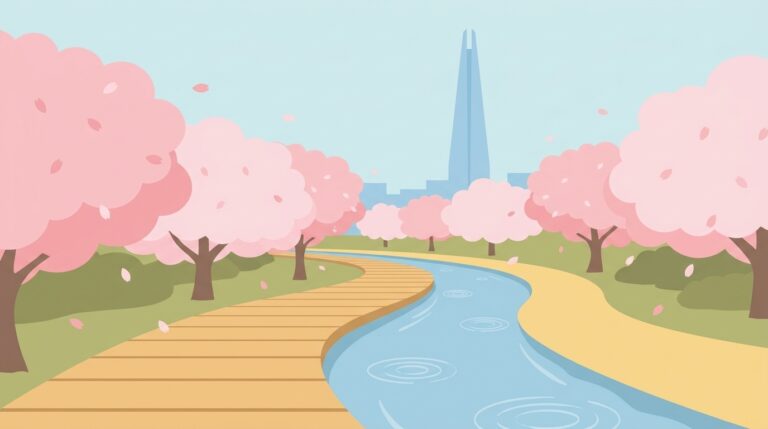
Chasing Cherry Blossoms in Korea: The Ultimate Mid-Level Guide to Spring and Spot-Hunting
Phase 1: Empathy (스토리 몰입형 오프닝)
안녕하세요! It’s your K-culture navigator and friendly Korean bestie from 매일한글 (Daily Hangul)! 🌸
Picture this: It’s early April in Seoul. You’ve planned your dream trip to Korea, stepping out of your hotel expecting a romantic shower of pink petals, just like in your favorite K-Dramas. But instead, you’re met with bare branches or, even worse, green leaves because the blossoms already fell last week! Or maybe you made it to the riverfront, but you have no idea how to ask the locals where the “secret, less-crowded photogenic spots” are without sounding like a robotic textbook.
Many of my mid-level (B2) students tell me they feel frustrated. They know basic weather words like ‘봄’ (spring) and ‘꽃’ (flower), but they struggle to have a natural, fluid conversation about cherry blossom forecasts, peak bloom times, and local recommendations. Today, we are going to fix that. You’ll learn how to talk about the transient beauty of spring like a true Seoulite, navigate the peak season, and discover the best spots with confidence!
Phase 2: Deep-Dive into 3 Essential Expressions (핵심 표현 3선 심층 분석)
Let’s upgrade your spring vocabulary with three crucial expressions that will make you sound incredibly natural.
1. 벚꽃이 만개하다 (be in full bloom)
- Pronunciation: beot-kkoti man-gae-hada (Sounds like: “but-kko-tee mahn-gae-hah-dah”)
- Meaning: The cherry blossoms are in full bloom (100% open).
- K-Culture Moment: You will hear this constantly on the morning news and weather forecasts (일기예보) in late March. Anchors will excitingly report, “이번 주말에 여의도 벚꽃이 만개할 예정입니다!” (Yeouido cherry blossoms are expected to be in full bloom this weekend!)
- Editor’s Insight: While ‘피다’ (to bloom) is basic, ‘만개하다’ (萬開–) uses Hanja (Sino-Korean characters) meaning “fully open.” Using this word instantly elevates your Korean level from beginner to intermediate.
- Situation Spectrum: Casual (✅) / Semi-formal (✅) / Formal (✅)
- 🤔 Think About It: In English, we say “in full bloom.” Why do you think Korean uses a specific Hanja-derived verb (‘만개하다’) for this seasonal peak? How does your native language describe this brief, beautiful moment?
2. 꽃샘추위 (the last cold snap in early spring)
- Pronunciation: kkot-saem-chu-wi (Sounds like: “kote-saem-choo-wee”)
- Meaning: “The cold that is jealous of the flowers.”
- K-Culture Moment: In K-Dramas, characters often wear cozy trench coats or light scarves in early spring, complaining about this sudden cold. A character might say, “오늘 날씨 왜 이렇게 춥지? 아, 꽃샘추위인가 봐요.” (Why is it so cold today? Ah, it must be the spring cold snap.)
- Editor’s Insight: This is one of the most poetic words in the Korean language. ‘꽃’ (flower) + ‘샘’ (from ‘시기/샘나다’, to be jealous) + ‘추위’ (cold). Winter is literally “jealous” of the beautiful spring flowers blooming, so it throws one last icy tantrum. When you use this word, locals will be amazed by your cultural depth!
- Situation Spectrum: Casual (✅) / Semi-formal (✅) / Formal (✅)
- 🤔 Think About It: How does your culture view the transition from winter to spring? Is there a poetic name for that final, unexpected cold breeze?
3. 꽃구경 가다 (to go flower viewing / sightseeing)
- Pronunciation: kkot-gu-gyeong ga-da (Sounds like: “kote-goo-gyung gah-dah”)
- Meaning: To go out to look at and enjoy the spring flowers.
- K-Culture Moment: Every spring, your Korean social media feed (especially Instagram) will be flooded with hashtags like #꽃구경 (#FlowerViewing). Friends will text you: “이번 주말에 나랑 꽃구경 갈래?” (Do you want to go look at flowers with me this weekend?)
- Editor’s Insight: ‘구경’ means sightseeing or looking around. While Westerners might say “let’s go see the cherry blossoms,” Koreans specifically package this into an active verb phrase ‘꽃구경 가다’ which implies a full-day outing with street food, picnics, and taking hundreds of photos.
- Situation Spectrum: Casual (✅) / Semi-formal (✅) / Formal (⚠️ – use ‘꽃구경을 가다’ or ‘나들이를 가다’ in formal contexts)
- 🤔 Think About It: Why is “looking at flowers” treated as a specific, collective social activity in Korea, rather than just an individual observation?
Phase 3: Textbook Korean vs. Real-Life Korean (교과서 한국어 vs 진짜 한국어)
Let’s compare how textbooks teach spring weather versus how Koreans actually talk in 2024.
Situation 1: Expressing that there are too many people at a cherry blossom spot
- 📖 Textbook Korean: 사람들이 아주 많아서 복잡합니다. (sa-ram-deu-ri a-ju man-a-seo bok-jap-ham-ni-da.) – “There are many people, so it is crowded.”
- 🗣️ 진짜 한국어: 완전 사람 반, 꽃 반이더라고요! (wan-jeon sa-ram ban, kkot ban-i-deo-ra-go-yo!) – “Literally, it was half people, half flowers!”
- 💡 Why the difference? While the textbook version is grammatically correct, it feels very dry. Real Koreans use the witty idiom “사람 반, 꽃 반” (half people, half flowers) or “사람에 치이다” (to be bumped/jostled by people) to playfully exaggerate the massive spring crowds.
Situation 2: Reacting to the wind blowing away the cherry blossoms
- 📖 Textbook Korean: 바람이 불어서 벚꽃이 떨어집니다. (ba-ra-mi bu-reo-seo beot-kkoti tteo-reo-jim-ni-da.) – “The wind is blowing, so the cherry blossoms are falling.”
- 🗣️ 진짜 한국어: 벚꽃 비가 내리는데 진짜 예술이에요! (beot-kkot bi-ga nae-ri-neun-de jin-짜 ye-sul-i-e-yo!) – “It’s raining cherry blossom petals, it’s a work of art!”
- 💡 Why the difference? Koreans love sensory and poetic expressions. Instead of just “falling,” they say “벚꽃 비” (cherry blossom rain) or “벚꽃 엔딩” (cherry blossom ending – inspired by Busker Busker’s legendary song) to describe the beautiful, romantic moment petals flutter down like snow.
Phase 4: K-Culture Deep-Dive & Non-Verbal Manners (K-Culture 딥다이브 & 비언어적 매너)
4-1. Nunchi (눈치) & Picnic Etiquette
When going for ‘꽃구경’ (flower viewing) in famous spots like Yeouido Hangang Park, Nunchi (tact/situational awareness) is key:
* The Mat (돗자리) Rule: When finding a spot to lay down your picnic mat, never place it too close to another group. Give at least a meter of breathing space.
* Trash Responsibility: Do not leave your trash behind. Koreans are extremely strict about recycling. Carry a small plastic bag with you to collect your trash, and separate plastic, paper, and food waste at designated park recycling zones.
* The Branch Rule: Never, ever pull or break a cherry blossom branch to take a photo. It is considered extremely rude and harmful to the environment. Instead, gently hold a low-hanging branch with your hand without bending it, or let the wind do the work!
4-2. The Spring Cultural Anthem: “Cherry Blossom Ending”
In Korea, there is a phenomenon called “벚꽃 연금” (Cherry Blossom Pension). It refers to the song “Cherry Blossom Ending” (벚꽃 엔딩) by Busker Busker. Released in 2012, this song climbs back up the music charts every single spring like clockwork. When you hear this acoustic, breezy melody playing from cafes, you officially know spring has arrived!
Phase 5: Practical Roleplay Scenario (실전 롤플레이 시나리오)
Let’s practice! You are planning a weekend trip to a cherry blossom spot with your Korean colleague, Min-ji (민지). You want to avoid the worst crowds and find a truly local-approved spot.
- Background: Office breakroom during lunch, late March.
- Min-ji (민지): A stylish Seoulite who loves photography and hates crowded tourist traps.
The Conversation
- You: 민지 씨, 혹시 이번 주말에 벚꽃 구경 갈 계획 있어요?
(Min-ji ssi, hok-si i-beon ju-ma-re beot-kkot gu-gyeong gal gye-hoek isseo-yo? / “Min-ji, do you happen to have plans to go cherry blossom viewing this weekend?”) - Min-ji: 아, 맞다! 벌써 벚꽃 시즌이네요. 여의도로 갈까 했는데, 거기는 사람 반 꽃 반일 것 같아서 걱정이에요.
(Ah, mat-da! Beol-sseo beot-kkot si-jeun-i-ne-yo. Yeo-ui-do-ro gal-kka haet-neun-de, geo-gi-neun sa-ram ban kkot ban-il geot gat-a-seo geok-jeong-i-e-yo. / “Ah, that’s right! It’s already cherry blossom season. I thought about going to Yeouido, but I’m worried it’ll be half people and half flowers.”) - You: 🎭 [Nodding understandingly] 맞아요. 여의도는 너무 사람에 치일 것 같아요. 혹시 다른 숨은 명소 아는 곳 있어요?
(Ma-ja-yo. Yeo-ui-do-neun neo-mu sa-ram-e chi-il geot gat-a-yo. Hok-si da-reun sum-eun myeong-so a-neun got isseo-yo? / “Agreed. Yeouido seems like it’ll be too overwhelming with people. Do you happen to know any other hidden gems/spots?”) - Min-ji: 음… 저는 개인적으로 양재천이나 합정동 당인리 발전소 길을 추천해요! 거리가 진짜 예쁜데 여의도보다는 훨씬 한적하거든요.
(Eum… jeo-neun gae-in-jeok-eu-ro Yang-jae-cheon-i-na Hap-jeong-dong Dang-in-ri bal-jeon-so gil-eul chu-cheon-hae-yo! Geo-ri-ga jin-jja ye-ppeun-de Yeo-ui-do-bo-da-neun hwol-ssin han-jeok-ha-geo-deun-yo. / “Hmm… personally, I recommend Yangjae Stream or the Danginri Power Plant road in Hapjeong-dong! The streets are beautiful but way quieter than Yeouido.”) - You: 🎭 [Eyes sparkling with interest] 와, 정말요? 언제쯤 가야 만개한 벚꽃을 볼 수 있을까요?
(Wa, jeong-mal-yo? Eon-je-jjeum ga-ya man-gae-han beot-kkot-eul bol su isseu-kka-yo? / “Wow, really? Around when should we go to see the fully bloomed cherry blossoms?”) - Min-ji: 올해는 꽃샘추위 때문에 개화 시기가 조금 늦춰졌대요. 아마 다음 주 수요일쯤 만개해서 주말이 피크일 것 같아요!
(Ol-hae-neun kkot-saem-chu-wi ttae-mun-e gae-hwa si-gi-ga jo-geum neut-chwo-jyeot-dae-yo. A-ma da-eum ju su-yo-il-jjeum man-gae-hae-seo ju-mal-i pi-keu-il geot gat-a-yo! / “They say the bloom is a bit delayed this year due to the spring cold snap. It will probably be in full bloom around next Wednesday, so next weekend will be the peak!”) - You: 그럼 우리 다음 주 토요일 아침 일찍 양재천으로 가요. 돗자리랑 간식은 제가 준비할게요!
(Geu-reom u-ri da-eum ju to-yo-il a-chim il-jjik Yang-jae-cheon-eu-ro ga-yo. Dot-ja-ri-rang gan-sik-eun je-ga jun-bi-hal-ge-yo! / “Then let’s go to Yangjae Stream early next Saturday morning. I’ll prepare the picnic mat and snacks!”) - Min-ji: 좋아요! 벌써 설레네요. 인생샷 건져 드릴게요!
(Jo-ha-yo! Beol-sseo seol-re-ne-yo. In-saeng-syat geon-jyeo deu-ril-ge-yo! / “Sounds great! I’m already excited. I’ll help you get your once-in-a-lifetime photo!”)
🔀 Choose Your Path! (인터랙티브 분기점)
How would you reply to Min-ji’s offer to take your photo (인생샷)?
- A: “진짜요? 사진 잘 찍어주시면 제가 저녁 살게요!” (Really? If you take good photos, I’ll buy you dinner!)
- B: “아니요, 사진은 괜찮아요. 그냥 꽃만 볼게요.” (No, photos are fine. I’ll just look at the flowers.)
- C: “저 사진 완전 못 찍는데 연습 많이 해올게요!” (I’m terrible at taking photos, I’ll practice a lot before coming!)
Feedback on Your Choice:
- Select A (Best): Perfect! It shows great appreciation and natural reciprocity (정), which Koreans love. Offering to buy dinner/coffee in exchange for a favor builds a strong bond.
- Select B (Bad): Too cold and distant. In Korea, taking photos is a central part of the ‘꽃구경’ bonding experience. Declining outright might make Min-ji feel awkward.
- Select C (Risk): Humorous and modest, but it might put too much pressure on yourself! Keep it light and fun.
Phase 6: 10-Second Emotional Shadowing Drill (10초 감정 섀도잉 드릴)
Practice speaking with real Korean emotions. The / indicates a tiny pause to breathe and create natural rhythm.
- [😊 Expressing excited anticipation]
- “이번 주말에 / 드디어 벚꽃이 / 만개한대요!”
- i-beon ju-ma-re / deu-di-eo beot-kkoti / man-gae-han-dae-yo!
- (They say the cherry blossoms / are finally / in full bloom this weekend!)
- [🥺 Playfully complaining about crowds]
- “여의도는 / 사람 반 / 꽃 반이라 / 치일 것 같아요!”
- Yeo-ui-do-neun / sa-ram ban / kkot ban-i-ra / chi-il geot gat-a-yo!
- (Yeouido / is half people / half flowers, so / I feel like I’ll get squeezed!)
Phase 7: K-Culture Mini-Dictionary (K-Culture 미니 사전)
- 인생샷 (In-saeng-syat) | Once-in-a-lifetime shot
- A slang term combining ‘인생’ (life) and ‘샷’ (shot). It refers to the absolute best, most beautiful photo of yourself that you might keep as your profile picture for months.
- 개화 시기 (Gae-hwa Si-gi) | Blooming period/forecast
- A formal term used in news and travel blogs. If you want to search Google/Naver for the latest bloom dates, type:
2024 벚꽃 개화 시기.
- A formal term used in news and travel blogs. If you want to search Google/Naver for the latest bloom dates, type:
- 한적하다 (Han-jeok-hada) | To be quiet, tranquil, and uncrowded
- The holy-grail adjective for cherry blossom hunting. While ‘조용하다’ means quiet, ‘한적하다’ captures the cozy, peaceful mood of a spacious path.
- 나들이 (Na-deu-ri) | A short outing/excursion
- A warm, nostalgic word for a family, couple, or friendly picnic trip to enjoy nature.
Phase 8: Traveler’s Survival Kit (여행자를 위한 생존 키트)
Survival Expressions TOP 3
- “여기 벚꽃 사진 잘 나오는 스팟이 어디예요?”
- Yeo-gi beot-kkot sa-jin jal na-o-neun seu-pat-i eo-di-yeo-yo?
- (Where is the best photogenic spot for cherry blossoms around here?)
- “실례지만 사진 한 장만 찍어주실 수 있나요?”
- Sil-rye-ji-man sa-jin han jang-man jji-geo-ju-sil su in-na-yo?
- (Excuse me, but could you take a quick photo of me/us?)
- “벚꽃 축제 행사장 가려면 몇 번 출구로 나가야 해요?”
- Beot-kkot chuk-je haeng-sa-jang ga-ryeo-myeon myeot beon chul-gu-ro na-ga-ya hae-yo?
- (Which exit should I take to get to the cherry blossom festival?)
🗺️ Editor’s Travel Note
Don’t rely on global map apps in Korea; they don’t update local transit well! Make sure to download the Naver Map App (네이버 지도) to find hidden walking trails along Yangjae Stream or Seokchon Lake. Also, check weather updates via the Korea Meteorological Administration portal for real-time blooming status updates.
(Disclaimer: Bloom dates can fluctuate up to 5-7 days depending on temperature changes, so always check the latest weekly reports before traveling.)
Phase 9: “Going Deeper” – Cultural Reflection (“한 발 더 깊이”)
In Korea, cherry blossoms are loved not just because they are pretty, but because of their ephemerality (덧없음). They bloom beautifully for only one week, and then a single spring rain washes them away. This reflection of life’s transient nature deeply resonates with Koreans, prompting everyone to drop their busy, stressful workloads to enjoy “this exact moment” with loved ones. It teaches us to slow down, practice mindfulness, and cherish fleeting beauty.
💬 Your Turn: Does your country have a season or natural phenomenon that makes the entire nation pause and step outside? Tell me in the comments below!
Phase 10: FAQ & Common Mistakes (FAQ & 오해 방지)
Q: Is Yeouido really the absolute best place to see cherry blossoms in Seoul?
A: Yeouido is indeed beautiful and massive, but it gets incredibly crowded. If you dislike packed spaces, try Seokchon Lake (석촌호수) in Jamsil, Seoul Forest (서울숲), or Yangjaecheon (양재천) which offer equally stunning views with slightly more room to breathe.
Q: Can I wear whatever I want to a flower viewing outing?
A: While there is no dress code, most Koreans wear light, pastel-toned outfits (white, beige, light pink) to match the blossoms for their ‘인생샷’. Also, since you will be walking several kilometers, stylish but comfortable sneakers are highly recommended!
Q: Is the ‘꽃샘추위’ (spring cold snap) really that cold?
A: Yes! Even if the afternoon sun feels warm, the wind can feel icy. Koreans always dress in layers (such as a light trench coat over a knit sweater) so they can adapt to the shifting spring temperatures.
🚨 Common Mistakes Alert!
- Calling all spring flowers ‘벚꽃’ (Cherry blossoms): Remember, early spring also has beautiful yellow ‘개나리’ (forsythia) and purple ‘진달래’ (azaleas). Don’t confuse them!
- Using ‘피다’ for everything: While ‘벚꽃이 피다’ (blossoms bloom) is fine, use ‘만개하다’ (fully bloom) when they are at their absolute peak to show off your advanced vocabulary.
- Shaking the tree for a petal-falling video: Please do not shake the trunks. It harms the trees and is highly frowned upon by park staff and locals.
Phase 11: Action Mission (액션 미션)
- Bronze: Go to Instagram or Naver and search the hashtag
#꽃구경or#벚꽃개화시기and read 3 Korean posts. - Silver: Write a comment below in Korean explaining which Seoul spot you want to visit (e.g., “저는 이번 봄에 서울숲으로 꽃구경 가고 싶어요!”).
- Gold: The next time you see a flower, take a photo and upload it to your social media with the caption: “드디어 벚꽃 만개! 🌸✨”
Phase 12: Interactive Quiz Challenge (인터랙티브 퀴즈 챌린지)
1. Context Quiz
What does a Korean mean when they say a place is “사람 반, 꽃 반”?
* A) The park is very peaceful and quiet.
* B) There are too many people at the spot, making it crowded.
* C) Only half of the flowers have bloomed.
2. Fill-in-the-Blank
“올해는 ( ) 때문에 봄인데도 바람이 꽤 쌀쌀하네요.”
(Due to the early spring cold snap, the wind is quite chilly even though it is spring.)
3. True or False
- True or False: ‘만개하다’ means that the flowers have started to wither and drop. (T/F)
🎉 Click here to reveal the answers and explanations!
- Answer: B
- Explanation: “사람 반, 꽃 반” literally translates to “half people, half flowers,” indicating extreme crowds.
- Answer: 꽃샘추위 (kkot-saem-chu-wi)
- Explanation: The poetic term for the late spring cold snap that is “jealous of the flowers.”
- Answer: False
- Explanation: ‘만개하다’ means to be in full, peak bloom. The term for flowers falling is ‘지다’ (e.g., 벚꽃이 지다).
- Explanation: ‘만개하다’ means to be in full, peak bloom. The term for flowers falling is ‘지다’ (e.g., 벚꽃이 지다).







