

안녕하세요! (Annyeonghaseyo!) I’m your Daily Hangul editor, your friendly neighborhood guide to mastering Korean through real-life cultural experiences!
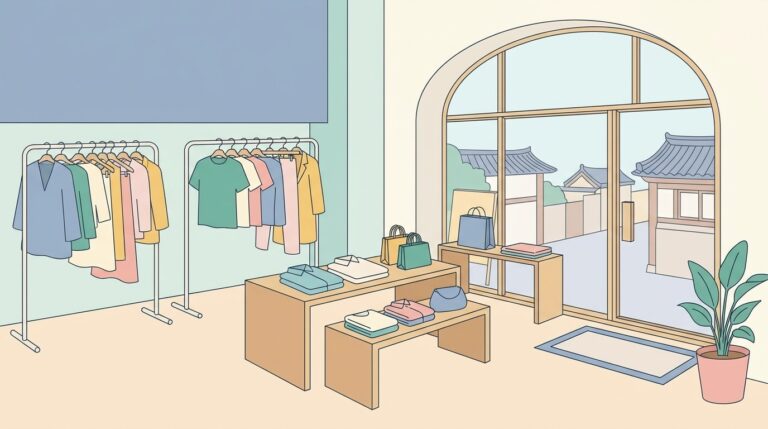
Imagine this: You are walking through the trendy, neon-lit streets of Hongdae in Seoul. You step into a chic boutique playing your favorite K-pop track. Suddenly, you spot it—the perfect, cozy oversized sweater. You touch the soft fabric and your eyes light up. You want to express your delight to the friendly shop assistant standing nearby, but your mind goes blank. Do you just nod and say “Good!”?
Don’t worry! Today, we are going to learn how to naturally say “This is pretty” and navigate a Korean clothing store like a true local. By the end of this guide, you will be shopping in Myeongdong with absolute confidence!
Phase 2: Core Expressions Deep Dive
1. 이거 예뻐요 (Igeo yeppeoyo)
- Pronunciation: ee-guh-ye-bber-yo (Sounds like “ee-guh” + “yup-poh-yo” with a soft ‘p’)
- Meaning: This is pretty. (Literal: “This / is pretty”)
- K-Culture Moment: Think of your favorite K-drama shopping montage! When the main lead tries on a stylish outfit, walks out, and their partner gasps, whispering softly: “이거 예쁘다…” (Igeo yeppuda… / This is pretty…)
- Editor’s Insight: “이거” means “this” and “예뻐요” comes from the verb “예쁘다” (to be pretty). In Korean, you don’t always need to say “I like this.” Describing the item as “pretty” is the most natural way to show interest!
- Situation Spectrum: Casual: ✅ (이거 예뻐) | Semi-formal: ✅ (이거 예뻐요) | Formal: 🚫 (이것은 아름답습니다 – This sounds too poetic, like describing a sunset in a novel!)
- 🤔 Think About It: In English, we often say “I like this.” In Korean, the focus is placed on the object’s beauty (“This is pretty”) rather than the individual’s subjective liking. How does this reflect the polite, humble nature of Korean speech?
2. 이거 얼마예요? (Igeo eolmayeyo?)
- Pronunciation: ee-guh-ul-mah-yay-yo
- Meaning: How much is this?
- K-Culture Moment: Bargaining at the bustling Dongdaemun Night Market or picking up a trendy accessory at an underground shopping mall.
- Editor’s Insight: Always use this when the price tag is missing. It is polite, direct, and incredibly useful!
- Situation Spectrum: Casual: ✅ (이거 얼마야?) | Semi-formal: ✅ (이거 얼마예요?) | Formal: ✅ (이것은 얼마입니까?)
- 🤔 Think About It: Why do you think asking for prices directly is considered very natural and comfortable in Korea compared to some cultures where discussing money is avoided?
3. 입어봐도 돼요? (Ibeobwado dwaeyo?)
- Pronunciation: ee-buh-bwah-doh-dway-yo
- Meaning: Can I try this on?
- K-Culture Moment: Waiting in line for the fitting room at a popular spa brand in Gangnam.
- Editor’s Insight: “입다” means “to wear,” and “-봐도 돼요?” means “Is it okay to try…?” Always ask the staff before heading to the fitting room, especially with light-colored clothes!
- Situation Spectrum: Casual: ✅ (입어봐도 돼?) | Semi-formal: ✅ (입어봐도 돼요?) | Formal: ⚠️ (입어보아도 되겠습니까? – A bit too stiff for casual shopping!)
- 🤔 Think About It: Why do you think many Korean shops don’t allow trying on white or cream-colored shirts? (Hint: It is about keeping the clothes clean from makeup!)
Phase 3: Textbook Korean vs. Real Korean
Let’s compare what dry textbooks teach you versus how real Koreans actually talk while shopping!
Scenario 1: Expressing admiration
- 📖 Textbook Korean: “이것은 대단히 아름답습니다.” (Igeoseun daedanhi areumdapseumnida. / “This is extremely beautiful.”)
- 🗣️ 진짜 (Real) Korean: “이거 예쁜데요!” (Igeo yeppeundeyo! / “This is so pretty!” – with a warm realization) or “이거 대박 예뻐요!” (Igeo daebak yeppeoyo! / “This is super pretty!”)
- 💡 Why the difference? The textbook phrase is way too formal and dramatic. Using “-네요” or adding “대박” (daebak – awesome/super) makes you sound lively and friendly!
Scenario 2: Asking if the style fits you
- 📖 Textbook Korean: “이 옷이 저에게 어울립니까?” (I osi jeoege eoullimnika? / “Does this clothing suit me?”)
- 🗣️ 진짜 (Real) Korean: “이거 저한테 어울려요?” (Igeo jeohante eoullyeoyo? / “Does this look good on me?”)
- 💡 Why the difference? “이 옷이” sounds like a written exam. In daily life, “이거” (this) and “저한테” (to me) are much softer and flow naturally.
Phase 4: K-Culture Deep Dive & Non-verbal Manners
4-1. Nunchi (눈치) & Gestures
- The Soft Tilt: When saying “이거 예뻐요,” slightly tilt your head and gently touch the sleeve of the clothing. This non-verbal cue shows you appreciate the quality.
- The Open-Palm Point: Never point at an item with a single index finger. Instead, use an open palm facing upward to indicate the clothing item you are talking about. It shows respect to the shop clerk!
4-2. Shopping Culture Code: “Free Size” & OOTD
- The “Free Size” (프리사이즈) Mystery: In Korea, you will often see tags that say “Free.” This does not mean it is free of charge! It means “one size fits all” (usually fitting US sizes XS to M). If you are unsure, ask: “이거 프리사이즈예요?” (Igeo peurisaijeu-yeyo? / Is this free-size?)
- OOTD (오오티디): Koreans love taking mirror selfies in fitting rooms. If the lighting is perfect, don’t forget to take a snap for your social media!
Phase 5: Real-life Roleplay Scenario
Welcome to “Style 101”, a trendy boutique in Myeongdong. Meet Sora, the friendly store clerk. You (Minwoo) are looking for a nice jacket.
- Sora: “어서 오세요! 편하게 보세요.”
(Welcome! Please look around comfortably.) - Minwoo: “네, 감사합니다. (🎭 Walking around, pointing to a pastel blue cardigan) 와, 이거 예뻐요!”
(Yes, thank you. Wow, this is pretty!) - Sora: “그거 요즘 가장 인기 많은 디자인이에요! 한 번 입어보실래요?”
(That’s our most popular design these days! Would you like to try it on?) - Minwoo: “네! 이거 얼마예요?”
(Yes! How much is this?) - Sora: “삼만 오천 원(35,000원)이에요.”
(It is 35,000 won.) - Minwoo: “가격도 좋네요. 저… 이거 입어봐도 돼요?”
(The price is good too. Excuse me… can I try this on?) - Sora: “네, 당연하죠! 저기 피팅룸에서 입어보세요.”
(Yes, of course! You can try it on in that fitting room over there.) - Minwoo: “감사합니다! 입어볼게요.”
(Thank you! I will try it on.)
🔀 Interactive Choice Point!
You tried on the cardigan and it fits beautifully! What do you say to Sora now?
- A) “이거 너무 작아요. 싫어요.” (Igeo neomu jagayo. sireoyo.)
- B) “마음에 들어요! 이거 주세요.” (Ma-eume deureoyo! Igeo juseyo.)
- C) “깎아주세요!” (Kkakkajuseyo!)
Choice Feedback:
- A (Bad): Too blunt! Saying “I hate it” (실어요) might hurt Sora’s feelings. If it is too small, say: “조금 작아요” (Jogeum jagayo / It’s a bit small).
- B (Best): Perfect! “마음에 들어요” means “I like it” and “이거 주세요” means “Please give me this one.” This is polite and clear!
- C (Risk): In modern Korean boutiques, prices are fixed. Asking for a discount (깎아주세요) at a stylish store in Myeongdong might make the situation awkward. Keep bargaining for traditional markets!
Phase 6: 10-Second Emotion Shadowing Drill
Let’s practice speaking with real Korean emotions! Pause at the slashes (/).
- “이거 / 예뻐요!”
- [😊 Happy and excited—your eyes are sparkling]
- “이거 / 얼마예요?”
- [🧐 Curious and polite—tilting your head forward slightly]
- “입어봐도 / 돼요?”
- [🥺 Polite with a soft, asking smile—raising the tone at the end]
Phase 7: K-Culture Mini Dictionary
- 피팅룸 (Piting-rum) | Fitting Room | “피팅룸 어디에 있어요?” (Where is the fitting room?)
- 거울 (Geoul) | Mirror | “거울이 진짜 예쁘네요.” (The mirror is really pretty.)
- 추천 (Chucheon) | Recommendation | “추천해 주세요!” (Please recommend something!)
- 세일 (Seil) | Sale | Look out for red signs saying “세일” or “할인” (discount)!
Phase 8: Traveler’s Survival Kit
Survival Phrases TOP 3:
- 이거 다른 색상 있어요? (Igeo dareun saeksang isseoyo?)
- Pro Tip: Use this when you love the design but want it in black or white!
- 새 제품으로 주세요. (Sae jepumeuro juseyo.)
- Pro Tip: Ask this to get a fresh, packaged item from the back instead of the display model.
- 카드 돼요? (Kadeu dwaeyo?)
- Pro Tip: “Do you accept cards?” credit cards are accepted almost everywhere in Korea!
Editor’s Travel Note:
To discover unique clothing shops, skip the main streets and explore the alleys of Mapo-gu. Don’t forget to download the Naver Map App to navigate like a local. Note: Store hours and payment policies may vary depending on local conditions.
Phase 9: “One Step Deeper” (Thinking Corner)
In Korean shopping culture, there is a beautiful concept of soft interactions. Shop clerks often use warm, affectionate tones. When you say “이거 예뻐요” (This is pretty), it isn’t just a statement; it is a way to start a friendly connection with the seller. Giving a small compliment back to the store owner or clerk creates immediate “Jeong” (정 – warm feeling of attachment).
💬 Your Turn: Have you ever used a compliment while shopping in your country? How did the seller react? Let us know in the comments below!
Phase 10: FAQ & Common Mistakes
Q: Can I return or exchange clothes in Korea?
A: Generally yes, within 7 to 14 days with a receipt and tags intact. However, many boutique shops do not allow returns on white clothing, knitwear, or sale items. It is always wise to ask: “환불 돼요?” (Hwanbul dwaeyo? / Is a refund possible?)
Q: Do I need to take off my shoes before entering a fitting room?
A: Yes! Most Korean fitting rooms have a carpeted or raised wooden floor. You must take off your shoes and step onto the carpet. Usually, slippers are provided inside.
Q: What is a “face cover” in Korean dressing rooms?
A: If you are trying on tops and wearing makeup, the clerk might hand you a thin white fabric sheet (페이스타올). You place it over your head before slipping the shirt on to prevent makeup stains!
🚨 Common Mistakes Alert!
- Calling the clerk “너” (Neor / You): This is highly informal and rude. Instead, just call them “저기요” (Jeogiyo / Excuse me) or don’t use pronouns at all!
- Wearing shoes into the fitting room: Stepping onto the fitting room floor with shoes on is considered very dirty in Korea. Look for the floor boundary line.
- Bargaining in modern malls: Do not try to bargain at department stores or major brands like Gentle Monster or Spao. Keep your bargaining skills for the traditional flea markets!
Phase 11: Action Mission & Engagement
- 🥉 Bronze Mission: Look at your favorite shirt in your closet right now, point to it, and say out loud: “이거 예뻐요!” three times.
- 🥈 Silver Mission: Take a picture of your OOTD (Outfit of the Day) and share it on Instagram. Tag us and use the hashtag #DailyHangul_OOTD!
- 🥇 Gold Mission: Next time you watch a K-drama, listen closely to see if you can catch the characters saying “예뻐요” or “예쁘다” while shopping!
Phase 12: Interactive Quiz Challenge
Quiz 1: How do you politely ask “How much is this?”
- 이거 예뻐요
- 이거 얼마예요?
- 입어봐도 돼요?
🔍 Check the Answer
Correct Answer: 2. 이거 얼마예요?
Explanation: “이거 얼마예요?” is the magic phrase to ask for the price. (1 means “This is pretty,” and 3 means “Can I try this on?”)
Quiz 2: Fill in the blank:
“이거 ________ 돼요?” (Meaning: Can I try this on?)
🔍 Check the Answer
Correct Answer: 입어봐도 (ibeobwado)
Explanation: The full sentence is “이거 입어봐도 돼요?” which means “Can I try this on?”
Quiz 3: True or False?
In Korean fitting rooms, you should always keep your street shoes on while trying on clothes.
🔍 Check the Answer
Correct Answer: False!
Explanation: You should always remove your shoes before stepping onto the fitting room floor to keep the area clean.







