

Master the Art of Korean Photo Booths: Essential Slang and Etiquette for “Insa” Photo Shoots
Phase 1: Empathy (Welcome to the K-Photo Booth Craze!)
안녕하세요! (Annyeonghaseyo!) It’s your K-Culture Navigator and favorite Korean bestie from Daily Hangul.
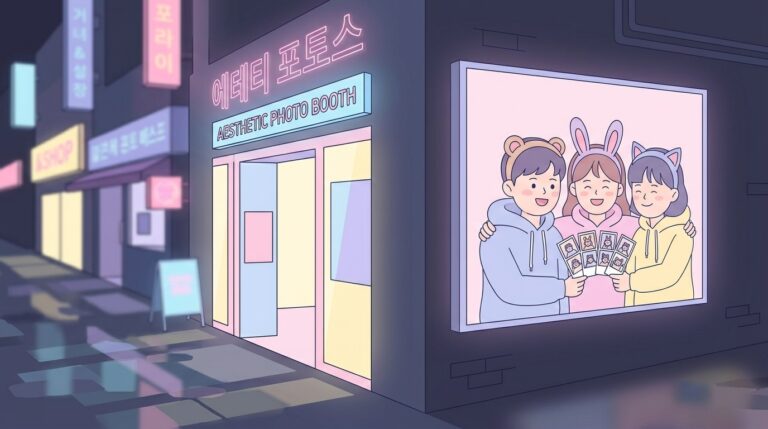
Have you ever walked down the neon-lit streets of Hongdae, Gangnam, or Seongsu and noticed bright, aesthetic shops packed with people wearing goofy animal hats, holding curling irons, and posing like K-pop idols? Welcome to the world of 인생네컷 (Insaeng-ne-keot) — “Life’s Four Cuts” (Korean photo booths)!
For Koreans, these aren’t just retro sticker pictures. They are a daily ritual, a memory diary, and the ultimate Instagram fuel. But if you’ve ever stepped into one, you might have felt a sudden rush of panic: “Which frame do I choose? How do we pose in under 10 seconds? What did that button mean?”
Don’t worry! Today, we are going to master the exact, trendy Korean expressions you need to sound like a local, pose like a pro, and navigate any Korean photo booth with absolute confidence. Let’s dive in!
Phase 2: Deep Dive into 3 Essential Expressions
1. 인생샷 건졌다! (Insaeng-syat geon-jeot-da!)
- Pronunciation: In-saeng-syat geon-jeot-da (Sounds like: “In-sang-shat gun-jut-dah”)
- Meaning: “I just snagged my life-shot!” (I got the perfect, once-in-a-lifetime photo!)
- K-Culture Moment: You’ll hear this constantly on Korean lifestyle vlogs or dramas when a character finally gets that flawless Instagram-worthy photo after taking 50 shots.
- Editor’s Insight: 인생 (Insaeng) means “life” and 샷 (syat) means “shot.” 건지다 (geon-jida) literally means to fish something out of the water or rescue it. Together, it means you “rescued” or “snagged” a masterpiece from a sea of mediocre photos.
- Situation Spectrum: Casual ✅ | Semi-formal ⚠️ | Formal 🚫
- 🤔 Think About It: Why do you think Korean youth prefix “Insaeng” (Life) to everyday things like “Insaeng photo,” “Insaeng menu,” or “Insaeng movie”? It shows how passionately Koreans celebrate small, perfect moments!
2. 소품 골라보자. (Sopum gol-la-bo-ja.)
- Pronunciation: So-pum gol-la-bo-ja (Sounds like: “So-poom gol-lah-bo-jah”)
- Meaning: “Let’s choose some props.”
- K-Culture Moment: Entering a photo booth booth feels like a mini costume party. Friends rush to the shelves to grab matching funny sunglasses, plush bunny ears, or quirky toy hammers.
- Editor’s Insight: 소품 (sopum) means props or accessories. 골라보자 (gol-la-bo-ja) comes from 고르다 (to choose) + ~어 보다 (to try doing) + ~자 (let’s). It’s the ultimate friendly invitation to start the fun.
- Situation Spectrum: Casual ✅ | Semi-formal ✅ | Formal 🚫
- 🤔 Think About It: How does choosing props together ease the awkwardness of taking photos? In Korea, it’s the perfect icebreaker!
3. 필터 뭐로 할까? (Pil-teo mwo-ro hal-kka?)
- Pronunciation: Pil-teo mwo-ro hal-kka? (Sounds like: “Peel-tuh mwo-ro hal-kah?”)
- Meaning: “Which filter should we use?”
- K-Culture Moment: After shooting, you have about 15 seconds to select a filter (bright, warm, black-and-white, or cool-toned) on the touch screen before the system auto-selects one.
- Editor’s Insight: 필터 (pil-teo) is the phonetic spelling of “filter.” 뭐로 할까? (mwo-ro hal-kka) means “Which one should we go with?” using the tentative, conversational ending ~(으)ㄹ까.
- Situation Spectrum: Casual ✅ | Semi-formal ✅ | Formal 🚫
- 🤔 Think About It: While Western trends often lean toward raw, unfiltered photos, K-beauty culture loves the soft, bright, and flawless look of Korean photo filters. Which style do you prefer?
Phase 3: Textbook Korean vs. Real-Life Korean
Situation 1: Suggesting to take a photo
- 📖 Textbook Korean: “사진을 찍읍시다.” (Sajineul jjigeupsida. – “Let’s take a photo.”)
- 🗣️ Real-Life Korean: “우리 네컷 사진 찍으러 가자!” (Uri ne-keot sajin jjigeureo gaja! – “Let’s go take four-cut photos!”)
- 💡 Why the difference? Textbook Korean is too stiff and formal for friends. Using 네컷 사진 (ne-keot sajin) instantly shows you know the trend, and ending with ~자 (let’s) feels warm and natural.
Situation 2: When the photo turns out amazing
- 📖 Textbook Korean: “사진이 아주 멋집니다.” (Sajini aju meotjimsida. – “The photo is very cool.”)
- 🗣️ Real-Life Korean: “와, 이거 완전 대박 잘 나왔다!” (Wa, igeo wanjeon daebak jal nawatda! – “Wow, this turned out absolutely amazing!”)
- 💡 Why the difference? Locals rarely use “멋집니다” in casual settings. They use 잘 나왔다 (jal nawatda – literally “came out well”) paired with the slang 완전 (wanjeon – totally) and 대박 (daebak – awesome).
Phase 4: K-Culture Deep Dive & Non-Verbal Manners
4-1. Nunchi & Etiquette in the Booth
- The Curling Iron Courtesy: Almost every booth shop has a vanity area with hair straighteners and hair dryers. Feel free to style your hair, but be mindful of 눈치 (Nunchi – situational awareness)! Don’t hog the mirror if others are waiting. Also, remember to turn off the power when done.
- The QR Code Checklist: On the start screen, always check the box that says QR 코드 동의 (Agree to QR Code). This prints a tiny QR code on your physical photo, allowing you to download the digital image and a cute video of you posing in real-time!
4-2. The “Four-Cut” Culture Code
In Korea, “four-cut photos” are a social archive. People stick their photos on their refrigerators, office monitors, or dedicated photo albums. Most booths also let you stick your “fails” or duplicates on the shop walls using masking tape, creating a massive, collaborative art wall of happy faces.
Phase 5: Interactive Roleplay Scenario
Setting: You are at a trendy Photoism booth in Hongdae with your Korean friend, Minji (민지). The timer is ticking, and the energy is high!
- Minji: “우와, 여기 소품 진짜 많다! 너 뭐 쓸래?” (Wow, there are so many props here! What do you want to wear?)
- You (🎭 Excitedly): “나 이 토끼 머리띠 쓸래! 너는?” (Na i tokki meoritti sseullae! Neoneun? – “I want to wear this bunny headband! How about you?”)
- Minji: “그럼 난 이거! 자, 이제 부스 안으로 들어가자.” (Then I’ll wear this! Okay, let’s go inside the booth now.)
- You (🎭 Pointing at screen): “화면 터치하고 수량 선택하면 돼?” (Hwamyeon teochihago suryang seontaekhamyeon dwae? – “Should I touch the screen and select the quantity?”)
- Minji: “응! 우리 두 장으로 하자. 결제는 카드로 할게.” (Yeah! Let’s do two copies. I’ll pay by card.)
- You (🎭 Posing quickly): “벌써 타이머 시작됐다! 첫 번째 포즈 뭐 하지?” (Beolsseo taimeo sijakdaetda! Cheot beonjjae poje mwo haji? – “The timer already started! What’s our first pose?”)
- Minji: “볼하트 하자, 볼하트!” (Let’s do a cheek heart, cheek heart!)
- You (🎭 Laughing as flash goes off): “아, 너무 웃겼어! 잘 나왔을까?” (Ah, neomu utgyeosseo! Jal nawasseulkka? – “Ah, that was so funny! Did it turn out well?”)
🔀 Interactive Choice Point
The photos are printed! Minji asks: “어때, 마음에 들어?” (How is it, do you like it?) How do you respond?
- Option A: “사진이 아주 좋습니다.” (Sajini aju joseumnida.)
- Option B: “대박! 우리 완전 인생샷 건졌어!” (Daebak! Uri wanjeon insaeng-syat geon-jeot-da!)
- Option C: “필터가 나빠요.” (Pilteoga nappayo.)
💡 Feedback:
- Option A (Risk): Grammatically correct, but way too robotic. Minji might feel a bit of social distance!
- Option B (Best): Perfect! It’s enthusiastic, natural, and uses the slang we just learned. Minji will high-five you!
- Option C (Bad): Too direct and blunt. If you don’t like the filter, it’s better to say “다른 필터가 더 나았을 것 같아” (I think another filter would have been better).
Phase 6: 10-Second Emotion Shadowing Drill
Practice saying these out loud with real emotion! Follow the pauses (/) and tone cues.
[😊 Super Excited]
“대박! / 우리 / 완전 / 인생샷 건졌어!”
(Dae-bak! / u-ri / wan-jeon / in-saeng-syat geon-jeot-da!)-
[🥺 Hurried & Panicked]
“어떡해! / 벌써 / 타이머 / 시작됐어!”
(Eo-tteok-hae! / beol-sseo / tai-meo / si-jak-daet-seo!) -
[🤔 Curious & Sweet]
“우리 / 무슨 포즈 / 할까?”
(U-ri / mu-seun po-jeu / hal-kka?)
Phase 7: K-Culture Mini Dictionary
- 머리띠 (Meoritti) | Headband / Hairband | Used to refer to the countless plush animal ears available at photo booths.
- 볼하트 (Bol-hateu) | Cheek Heart | A popular pose where you make a half-heart shape with your hand and press it against your cheek.
- 인생네컷 (Insaeng-ne-keot) | Life’s Four Cuts | Originally a specific brand name, but now used as a generic term for all photo booths in Korea.
- 소품 (Sopum) | Props | Sunglasses, hats, wigs, and toys used to spice up the photos.
Phase 8: Survivor Kit for Travelers
Survival Phrases TOP 3
- “카드 결제 돼요?” (Kadeu gyeolje dwaeyo?) – “Does it take card payments?” (Pro Tip: Almost all Korean photo booths are cashless now!)
- “재촬영 할게요.” (Jaechworyeong halgeyo.) – “We’ll retake the photos.” (Most booths offer a one-time ‘retake’ option if you mess up your first poses!)
- “비닐 봉투 어디 있어요?” (Binil bongtu eodi isseoyo?) – “Where are the plastic sleeves?” (Booths provide free plastic sleeves so your photos don’t get scratched in your bag.)
Editor’s Travel Note
When navigating popular areas, you can easily find nearby booths using the Naver Map App (네이버 지도). Just search for “인생네컷” or “포토이즘” (Photoism) to find the closest highly-rated booth. Note: Store configurations and payment options may vary by location.
Phase 9: Deepening Your Perspective (Thinking Corner)
In many Western cultures, photos are often taken to capture individual beauty or candid moments. In Korea, however, photo booths are highly collaborative and structured. Posing together in synchronized, cute poses (like matching hearts or funny faces) reflects the deep-rooted 공동체 문화 (gongdongche munhwa – community culture). It’s an interactive game where creating a shared, fun memory is more important than just looking perfect.
💬 Your Turn: What is the go-to pose with your friends when you take photos? Let us know in the comments below!
Phase 10: FAQ & Avoiding Common Mistakes
Q: Can I pay with cash in Korean photo booths?
A: While older booths accept 1,000 KRW bills, almost 90% of modern photo booths in trendy areas like Hongdae are card-only. Always keep a debit/credit card handy!
Q: How do I get the video of us posing?
A: You must check the “QR Code Agreement” (QR 코드 동의) on the screen before you pay. If you skip this, the QR code won’t print on your photo, and you won’t be able to download the digital video.
Q: Is there a time limit inside the booth?
A: Yes! Once the camera starts, you usually have 8 to 10 seconds per shot. It goes incredibly fast, so plan your 4 poses before you hit start!
🚨 Common Mistakes Alert!
- Mistake 1: Staring at the screen instead of the actual camera lens. (Correct Action: Look directly at the physical lens at the top of the booth when the countdown hits 1!)
- Mistake 2: Forgetting to peel off the backing tape of the photos. (Correct Action: These are usually printed on thick cardstock, not stickers. Don’t try to peel them unless they are specified as sticker sheets!)
Phase 11: Action Mission
- 🥉 Bronze Mission: Practice saying “인생샷 건졌어!” three times in front of the mirror with your best pose.
- 🥈 Silver Mission: Next time you take a selfie or a photo, post it on Instagram, tag @DailyHangul, and caption it: “오늘 완전 인생샷 건졌다!”
- 🥇 Gold Mission: Walk into a Korean photo booth, select your props, choose your frame, and complete a full shoot using only the Korean on-screen instructions!
Phase 12: Interactive Quiz Challenge
Test your K-Photo Booth knowledge!
1. What does “인생샷 건졌다” mean?
- A) I dropped my phone in the water.
- B) I took the worst photo of my life.
- C) I snagged the perfect, life-defining photo.
2. Fill in the blank: “소품 ______하자.” (Let’s choose some props.)
- A) 가자 (gaja)
- B) 골라보자 (gol-la-bo-ja)
- C) 먹자 (meokja)
🔍 Reveal Answers & Explanations
-
Correct Answer: C
Explanation: “인생샷” is a combination of life (인생) and shot (샷), meaning a once-in-a-lifetime photo! -
Correct Answer: B
Explanation: “골라보자” comes from 고르다 (to choose/select). Option A means “let’s go,” and Option C means “let’s eat!”







