

The Power of the Crowd: Understanding Korea’s Candlelight Vigils and Modern Civic Consciousness
Phase 1: Empathy (Welcome, Chingu!)
안녕하세요! (Annyeonghaseyo!) It’s your friendly neighborhood Korean editor from Daily Hangul! 👋
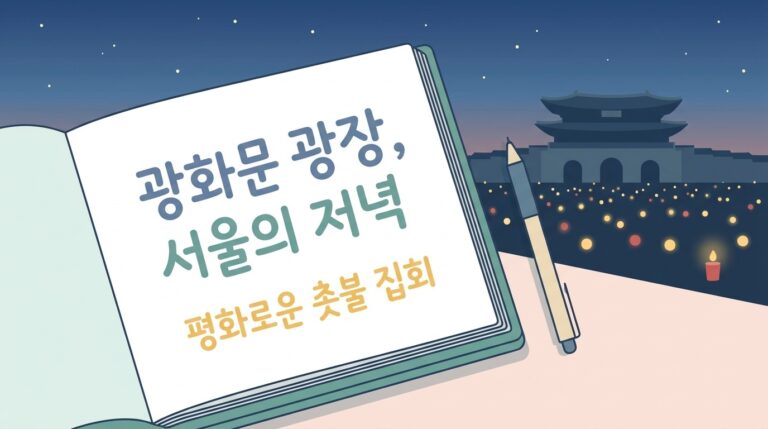
Imagine walking through the heart of Seoul—Gwanghwamun Square—on a crisp autumn evening. Instead of the usual bustling traffic, you are greeted by a breathtaking sea of warm, flickering lights. Thousands of people are sitting orderly on the asphalt, holding small paper-cup candles, singing in unison, and peacefully demanding political accountability. This is not a riot; it is a festival of democracy.
If you have watched K-Dramas like Stranger (비밀의 숲) or read about Korea’s rapid transformation from a war-torn nation to a cultural powerhouse, you have likely encountered this unique collective energy. For C1-level learners, discussing social movements and history in Korean can feel intimidating. You might ask yourself: “Am I using too formal of a tone? Do I sound like a textbook, or can I express complex political opinions naturally like a local?”
Today, we are diving deep into the vocabulary of modern Korean civic consciousness. By the end of this guide, you will be able to discuss civil movements, collective willpower, and historical turning points with the nuance and depth of a native speaker.
Phase 2: Deep-Dive into 3 Essential Expressions
Let’s explore three powerful terms that capture the essence of Korean civic action. These are not just words; they are the emotional and historical pillars of modern Korean society.
1. 평화 시위 (Pyeonghwa Siwi)
- Pronunciation: Pyeong-hwa Shi-wi (Rhymes with “young-wah” + “she-we”)
- Meaning: Peaceful Protest / Peaceful Demonstration
- K-Culture Moment: In news broadcasts and documentaries covering the 2016-2017 Candlelight Revolution (촛불 혁명), you will constantly hear reporters praise the pyeonghwa siwi for its lack of violence and festival-like atmosphere, complete with live music performances and free hot tea.
- Editor’s Insight: While “시위” (siwi) can sometimes carry a confrontational nuance, prefixing it with “평화” (pyeonghwa / peace) highlights a highly organized, non-violent, and family-friendly approach to assembly that Koreans take immense pride in.
- Situation Spectrum: Casual (⚠️) / Semi-formal (✅) / Formal (✅)
- 🤔 Think About It: How does your home country’s protesting culture compare to Korea’s highly organized pyeonghwa siwi, where citizens even clean up their own trash before leaving?
2. 목소리를 내다 (Moksorireul Naeda)
- Pronunciation: Mok-so-ri-reul Nae-da (Mok-so-ri like “oak-story” + reul + “nay-dah”)
- Meaning: To raise one’s voice; to speak out / make oneself heard (Literally: “To emit/produce a voice”).
- K-Culture Moment: Used frequently in contemporary social dramas and podcasts when characters urge citizens or marginalized groups to actively participate in public discourse.
- Editor’s Insight: Beyond the physical act of speaking, this idiom represents civic agency. It means transitioning from a passive observer to an active agent of social change.
- Situation Spectrum: Casual (✅) / Semi-formal (✅) / Formal (✅)
- 🤔 Think About It: Is there a social cause in your community where you felt compelled to “목소리를 내다”?
3. 시민 의식 (Simin Uisik)
- Pronunciation: Shi-min Ui-shik (Shi-min like “she-mean” + Ui-shik like “we-seek” with a soft ‘sh’)
- Meaning: Civic consciousness / Civic awareness / Public spirit
- K-Culture Moment: Sociological talk shows (like Alseonshinjob / 알쓸신잡) often dissect how Korea’s high simin uisik was the driving force behind overcoming national crises, from the 1997 IMF Gold Collecting Campaign to modern peaceful rallies.
- Editor’s Insight: This goes beyond just obeying the law. It represents a deep, collective responsibility toward one’s community and the nation’s democratic health.
- Situation Spectrum: Casual (⚠️ – a bit heavy for daily chit-chat) / Semi-formal (✅) / Formal (✅)
- 🤔 Think About It: Why is “시민 의식” so highly valued in a society historically rooted in collectivism?
Phase 3: Textbook Korean vs. Real-Life Korean
When discussing public gatherings, textbooks often teach outdated or overly rigid vocabulary. Let’s look at the real-life upgrades.
Situation 1: Describing a massive crowd gathering for a cause
- 📖 Textbook Korean: 사람들이 광장에 많이 모였습니다. (Saramdeuri gwangjange mani moyeotseumnida.) – “Many people gathered in the square.”
- 🗣️ Real-Life Korean: 광장이 시민들로 인산인해를 이루었어요. (Gwangjang-i simin-deul-lo insaninhae-reul irueosseoyo.) – “The square was a human sea of citizens (packed to the brim).”
- 💡 Why the difference? 인산인해 (In-san-in-hae / 人山人海) is a beautiful four-character idiom (Sajaseong-eo) literally meaning “mountains of people, seas of people.” C1 speakers use this to paint a vivid picture of immense scale.
Situation 2: Expressing deep empathy and solidarity with a movement
- 📖 Textbook Korean: 저도 그 사람들의 의견에 동의합니다. (Jeodo geu saramdeuri uigyeone dong-uihamnida.) – “I also agree with those people’s opinions.”
- 🗣️ Real-Life Korean: 저도 그분들의 뜻에 깊이 공감하고 연대하고 싶어요. (Jeodo geubundeurui ttause gipi gonggamhago yeondaehago sipeoyo.) – “I also deeply empathize and want to stand in solidarity with their cause.”
- 💡 Why the difference? In mature socio-political discussions, simply “agreeing” (동의) sounds clinical. Using 공감 (empathy) and 연대 (solidarity) shows emotional depth and sophisticated vocabulary choice.
Phase 4: K-Culture Deep-Dive & Non-Verbal Manners
4-1. Gestures, Eye Contact, and Etiquette at a Protest
If you ever attend a peaceful assembly in Korea, observing non-verbal etiquette is crucial:
* The Candlelight Grip: Hold your candle (usually in a paper cup to prevent dripping wax) at chest level. It is a symbol of peaceful vigil, not a weapon. Moving it aggressively is frowned upon.
* Space & Path-making: Even in a crowd of one million, people actively make paths for emergency services or families with strollers. Keep your hands close to your body and avoid pushing.
* Tidiness: Always take your trash with you. You will see volunteers carrying garbage bags at the end of a rally; helping them is considered the pinnacle of simin uisik.
4-2. The Cultural Code: Gwangjang (The Square) as a Living Stage
In Western history, squares were often sites of revolution and conflict. In Korea, Gwanghwamun Square (광화문광장) is a living, breathing historical stage. It’s where citizens celebrated the 2002 World Cup, where they mourned national tragedies, and where they held candles to change presidents. This unique spatial identity merges political protest with cultural festival, where you can buy street food, listen to rock bands, and demand constitutional reform all at once.
Phase 5: Real-Life Roleplay Scenario
Setting: A cozy cafe in Insadong, Seoul. Min-jun (a local history graduate student) and Sarah (a foreign exchange student) are discussing a documentary they just watched about the 2016 Candlelight Revolution.
Character Profiles:
- 민준 (Min-jun): Passionate about modern history, gentle, uses expressive language.
- 사라 (Sarah): Curiously analytical C1-level learner, eager to connect history to daily culture.
민준: 사라 씨, 방금 본 다큐멘터리 어땠어요? 한국의 촛불 집회에 대해 전부터 알고 있었나요?
      (Sarah, how did you find the documentary? Did you know about Korea's Candlelight Vigils before?)

사라: 🎭 (눈을 반짝이며) 정말 인상적이었어요! 그렇게 많은 사람들이 모였는데도 질서정연하다는 게 믿기지 않아요.
      (It was truly impressive! I can't believe how orderly it was despite so many people gathering.)

민준: 맞아요. 그 당시 광장은 정말 '평화 시위'의 정석이었죠. 폭력 사태 없이 문화제처럼 진행되었거든요.
      (Exactly. At that time, the square was the textbook definition of a 'peaceful protest.' It proceeded like a cultural festival without any violence.)

사라: 🎭 (고개를 끄덕이며) 네, 다큐멘터리에서 아이를 데려온 가족들이 축제처럼 즐기는 모습이 아주 신선했어요.
      (Yes, it was very refreshing to see families who brought their children enjoying it like a festival in the documentary.)

민준: 그것이 바로 우리가 흔히 말하는 성숙한 '시민 의식'의 힘이 아닐까 싶어요. 서로 배려하는 마음이요.
      (I think that is precisely the power of what we call mature 'civic consciousness.' A mind of mutual consideration.)

사라: 🎭 (진지한 표정으로) 단순한 불만이 아니라, 다 함께 더 나은 사회를 위해 '목소리를 내는' 모습이 감동적이었어요.
      (Rather than mere complaints, seeing everyone 'raising their voices' together for a better society was deeply moving.)

민준: 네, 평범한 시민들이 모여 역사의 물줄기를 바꾼 셈이죠. 사라 씨 나라에서는 이런 대규모 집회가 어떻게 진행되나요?
      (Yes, ordinary citizens gathered and essentially changed the course of history. How are these large-scale rallies held in your country?)

사라: 🎭 (생각에 잠기며) 우리나라도 시위가 자주 있지만, 이렇게 전 국민이 한마음으로 촛불을 드는 방식은 드문 것 같아요.
      (We have protests often in my country too, but I think this way of the whole nation holding candles with one heart is quite rare.)
🔀 Interactive Choice Point
How would you respond to Min-jun’s question about how protests are viewed in your country?
- Choice A (Best): “나라마다 표현 방식은 다르지만, 평화적으로 연대하려는 마음은 다 비슷한 것 같아요.” (Although methods of expression differ by country, I think the desire to peacefully stand in solidarity is similar.)
- Feedback: Excellent! You used the C1-level nuance 연대하다 (to stand in solidarity) and showed cultural empathy.
- Choice B (Bad): “우리 나라는 시위하면 다 부서지고 난리 나요.” (In my country, if there is a protest, everything gets destroyed and it’s a mess.)
- Feedback: Too colloquial and self-deprecating. While honest, it lacks the socio-cultural vocabulary expected at a C1 level.
- Choice C (Risk): “한국의 촛불 집회만 특별하고 최고인 것 같아요.” (I think only Korea’s candlelight vigils are special and the best.)
- Feedback: Risks sounding like empty flattery. A balanced comparative perspective is better for mature discourse.
Phase 6: 10-Second Emotional Shadowing Drill
To sound truly natural, you need to master the rhythm of pausing and emotional delivery. Practice this high-level sentence expressing admiration for civic action.
“수많은 시민들이 / 한마음 한뜻으로 / 평화롭게 목소리를 내는 모습이 / 정말 경이로웠어요.”
- Pronunciation Guide: Sumaneun simindeuri / han-ma-eum han-tteu-seuro / pyeong-hwa-rop-ge mok-so-ri-reul nae-neun mop-seub-i / jeong-mal gyeong-i-ro-weot-seo-yo.
- Rhythm Pause: Pausing briefly at
/helps emphasize the key concept of “one mind and one soul” (한마음 한뜻으로). - Emotion Guide:
[🥺 Deeply moved, with sincere admiration]Soften your voice slightly on “경이로웠어요” (it was wondrous/marvelous) to convey deep emotional resonance.
Phase 7: K-Culture Mini Dictionary
- 촛불 혁명 (Chot-bul Hyeok-myeong) | The Candlelight Revolution
- Refers specifically to the series of peaceful protests in Korea from 2016 to 2017 that led to the impeachment of the president. It is regarded as a hallmark of modern Korean democracy.
- 질서정연하다 (Jil-seo-jeong-yeon-hada) | Highly Orderly / Well-organized
- Used to describe scenes where massive crowds move in perfect sync, queue beautifully, and avoid chaos.
- 한마음 한뜻 (Han-ma-eum Han-tteut) | One Mind, One Intent
- An idiomatic expression describing complete unity of purpose among a group of people.
- 공론장 (Gong-ron-jang) | Public Sphere / Public Forum
- A sociological term for places (both physical like Gwanghwamun, and digital like online communities) where citizens freely debate and form public opinion.
Phase 8: Traveler’s Survival Kit
If you visit Seoul and find yourself near Gwanghwamun Square during a cultural event, keep these tips and phrases handy.
Survival Phrases
- “오늘 무슨 행사가 있나요?” (Oneul museun haeng-sa-ga in-na-yo?)
- Pro Tip: “Is there an event going on today?” Perfect for asking locals if you see a crowd gathering.
- “출구로 나가려면 어디로 가야 하죠?” (Chul-gu-ro na-ga-ryeo-myeon eo-di-ro ga-ya ha-jyo?)
- Pro Tip: “Which way should I go to reach the exit?” Crucial in dense crowds near subway stations.
- “길 좀 비켜주실 수 있을까요?” (Gil jom bi-kyeo-ju-shil su is-seul-kka-yo?)
- Pro Tip: “Could you please let me through?” A polite, high-level way to navigate through tightly packed public spaces.
Editor’s Travel Note 🗺️
When huge events happen in central Seoul, GPS signals can occasionally be laggy due to network congestion, and subway stations might bypass certain stops. Before heading out, check live transit updates using Naver Map App or KakaoMap. Also, public restrooms in nearby major buildings (like the Kyobo Bookstore building) are usually open to the public, but expect lines!
Phase 9:
Frequently Asked Questions (FAQ)
Q: What does "평화 시위 (Pyeonghwa Siwi)" mean in Korean and how do you pronounce it?
A: In Korean, "평화 시위 (Pyeonghwa Siwi)" is pronounced [Pyeong-hwa Shi-wi (Rhymes with "young-wah" + "she-we"] and means: Peaceful Protest / Peaceful Demonstration
Q: What does "목소리를 내다 (Moksorireul Naeda)" mean in Korean and how do you pronounce it?
A: In Korean, "목소리를 내다 (Moksorireul Naeda)" is pronounced [Mok-so-ri-reul Nae-da (Mok-so-ri like "oak-story" + reul + "nay-dah"] and means: To raise one's voice; to speak out / make oneself heard (Literally: "To emit/produce a voice").
Q: What does "시민 의식 (Simin Uisik)" mean in Korean and how do you pronounce it?
A: In Korean, "시민 의식 (Simin Uisik)" is pronounced [Shi-min Ui-shik (Shi-min like "she-mean" + Ui-shik like "we-seek" with a soft 'sh'] and means: Civic consciousness / Civic awareness / Public spirit







