

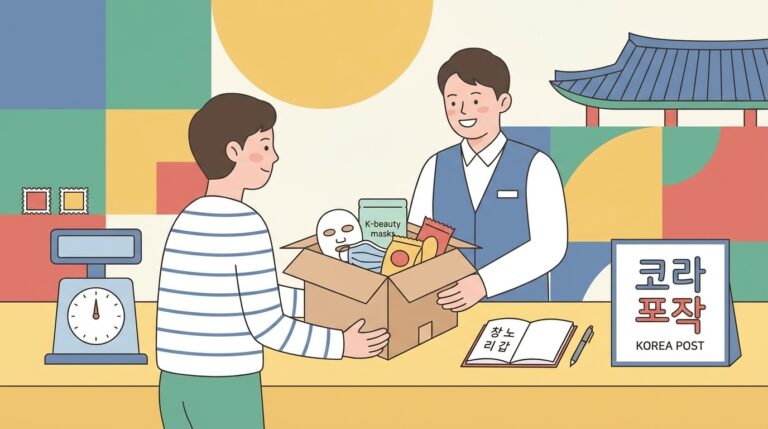
Sending K-Culture Vibes? How to Describe Your Package Contents at a Korean Post Office
Phase 1: Oh No, What’s Inside? (An Empathic Opening)
안녕하세요! (An-nyeong-ha-se-yo!) Hello, your favorite Korean language partner and editor from Daily Hangul is here!
Imagine this: You’ve had the time of your life in Seoul. You’ve gathered gorgeous K-beauty face masks, sweet Korean snacks (like Honey Butter Chips!), and a stack of K-Pop albums for your friends back home. Your suitcase is practically screaming, so you head to a local Korean post office (우체국 – U-che-guk) to ship a care package.
You stand in line, feeling confident. But then, the friendly clerk points to your open box and asks:
“내용물이 무엇인가요?” (Nae-yong-mul-i mu-eot-in-ga-yo?)
Gulp. Your mind goes blank. “Inside… snack… and… beautiful face thing?”
Don’t worry! This is a classic “pain point” for many travelers. Today, we are going to learn how to confidently declare your package contents in simple, natural Korean. By the end of this guide, you’ll breeze through the post office like a local!
Phase 2: Three Golden Expressions for Declaring Contents
Let’s break down the three most important phrases you need to know. These are perfect for beginner (A2) learners!
1. 내용물이 뭐예요? (Nae-yong-mul-i mwo-yae-yo?)
- Pronunciation: Nay-yong-mool-ee mwo-yay-yo? (Sounds like “nay-yong” + the English word “wool”)
- Meaning: “What are the contents?” (This is what the clerk will ask you!)
- K-Culture Moment: You will hear this expression in every K-Drama when a character ships a mysterious parcel—or when an idol receives a custom gift package from international fans!
- Editor’s Insight: 내용물 (nae-yong-mul) literally translates to “inside-use-object” (contents). The ending ~예요 makes it polite but friendly.
- Situation Spectrum: Casual (⚠️) / Semi-formal (✅) / Formal (✅)
- 🤔 Think About It: In English, we often ask “What’s inside?” which is very direct. In Korean, asking for the formal term “contents” (내용물) keeps things professional yet polite.
2. 화장품이랑 옷이 들어있어요. (Hwa-jang-pum-i-rang ot-i deul-eo-is-seo-yo.)
- Pronunciation: Hwa-jahng-poom-ee-rahng oht-ee deul-uh-eet-suh-yoh.
- Meaning: “There are cosmetics and clothes inside.”
- K-Culture Moment: The ultimate care package list! Sending trendy Korean clothes and skincare products to your besties.
- Editor’s Insight: ~랑 (rang) means “and” in conversational Korean. It’s much more natural than the textbook ~과/와 when speaking!
- Situation Spectrum: Casual (✅) / Semi-formal (✅) / Formal (⚠️)
- 🤔 Think About It: Listing items with ~이랑 (i-rang) keeps your sentences flowing smoothly without sounding like a robotic dictionary.
3. 깨지는 물건은 없어요. (Kkae-ji-neun mul-geon-eun eops-eo-yo.)
- Pronunciation: Kkae-jee-neun mool-guhn-eun uhp-suh-yoh.
- Meaning: “There are no fragile items.”
- K-Culture Moment: Essential to say when shipping fragile ceramic mugs from traditional markets in Insadong or delicate glass skincare bottles.
- Editor’s Insight: 깨지다 (kkae-ji-da) means “to break.” 깨지는 물건 literally means “breaking objects” (fragile items).
- Situation Spectrum: Casual (⚠️) / Semi-formal (✅) / Formal (✅)
- 🤔 Think About It: Keeping the post office staff informed shows respect for their hard work and ensures your package gets handled correctly!
Phase 3: Textbook Korean vs. Real Korean
When we learn from old-school textbooks, we often sound like legal documents. Let’s compare textbook phrases with how real Koreans talk at the post office counter!
Situation 1: Asking if there are forbidden items
- 📖 Textbook: “포장 상자 내부에 항공 수송 금지 물품이 포함되어 있습니까?” (Are air transport prohibited items included inside the packaging box?)
- 🗣️ 진짜 한국어 (Real Korean): “혹시 금지 물품 들어있어요?” (By any chance, are there forbidden items inside?)
- 💡 Why the difference? Real people value efficiency and speed, especially in fast-paced Korea! Using shorter, direct words like 금지 물품 (forbidden items) keeps things simple.
Situation 2: Asking if the food inside will spoil
- 📖 Textbook: “식료품의 부패 가능성이 존재합니까?” (Does the possibility of food decomposition exist?)
- 🗣️ 진짜 한국어 (Real Korean): “이거 상하는 음식이에요?” (Is this food that spoils/goes bad?)
- 💡 Why the difference? “상하다” (sang-ha-da) is the common, everyday verb for food going bad. It is much warmer and easier to understand than dry academic terms.
Phase 4: K-Culture Deep Dive & Non-verbal Manners
4-1. The Art of “Jeong” (정) and Post Office Etiquette
In Korea, we have a beautiful word called 정 (Jeong)—it represents deep affection, bonding, and sharing. Sending a package (택배 – Taek-bae) is a modern way of showing Jeong.
When declaring your items, follow these non-verbal tips to show great manners:
* Use Both Hands: When handing over your ID card, payment card, or customs declaration form, always hold it with both hands (or support your right forearm with your left hand). This is a sign of high respect!
* The Nod: When the clerk checks your box, gently nod your head to show you understand. It builds instant rapport.
4-2. The “K-Beauty & Snack” Shipping Craze
If you visit any post office in areas like Sinchon or Myeongdong, you will see global travelers packing boxes high with instant ramyun, seaweed snacks (김 – gim), and sheet masks. Because of strict air shipping rules, always remember: No pressurized spray cans or loose batteries!
Phase 5: Real-Life Roleplay Scenario
Let’s step into a lively post office in Seoul! You are Alex, and you are talking to Min-ji, a helpful post office clerk.
- Setting: A bustling post office near Hongdae.
- Characters:
- Alex (A2 Korean Learner): Excited but a bit nervous.
- Min-ji (Clerk): Efficient, friendly, and fast-paced.
💬 The Dialogue
- Min-ji: “어서 오세요! 이 박스 해외 배송이신가요?”
(Welcome! Is this box for international shipping?)🎭 Smiling warmly - Alex: “네, 미국으로 보낼 거예요.”
(Yes, I am going to send it to the USA.)🎭 Pointing at the destination address - Min-ji: “상자 안에 내용물이 뭐예요?”
(What are the contents inside the box?)🎭 Looking over the package - Alex: “과자랑 K-Pop 앨범이 들어있어요.”
(There are snacks and K-Pop albums inside.)🎭 Miming holding a CD - Min-ji: “혹시 스프레이나 배터리 같은 위험 물질은 없죠?”
(By any chance, there are no dangerous items like sprays or batteries, right?)🎭 Checking her screen guidelines - Alex: “네, 그런 거 전혀 없어요.”
(Yes, there’s absolutely nothing like that.)🎭 Shaking hands in a 'no' gesture - Min-ji: “좋습니다. 깨지는 물건도 없나요?”
(Great. No fragile items either?)🎭 Tapping the cardboard box - Alex: “네, 깨지는 건 없어요. 안전해요!”
(Yes, nothing fragile. It’s safe!)🎭 Smiling confidently
🔀 Interactive Choice Point
Min-ji asks you: “여기에 액체류(liquids)가 있습니까?” What do you say?
- Choice A: “액체 전혀 없어요.” (No liquids at all.)
- Feedback: BEST! Clear, accurate, and reassuring. The clerk will love your quick answer.
- Choice B: “몰라요.” (I don’t know.)
- Feedback: BAD. This might cause the clerk to ask you to open the sealed box to inspect it. Uh-oh!
- Choice C: “전부 선물이에요.” (Everything is a gift.)
- Feedback: RISK. While sweet, customs needs to know what the gift is. Be specific!
Phase 6: 10-Second Emotion Shadowing Drill
Let’s practice speaking with real Korean feelings! Pay attention to the pauses (/) and the emotional cues.
- “과자랑 / K-Pop 앨범이 / 들어있어요.”
- Emotion:
[😊 Brightly and proudly] - Focus: Say “과자랑” (kwa-ja-rang) with a cheerful bounce!
- Emotion:
- “깨지는 물건은 / 전혀 없어요!”
- Emotion:
[😌 Reassuringly and calmly] - Focus: Stress “전혀” (jeon-hyeo – not at all) to make the clerk feel safe.
- Emotion:
Phase 7: K-Culture Mini Dictionary
| Word (Hangul + Romanization) | English Translation | Real-Life Usage Note |
|---|---|---|
| 1. 택배 (Taek-bae) | Parcel / Delivery | You will see “택배” trucks everywhere in Korea. It’s the lifeblood of Korean shopping! |
| 2. 송장 (Song-jang) | Shipping Label / Invoice | The paper stick-on sheet where you write the sender and receiver’s addresses. |
| 3. 금지 물품 (Geum-ji mul-pum) | Prohibited Items | Items you cannot ship by air (like perfumes, aerosol cans, and batteries). |
| 4. 우표 (U-pyo) | Postage Stamp | Great to collect! Korean post offices sell beautiful limited-edition cultural stamps. |
Phase 8: Traveler’s Survival Kit
Survival Expressions TOP 3
- “가장 빠른 걸로 보내주세요.” (Ga-jang bba-reun geol-ro bo-nae-ju-se-yo.)
- Pro Tip: “Please send it via the fastest shipping option.” (Great for requesting EMS!)
- “우체국 상자 3호 하나 주세요.” (U-che-guk sang-ja sam-ho ha-na ju-se-yo.)
- Pro Tip: “Please give me one Post Office Box Size 3.” (Korean post office boxes are numbered 1 to 5 by size.)
- “테이프 어디에 있어요?” (Te-i-peu eo-di-e is-seo-yo?)
- Pro Tip: “Where is the packing tape?” (Every Korean post office has a free packing station with tape and scissors!)
📌 Editor’s Travel Note
When navigating to a post office in Korea, Google Maps might let you down! Instead, use local navigation apps. Search for “우체국” (Post Office) using the Naver Map App Download for instant, accurate directions.
(Note: Post offices in Korea are generally open from 9:00 AM to 6:00 PM on weekdays only. Hours may vary during public holidays.)
Phase 9: One Step Deeper
In many Western cultures, mail is simply utility. But in Korea, sending a package is an emotional event. Parents send homemade side dishes (밑반찬 – mit-ban-chan) to their children living in other cities. Friends send sweet treats to those studying hard for exams.
This culture of care means that when the post office clerk asks you “What is inside?” they are not just checking rules—they are helping you safely transport your precious “Jeong” (정) across the world.
💬 Your Turn: If you could send a box of Korean goodies to anyone in the world right now, what would you put inside? Let me know in the comments below!
Phase 10: FAQ & Common Mistakes
Q: Can I ship standard Korean cosmetics internationally?
A: Yes! Sheet masks, creams, and lotions are perfectly fine. Just make sure you do not ship pressurized spray cans (like mist sprays) as they are strictly prohibited on flights.
Q: How do I select the right box size?
A: Walk into any post office, and you will see sample boxes displayed on the wall with prices. Grab the box size you need, pack your items at the packing station, and pay for the box at the counter when shipping.
Q: Do I need to write the address in Korean?
A: For international packages, you can write the destination address in English. However, writing the destination country in bold Korean (e.g., 미국 for USA, 영국 for UK) helps local staff sort it much faster!
🚨 Common Mistakes Warning Board
- Mistake 1: Writing “GIFT” or “선물” as the only description.
- Correct Action: Be specific. Write “Clothes” (옷) or “Snacks” (과자) to avoid customs delays.
- Mistake 2: Leaving batteries inside electronic K-pop toys or lightsticks.
- Correct Action: Always open the toy and remove the AAA or AA batteries before packing.
- Mistake 3: Forgetting to tape the bottom of the box securely.
- Correct Action: Use the heavy-duty packing tape provided at the post office table. Make an “H” pattern on the bottom for maximum safety!
Phase 11: Action Mission!
- Bronze Mission: Look around your room right now. Say out loud 3 things you see using the “[Item]이랑 [Item]이 들어있어요” pattern.
- Silver Mission: Take a photo of your favorite Korean snack or beauty item, post it on social media, and write: “이거 친구한테 보낼 거예요!” (I will send this to my friend!)
- Gold Mission: Find a K-Drama scene set in a post office or showing a delivery courier, and listen carefully to see if you can hear the word “택배” (taekbae)!
Phase 12: Interactive Quiz Challenge
Test your post office survival skills!
1. Match the word to its meaning:
- A. 내용물 (Nae-yong-mul)
- B. 금지 물품 (Geum-ji mul-pum)
- C. 깨지는 물건 (Kkae-ji-neun mul-geon)
(Options: 1. Fragile items, 2. Contents, 3. Forbidden items)
🔍 View Answer & Explanation
Answer: A-2, B-3, C-1!
Remember, 내용물 is contents, 금지 물품 is forbidden items, and 깨지는 물건 refers to breakable/fragile things.
2. Fill in the blank:
“상자 안에 과자( ) 옷이 들어있어요.” (There are snacks AND clothes inside the box.)
🔍 View Answer & Explanation
Answer: 랑 (or 이랑 after consonants)
Since “과자” ends in a vowel, we use “랑” to make “과자랑” (snacks and…).
3. True or False:
Lithium batteries and aerosol hairsprays are allowed in international air shipping from Korea.
🔍 View Answer & Explanation
Answer: False!
These are classified as dangerous goods (위험 물질) and will be rejected at the post office counter. Always double-check before boxing them up!
Keep practicing, and next time you step into a Korean post office, you’ll be the coolest student in the room! 다음에 또 만나요! (See you next time!)







