

Never Get Confused in Korean Gift Shops Again: How to Order Exactly How Many Items You Want
Phase 1: Welcome to the Daily Hangul Shop!
안녕하세요! (An-nyeong-ha-se-yo!) Hello there! This is your Daily Hangul editor and your trusty local culture guide.
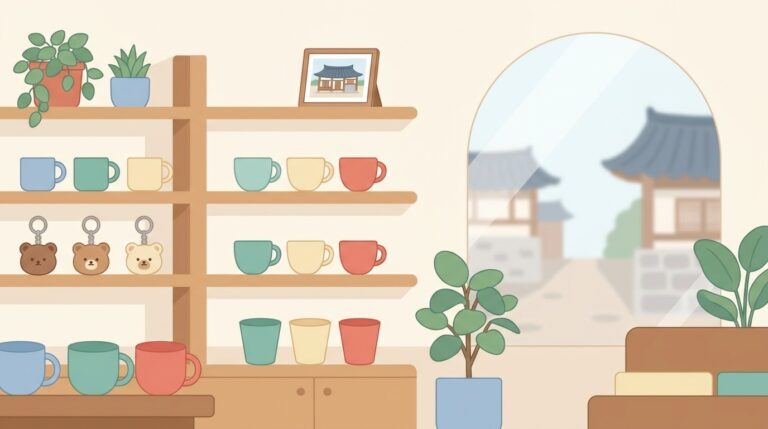
Imagine this: You are walking down a lively alley in Hongdae, Seoul. You step into a cozy, pastel-toned stationery shop filled with adorable stickers, animal keyrings, and aesthetic notebooks. Your heart does a little leap—you find the perfect bear-shaped phone grip. You want to buy one for yourself and one for your best friend.
You walk up to the friendly clerk at the register. They smile and ask how many you would like. Suddenly, your brain freezes. “Is it ‘il gae’? ‘ees gae’? Or ‘hana’?”
Don’t worry! Every Korean learner has stood right where you are. Counting things in Korean can feel tricky because Korean has two different number systems. But today, we are going to unlock the secret of Native Korean Numbers for shopping. By the end of this guide, you will be ordering your favorite items with absolute confidence, just like a local. Let’s dive in!
Phase 2: Core Expressions – The Shopping Trio
To buy items smoothly, you only need to master three basic building blocks. Let’s look at them closely.
1. 한 개 (han gae)
- Pronunciation: hahn-gheh (sounds like “hahn” + “ge” in “get”)
- Meaning: One item (Directly: “One piece”)
- K-Culture Moment: If you watch K-dramas, you will often see characters ordering “한 개” of their favorite street food snack, like a single skewer of spicy tteokbokki!
- Editor’s Insight: The standalone word for the number one is 하나 (ha-na). However, when we add a counter word like 개 (gae – item) right after it, “하나” shrinks to 한 (han). It is just like how “one” changes to “a” or “an” in English to flow better!
- Situation Spectrum: Casual ✅ | Semi-formal ✅ | Formal ✅ (Perfect for any shop!)
- 🤔 Think About It: Why do you think Korean uses different shapes for numbers when counting items versus just saying the number alone? Does your native language have similar changes?
2. 두 개 주세요 (du gae ju-se-yo)
- Pronunciation: doo-gheh-joo-seh-yo (sounds like “do” + “get” + “joo-say-yo”)
- Meaning: Please give me two.
- K-Culture Moment: Imagine buying two sweet, warm red-bean fish breads (붕어빵, bungeoppang) on a cold winter night to share with your friend.
- Editor’s Insight: Just like number one, the number two, 둘 (dul), drops its final ‘l’ sound and becomes 두 (du) when followed by the counter 개 (gae).
- Situation Spectrum: Casual ⚠️ (Without ‘요’) | Semi-formal ✅ | Formal ✅
- 🤔 Think About It: “주세요” is the magic polite key in Korea. Adding it to the end of any count makes you instantly sound sweet and respectful. How do you polite-check your orders at home?
3. 세 개 (se gae)
- Pronunciation: seh-gheh (sounds like the word “say” + “get”)
- Meaning: Three items
- K-Culture Moment: Getting three matching K-pop character keyrings at a merchandise shop in Myeongdong.
- Editor’s Insight: The pattern continues! The number three, 셋 (set), sheds its final sound and becomes 세 (se) before the counter.
- Situation Spectrum: Casual ✅ | Semi-formal ✅ | Formal ✅
- 🤔 Think About It: Notice how natural “세 개” (seh-gheh) feels to say compared to “셋 개” (set-gheh). Korean pronunciation naturally softens to make speaking easier!
Phase 3: Textbook Korean vs. Real Korean
Let’s compare what formal grammar books teach you versus what you will actually hear on the streets of Seoul.
Scenario A: Ordering apples at a market
- 📖 Textbook Korean: “사과 세 개를 구매하기를 원합니다.” (sa-gwa se gae-reul gu-mae-ha-gi-reul won-hap-ni-da.)
- Meaning: “I desire to purchase three pieces of apples.”
- 🗣️ Real Korean: “사과 세 개 주세요.” (sa-gwa se gae ju-se-yo.)
- Meaning: “Three apples, please!”
- 💡 Why is it different? Real-life shopping is all about speed and friendliness. You don’t need heavy grammar like “I desire to purchase.” Simply name the item, say the count, and add “주세요” (please give).
Scenario B: Ordering a book
- 📖 Textbook Korean: “책 한 개를 주십시오.” (chaek han gae-reul ju-sip-si-o.)
- Meaning: “Please bestow upon me one piece of book.”
- 🗣️ Real Korean: “책 한 권 주세요.” (chaek han gwon ju-se-yo.)
- Meaning: “One book, please.”
- 💡 Why is it different? While “개” (gae) is the ultimate general counter for objects, books have their own special counter: 권 (gwon). Using “권” makes you sound like an absolute pro!
Phase 4: K-Culture Deep Dive & Non-verbal Manners
4-1. Nunchi & Hand Gestures
When ordering in Korea, body language says a lot!
* How to point: Avoid pointing with a single stiff index finger. Instead, use a soft, open hand gesturing toward the item you want. It shows respect and good Nunchi (tact/awareness).
* Counting on fingers: When showing “two” with your hand, raise your index and middle finger (like a peace sign) with your palm facing the clerk.
* Eye Contact: Keep soft, friendly eye contact and give a light nod when saying “감사합니다” (gam-sa-ham-ni-da – Thank you) after receiving your items.
4-2. The “1+1” and “2+1” Convenience Store Culture
Walk into any Korean convenience store like GS25, CU, or 7-Eleven, and you will see bright tags on shelves reading “1+1” (one plus one) or “2+1” (two plus one).
This is a huge part of daily life in Korea! If you bring two items of a “2+1” deal to the counter, the clerk might kindly say:
“하나 더 가져오세요!” (ha-na deo ga-jyeo-o-se-yo!)
“Bring one more! (It’s free!)”
Now you can reply with a big smile: “아, 감사합니다!” (Ah, gam-sa-ham-ni-da! – Oh, thank you!).
Phase 5: Real-Life Roleplay
Setting: A trendy stationery and lifestyle shop in the artistic neighborhood of Yeonnam-dong.
Characters: You and Minji (민지), the friendly shop manager.
Minji: "어서 오세요! 찾으시는 물건 있으세요?"
       (eo-seo o-se-yo! chat-eu-si-neun mul-geon is-seu-se-yo?)
       🎭 [Smiling warmly, tidying up cute bear keyrings]
       "Welcome! Are you looking for anything in particular?"

You:   "네, 이 그립톡 너무 귀여워요."
       (ne, i geu-rip-tok neo-mu gwi-yeo-wo-yo.)
       🎭 [Pointing softly to a brown bear phone grip]
       "Yes, this phone grip is so cute."

Minji: "그거 요즘 정말 인기 많아요! 선물용으로도 좋아요."
       (geu-geo yo-jeum jeong-mal in-gi man-ah-yo! seon-mul-yong-eu-ro-do jo-ah-yo.)
       🎭 [Nodding enthusiastically]
       "That one is super popular lately! It's great as a gift, too."

You:   "이거 두 개 주세요."
       (i-geo du gae ju-se-yo.)
       🎭 [Holding up two fingers with palm facing Minji]
       "Two of these, please."

Minji: "네, 두 개요. 선물 포장해 드릴까요?"
       (ne, du gae-yo. seon-mul po-jang-hae deu-ril-kka-yo?)
       🎭 [Showing a small pastel gift box]
       "Sure, two. Would you like gift wrapping?"

You:   "아니요, 괜찮아요. 그냥 주세요."
       (a-ni-yo, gwaen-chan-ah-yo. geu-nyang ju-se-yo.)
       🎭 [Waving hand gently with a soft smile]
       "No, thank you. Just as they are, please."

Minji: "네! 봉투 필요하세요?"
       (ne! bong-tu pil-yo-hae-se-yo?)
       🎭 [Holding up a small paper shopping bag]
       "Okay! Do you need a bag?"

You:   "네, 한 개 주세요."
       (ne, han gae ju-se-yo.)
       🎭 [Nodding politely]
       "Yes, please give me one."
🔀 Your Turn: What would you say next?
Minji asks if you want to add a cute sticker sheet. Choose your response:
* A) “네, 이 개 주세요” (ne, i gae ju-se-yo)
* B) “네, 두 개 주세요” (ne, du gae ju-se-yo)
* C) “네, 둘 개 주세요” (ne, dul gae ju-se-yo)
💡 Feedback on Your Choice:
- If you chose A: ❌ Bad. “이” (i) is a Sino-Korean number (used for money/dates). We never use it with the item counter “개”. The clerk will be confused!
- If you chose B: Best! You correctly changed “둘” to “두” and added the counter “개” with the polite ending “주세요”. Outstanding!
- If you chose C: ⚠️ Risk. You used the correct native number system, but forgot to drop the final sound of “둘” before the counter. Minji will understand you, but she might gently clarify: “아, 두 개요?” (Ah, two?)
Phase 6: 10-Second Emotional Shadowing Drill
Let’s practice speaking with real Korean emotion! Keep an eye on the pause marks / and emotional cues.
- “이거 / 두 개 / 주세요!”
- [😊 Friendly & Excited – imagine buying sweet snacks!]
- ee-geo / doo-gheh / joo-seh-yo!
- “한 개만 / 주세요.”
- [🥺 Soft & Gentle – asking for just one gently]
- hahn-gheh-mahn / joo-seh-yo.
- “봉투 / 한 개 / 주세요.”
- [😐 Polite & Calm – at the checkout counter]
- bong-too / hahn-gheh / joo-seh-yo.
Phase 7: K-Culture Mini Dictionary
| Word (Korean + Romanization) | Translation | Everyday Usage & Local Context |
|---|---|---|
| 개 (gae) | General item counter | The ultimate lifesaver! Use this for apples, phone grips, keyrings, and almost any solid object. |
| 잔 (jan) | Cup / Glass counter | Crucial for cafes! Use this to order “커피 한 잔” (one cup of coffee) or “맥주 두 잔” (two glasses of beer). |
| 병 (byeong) | Bottle counter | Essential at restaurants. Use it to order “콜라 한 병” (one bottle of cola) or “소주 두 병” (two bottles of Soju). |
| 봉지 (bong-ji) | Bag counter | Perfect for grocery shopping or snack runs. Use it for “감자칩 한 봉지” (one bag of potato chips). |
Phase 8: The Traveler’s Survival Kit
Survival Expressions TOP 3
- “이거 얼마예요?” (i-geo eol-ma-yeo?)
- Meaning: How much is this?
- Pro Tip: Simply point to the item and say this with a warm smile.
- “카드 돼요?” (ka-deu dwae-yo?)
- Meaning: Do you take cards?
- Pro Tip: South Korea is almost completely cashless. Even for a 1,000 KRW drink, card payment is standard!
- “영수증 괜찮아요.” (yeong-su-jeung gwaen-chan-ah-yo.)
- Meaning: I’m fine without a receipt.
- Pro Tip: Keep your wallet light by declining paper receipts at fast checkouts.
🗺️ Editor’s Travel Note
When traveling, navigation is key! Ditch other map apps and make sure to download the Naver Map App to find local boutique shops, cute cafes, and markets. Also, look into getting a Korea Tour Card for effortless transit payments and handy shopping discounts across the city!
Phase 9: One Step Deeper – The Story Behind Two Numbers
Why does Korean have both Native and Sino-Korean numbers? It reflects Korea’s rich history.
Sino-Korean numbers (일, 이, 삼…) were adopted long ago from Chinese characters and are used for formal, structured measurements like money, dates, and phone numbers. Native Korean numbers (하나, 둘, 셋…) represent the true, warm heart of daily living—used for counting objects, people, hours, and age.
It is a beautiful system where history and daily human connection exist side-by-side.
💬 Your Turn
What is the absolute first thing you want to buy when you land in Seoul? Tell us in the comments below! (e.g., “I want to buy 두 개 of milk tea!”)
Phase 10: FAQ & Common Mistakes
Q: Can I just use “개” (gae) for everything if I forget other counters?
A: Absolutely! As an A1 beginner, “개” is your absolute best friend. Even if a book has its own counter (“권”), saying “책 한 개” is perfectly understandable. No local will judge you; they will love that you are trying!
Q: When do I use Native Korean numbers versus Sino-Korean numbers?
A: Use Native numbers (한, 두, 세…) when you are physically counting items, people, or hours. Use Sino-Korean numbers (일, 이, 삼…) for prices, room numbers, phone numbers, and dates.
Q: Is there a difference between “하나” and “한”?
A: Yes! Use “하나” (ha-na) when counting by itself (e.g., “One, two, three!” -> “하나, 둘, 셋!”). Use “한” (han) only when a counter word like “개” directly follows it (e.g., “한 개”).
🚨 The “Oops!” Board: Common Beginner Mistakes
| Common Mistake | Correct Action | Why? |
|---|---|---|
| Saying “일 개 주세요” (il gae ju-se-yo) | Say “한 개 주세요” (han gae ju-se-yo) | “일” is Sino-Korean. Always use Native numbers (“한”) with physical counters like “개”. |
| Saying “둘 개 주세요” (dul gae ju-se-yo) | Say “두 개 주세요” (du gae ju-se-yo) | “둘” drops its final letter ‘ㄹ’ to become “두” when followed by a counter. |
| Pronouncing 셋 개 as set-gae | Pronounce it as 세 개 (seh gae) | “셋” drops its final letter ‘ㅅ’ to become “세” before a counter. |
Phase 11: Action Mission – Choose Your Challenge!
- 🥉 Bronze Mission (Solo): Stand in front of your fridge. Find an apple, an egg, or a water bottle. Point at it and say out loud: “이거 한 개 주세요!”
- 🥈 Silver Mission (Social): Record a quick 5-second audio of yourself saying “이거 두 개 주세요” and share it on Instagram. Tag us
@DailyHangulso our editors can send you cheering feedback! - 🥇 Gold Mission (Real-Life): Next time you visit a local Asian supermarket or order Korean food online, say “세 개” (three items) out loud while packing your basket!
🎮 K-Culture Search Mission
Watch any slice-of-life K-drama tonight (like Reply 1988 or Our Blues). Keep your ears open during convenience store or market scenes. Can you spot the characters saying “주세요” (ju-se-yo)? Let us know if you hear it!
Phase 12: Interactive Quiz Challenge
Test your new skills! Tap each question to reveal the correct answer.
1. Which of the following is the correct way to order 3 keyrings?
- A) 삼 개 주세요 (sam gae ju-se-yo)
- B) 셋 개 주세요 (set gae ju-se-yo)
- C) 세 개 주세요 (se gae ju-se-yo)
🔍 Reveal Answer & Explanation
Correct Answer: C) 세 개 주세요 (se gae ju-se-yo)
Explanation: The number three (셋) drops its final ‘ㅅ’ to become ‘세’ before the counter ‘개’. Option A uses a Sino-Korean number, and Option B forgets to drop the final letter!
2. Fill in the blank: “Coffee, please!” -> “커피 한 ____ 주세요.”
- A) 병 (byeong)
- B) 잔 (jan)
- C) 개 (gae)
🔍 Reveal Answer & Explanation
Correct Answer: B) 잔 (jan)
Explanation: ‘잔’ is the specific counter for cups and glasses. While ‘개’ (Option C) would be understood, using ‘잔’ makes you sound beautifully natural!
3. True or False: In Korea, “1+1” on a store shelf means “Buy 1, Get 1 Free.”
- A) True
- B) False
🔍 Reveal Answer & Explanation
Correct Answer: A) True
Explanation: Yes! “1+1” (one plus one) is Korea’s super popular deal. Make sure to bring both items to the register to claim your freebie!
Note: Travel and store promotion details in this guide are subject to change by local operators.







