

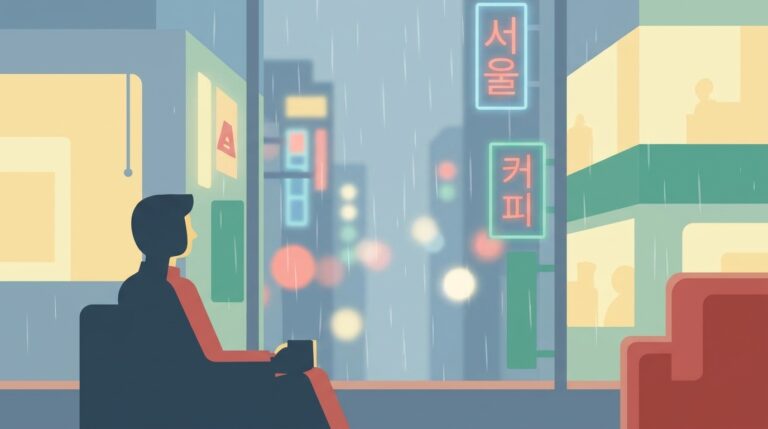
Is It Burnout, or Is It Korea? Decoding the Silent Exhaustion of the ‘Piro-Sahoe’
Phase 1: Empathy (스토리 몰입형 오프닝)
안녕하세요! Welcome back to another deep dive with Daily Hangul. I’m your local culture navigator and senior editor.
Imagine this: It’s 10:00 PM on a Tuesday in Yeouido, Seoul’s financial hub. Looking up at the towering glass skyscrapers, you notice almost every floor is still lit. Inside, sitting in front of dual monitors, is a brilliant professional. They have achieved the “Korean Dream”—a prestigious job, a neat apartment, and a polished resume. Yet, as they stare at another spreadsheet, a heavy, cold weight settles in their chest. It’s not just fatigue; it’s a profound, hollow sense of emptiness.
In Korea, we call this 번아웃 증후군 (Burnout Syndrome), but it’s rarely just an individual’s struggle. When you watch K-dramas like My Liberation Notes (나의 해방일지) or Misaeng (미생), you see characters suffocated not by physical labor, but by the relentless, structural pressure to conform, compete, and constantly self-optimize.
Today, we are stepping into the realm of C2 (Advanced) Korean. We aren’t just learning how to say “I’m tired.” Instead, we will dissect the sociological and psychological machinery behind modern Korean exhaustion. By mastering these nuanced, high-level concepts, you won’t just speak Korean—you will understand the collective subconscious of a society caught between traditional collectivism and hyper-capitalism. Let’s begin.
Phase 2: 핵심 표현 3선 심층 분석 (Deep-Dive Expressions)
1. 피로사회 (Piro-sahoe)
- Pronunciation: [Pi-ro-sa-hoe] (Sounds like pee-roh-sah-way)
- Meaning: “Fatigue Society” or “Burnout Society”
- K-Culture Moment: This term, popularized by the Korean-German philosopher Byung-Chul Han, is frequently referenced in serious Korean cultural essays, podcast panels, and intellectual dramas when discussing why modern Koreans feel perpetually exhausted despite technological advancement.
- Editor’s Insight: Unlike simply being tired (피곤하다), 피로사회 refers to a systemic, cultural condition where individuals voluntarily exploit themselves in the name of achievement, mistakenly believing they are free.
- Situation Spectrum: Casual (🚫) / Semi-formal (⚠️) / Formal (✅)
- 🤔 Think About It: Does your home country feel like a piro-sahoe, or is productivity viewed as a means to an end rather than an end in itself?
2. 갓생 살기 (Gat-saeng Salgi)
- Pronunciation: [Gat-saeng-sal-gi] (Sounds like gat-sang-sal-ghee)
- Meaning: Living a “God-life” (an ultra-productive, highly disciplined life)
- K-Culture Moment: Look up “갓생 브이로그” (Gat-saeng Vlogs) on YouTube. You’ll see young Koreans waking up at 5:00 AM, studying for certifications, working out, and journaling, all before their actual workday begins.
- Editor’s Insight: While “갓생” sounds incredibly positive, psychologists argue it is a coping mechanism. In a structural system where upward mobility is stagnant, controlling one’s micro-habits becomes a defense mechanism against existential anxiety.
- Situation Spectrum: Casual (✅) / Semi-formal (✅) / Formal (🚫)
- 🤔 Think About It: Is the pursuit of a “God-life” empowering, or is it just another layer of structural pressure disguised as self-care?
3. 현타가 오다 (Hyeontaga Oda)
- Pronunciation: [Hyeon-ta-ga-o-da] (Sounds like hyun-tah-gah-oh-dah)
- Meaning: A sudden reality check; the crash after hyper-focus; realizing the futility of one’s efforts.
- K-Culture Moment: Commonly used in variety shows when a celebrity works incredibly hard at a ridiculous game, only to realize the prize is a single piece of fruit.
- Editor’s Insight: Short for “현자타임” (Sage Time), this slang has evolved into a deeply psychological term representing the moment of disillusionment when you realize that running on the corporate treadmill hasn’t brought you actual happiness.
- Situation Spectrum: Casual (✅) / Semi-formal (⚠️) / Formal (🚫)
- 🤔 Think About It: When was the last time you worked incredibly hard for a goal, only to experience hyeonta once you achieved it?
Phase 3: 교과서 한국어 vs 진짜 한국어 (Textbook vs. Real Korean)
Situation 1: Expressing complete mental and physical depletion.
- 📖 Textbook Korean: “직장 생활이 너무 고단하여 심신이 대단히 지쳤습니다.”
- Translation: “Because corporate life is very exhausting, my mind and body are extremely tired.”
- 🗣️ 진짜 한국어 (C2 Level): “끝없는 경쟁 속에 치이다 보니, 결국 번아웃이 와서 영혼까지 갈려 나간 기분이에요.”
- Translation: “Being constantly jostled in this endless competition, I’ve ended up hit by burnout, and I feel like my very soul has been ground away.”
- 💡 왜 다를까? (Why is it different?): The textbook sentence is sterile and grammatically dry. Real Koreans use violent, visceral metaphors like “영혼이 갈리다” (to have one’s soul ground down like coffee beans) to express the structural extraction of their labor and energy.
Situation 2: Explaining why you can’t stop working even when exhausted.
- 📖 Textbook Korean: “사회 구조적인 도태가 두려워 일을 멈출 수 없습니다.”
- Translation: “I cannot stop working because I fear being structurally marginalized by society.”
- 🗣️ 진짜 한국어 (C2 Level): “남들보다 뒤처지거나 도태될까 봐, 불안해서 손에서 일을 못 놓겠어요.”
- Translation: “I’m terrified of falling behind others or being obsolete (marginalized), so the anxiety keeps me from letting go of work.”
- 💡 왜 다를까? (Why is it different?): Advanced natural Korean relies heavily on the psychological state of “도태” (natural selection/obsolescence) and the visceral phrase “손에서 일을 못 놓다” (unable to release work from one’s hands), depicting a physical inability to rest.
Phase 4: K-Culture 딥다이브 & 비언어적 매너
4-1. 눈치 (Nunchi) & Non-Verbal Exhaustion
In a C2 context, understanding burnout requires understanding Korean non-verbal language. When a colleague is experiencing systemic burnout:
* 한숨 쉬기 (Heavy Sighing): In many Western cultures, a loud, deep sigh is considered passive-aggressive or rude. In Korea, a deep, resonant sigh (땅이 꺼지도록 쉬는 한숨—a sigh deep enough to sink the earth) is often accepted as a natural outlet for han (한) or systemic frustration.
* 시선 처리 (The Resigned Gaze): Instead of keeping sharp eye contact, a burnt-out colleague will often stare blankly into the distance (멍 때리다). It is polite not to snap them out of it immediately; give them their momentary mental sanctuary.
4-2. The Structural Mirror of My Liberation Notes
In the masterpiece K-drama My Liberation Notes, the characters complain not of physical ailments, but of the exhausting social expectations—such as mandatory corporate socializing clubs (동호회). The dialogue elegantly critiques the “social tax” of Korean professional life. It highlights how collectivism, which once rebuilt Korea from ruins, has mutated into a structural cage of peer pressure, leading to an epidemic of silent burnout.
Phase 5: 실전 롤플레이 시나리오 (Roleplay Script)
Setting: A cozy, dim alleyway izakaya in Mapo, Seoul. Rain is pattering outside. Two friends, Ji-min (a senior Korean corporate manager) and Alex (an advanced expat researcher), are unwinding after an exhausting quarterly review.
- 지민 (Ji-min): 🎭 (술잔을 돌리며 깊은 한숨을 쉰다) 하아… 알렉스 씨, 요즘 회사 다닐 맛 나요? 저는 진짜 영혼 탈곡기에 들어갔다 나온 기분이에요.
- [Rotating her glass, sighs deeply] Haa… Alex, do you find work meaningful lately? I feel like I’ve just been put through a soul-threshing machine.
- 알렉스 (Alex): 🎭 (공감하며 고개를 끄덕인다) 안 그래도 지민 씨 안색이 안 좋아 보였어요. 분기 실적 압박 때문에 그래요, 아니면 구조적인 문제예요?
- [Nods with empathy] I noticed you didn’t look too well, Ji-min. Is it because of the quarterly performance pressure, or is it a structural issue?
- 지민 (Ji-min): 🎭 (자조적인 미소를 지으며) 둘 다죠. 우리 사회 자체가 끝없이 자신을 채찍질해야 직성이 풀리는 피로사회잖아요. 조금이라도 쉬면 당장 도태될 것 같은 불안감이 엄습해요.
- [With a self-deprecating smile] Both. Our society itself is a ‘Fatigue Society’ that is only satisfied when it constantly whips itself. The moment I rest even a little, the anxiety of becoming obsolete hits me.
- 알렉스 (Alex): 🎭 (술을 한 모금 마신다) 맞아요. 한국의 ‘갓생’ 트렌드도 결국엔 불안을 이겨내려는 눈물겨운 몸부림처럼 보여요. 주체적인 삶이라기보다 살아남기 위한 생존 전략이랄까.
- [Takes a sip of alcohol] Exactly. The Korean ‘Gat-saeng’ trend also looks like a tearful struggle to overcome anxiety. Rather than an autonomous life, it feels like a survival strategy to stay afloat.
- 지민 (Ji-min): 🎭 (눈이 동그래지며) 정확해요! 남들 눈치 보랴, 스펙 쌓으랴, 내 삶의 주도권은 어디 갔나 싶어 문득 현타가 세게 와요.
- [Eyes widening] Precisely! Caring about what others think, piling up specs—I suddenly get hit hard by ‘hyeonta’, wondering where the control over my own life went.
- 알렉스 (Alex): 🎭 (잔을 부딪치며) 지민 씨 잘못이 아니에요. 이건 개인의 나약함이 아니라, 시스템이 우리에게 과부하를 걸고 있는 거니까요.
- [Clinks glasses] It’s not your fault, Ji-min. This isn’t individual weakness; the system is overloading us.
- 지민 (Ji-min): 🎭 (잔을 비우며 가벼운 미소를 짓는다) 고마워요, 알렉스 씨. 한국 사람보다 제 마음을 더 잘 알아주네요. 우리 오늘 밤만큼은 ‘갓생’ 말고 ‘막생’ 살아요!
- [Empties her glass and smiles lightly] Thank you, Alex. You understand my mind better than Koreans do. Tonight, let’s live a ‘careless life’ instead of a ‘God-life’!
- 알렉스 (Alex): 🎭 (웃음을 터뜨리며) 좋습니다! 오늘은 영혼 충전의 날로 지정하죠!
- [Bursting into laughter] Sounds good! Let’s designate tonight as Soul Recharge Day!
🔀 Interactive Choice (인터랙티브 분기점)
At this moment, Ji-min asks you: “알렉스 씨는 번아웃이 올 때 어떻게 극복해요?” (How do you overcome burnout, Alex?)
- Option A: “저는 그냥 아무것도 안 하고 멍 때려요. 생산성 강박에서 벗어나는 게 우선이니까요.”
- Option B: “더 열심히 운동하고 공부해서 극복해요. 원래 위기는 정면 돌파해야죠!”
- Option C: “한국 사회의 구조적 모순을 생각하면 그냥 다 포기하고 이민 가고 싶어요.”
💡 Feedback on Your Choice:
- Best Choice (Option A): 🌟 Excellent! This shows an advanced understanding of the psychological remedy to Piro-sahoe. Encouraging “멍 때리기” (blank spacing) directly challenges the relentless drive of Korean overwork culture.
- Risk Choice (Option B): ⚠️ Be careful. While proactive, telling a burnt-out Korean to solve burnout by “working harder” (정면 돌파) can sound like toxic positivity, potentially exacerbating their feelings of structural entrapment.
- Bad Choice (Option C): 🚫 Too pessimistic and heavy. While structurally accurate, declaring that you want to pack up and leave can kill the supportive, friendly atmosphere of the drinking table.
Phase 6: 10초 감정 섀도잉 드릴 (Shadowing Drill)
Practice saying these high-level sentences with the exact emotional cadence of a native speaker. / denotes a natural pause.
[🥺 지치고 쓸쓸한 목소리로]
“열심히 살면 / 행복해질 줄 알았는데… / 남는 건 / 깊은 번아웃뿐이네요.”
(Yeol-sim-hi sal-myeon / haeng-bok-hae-jil jul a-rat-neun-de… / nam-neun geon / gi-peun beon-a-ut-ppun-i-nae-yo.)-
[😔 자조적이며 담담한 목소리로]
“도태될까 봐 / 불안해하는 우리 사회가 / 바로 / 거대한 피로사회가 아닐까요?”
(Do-tae-doel-kka bwa / bul-an-hae-ha-neun u-ri sa-hoe-ga / ba-ro / geo-dae-han pi-ro-sa-hoe-ga a-nil-kka-yo?)
Phase 7: K-Culture 미니 사전 (Mini Dictionary)
- 야근 (Yageun) | Overtime Work: More than just working late; it’s a structural cultural phenomenon historically tied to showing loyalty to the group.
- 비교 지옥 (Bigyo Jiok) | Comparison Hell: The psychological torment stemming from hyper-connected social media (especially Instagram in Korea), where everyone showcases an idealized, affluent life.
- 힐링 (Healing) | Therapeutic Relaxation: Used as a noun in Korea to describe any activity—cafe hopping, forest walks, temple stays—that temporarily escapes structural stress.
- 현자타임 (Hyeon-ja Time) | Sage Time: The root slang of hyeonta. It describes a state of pure, passionless, objective clarity that comes after a peak event.
Phase 8: 여행자를 위한 생존 키트 (Traveler’s Survival Kit)
If you find yourself overwhelmed in the concrete jungle of Seoul, use these lifelines:
Survival Phrases TOP 3:
- “조금 쉬어 가도 괜찮아요.” (Jo-geum swi-eo ga-do gwen-chan-a-yo.)
*
Frequently Asked Questions (FAQ)
Q: What does "피로사회 (Piro-sahoe)" mean in Korean and how do you pronounce it?
A: In Korean, "피로사회 (Piro-sahoe)" is pronounced [Pi-ro-sa-hoe] and means: "Fatigue Society" or "Burnout Society"
Q: What does "갓생 살기 (Gat-saeng Salgi)" mean in Korean and how do you pronounce it?
A: In Korean, "갓생 살기 (Gat-saeng Salgi)" is pronounced [Gat-saeng-sal-gi] and means: Living a "God-life" (an ultra-productive, highly disciplined life)
Q: What does "현타가 오다 (Hyeontaga Oda)" mean in Korean and how do you pronounce it?
A: In Korean, "현타가 오다 (Hyeontaga Oda)" is pronounced [Hyeon-ta-ga-o-da] and means: A sudden reality check; the crash after hyper-focus; realizing the futility of one's efforts.







