Healing the Unseen Wounds: Navigating Crime Victim Compensation and Trauma Recovery in Korea
Phase 1: Empathy (스토리 몰입형 오프닝)
안녕하세요! Welcome back to Daily Hangul, your premium Korean cultural navigator. I’m your senior editor, here to walk with you through the deep, complex, yet incredibly vital aspects of Korean society.
If you have ever watched the heavy-hitting legal thriller K-Drama Stranger (비밀의 숲) or the deeply emotional healing drama It’s Okay to Not Be Okay (사이코지만 괜찮아), you already know that Korean television doesn’t shy away from the dark realities of crime and the profound, invisible wounds left behind. But what happens in real-life Korea when a crime occurs? How does the state step in to not just prosecute the perpetrator, but to hold the hand of the victim?
For advanced learners at the C2 level, discussing crime and justice requires more than basic vocabulary. It demands an understanding of systemic empathy, legal structures, and psychological recovery. Today, we are exploring Crime Victim Compensation (범죄 피해자 구조금 제도) and Trauma Healing (트라우마 치유). Navigating these systems in a foreign country can be overwhelming, but mastering these terms will empower you to engage in high-level sociological debates, understand complex news reports, and truly comprehend the Korean pursuit of restorative justice.
Phase 2: 핵심 표현 3선 심층 분석 (Deep Dive into Core Expressions)
1. 심신을 추스르다 (Sim-sin-eul chu-seu-reu-da)
- Pronunciation: Sim-shin-eul choo-seu-reu-da (Sounds like “sheem-sheen-eul choo-seu-reu-da” with a soft, rhythmic flow on 추스르다)
- Meaning: Lit. “To gather/realign one’s mind and body” -> Fig. To compose oneself, to regain physical and emotional stability after a major shock or trauma.
- K-Culture Moment: In the legal drama Juvenile Justice (소년심판), a traumatized mother of a victim is gently advised by a counselor: “어머님, 지금은 그 누구보다 심신을 추스르셔야 할 때입니다.” (Mother, right now, more than anyone else, you need to gather your physical and mental strength.)
- Editor’s Insight: 추스르다 is an incredibly beautiful, empathetic verb. It implies that after a massive blow, one’s mind and body have been scattered or unraveled like loose threads. By “gathering” them back together, you are slowly reclaiming your agency. It goes far deeper than simply “resting” (쉬다).
- Situation Spectrum:
- Casual: ⚠️ (Slightly too literary for a casual coffee chat, but acceptable if speaking of a mutual friend’s recovery)
- Semi-formal: ✅ (Excellent for showing deep empathy to a colleague going through a hard time)
- Formal: ✅ (Frequently used in counseling, legal, and news broadcasts)
- 🤔 Think About It: How does your native language express the concept of simultaneously healing both the body and the mind as an undivided unit? In Korean, 심신 (mind-body) is almost always treated as a singular entity.
2. 구조금을 청구하다 (Gu-jo-geum-eul cheong-gu-ha-da)
- Pronunciation: Goo-jo-geum-eul chong-goo-ha-da (The word 구조금 merges the concepts of rescue/relief 구조 and fund 금)
- Meaning: To claim/apply for state-sponsored crime victim compensation.
- K-Culture Moment: In a gritty investigative drama like Taxi Driver (모범택시), when victims are left financially devastated, a legal advocate might say: “국가로부터 구조금을 청구할 수 있으니, 서류 준비를 도와드리겠습니다.” (We can claim victim compensation from the state, so I will help you prepare the documents.)
- Editor’s Insight: While many foreigners know the word 배상금 (punitive damages/civil compensation from the offender), 구조금 specifically refers to the state-funded monetary relief paid to victims of violent crimes (or their bereaved families) when the offender cannot pay. It is a constitutional right in Korea, reflecting the state’s responsibility for public safety.
- Situation Spectrum:
- Casual: 🚫 (Too bureaucratic for casual talk)
- Semi-formal: ✅ (Used in educational or advocacy settings)
- Formal: ✅ (The standard legal phrasing in petitions and government applications)
- 🤔 Think About It: Is the idea of the “state” paying for a criminal’s actions a standard expectation in your home country, or is it viewed as an optional safety net?
3. 상처를 보듬다 (Sang-cheo-reul bo-deum-da)
- Pronunciation: Sang-chuh-reul boh-deum-da (The verb 보듬다 sounds warm and comforting, mimicking the physical act of cradling)
- Meaning: Lit. “To cradle or embrace a wound” -> Fig. To tenderly heal, comfort, and embrace someone’s deep emotional trauma.
- K-Culture Moment: Often found in healing dramas like My Mister (나의 아저씨), where characters with deeply broken pasts find solace in each other: “서로의 상처를 보듬으며 조금씩 일상으로 돌아갔다.” (Embracing each other’s wounds, they slowly returned to their daily lives.)
- Editor’s Insight: While 치료하다 (to treat medically) or 치유하다 (to heal) are functional, 보듬다 conveys a maternal, unconditional warmth. It suggests wrapping your arms around someone’s brokenness so they don’t have to carry it alone.
- Situation Spectrum:
- Casual: ✅ (Used in intimate, deeply empathetic conversations)
- Semi-formal: ✅ (Perfect for essays, letters, and warm counseling environments)
- Formal: ✅ (Used in speeches addressing social welfare and healing initiatives)
- 🤔 Think About It: Why does the Korean language have so many verbs for physical touch (보듬다, 어루만지다, 안아주다) to describe psychological healing? What does this say about the collective culture of community care?
Phase 3: 교과서 한국어 vs 진짜 한국어 (Textbook vs. Real-Life Korean)
Advanced Korean is all about shedding sterile, textbook-style translations and embracing natural, socio-contextual idioms. Let’s look at how native Koreans actually speak in legal and healing contexts.
Situation 1: Discussing Financial Relief after a Crime
- 📖 Textbook Style: “범죄 피해를 입었을 때 국가가 돈을 줍니다.” (When you suffer crime damage, the state gives money.)
- 🗣️ Real-Life Native Style: “범죄 피해자 구조금 제도를 통해 일상 회복을 위한 실질적인 지원을 받을 수 있습니다.” (Through the Crime Victim Compensation system, you can receive practical support to restore your daily life.)
- 💡 Why the Difference? The textbook style sounds childish and transactional. At a C2 level, using terms like 실질적인 지원 (practical/tangible support) and 일상 회복 (restoration of daily life) demonstrates a sophisticated grasp of policy and human-centric administrative terms.
Situation 2: Expressing Someone’s Intense Psychological Trauma
- 📖 Textbook Style: “그 사람은 마음이 너무 아프고 충격을 받았습니다.” (That person is very heartbroken and shocked.)
- 🗣️ Real-Life Native Style: “정신적 외상으로 인해 일상생활이 아예 마비된 상태예요.” (Due to psychological trauma, their daily life is completely paralyzed.)
- 💡 Why the Difference? 정신적 외상 is the formal Hanja term for trauma, and describing a life as 마비되다 (to be paralyzed) captures the terrifying reality of PTSD far more vividly and professionally than simply saying “my heart hurts.”
Phase 4: K-Culture 딥다이브 & 비언어적 매너 (Cultural Nuances & Etiquette)
4-1. Nunchi (눈치) & Non-Verbal Manners in Trauma Support
When discussing trauma or supporting a crime victim in Korea, your non-verbal cues must scream respect and sensitivity. This is the ultimate test of your Nunchi (눈치).
1. The Active Gaze (시선 처리): Avoid intensely staring directly into a victim’s eyes when they are recounting painful memories. In Korea, an overly intense direct gaze can feel interrogative and aggressive. Instead, keep a soft, slightly lowered gaze, occasionally making warm eye contact.
2. The Soft Nod (경청의 끄덕임): When listening to someone explain their hardship, use slow, deep nods of the head rather than quick, short ones. Quick nodding can make you seem impatient, as if you want them to wrap up the story.
3. Tone Control (어조): Drop your vocal pitch by a couple of tones. Speak in a quiet, grounded voice (차분한 목소리). Avoid high-pitched “exclamations of pity” (like “Oh my god!” equivalent in Korean), which can make the victim feel like an object of spectacle.
4-2. The K-Drama Code: “Smile Centers” (스마일센터)
Have you ever noticed in K-Dramas that when a victim survives a brutal event, a warm, modern facility is shown where they receive therapy, baking classes, and legal advice?
This is not a fictional TV set. It is based on Korea’s real-life Smile Centers (스마일센터). Funded by the Ministry of Justice, these centers are dedicated nationwide sanctuaries where victims of violent crimes receive free psychological therapy, legal assistance, and temporary housing. Understanding the existence of the Smile Center is key to understanding how Korea attempts to shift from a punishment-focused legal system to a victim-centered recovery system.
Phase 5: 실전 롤플레이 시나리오 (Real-Life Roleplay Scenario)
Scenario Context: Ji-won (지원), a foreign resident in Seoul, is consulting Hyeon-woo (현우), a professional legal counselor at a local Smile Center, following a distressing stalking and break-in incident. They are discussing structural and emotional rehabilitation support.
Characters:
- 지원 (Ji-won): Shaken but seeking proactive solutions to reclaim her life.
- 현우 (Hyeon-woo): An empathetic, highly professional trauma legal counselor.
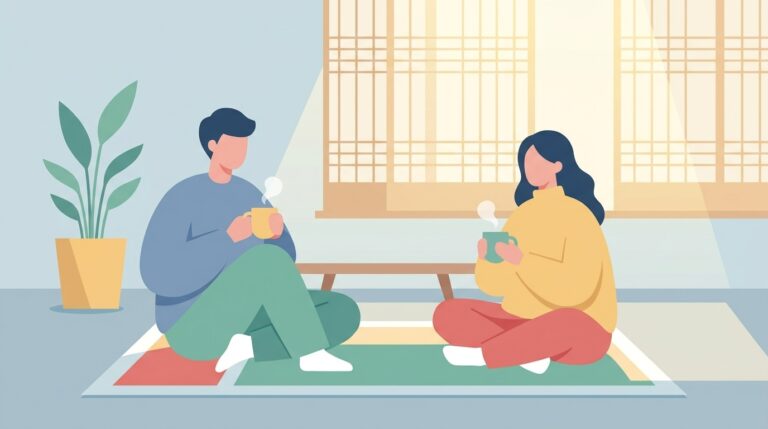
현우: (따뜻하게 차를 건네며) 지원 씨, 먼 길 오시느라 고생 많으셨어요. 마실 것 좀 들면서 천천히 말씀하세요.
      [Hyeon-woo: (Warmly handing over tea) Ji-won, thank you for making the long journey here. Please have a drink and speak at your own pace.]

지원: (잔을 두 손으로 쥐고) 감사합니다. 아직도 집에 혼자 있으면 가슴이 두근거리고, 일상생활이 거의 마비된 상태예요.
      [Ji-won: (Holding the cup with both hands) Thank you. Still, when I am home alone, my heart races, and my daily life is practically paralyzed.]

현우: (깊이 고개를 끄덕이며) 당연한 반응입니다. 갑작스러운 범죄 피해로 인해 심신이 많이 피폐해지셨을 거예요.
      [Hyeon-woo: (Nodding deeply) That is a completely natural reaction. Your mind and body must have become highly exhausted due to this sudden crime victimization.]

지원: 법적인 절차도 복잡하고, 당장 치료비나 이사 비용 때문에 경제적인 부담도 너무 커서 밤에 잠이 안 와요.
      [Ji-won: The legal procedures are so complex, and the financial burden of immediate medical therapy and moving costs is so heavy that I can't sleep at night.]

현우: (안심시키는 미소로) 너무 걱정하지 마세요. 우선 국가에서 지원하는 '범죄 피해자 구조금'을 청구할 수 있도록 저희가 서류 작업을 도와드릴게요.
      [Hyeon-woo: (With a reassuring smile) Please don't worry too much. First, we will help you with the paperwork to claim the 'Crime Victim Compensation' supported by the state.]

지원: (눈시울이 붉어지며) 정말 그런 실질적인 지원을 제가 받을 수 있을까요? 외국인이라 안 될 줄 알았어요.
      [Ji-won: (Her eyes welling up with tears) Can I really receive such practical support? I thought it wouldn't be possible because I am a foreigner.]

현우: 대한민국 법은 상호주의와 인도주의적 차원에서 외국인 피해자도 두텁게 보호하고 있습니다. 걱정 붙들어 매셔도 됩니다.
      [Hyeon-woo: Under reciprocity and humanitarian principles, Korean law robustly protects foreign victims as well. You can cast your worries aside.]

지원: (깊이 안도하며 한숨을 내쉰다) 마음의 짐이 조금은 덜어지는 것 같아요. 이제 조금씩 심신을 추스르고 회복에 집중해 볼게요.
      [Ji-won: (Sighs with deep relief) It feels like a bit of the weight on my mind has been lifted. I will try to gather my mind and body step by step and focus on recovery now.]
🔀 Interactive Choice Point
How should Ji-won respond to Hyeon-woo’s final offer to pair her with an art therapy program at the center?
- Choice A: “치료 같은 건 필요 없고 돈만 빨리 나오게 해 주세요.” (I don’t need therapy; just make sure the money comes out quickly.)
- Choice B: “상처를 보듬어 줄 수 있는 프로그램이라면 뭐든 참여해 보고 싶어요. 추천해 주시겠어요?” (If it’s a program that can embrace my wounds, I’d love to participate in anything. Could you recommend one?)
- Choice C: “외국인은 어차피 한국인들이랑 어울리기 힘들 텐데 그냥 혼자 알아서 할게요.” (It will be hard for a foreigner to mingle with Koreans anyway, so I’ll just handle it on my own.)
💡 Feedback:
- Best Choice: Choice B! This shows incredible linguistic mastery of the highly nuanced phrase 상처를 보듬다. It also aligns perfectly with the collaborative, community-based trauma recovery model of Korean support networks.
- Bad Choice: Choice A. This sounds extremely transactional, dismissive of professional help, and linguistically abrasive (치료 같은 건 has a dismissive tone). It completely ruptures the rapport with the counselor.
- Risk Choice: Choice C. While self-reliance is understandable, this defensive posture prevents you from accessing free, life-saving therapeutic networks. In Korean culture, refusing state-backed community support with an assumption of exclusion might close doors to valuable resources.
Phase 6: 10초 감정 섀도잉 드릴 (10-Second Emotion Shadowing Drill)
To speak like a C2 native, your intonation must match the heavy, emotional gravity of the situation. Practice these sentences aloud, paying attention to the pauses (/) and emotional cues.
[🥺 Deeply exhausted, yet seeking help]
“갑작스러운 사고로 / 심신이 완전히 무너졌지만, / 조금씩 / 일상을 회복해 보려고 해요.”
(gap-jak-seu-reo-un sa-go-ro / sim-sin-i wan-jeon-hi mu-neo-jyeot-ji-man, / jo-geum-ssik / il-sang-eul hoe-bok-hae bo-ryeo-go hae-yo.)-
[🤝 Highly reassuring, firm legal tone]
“범죄 피해자 구조금 제도는 / 국가가 마땅히 제공해야 할 / 피해자의 권리이자 / 따뜻한 손길입니다.”
(beom-joe pi-hae-ja gu-jo-geum je-do-neun / guk-ga-ga ma-ttang-hi je-gong-hae-ya hal / pi-hae-ja-ui gwon-ri-i-ja / tta-tteut-han son-gil-im-ni-da.)
Phase 7: K-Culture 미니 사전 (Mini Dictionary)
| Word / Expression | Meaning & Cultural Context | Real-Life Application |
|---|---|---|
| 스마일센터 (Smile Center) | Government-funded specialized trauma recovery center for crime victims. | “심리 상담을 받으러 스마일센터를 방문했어요.” (I visited the Smile Center for psychological counseling.) |
| 일상을 복원하다 (To restore daily life) | An advanced phrase describing the process of returning to normal after a trauma. | “치유의 최종 목적지는 평화로운 일상을 복원하는 것입니다.” (The final goal of healing is restoring daily life to peace.) |
| 피해 회복 (Victim recovery/reparations) | The holistic process of physical, mental, and financial recovery from a crime. | “가해자 처벌뿐만 아니라 피해 회복도 중요합니다.” (Not only punishment of the perpetrator but victim recovery is also important.) |
| 심리적 안전지대 (Psychological safe zone) | A mental state or physical space where a trauma survivor feels entirely safe. | “상담사님 덕분에 이곳이 제 심리적 안전지대가 되었어요.” (Thanks to the counselor, this place has become my psychological safe zone.) |
Phase 8: 여행자를 위한 생존 키트 (Survival Kit for Foreign Residents)
No one wants to think about crime while living or traveling abroad, but preparation is power. Here is your essential toolkit:
Survival Expressions TOP 3:
- “범죄 피해 구제 관련 상담을 받고 싶습니다.”
(beom-joe pi-hae gu-je gwan-ryeon sang-dam-eul bat-go sip-seum-ni-da.)
-> “I would like a consultation regarding crime victim relief/remedy.” - “외국어 통역 지원을 받을 수 있을까요?”
(oe-guk-eo tong-yeok ji-won-eul bat-go is-seul-kka-yo?)
-> “Is it possible to receive foreign language interpretation support?” - “피해자 신변 보호 조치를 요청합니다.”
(pi-hae-ja sin-byeon bo-ho jo-chi-reul yo-cheong-ham-ni-da.)
-> “I request victim personal safety protection measures (e.g., emergency smartwatches, patrols).”
✈️ Editor’s Survival Note:
If you ever find yourself a victim of a crime in Korea, do not panic. Call the Korean National Police Agency emergency hotline at 112 immediately. For legal and compensation assistance specifically tailored to foreigners, you can reach out to the Korea Legal Aid Corporation or search for your nearest local 스마일센터 (Smile Center) which offers legal, psychological, and medical translation services free of charge.
Phase 9: “한 발 더 깊이” (Going Deeper: Reflective Essay)
Historically, the global legal paradigm focused almost entirely on retributive justice—how to catch and punish the criminal. However, modern Korean jurisprudence is undergoing a massive shift toward restorative justice (회복적 사법). This shift is deeply tied to Korea’s traditional philosophical emphasis on Jeong (정) and collective healing.
In Korea, trauma is not viewed merely as an isolated, individual psychiatric problem, but as a tear in the collective social fabric. When a citizen or resident is harmed, the community has a duty to stitch them back in. This is why the state-funded Crime Victim Compensation and the Smile Centers are structured around holistic healing. They recognize that unless a victim’s mind and body are fully gathered (심신을 추스르다), society itself remains broken.
💬 Your Turn: How does your home country view the relationship between justice and healing? Is the focus purely on punishing the guilty, or are there highly active systems designed to embrace the victim’s wounds (상처를 보듬다)? Share your thoughts in the comments below!
Phase 10: FAQ & 오해 방지 (FAQ & Common Mistakes)
FAQ
Q: Can non-Korean citizens apply for the Crime Victim Compensation Fund (범죄 피해자 구조금) in Korea?
A: Yes! Under Article 32 of the Crime Victim Protection Act, foreign nationals who are victims of crimes committed within South Korea are eligible for victim compensation. This is subject to certain conditions, such as reciprocity laws (whether the victim’s home country offers similar protection to Koreans) and humanitarian considerations.
Q: What kinds of crimes qualify for structural compensation from the state?
A: The compensation is primarily geared toward victims of violent crimes that result in severe physical injury, disability, or death (e.g., murder, assault, severe sexual violence, stalking resulting in physical/mental trauma).
Q: Is the counseling at the Smile Center completely free?
A: Yes, absolutely. All psychological therapy, psychiatric medical cost support, legal advice, and temporary shelter services provided by the Smile Center are 100% funded by the government for verified crime victims.
🚨 흔한 실수 (Common Mistakes) Warning Board
- Mistranslating “Trauma”:
- Incorrect: “어제 너무 무서운 영화를 봐서 트라우마가 생겼어요.” (Using 트라우마 casually for a simple scare)
- Correct: 트라우마 (or 정신적 외상) should be reserved for clinical, severe psychological distress. For everyday scares, use “깜짝 놀랐다” or “소름 돋았다.”
- Confusing 구조금 (Compensation Fund) with 보상금 (Reward Fund):
- Incorrect: “범인을 신고해서 보상금 대신 구조금을 받았어요.”
- Correct: 구조금 is specifically relief money for victim recovery. 보상금 (or 포상금) is a reward given for reporting a criminal or assisting police. Keep these legally distinct!
- Using too casual phrasing with trauma victims:
- Incorrect: “야, 기운 내! 시간 지나면 다 나아.”(Hey, cheer up! Time heals all wounds.) -> This invalidates complex trauma.
- Correct: “급하게 생각하지 마시고 천천히 심신을 추스르세요.” (Do not rush, and slowly gather your mind and body.)
Phase 11: 액션 미션 & 참여 유도 (Action Missions)
Ready to put your advanced Korean to the test? Take on our 3-Step Action Mission:
- 🥉 Bronze Mission: Write a 3-sentence diary entry in Korean expressing how you would help a friend who needs to “gather their mind and body” (심신을 추스르다).
- 🥈 Silver Mission: Share a post on social media reviewing a legal or psychological K-Drama you’ve watched, using the terms 정신적 외상 (trauma) and 상처를 보듬다 (embracing wounds). Tag us at #DailyHangul!
- 🥇 Gold Mission: Look up a recent Korean news article about “범죄 피해자 지원” (Crime Victim Support) and summarize the practical support measures mentioned using the vocabulary learned today.
🎮 K-Culture Mission:
Watch the legal drama Extraordinary Attorney Woo (이상한 변호사 우영우) or Juvenile Justice (소년심판). See if you can spot characters talking about 피해 회복 (victim recovery) or the psychological toll of crime on the victims! Write down any terms you recognize.
Phase 12: 인터랙티브 퀴즈 챌린지 (Interactive Quiz Challenge)
Test your knowledge of advanced legal and healing Korean!
1. Vocabulary Match
What is the most appropriate verb to fill in the blank?
“치유는 타인의 아픔과 ___________ 과정에서 시작됩니다.”
(Healing begins in the process of ___________ another’s pain.)
* A) 때리는 (hitting)
* B) 청구하는 (claiming)
* C) 보듬는 (embracing/cradling)
2. True or False?
Foreigners residing in Korea cannot receive any state support or compensation even if they are victims of violent crimes within Korean territory. (T / F)
🔍 Click here to reveal the answers and detailed explanations!
Answers:
- Correct Answer: C) 보듬는
- Explanation: 보듬다 (to embrace/cradle) is structurally and emotionally the perfect fit when talking about soothing another person’s deep mental pain. 청구하다 means to legally claim money, which does not fit “pain.”
- Correct Answer: False!
- Explanation: South Korea actively extends its 범죄 피해자 구조금 제도 (Crime Victim Compensation) and 스마일센터 services to foreign residents under humanitarian and reciprocity principles. Never hesitate to seek help!
- Explanation: South Korea actively extends its 범죄 피해자 구조금 제도 (Crime Victim Compensation) and 스마일센터 services to foreign residents under humanitarian and reciprocity principles. Never hesitate to seek help!
Thank you for joining us on this deep, empathetic journey into Korean law and language. Keep learning, keep caring, and see you in the next premium edition of Daily Hangul!