

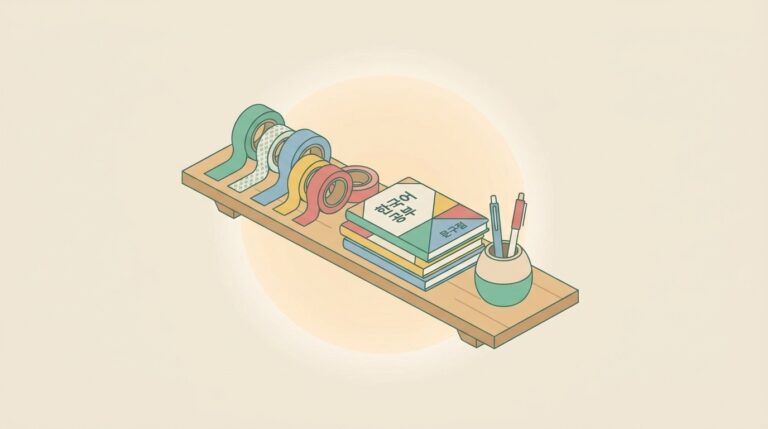
Easy Korean at the Stationery Store: How to Ask for Tape Like a Local!
안녕하세요! (Annyeonghaseyo!) Hello, dear friend! I’m your Daily Hangul editor, your personal guide to mastering everyday Korean and diving deep into the beautiful local culture.
Imagine this: You are walking down a cute, cozy alley in Seoul. You spot a lovely, nostalgic Korean stationery store—what locals call a 문구점 (mungujeom). The shelves are packed with adorable stickers, colorful diaries, and aesthetic planning tools. You want to buy some cute tape to decorate your travel journal or pack a gift for a friend. But suddenly, your mind goes blank. How do you ask for tape in Korean?
Don’t worry! Today, we are going to learn how to ask for “tape” easily and confidently, using natural, real-life Korean. After reading this quick guide, you will be able to walk into any Korean stationery shop and get exactly what you need with a warm smile. Let’s dive in!
Phase 2: Core Korean Expressions for Buying Tape
Let’s look at three essential expressions you can use right away.
1. 테이프 있어요? (Teipeu isseoyo?)
- Pronunciation: Tay-ee-peu ees-suh-yo? (Sounds like “tape” split into three soft syllables, followed by “ees-suh-yo”).
- Meaning: “Do you have tape?” (Literally: Does tape exist?)
- K-Culture Moment: You will hear this in cute lifestyle vlogs on YouTube when creators search for aesthetic stationery supplies in places like Hongdae or Yeonnam-dong.
- Editor’s Insight: The word 있어요? (isseoyo?) is the ultimate magic wand in Korea. If you need anything at all, just say [Noun] + 있어요? and shop owners will immediately help you find it!
- Situation Spectrum: Casual ✅ | Semi-formal ✅ | Formal ⚠️
- 🤔 Think About It: In Korean, we don’t say “Do you have tape?” We just say “Does tape exist?” Why do you think Korean culture prefers to leave out the word “you” in polite daily conversations?
2. 박스 테이프 (Bakseu teipeu)
- Pronunciation: Bahk-seu tay-ee-peu (Say “box” with a soft Korean flow, then “tape”).
- Meaning: Packaging tape / Heavy-duty box tape.
- K-Culture Moment: Essential when you are sending a box of delicious Korean snacks or K-pop albums back home via EMS at the local Post Office (우체국 – ucheguk).
- Editor’s Insight: If you ask for just “tape,” a clerk might hand you tiny clear tape. If you need thick brown or clear tape for heavy packing, make sure to specify 박스 테이프!
- Situation Spectrum: Casual ✅ | Semi-formal ✅ | Formal ✅
- 🤔 Think About It: Koreans love using English loanwords but adapt them to fit Korean phonetics. How does recognizing “box” as “박스” make learning Korean feel a bit closer to home?
3. 양면테이프 (Yangmyeon teipeu)
- Pronunciation: Yahng-myuhn tay-ee-peu (“Yang” as in yin-yang, “myeon” like noodles, then “tape”).
- Meaning: Double-sided tape (Literally: “Both-sides tape”).
- K-Culture Moment: Perfect for pasting beautiful instax photos or concert tickets into your personal diary.
- Editor’s Insight: 양면 (Yangmyeon) means “both sides.” You might also see this word on menus when ordering half-and-half items or when printing double-sided papers!
- Situation Spectrum: Casual ✅ | Semi-formal ✅ | Formal ✅
- 🤔 Think About It: Breaking down compound words makes Korean much easier! “Yang” (both) + “Myeon” (side/face) + “Teipeu” (tape). Can you see how logical Korean vocabulary is?
Phase 3: Textbook Korean vs. Real-Life Korean
When we look at traditional Korean textbooks, the phrases can sometimes sound a bit too stiff or robotic. Let’s see how real locals actually talk!
Situation 1: Asking where the tape is located
- 📖 Textbook Style: 테이프는 어디에 위치하고 있습니까? (Teipeuneun eodie wichihago isseumnikka? – “Where is the tape located?”)
- 🗣️ Real Local Style: 테이프 어디 있어요? (Teipeu eodi isseoyo? – “Where is the tape?”)
- 💡 Why it’s different: In real life, speed and warmth are key. Dropping complex verbs and particles like “는” and “에” makes you sound incredibly natural and friendly.
Situation 2: Asking for trendy glue tape (roller tape)
- 📖 Textbook Style: 접착용 롤러 테이프를 주십시오. (Jeobchakyong lolreo teipeureul jusipsio. – “Please give me adhesive roller tape.”)
- 🗣️ Real Local Style: 풀테이프 주세요. (Pulteipeu juseyo. – “Glue-tape, please.”)
- 💡 Why it’s different: 풀 (Pul) means glue. By combining “풀” and “테이프,” Koreans created the super common term 풀테이프 (Pulteipeu). It’s the ultimate clean way to stick papers together without mess!
Phase 4: K-Culture Deep Dive & Non-verbal Manners
4-1. The Art of “Two Hands” (두 손)
When paying for your tape or receiving it from the shop owner, always use two hands (두 손 – du son). You can gently place your left hand under your right forearm or wrist while handing over your card or cash. Combine this with a light nod of your head, and you will immediately melt the heart of any local shop owner! It shows beautiful respect.
4-2. The Cozy Culture of “Dakku” (다꾸)
Have you heard of 다꾸 (Dakku)? It is short for 다이어리 꾸미기 (Daieori Kkumigi – Diary Decorating). In Korea, journal decorating is a massive aesthetic movement! People collect hundreds of decorative tapes called 마스킹 테이프 (maseuking teipeu – masking tape). Walking into a local stationery shop in Korea isn’t just a chore; it’s a creative playground where people find peace and happiness.
Phase 5: Real-World Roleplay Scenario
Let’s practice! Imagine you are inside a beautiful independent stationery shop in Seoul called “Mimi Stationery” (미미문구). The shop owner, a kind elder lady (사장님 – Sajangnim), is sorting lovely stickers behind the counter.
🎭 Let’s Play!
- Sajangnim (Owner): 어서 오세요! 뭐 찾으시는 거 있으세요?
(Eoseo oseyo! Mwo chajeusineun geo isseuseyo?)
“Welcome! Is there something you are looking for?” -
Learner (You): 🎭 [Politely smiling and bowing slightly]
안녕하세요! 혹시 테이프 있어요?
(Annyeonghaseyo! Hoksi teipeu isseoyo?)
“Hello! By any chance, do you have tape?” -
Sajangnim (Owner): 네, 있어요! 어떤 테이프 찾으세요?
(Ne, isseoyo! Eotteon teipeu chajeuseyo?)
“Yes, we do! What kind of tape are you looking for?” -
Learner (You): 🎭 [Pointing to the packaging box in your bag]
음… 박스 테이프랑 예쁜 테이프요.
(Eum… bakseu teipeurang yeoppeun teipeuyo.)
“Hmm… Box tape and pretty tape.” -
Sajangnim (Owner): 아, 박스 테이프는 저기 3번 코너에 있고, 예쁜 마스킹 테이프는 이쪽에 있어요.
(Ah, bakseu teipeuneun jeogi sambeon koneoe itgo, yeoppeun maseuking teipeuneun itjoge isseoyo.)
“Ah, the box tape is over there in corner 3, and the pretty masking tapes are on this side.” -
Learner (You): 🎭 [Looking at the colorful designs with sparkling eyes]
우와, 진짜 예뻐요! 이 마스킹 테이프 하나 주세요.
(Uwa, jinjja yeoppeoyo! I maseuking teipeu hana juseyo.)
“Wow, it’s so pretty! Please give me one of this masking tape.” -
Sajangnim (Owner): 네, 알겠습니다. 더 필요하신 건 없으세요?
(Ne, algetseumnida. Deo piryohasin geon eopseuseyo?)
“Yes, understood. Is there anything else you need?” -
Learner (You): 🎭 [Handing over your card with both hands]
네, 없어요. 계산해 주세요!
(Ne, eopseyo. Gyesanhae juseyo!)
“No, that’s all. Please check out!”
🔀 Interactive Choice!
What would you say if you wanted to know the price of the tape?
* A) 이거 얼마예요? (Igeo eolmayeyo?)
* B) 이거 깎아주세요! (Igeo kkakkajuseyo!)
* C) 이거 너무 비싸요. (Igeo neomu bissayo.)
Feedback on your choice:
* Selecting A: Best! “이거 얼마예요?” means “How much is this?” It is highly practical and polite.
* Selecting B: Risk! Asking for a discount (“깎아주세요”) for a cheap stationery item like tape might make the owner feel uncomfortable.
* Selecting C: Bad! Saying “This is too expensive” directly to the shop owner can sound rude.
Phase 6: 10-Second Emotion Shadowing Drill
Let’s practice speaking with the right rhythm and emotion! The slash / represents a tiny pause to help you sound incredibly natural.
- Drill 1: Asking with sweet curiosity
- “혹시 / 테이프 / 있어요? 🥺”
- Hoksi / teipeu / isseoyo?
- Emotion Guide: Soft, friendly, and slightly curious. Raise your voice slightly at the end!
- Drill 2: Expressing pure joy and excitement
- “이 / 마스킹 테이프 / 진짜 예뻐요! 😍”
- I / maseuking teipeu / jinjja yeoppeoyo!
- Emotion Guide: Let your eyes go wide and speak with bright energy to show you genuinely love the design.
Phase 7: K-Culture Mini Dictionary
- 마스킹 테이프 (Maseuking teipeu) | Masking Tape | Colorful paper tapes used to stick photos beautifully without leaving sticky glue behind.
- 풀테이프 (Pulteipeu) | Glue Tape | A neat roller glue that applies smoothly like correction tape.
- 사장님 (Sajangnim) | Store Owner / Boss | A respectful and polite way to address any shop or small restaurant owner in Korea.
- 다꾸 (Dakku) | Diary Decorating | A popular hobby of planning, sticker pasting, and journaling in lovely notebooks.
Phase 8: Traveler’s Survival Kit
Top 3 Survival Expressions for Stationery Lovers
- 이거 어디 있어요? (Igeo eodi isseoyo? – Where is this?)
- Pro Tip: Show a photo of what you want on your smartphone to the shop owner while saying this!
- 봉투 필요해요. (Bongtu piryohaeyo. – I need a shopping bag.)
- Pro Tip: In Korea, eco-laws require shops to charge a small fee (usually 100 to 200 KRW) for shopping bags.
- 카드 돼요? (Kadeu dwaeyo? – Do you accept cards?)
- Pro Tip: Korea is almost entirely cashless. Even the smallest stationery shops gladly accept credit cards!
Editor’s Travel Note
Before stepping out, download the 네이버 지도 (Naver Map) app! It is far more accurate than Google Maps in Korea. Search for “소품샵” (sopum-syap / prop shop) or “문구점” (mungujeom) to find hidden local gems with gorgeous custom tapes!
Phase 9: “One Step Deeper” (Reflection)
In many Western cultures, stationery is seen as simple school or office utilities. However, in Korea, stationery is a lifestyle. Writing down memories, sealing letters with beautiful wax, and picking the perfect tape represents 소확행 (Sohwakhaeng)—”small but certain happiness.” Taking time to decorate a single page shows a beautiful commitment to remembering the precious moments of daily life.
💬 Your Turn: What does stationery mean to you? Do you enjoy collecting cute tapes or stickers? Leave a comment below and share your thoughts with our Daily Hangul community!
Phase 10: FAQ & Common Mistakes
Q: Is the Korean word “테이프” pronounced exactly like the English “tape”?
A: Very close, but not exactly! While English says “tape” in one quick syllable, Korean divides it into three distinct, soft beats: 테-이-프 (Te-i-peu). Make sure to prononuce the final “peu” softly!
Q: Can I find these types of tapes at local convenience stores?
A: Yes! General clear tapes and packing box tapes can be found in the stationery section of any Korean convenience store (편의점 – pyeonijeom). However, for decorative masking tapes, you should head to 다이소 (Daiso) or small indie stationery shops.
Q: How do I ask for scissors if I want to cut the tape right away?
A: You can say, “가위 있어요?” (Gawi isseoyo? – Do you have scissors?).
🚨 Common Mistakes Alert!
- Mistake 1: Pronouncing it as a single flat word “테잎 (Teip)”.
- Correct Action: Say 테이프 (Te-i-peu) with three distinct sounds.
- Mistake 2: Asking for “종이 테이프 (Paper tape)” when you want pretty washi tape.
- Correct Action: Ask for 마스킹 테이프 (Maseuking teipeu) to get the artistic, decorative ones.
- Mistake 3: Grabbing the tape and paying without saying anything.
- Correct Action: Say 안녕하세요! (Annyeonghaseyo!) with a warm nod first to connect with the local merchant!
Phase 11: Action Mission & Engagement
- Bronze Mission 🥉: Practice saying “테이프 있어요?” out loud in front of your mirror three times with a bright smile!
- Silver Mission 🥈: Take a photo of your favorite journaling tape at home, post it on social media, tag us, and write “이거 제 마스킹 테이프예요! (This is my masking tape!)”.
- Gold Mission 🥇: On your next trip to Korea, step into a local shop, look the owner in the eye, use both hands, and politely ask: “사장님, 혹시 마스킹 테이프 어디 있어요?”
Phase 12: Interactive Quiz Challenge
Let’s test what you learned today! Click to reveal the answers.
1. Match the Tape!
Which tape do you need to pack a heavy shipping box?
* A) 마스킹 테이프 (Maseuking teipeu)
* B) 박스 테이프 (Bakseu teipeu)
* C) 양면테이프 (Yangmyeon teipeu)
Click for the Answer & Explanation!
Answer: B) 박스 테이프 (Bakseu teipeu)
Excellent! “박스 테이프” means box tape, which is heavy-duty and perfect for packing boxes. “마스킹 테이프” is for decoration, and “양면테이프” is double-sided tape!
2. Fill in the Blank!
Complete the magic phrase to ask: “Do you have tape?”
* “테이프 ____________?”
Click for the Answer & Explanation!
Answer: 있어요 (isseoyo)
Fantastic! The full phrase is “테이프 있어요?” (Teipeu isseoyo?). Remember, “있어요?” is the ultimate magic word to ask if something is available!
3. True or False?
In Korea, it is polite to give your card to the store owner with only one hand.
Click for the Answer & Explanation!
Answer: False!
Always use two hands (두 손 – du son) to show respect and warmth when paying or receiving items in Korea!







