

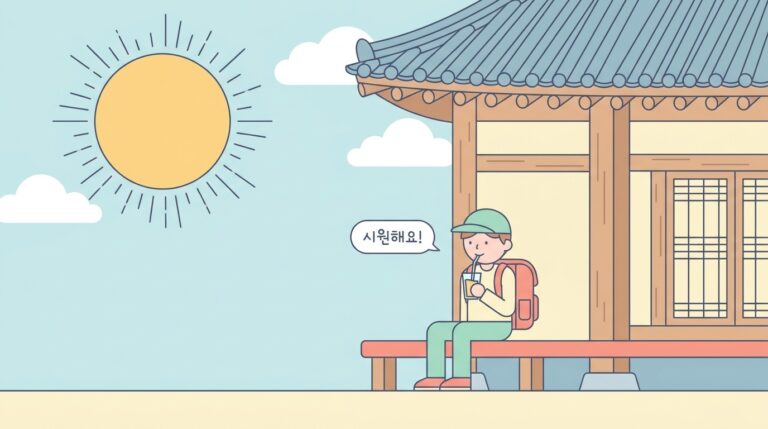
Stay Safe in Seoul: How to Handle a Heatwave Warning Like a Local
Phase 1: Empathy (An Emergency Buzzes in Seoul!)
안녕하세요! (An-nyeong-ha-se-yo!) Your Korean best friend and Daily Hangul’s Senior Editor here!
Imagine this: You are walking down the vibrant streets of Hongdae. The summer sun is sizzling, and you are dreaming of a cold sweet drink. Suddenly, BZZZZ! Your phone screen flashes with a loud alarm and a red-bordered text message:
[재난문자] 서울지역 폭염경보 발령…
Don’t panic! This is a 폭염 경보 (Pok-yeom Gyeong-bo)—a Heatwave Warning. For many absolute beginners (A1), seeing an urgent, all-Korean emergency alert can be terrifying. You might ask yourself: “Is it an earthquake? Should I run?”
Today, we are going to demystify these summer emergency alerts. This guide is built based on real feedback from foreign travelers who spent their first summer in Korea. By the end of this quick read, you will not only understand what to do, but you will also know how to ask for water, find shelter, and stay completely safe with confidence. Let’s beat the heat together!
Phase 2: Core Phrases (3 Key Expressions for Survival)
Here are three simple, life-saving phrases you can use when the Korean summer gets a little too intense.
1. 너무 더워요 (Neo-mu deo-wo-yo)
- Pronunciation: Neo-mu deo-wo-yo (Sounds like “No-moo duh-wo-yo”)
- Meaning: It is too hot.
- K-Culture Moment: You will hear K-Drama characters sighing this while standing in front of an open convenience store freezer or waving a mini-fan desperately.
- Editor’s Insight: “너무” means “too” or “very”, and “더워요” is the polite form of “hot”. Use this to politely express that you are struggling with the heat.
- Situation Spectrum: Casual (⚠️ 너무 더워 / Neo-mu deo-wo) | Semi-formal (✅ 너무 더워요) | Formal (🚫 매우 덥습니다 / Mae-u deop-seup-ni-da)
- 🤔 Think About It: In English, we say “It’s boiling.” In Korean, people often say “더워 죽겠어요” (Deo-wo juk-get-eo-yo), which literally means “I’m dying of heat!” How does your culture express extreme weather?
2. 물 주세요 (Mul ju-se-yo)
- Pronunciation: Mul ju-se-yo (Sounds like “Mool joo-seh-yo”)
- Meaning: Please give me water.
- K-Culture Moment: Walking into any Korean local restaurant (식당) and asking the owner (이모님 – Imo-nim) for immediate hydration.
- Editor’s Insight: “물” is water, and “주세요” is the magic beginner word for “please give me”. It is simple, direct, and universally understood.
- Situation Spectrum: Casual (⚠️ 물 줘 / Mul jwo) | Semi-formal (✅ 물 주세요) | Formal (⚠️ 물을 부탁드립니다 / Mur-eul bu-tak-deu-rim-ni-da)
- 🤔 Think About It: In Korean restaurants, cold water is almost always free and self-service (셀프 / Sel-peu). Look for a water purifier if the server points and says “물은 셀프입니다”!
3. 더위 조심하세요 (Deo-wi jo-sim-ha-se-yo)
- Pronunciation: Deo-wi jo-sim-ha-se-yo (Sounds like “Duh-wee jo-sheem-hah-seh-yo”)
- Meaning: Please be careful of the heat.
- K-Culture Moment: Your favorite K-Pop idol ending a summer live stream by wishing fans stay safe under the blazing sun.
- Editor’s Insight: “더위” means “the heat”, and “조심하세요” means “please be careful”. It shows empathy and warmth toward the person you are speaking to.
- Situation Spectrum: Casual (⚠️ 더위 조심해 / Deo-wi jo-sim-hae) | Semi-formal (✅ 더위 조심하세요) | Formal (⚠️ 무더위에 건강 유의하십시오 / Mu-deo-wi-e geon-gang yu-ui-hap-si-o)
- 🤔 Think About It: Koreans love checking in on each other’s physical well-being. Saying this shows you truly understand Korean social manners.
Phase 3: Textbook Korean vs. Real Korean
Let’s compare the stiff expressions in old textbooks with what Koreans actually say on hot summer days.
Situation 1: Saying “It’s hot!”
- 📖 Textbook Korean: 기온이 매우 높습니다. (Gi-on-i mae-u nop-seup-ni-da.)
- Translation: “The temperature is very high.”
- 🗣️ Real Korean: 날씨 진짜 덥네요! (Nal-ssi jin-jja deop-ne-yo!)
- Translation: “The weather is seriously hot!”
- 💡 Why the difference? Nobody talks like a weather forecast in real life! Using “진짜” (really) and “-네요” (an ending showing surprise or agreement) makes you sound friendly and natural.
Situation 2: Suggesting to go inside
- 📖 Textbook Korean: 실내로 대피하십시오. (Sil-nae-ro dae-pi-hap-si-o.)
- Translation: “Please evacuate to the indoors.”
- 🗣️ Real Korean: 우리 안으로 들어가요. (U-ri an-eu-ro deul-eo-ga-yo.)
- Translation: “Let’s go inside.”
- 💡 Why the difference? Unless there is an extreme natural disaster, “대피” (evacuation) sounds too scary. Locals simply suggest escaping the sun by going into a cool building.
Phase 4: K-Culture Deep-Dive & Non-Verbal Manners
4-1. The “Aigo, Hot!” Gesture
When walking in a heatwave in Korea, non-verbal communication is key. You will notice locals wiping their forehead, using their hand as a fan (손부채질 – Son-bu-chae-jil), and letting out a deep sigh: “하아~ 더워…” (Haa~ deo-wo…). If you do this in a shop, the owner will immediately understand, turn up the air conditioner, and hand you cold water!
4-2. Fighting Fire with Fire: Samgyetang (삼계탕)
Did you know Koreans eat steaming hot chicken soup on the hottest days of the year? This tradition is called 이열치열 (I-yeol-chi-yeol), which means “fighting heat with heat.” The belief is that consuming hot, nutrient-rich food makes your body sweat and naturally cools you down. If you want to experience real summer culture, head over to a Samgyetang restaurant on 복날 (Bok-nal)—the three hottest days of summer!
Phase 5: Real-Life Roleplay Scenario
The Setup
You are walking in the shopping district of Myeongdong with your Korean friend, Min-su (민수). The sun is blinding, and you both receive a loud emergency alert on your phones.
[Emergency Alert / 재난문자]
[서울특별시장] 오늘 11시 폭염경보 발령. 야외활동 자제 및 물 자주 마시기...
Turn 1 [Min-su]:
민수: 🎭 (Looks at his phone screen and sighs heavily)
      와, 진짜 덥다! 폰 봤어요? 폭염 경보 문자 왔어요.
      (Wa, jin-jja deop-da! Pon bwat-eo-yo? Pok-yeom gyeong-bo mun-ja wat-eo-yo.)
      "Wow, it's so hot! Did you see your phone? A heatwave warning message arrived."

Turn 2 [You]:
유저: 🎭 (Nods while wiping sweat from your forehead)
      네, 봤어요. 너무 더워요!
      (Ne, bwat-eo-yo. Neo-mu deo-wo-yo!)
      "Yes, I saw it. It is too hot!"

Turn 3 [Min-su]:
민수: 🎭 (Points to a nearby cafe)
      우리 저기 카페로 들어갈까요? 에어컨 필요해요.
      (U-ri jeo-gi ka-pe-ro deul-eo-gal-kka-yo? E-eo-keon pil-yo-hae-yo.)
      "Shall we go into that cafe over there? We need air conditioning."

Turn 4 [You]:
유저: 🎭 (Looks thirsty and exhausted)
      좋아요. 목말라요. 빨리 가요.
      (Jo-a-yo. Mong-mal-la-yo. Ppal-li ga-yo.)
      "Sounds good. I'm thirsty. Let's go quickly."

Turn 5 [Min-su]:
민수: 🎭 (Pushes the cafe door open, feeling the cool blast of air)
      우와, 살 것 같다! 시원해요. 먼저 자리에 앉으세요.
      (U-wa, sal geot gat-da! Si-won-hae-yo. Meon-jeo ja-ri-e an-jeu-se-yo.)
      "Wow, I feel alive! It's so cool. Please sit down first."

Turn 6 [You]:
유저: 🎭 (Sits down and looks at Min-su)
      고마워요. 민수 씨, 물 주세요.
      (Go-ma-wo-yo. Min-su ssi, mul ju-se-yo.)
      "Thank you. Min-su, please give me water."

Turn 7 [Min-su]:
민수: 🎭 (Hands you a cold cup of water from the self-bar)
      여기요! 시원하게 마셔요. 오늘 더위 조심해야 해요.
      (Yeo-gi-yo! Si-won-ha-ge ma-syeo-yo. O-neul deo-wi jo-sim-hae-ya hae-yo.)
      "Here you go! Drink it cold. We must be careful of the heat today."

Turn 8 [You]:
유저: 🎭 (Takes a big sip and smiles)
      감사합니다! 이제 괜찮아요.
      (Gam-sa-ham-ni-da! I-je gwen-chan-a-yo.)
      "Thank you! Now I am okay."
🔀 Interactive Choice Point
Min-su suggests going back outside to walk to the next destination, but the heat is still rising. What do you do?
- Choice A: “너무 더워요. 우리 더 있어요.” (It’s too hot. Let’s stay longer.)
- Choice B: “괜찮아요! 지금 나가요!” (I’m okay! Let’s go out now!)
- Choice C: “싫어요. 안 나가요.” (No. I am not going out.)
💡 Feedback on Your Choice
- Choice A (Best!): Perfect! It is polite, realistic, and prioritizes your safety during a heatwave warning.
- Choice B (Risk): Oh no! Walking outside during peak hours of a 폭염 경보 can cause heatstroke. Stay indoors when possible.
- Choice C (Bad): While keeping you safe, “싫어요” (I hate it / No) sounds very blunt and rude to your friend. Use Choice A instead!
Phase 6: 10-Second Emotion Shadowing Drill
Speak like a local by practicing pauses (/) and expressing real physical feelings through your voice!
- 너무 / 더워요! (Neo-mu / deo-wo-yo!)
- [🥵 Exhausted and panting] “It is / so hot!”
- 시원한 / 물 / 주세요. (Si-won-han / mul / ju-se-yo.)
- [🥺 Thirsty and pleading] “Cold / water / please.”
- 더위 / 조심하세요! (Deo-wi / jo-sim-ha-se-yo!)
- [😊 Caring and friendly] “Take care / in the heat!”
Phase 7: K-Culture Mini-Dictionary
- 폭염 경보 (Pok-yeom Gyeong-bo) | Heatwave Warning | An emergency alert sent to phones when daily maximum temperatures are expected to reach 35°C (95°F) or higher for two consecutive days.
- 손선풍기 (Son-seon-pung-gi) | Hand Fan | A portable, rechargeable hand-held fan that is a mandatory summer accessory in Korea.
- 무더위 쉼터 (Mu-deo-wi Swim-teo) | Heat Wave Shelter | Designated cooling centers (usually banks, community centers, or subway station lounges) where anyone can sit and cool down under the A/C for free.
- 아이스 아메리카노 (A-i-seu A-me-ri-ka-no) | Iced Americano | Also known as “아아” (Ah-Ah). The fuel of South Korea. You will see millions of people carrying one on hot days.
Phase 8: Traveler’s Survival Kit
Survival Phrases
- 에어컨 켜주세요. (E-eo-keon kyeo-ju-se-yo.) – Please turn on the air conditioner.
- 아아 한 잔 주세요. (Ah-Ah han jan ju-se-yo.) – One Iced Americano, please.
- 여기 너무 더워요. (Yeo-gi neo-mu deo-wo-yo.) – It is too hot here.
Editor’s Travel Note
If you are traveling in Korea during summer, download the Emergency Ready App (안전디딤돌) from the App Store or Google Play. It provides emergency alerts in English! Also, if you are lost outside and feeling dizzy, search for “무더위 쉼터” (Cooling Shelter) on the Naver Map App. Bank lobbies are excellent unofficial shelters where you can step in to catch your breath. Note: Emergency instructions are subject to update by local authorities.
Phase 9: Go One Step Deeper (Safety and Caring in Korea)
In many Western cultures, emergency alerts are informational. But in Korea, a “폭염 경보” triggers a warm wave of social check-ins. You will see family group chats lighting up with “더위 조심하세요” and bosses telling employees to take longer lunch breaks inside. It stems from Korea’s deep-rooted 정 (Jeong)—the feeling of collective care and affection for your neighbors.
💬 Your Turn: How does your home country handle extreme summer heat? Do you receive SMS alerts like in Korea? Let me know in the comments below!
Phase 10: FAQ & Common Mistakes
Q: What should I do if I get an emergency alert text (재난문자) in Korean?
A: Do not panic! Take a screenshot and upload it to a translation app like Papago. If it says “폭염” (heatwave), simply avoid walking long distances outdoors, drink water, and head into a cool indoor area.
Q: Can I walk into any building to escape the heat?
A: Yes! Public municipal offices, community centers, and large bank lobbies in Korea are officially designated or socially accepted as spaces where you can escape the sun for a few minutes.
Q: How do I ask for a refill of water in a Korean restaurant?
A: Most restaurants have water purifiers. Walk up to it and refill your cup. If there is a bottle on your table, you can politely say to the staff: “물 더 주세요” (Mul deo ju-se-yo – More water, please).
🚨 Common Mistakes Board
| What Foreigners Do | Why It’s a Mistake | Correct Action |
|---|---|---|
| Ignoring the emergency SMS alert | You might get heat exhaustion | Take a screenshot, translate it, and look for a cool indoor area. |
| Asking a waiter “물은 얼마예요?” | Water is completely free | Just say “물 주세요” (Mul ju-se-yo) or look for “물은 셀프” (Water is self-service). |
| Saying “더워요!” angrily to staff | Sounds like you are complaining to them | Say “날씨가 너무 더워요” (The weather is too hot) instead. |
Phase 11: Action Mission
- Bronze Mission: Read “너무 더워요” out loud 3 times using the Emotion Shadowing drill.
- Silver Mission: When practicing with a friend or writing online today, use the phrase “더위 조심하세요” (Take care in the heat).
- Gold Mission: Go to a Korean cafe, order an “아이스 아메리카노” (Ah-Ah), and say “진짜 덥네요!” to the barista.
🎮 K-Culture Mission
Watch a summer-themed K-Drama episode (like Our Beloved Summer or Hometown Cha-Cha-Cha). Count how many times the characters fan themselves or drink “아아” (Iced Americano)!
Phase 12: Interactive Quiz Challenge
Test your knowledge to see if you are ready to survive a Korean summer!
1. What does the emergency message “폭염경보” mean?
- A) Heavy Rain Alert
- B) Heatwave Warning
- C) Typhoon Warning
2. Fill in the blank: If you are extremely hot and need water, you should ask “___ 주세요.”
- A) 물 (Mul)
- B) 밥 (Bap)
- C) 에어컨 (E-eo-keon)
3. True or False: In Korea, it is considered normal to eat hot chicken soup (Samgyetang) on the hottest days of summer.
- A) True
- B) False
🎉 Click here to check your answers!
Answers
- B) Heatwave Warning. “폭염” means heatwave, and “경보” means warning.
- A) 물 (Mul). “물 주세요” means “Please give me water.” (Bap = Rice/Food, E-eo-keon = Air Conditioner).
- A) True. This is the cultural custom of “이열치열” (fighting heat with heat)!






