

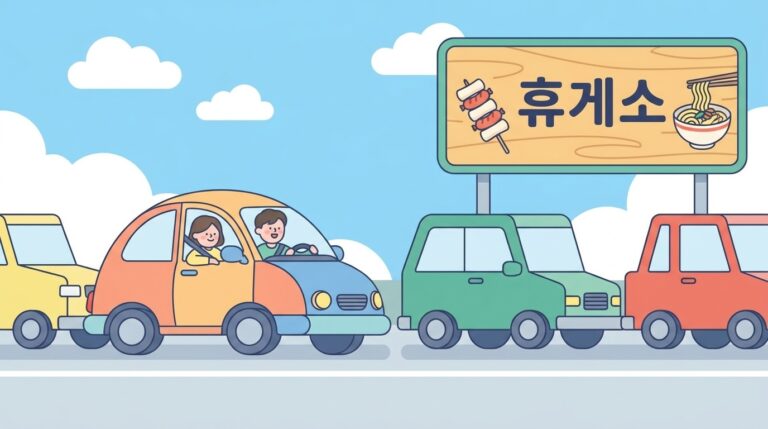
Stuck in Summer Traffic? Master South Korea’s Expressway Slang Like a Local!
Phase 1: Empathy (스토리 몰입형 오프닝)
안녕하세요! (Annyeonghaseyo!) Your friendly neighborhood Daily Hangul editor here! 🇰🇷✨
Imagine this: It’s late July—the peak of South Korea’s summer vacation season, famously known as 7말8초 (chil-mal-pal-cho / late July to early August). You’ve packed your bags, rented a car, and you’re heading to the gorgeous beaches of Gangneung or the scenic hills of Busan. You hit the Yeongdong Expressway, ready to play your favorite K-pop road trip playlist, but suddenly… red brake lights as far as the eye can see.
Welcome to the legendary 명절 급 교통체증 (holiday-level traffic jams) that happens every summer!
If you’ve ever felt trapped on a Korean highway, watching the GPS ETA climb from 2 hours to 5 hours, you’re not alone. Many of our intermediate learners have shared how stressful it is when they can’t understand the highway radio broadcasts or chat naturally with Korean friends in the car. Today, we’re going to transform that boring, bumper-to-bumper dread into a fun, cultural masterclass. You’ll learn exactly how Koreans express their frustration, survive the traffic, and find joy in the middle of a highway stall. Let’s dive in! 🚗💨
Phase 2: Key Expressions Deep Dive (핵심 표현 3선 심층 분석)
Let’s look at three essential phrases you will hear constantly when the roads turn into a parking lot.
1. 차가 엄청 막혀요 (Cha-ga eom-cheong mak-hyeo-yo)
- Pronunciation: Cha-gah um-chuhng mahk-hyuh-yo (Think of “eom-cheong” as “um” + “chung” with a strong emphasis, and “mak” like the first syllable of “mockery”).
- Meaning: The traffic is insanely jammed. (Literal: Cars are extremely blocked.)
- K-Culture Moment: You will hear this in almost every summer K-drama road trip episode. Typically, the driver sighs deeply, slaps the steering wheel, and says this to their passenger or into their hands-free phone.
- Editor’s Insight: While “교통이 혼잡하다” (traffic is congested) is what you see on official news bulletins, real Koreans always use “차가 막히다” in conversation. “엄청” (eom-cheong) adds a dramatic, colloquial punch to your frustration.
- Situation Spectrum: Casual: 차가 엄청 막혀 (✅) | Semi-formal: 차가 엄청 막혀요 (✅) | Formal: 차가 매우 정체되고 있습니다 (⚠️ – reserved for news reporters).
- 🤔 Think About It: In English, we say “traffic is heavy.” In Korean, we focus on the blockage (“막히다” – to be clogged/blocked). Why do you think Korean culture focuses so much on the concept of “flow” and “clogging” in everyday language?
2. 꼼짝달싹도 못 해요 (Kkom-jjak-dal-ssak-do mot hae-yo)
- Pronunciation: Kohm-jjak-dahl-ssahk-doh moht hae-yo (Make sure to double the ‘k’ and ‘s’ sounds—tense up your vocal cords like you’re squeezing into a tight space!).
- Meaning: I’m completely stuck / I can’t budge an inch.
- K-Culture Moment: Used when the highway literally becomes a parking lot and you haven’t moved a single meter in 15 minutes. It’s often paired with a dramatic head tilt.
- Editor’s Insight: This is a beautiful Korean mimicry word (의태어 – mimetic word). “꼼짝” means budging slightly, and “달싹” means making a tiny lifting movement. Putting them together with “못 하다” means you cannot even make the tiniest twitch. It’s highly expressive and will make native speakers go, “Wow, your Korean is so natural!”
- Situation Spectrum: Casual: 꼼짝달싹도 못 해 (✅) | Semi-formal: 꼼짝달싹도 못 해요 (✅) | Formal: 움직이기 어려운 상황입니다 (🚫 too dry!).
- 🤔 Think About It: How does your native language describe the feeling of being physically trapped or unable to move? Is it as visual/auditory as “꼼짝달싹”?
3. 휴게소 들렀다 가요 (Hyu-ge-so deul-reot-da ga-yo)
- Pronunciation: Hyu-geh-soh deul-rut-dah gah-yo (Glide quickly over “deul-reot-da”—it sounds like “dull-ut-dah”).
- Meaning: Let’s stop by a rest areas before we keep going.
- K-Culture Moment: Korean highway rest areas (휴게소) are not just bathrooms; they are legendary food heavens! Stopping here for Sotteok-Sotteok (sausage and rice cake skewers) or walnut cakes is the highlight of any road trip.
- Editor’s Insight: The verb “들르다” (to stop by / drop in) is combined with “~었다가” (doing something and then moving on to the next action). It flows naturally to suggest a quick pit stop to recharge.
- Situation Spectrum: Casual: 휴게소 들렀다 가자 (✅) | Semi-formal: 휴게소 들렀다 가요 (✅) | Formal: 휴게소에 방문한 후 이동하시겠습니다 (🚫 awkwardly robotic).
- 🤔 Think About It: Why are rest stops considered the ultimate healing spots during Korean traffic jams? What does this tell you about Korean food culture?
Phase 3: Textbook Korean vs. Real Korean (교과서 한국어 vs. 진짜 한국어)
Let’s look at how the books teach traffic versus how we actually talk in a hot car.
Situation 1: Telling someone you are late due to traffic
- 📖 Textbook: “도로가 혼잡하여 늦을 것 같습니다.” (Do-ro-ga hon-jap-ha-yeo neu-zeul geot gat-seum-ni-da. /
Frequently Asked Questions (FAQ)
Q: What does "차가 엄청 막혀요 (Cha-ga eom-cheong mak-hyeo-yo)" mean in Korean and how do you pronounce it?
A: In Korean, "차가 엄청 막혀요 (Cha-ga eom-cheong mak-hyeo-yo)" is pronounced [Cha-gah um-chuhng mahk-hyuh-yo (Think of "eom-cheong" as "um" + "chung" with a strong emphasis, and "mak" like the first syllable of "mockery"] and means: The traffic is insanely jammed. (Literal: Cars are extremely blocked.)
Q: What does "꼼짝달싹도 못 해요 (Kkom-jjak-dal-ssak-do mot hae-yo)" mean in Korean and how do you pronounce it?
A: In Korean, "꼼짝달싹도 못 해요 (Kkom-jjak-dal-ssak-do mot hae-yo)" is pronounced [Kohm-jjak-dahl-ssahk-doh moht hae-yo (Make sure to double the 'k' and 's' sounds—tense up your vocal cords like you're squeezing into a tight space!] and means: I'm completely stuck / I can't budge an inch.
Q: What does "휴게소 들렀다 가요 (Hyu-ge-so deul-reot-da ga-yo)" mean in Korean and how do you pronounce it?
A: In Korean, "휴게소 들렀다 가요 (Hyu-ge-so deul-reot-da ga-yo)" is pronounced [Hyu-geh-soh deul-rut-dah gah-yo (Glide quickly over "deul-reot-da"—it sounds like "dull-ut-dah"] and means: Let's stop by a rest areas before we keep going.







