

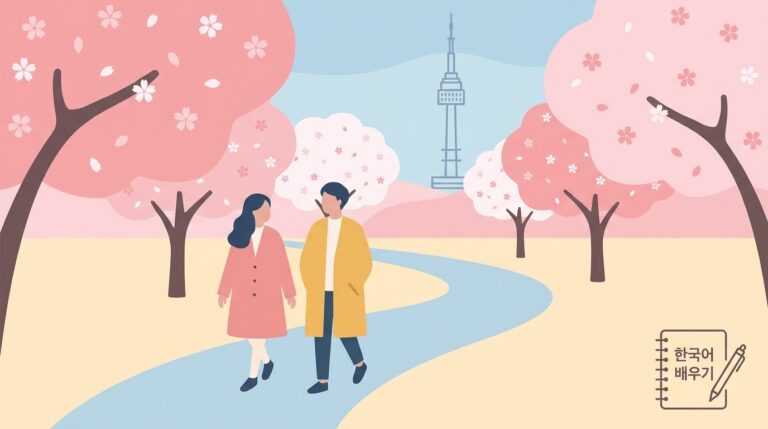
Do You Want to See Cherry Blossoms with Me? Let’s Ask a Friend in Korean!
Phase 1: Empathy (An Invitation to the Pink Petals)
안녕하세요! It’s your K-culture bestie from Daily Hangul (매일한글).
Spring in Korea is absolutely magical. The winter chill fades away, and suddenly, streets are lined with clouds of soft pink and white cherry blossoms. In Korea, this is the prime time for a 벚꽃 구경 (beot-kkot gu-gyeong – cherry blossom viewing). Naturally, you’ll want to invite that special someone, a close friend, or a colleague to join you.
But here’s the real pain point: how do you ask them out without sounding too stiff like a textbook, yet keeping the perfect balance of excitement and politeness? Many learners end up saying “벚꽃 축제에 가십시오” (which sounds way too formal, like a military command!) or “벚꽃 보러 가자” (which might be too casual if you aren’t close friends yet).
Don’t worry! Today, we are going to master the art of inviting someone to a cherry blossom festival using natural, B1-level Korean that hits the perfect emotional note. Let’s get you ready for spring!
Phase 2: Deep Dive into 3 Essential Expressions
Let’s look at three ways to invite someone, ranging from sweet and casual to polite and considerate.
1. 이번 주말에 벚꽃 보러 갈래요? (I-beon ju-mar-e beot-kkot bo-reo gal-rae-yo?)
- Pronunciation: Ee-beon joo-ma-rae beot-kkot bo-ruh gal-lae-yo? (Sounds like “gal-lay-yo?” with a soft, inviting tone)
- Meaning: “Would you like to go see the cherry blossoms this weekend?”
- K-Culture Moment: You hear this all the time in K-Dramas when the male lead finally musters up the courage to ask the female lead out on a casual weekend date under the Yeouido cherry blossom trees.
- Editor’s Insight: This uses the -(으)ㄹ래요? grammar pattern, which asks about the listener’s preference or intention in a very friendly, polite way. It’s perfect for someone you want to get closer to.
- Situation Spectrum: Casual ✅ | Semi-formal ✅ | Formal ⚠️
- 🤔 Think About It: In English, we often say “Do you want to…?” but in Korean, asking directly with “원해요?” (Do you want?) sounds too literal and awkward. Why do you think Koreans prefer asking about intentions using “갈래요?” instead?
2. 시간 되면 같이 벚꽃 축제 가요. (Si-gan doe-myeon gat-i beot-kkot chuk-je ga-yo.)
- Pronunciation: She-gan dweh-myeon gah-chee beot-kkot chook-jeh gah-yo.
- Meaning: “If you have time, let’s go to the cherry blossom festival together.”
- K-Culture Moment: This is the ultimate “low-pressure” invite. It’s perfect to send over KakaoTalk.
- Editor’s Insight: By adding 시간 되면 (if you have time), you are showing high respect and empathy (Nunchi!). It gives the other person an easy out if they are busy, preventing any social awkwardness.
- Situation Spectrum: Casual ✅ | Semi-formal ✅ | Formal 🚫
- 🤔 Think About It: How does giving someone an “easy escape” in an invitation reflect the Korean value of saving face (Chemyeon)?
3. 요즘 날씨가 참 좋은데, 벚꽃 보러 갈까요? (Yo-jeum nal-ssi-ga cham jo-eun-de, beot-kkot bo-reo gal-kka-yo?)
- Pronunciation: Yo-jeum nal-shee-gah cham jo-eun-deh, beot-kkot bo-ruh gal-kkah-yo?
- Meaning: “The weather has been so nice lately; shall we go see the cherry blossoms?”
- K-Culture Moment: A warm, conversational opening used among coworkers during lunch break while looking out at the sunny sky.
- Editor’s Insight: The ending -(으)ㄹ까요? means “Shall we…?” and is incredibly soft and polite. Starting with a comment about the beautiful weather (날씨가 참 좋은데) builds natural rapport before making the request.
- Situation Spectrum: Casual ✅ | Semi-formal ✅ | Formal ✅
Phase 3: Textbook Korean vs. Real-Life Korean
Let’s compare how textbooks teach invitations versus how real Koreans actually talk!
Scenario 1: Suggesting a trip to the festival
- 📖 Textbook: 우리 벚꽃 축제에 같이 동행합시다. (Woo-ri beot-kkot chuk-je-e gat-i dong-haeng-hap-si-da.)
- Translation: “Let us accompany each other to the cherry blossom festival.”
- 🗣️ Real Life: 우리 벚꽃 축제 같이 가요! (Woo-ri beot-kkot chuk-je gat-i ga-yo!)
- Translation: “Let’s go to the cherry blossom festival together!”
- 💡 Why the difference? Textbooks often use overly formal verbs like “동행하다” (to accompany), which sound incredibly robotic. In real life, “같이 가요” (let’s go together) is the warmest and most natural choice.
Scenario 2: Asking if someone is free
- 📖 Textbook: 귀하는 이번 주말에 시간이 있으십니까? (Gwi-ha-neun i-beon ju-mar-e si-gan-i is-seu-nip-ni-ka?)
- Translation: “Do you (esteemed reader) have time this weekend?”
- 🗣️ Real Life: 이번 주말에 특별한 계획 있어요? (I-beon ju-mar-e teuk-byeor-han gye-hoek is-seo-yo?)
- Translation: “Do you have any special plans this weekend?”
- 💡 Why the difference? Using “귀하” (you) or asking directly “Do you have time?” in formal honorifics feels like a business contract. Asking about “특별한 계획” (special plans) is a much softer, natural way to check their availability.
Phase 4: K-Culture Deep Dive & Non-verbal Manners
4-1. Nunchi & Gestures for Inviting
- The Soft Head Tilt: When asking “갈래요?” (Would you like to go?), tilt your head slightly to the side with a warm smile. This softens the question and shows friendly anticipation.
- Avoid Direct Pointing: When pointing towards the beautiful cherry blossom trees, use an open palm instead of a single finger. This is considered much more polite in Korean culture.
4-2. The “Cherry Blossom Ending” Culture
Every spring in Korea, Busker Busker’s legendary song “벚꽃 엔딩” (Cherry Blossom Ending) re-enters the music charts. Koreans joke that the song is a “Spring Carol” or a “Cherry Blossom Pension” for the singer because it plays everywhere—in cafes, malls, and streets. When inviting a friend, humming this song or mentioning it is a great icebreaker!
Phase 5: Real-Life Roleplay Scenario
Setting: Min-ji (your Korean colleague/friend) and You (Alex) are sitting in a cozy cafe, looking at the cherry blossoms starting to bloom outside the window.
- 민지: 와, 창밖에 벚꽃 진짜 예쁘게 피었네요! (Wa, chang-bak-ke beot-kkot jin-jja ye-ppeu-ge pi-eon-nae-yo!)
(Wow, the cherry blossoms outside the window are blooming so beautifully!) - 알렉스: 🎭 (Smiling warmly) 정말이네요. 봄이 진짜 왔나 봐요. (Jeong-mar-i-ne-yo. Bom-i jin-jja wan-na bwa-yo.)
(Indeed. It looks like spring has really come.) - 민지: 맞아요. 슬슬 꽃구경 가는 사람들이 많아졌어요. (Ma-ja-yo. Seul-seul kkot-gu-gyeong ga-neun sa-ram-deul-i man-a-jyeos-seo-yo.)
(Right. Slowly, more and more people are going to see the flowers.) - 알렉스: 🎭 (Leaning in slightly) 민지 씨, 혹시 이번 주말에 바빠요? (Min-ji ssi, hok-si i-beon ju-mar-e ba-ppa-yo?)
(Min-ji, by any chance, are you busy this weekend?) - 민지: 음, 이번 주말은 아무 계획 없어요. 왜요? (Eum, i-beon ju-mar-eun a-mu gye-hoek op-seo-yo. Wae-yo?)
(Hmm, I don’t have any plans this weekend. Why?) - 알렉스: 🎭 (Encouragingly) 요즘 날씨도 좋은데, 같이 벚꽃 축제 갈래요? (Yo-jeum nal-ssi-do jo-eun-de, gat-i beot-kkot chuk-je gal-rae-yo?)
(The weather has been so nice lately; do you want to go to the cherry blossom festival together?) - 민지: 오, 좋아요! 여의도 벚꽃 축제 갈까요? (Oh, jo-a-yo! Yeouido beot-kkot chuk-je gal-kka-yo?)
(Oh, I’d love to! Shall we go to the Yeouido Cherry Blossom Festival?) - 알렉스: 🎭 (Clapping hands gently) 네, 좋아요! 맛있는 것도 먹어요! (Ne, jo-a-yo! Mas-in-neun geot-do meog-eo-yo!)
(Yes, sounds great! Let’s eat some delicious food too!)
🔀 Interactive Branching Point: How will you respond to Min-ji’s suggestion?
- A) “좋아요! 토요일 점심때 봐요!” (Great! Let’s meet Saturday at lunchtime!)
- B) “저는 피곤하니까 일요일 늦게 가요.” (Since I am tired, let’s go late on Sunday.)
- C) “싫어요. 다른 곳에 가고 싶어요.” (No. I want to go somewhere else.)
Feedback:
- Choice A (Best): Perfect! It matches Min-ji’s enthusiastic tone and sets a concrete time immediately.
- Choice B (Risk): A bit too blunt. Explaining your tiredness right away might kill the exciting vibe of the invitation.
- Choice C (Bad): Direct rejection like “싫어요” is considered very rude in Korean. It is better to suggest an alternative gently.
Phase 6: 10-Second Emotion Shadowing Drill
Practice saying these lines naturally with the correct emotional vibe and pauses (/ marks the pause point).
- [😊 Filled with excitement]
- 이번 주말에 / 벚꽃 보러 / 갈래요? (I-beon ju-mar-e / beot-kkot bo-reo / gal-rae-yo?)
- [🥺 Shy but hopeful]
- 시간 되면 / 우리 / 같이 / 축제 가요. (Si-gan doe-myeon / u-ri / gat-i / chuk-je ga-yo.)
- [🌸 Bright and breezy]
- 날씨가 / 진짜 좋은데 / 같이 걸을까요? (Nal-ssi-ga / jin-jja jo-eun-de / gat-i geo-reul-kka-yo?)
Phase 7: K-Culture Mini Dictionary
- 꽃구경 (Kkot-gu-gyeong) | Flower viewing / Viewing spring blossoms. Highly popular activity for couples, friends, and families.
- 인생샷 (In-saeng-syat) | Life shot / The best photo of your life. Under the falling cherry blossom petals, you must take an “인생샷”!
- 돗자리 (Dot-ja-ri) | Picnic mat. Essential for sitting under cherry blossom trees while eating delivery food.
- 봄바람 (Bom-ba-ram) | Spring breeze. Often used in K-Pop lyrics to describe a fluttering heart.
Phase 8: Traveler’s Survival Kit
Survival Expressions TOP 3
- 여기 사진 좀 찍어주시겠어요? (Yeo-gi sa-jin jom jjig-eo-ju-si-ges-seo-yo?)
- “Could you take a photo of us here, please?” (Pro Tip: Hand your phone to a young Korean woman nearby; they are master photographers who will give you the ultimate 인생샷!)
- 여의도공원 가려면 몇 번 출구로 가야 해요? (Yeouido-gong-won ga-ryeo-myeon myeot beon chul-gu-ro ga-ya hae-yo?)
- “Which exit should I take to go to Yeouido Park?”
- 사람이 진짜 많네요! (Sa-ram-i jin-jja man-nae-yo!)
- “There are so many people!”
📌 Editor’s Travel Note:
To navigate the busy subway stations during festival season, make sure to download the Naver Map App for real-time subway crowd updates and exit routes. Note: Station exit numbers can be crowded, so follow the floral signs on the floor! (Information current as of spring season.)
Phase 9: “Going One Step Deeper” (Cultural Reflection)
In Korea, cherry blossoms blooming is not just a seasonal change; it is a shared emotional experience. It represents transience and the beauty of fleeting moments, as the blossoms only last for about a week. This is why inviting someone to “꽃구경” carries a unique cultural weight—it implies that you want to share a beautiful, precious, and limited moment of the year with them.
💬 Your Turn: Have you ever invited someone to go cherry blossom viewing? Let us know in the comments below what your favorite spring spot is!
Phase 10: FAQ & Avoiding Mistakes
Q: Can I use “같이 가자” (Gat-i ga-ja) to invite my coworker?
A: Only if you are extremely close and of the same age/rank. If not, it sounds rude. Stick to “같이 갈래요?” or “같이 가요” to keep it respectful and friendly.
Q: What is the difference between 꽃구경 (Kkot-gu-gyeong) and 벚꽃 축제 (Beot-kkot chuk-je)?
A: “꽃구경” is the general activity of looking at flowers. “벚꽃 축제” specifically refers to organized cherry blossom festivals that feature food stalls, street performances, and night lights.
Q: How do I reject a spring invite politely?
A: Avoid saying a flat “No” (싫어요 / 안 돼요). Instead, say: “가고 싶은데, 이번 주말에 약속이 있어서요. 아쉬워요!” (I want to go, but I have other plans this weekend. I’m so sad!)
🚨 Common Mistakes Alert!
- Mistake 1: Saying “벚꽃을 보고 싶어요?” (Do you want to see cherry blossoms?)
- Why: Too literal and sounds like an interview question.
- Correct Action: Say “벚꽃 보러 갈래요?”.
- Mistake 2: Forgetting the particle “~랑/하고” and saying “나 벚꽃 가요”.
- Why: Grammatically incorrect.
- Correct Action: Say “나랑 벚꽃 보러 가요” (Go see cherry blossoms with me).
- Mistake 3: Pronouncing “같이” as “gat-i”.
- Why: It sounds unnatural.
- Correct Action: Pronounce it as “gach-i” (가치).
Phase 11: Action Mission
- 🥉 Bronze Mission: Write the sentence “이번 주말에 시간 있어요?” in your diary.
- 🥈 Silver Mission: Share this blog post on your social media with the hashtag
#DailyHanguland write down your favorite cherry blossom festival location in Korea. - 🥇 Gold Mission: Use KakaoTalk to send “날씨 좋은데 같이 벚꽃 구경 갈래요?” to a Korean friend or classmate today!
- 🎮 K-Culture Mission: Listen to Roy Kim’s “봄봄봄” (Bom Bom Bom) and find the word “봄” (Spring) in the lyrics!
Phase 12: Interactive Quiz Challenge
1. Which of the following is the most natural way to ask a classmate out to see the cherry blossoms?
- A) 벚꽃을 꼭 보십시오.
- B) 이번 주말에 같이 벚꽃 보러 갈래요?
- C) 나랑 벚꽃 구경을 하시오.
Reveal Answer
Answer: B
Explanation: B is friendly, natural, and grammatically perfect for a peer or classmate. A and C sound like medieval commands!
2. Fill in the blank:
“요즘
__________가 참 좋은데, 벚꽃 구경 갈까요?” (The weather is so nice lately; shall we go see the cherry blossoms?)
Reveal Answer
Answer: 날씨 (nal-ssi – weather)
Explanation: Highlighting the great weather is the best way to open a spring invitation!
3. True or False: Saying “싫어요” is the best and most polite way to say you are busy when someone invites you to a festival.
Reveal Answer
Answer: False
Explanation: “싫어요” is too direct and harsh. To save face and be polite, you should express regret and explain that you have other plans.







