

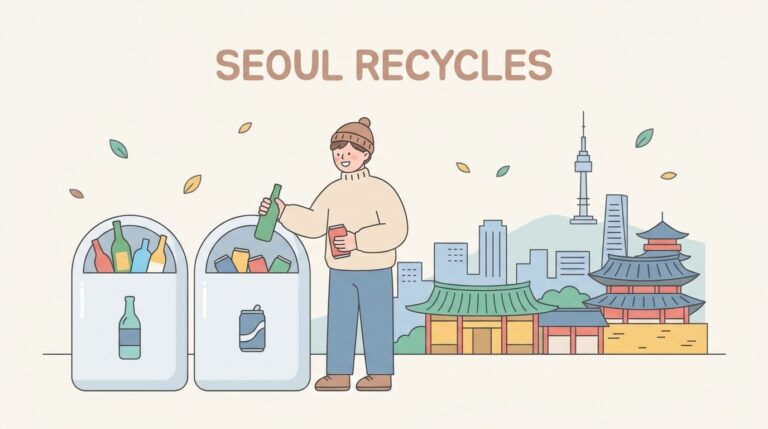
Master Korea’s Recycling: How to Sort Cans and Bottles Like a Local
Phase 1: Empathy (스토리 몰입형 오프닝)
안녕하세요! Daily Hangul Editor here, your trusty Korean culture navigator.
Imagine this: You are staying at a cozy Airbnb in Mapo, Seoul. You just finished a refreshing bottle of Korean pear juice (갈아만든 배 – gal-a-man-deun bae) and a can of fizzy Chilsung Cider (칠성사이다). You walk over to the trash bin, only to find three different boxes with complex labels, and your Korean host gently says, “Wait, in Korea, we have to separate those!”
Suddenly, you feel a wave of “recyle anxiety.” If this sounds familiar, don’t worry! You are not alone. Korea has one of the most efficient—yet strict—recycling systems in the world, called 분리배출 (bun-ri-bae-chul). Sorting cans and bottles is a daily ritual for locals. Based on feedback from hundreds of our learners, we’ve crafted this easy-to-follow guide to help you master bottle and can sorting with confidence. By the end of this post, you’ll feel like a true Seoulite!
Phase 2: Core Expressions (핵심 표현 3선 심층 분석)
1. 이거 캔으로 버려요? (I-geo kaen-eu-ro beo-ryeo-yo?)
- Pronunciation: Ee-geo kaen-eu-ro buh-ryuh-yo? (Sounds like “E-gaw can-oo-ro burr-yuh-yo?”)
- Meaning: “Do I throw this away as a can?”
- K-Culture Moment: You will hear this constantly in Korean dramas during clean-up scenes after a house party, rooftop barbecue, or Han River picnic.
- Editor’s Insight: The word 버려요 comes from 버리다 (to throw away). When you add ~으로/로 (as/into), you are asking about the specific recycling category.
- Situation Spectrum:
- Casual: 이거 캔으로 버려? (⚠️ only to close friends)
- Semi-formal: 이거 캔으로 버려요? (✅ perfect for neighbors, hosts)
- Formal: 이것은 캔류로 배출합니까? (🚫 too stiff for daily life)
- 🤔 Think About It: In your home country, do you separate metal cans from aluminum cans, or do they go into one bin? In Korea, they are usually grouped under 캔류 (Kaen-ryu – Cans Category)!
2. 라벨 떼야 돼요? (Ra-bel tte-ya dwae-yo?)
- Pronunciation: Rah-bel tteh-yah dweh-yo? (Rhymes with “La-bell play-ah-day-yo?”)
- Meaning: “Do I have to peel off the label?”
- K-Culture Moment: If you drink Soju or Makgeolli from plastic or glass bottles, you’ll notice many Korean eco-friendly brands now use easy-peel labels. Peeling them off is satisfying!
- Editor’s Insight: 떼다 means “to peel off” or “to detach.” In Korea, removing plastic labels from plastic/glass bottles before throwing them away is highly appreciated and often legally required.
- Situation Spectrum:
- Casual: 라벨 떼야 돼? (⚠️)
- Semi-formal: 라벨 떼야 돼요? (✅)
- Formal: 라벨을 제거해야 합니까? (🚫)
- 🤔 Think About It: How does your country encourage people to clean materials before recycling? In Korea, “empty, rinse, peel, and separate” is the golden rule!
3. 이것도 병이에요? (I-geot-do byeong-i-e-yo?)
- Pronunciation: Ee-gyut-doh byung-ee-eh-yo? (Make “byung” sound like a soft “bung” with a ‘y’)
- Meaning: “Is this also considered a bottle?” (e.g., cosmetic bottles, jar glass)
- K-Culture Moment: Often asked in trendy K-Beauty shops or traditional cafes when disposing of empty toner bottles or premium tea jars.
- Editor’s Insight: 병 (byeong) means bottle/glass jar. Sometimes premium glass bottles have plastic caps; knowing what counts as “pure glass” is key.
- Situation Spectrum:
- Casual: 이것도 병이야? (⚠️)
- Semi-formal: 이것도 병이에요? (✅)
- Formal: 이것도 유리병류에 해당합니까? (🚫)
Phase 3: Textbook vs. Real Korean (교과서 한국어 vs 진짜 한국어)
Situation 1: Asking where to put the glass bottle
- 📖 Textbook: 유리병 수거함은 어디에 있습니까? (Yu-ri-byeong su-geo-ham-eun eo-di-e is-seup-ni-ka? – “Where is the glass bottle collection bin?”)
- 🗣️ Real Korean: 병 어디에 둬요? (Byeong eo-di-e dwo-yo? – “Where do I put the bottles?”)
- 💡 Why the difference? Textbooks use formal nouns like 수거함 (collection receptacle), but locals simply use 어디에 둬요? (“Where do I place it?”) to keep things quick and friendly.
Situation 2: Confirming if a can needs to be washed
- 📖 Textbook: 캔을 물로 씻어서 배출해야 합니까? (Kaen-eul mul-ro ssis-eo-seo bae-chul-hae-ya hap-ni-ka? – “Must I rinse the can with water before discharging?”)
- 🗣️ Real Korean: 캔 헹궈야 돼요? (Kaen heng-gwo-ya dwae-yo? – “Do I need to rinse the can?”)
- 💡 Why the difference? 헹구다 (to rinse) is the active, everyday verb Koreans use instead of the formal/legalistic 씻어서 배출하다.
Phase 4: K-Culture Deep-Dive & Non-Verbal Manners
4-1. Nunchi & Gestures
When recycling in Korea, 눈치 (Nunchi – situational awareness) is your best friend.
* The “Show and Ask” Gesture: Hold the item up slightly to the security guard (경비아저씨 – Gyeong-bi-a-jeos-si) or your host, tilt your head slightly with an inquiring look, and ask your question. This shows extreme respect for their community rules.
* The Crushing Gesture: Always crush aluminum cans flat by stepping on them lightly before tossing them. It saves space, and doing this shows you know the unspoken etiquette!
4-2. Culture Code: The “Empty Bottle Refund” System
In Korea, you might see grandparents pushing carts filled with glass bottles. This is linked to the 공병 보증금 반환 제도 (Empty Bottle Refund System). If you return empty Soju (100 KRW) or Beer (130 KRW) bottles to a local supermarket, you get cash back! Look for the recycling icon with refund amounts on the bottle labels.
Phase 5: Real-Life Roleplay Scenario
Setting: The recycling zone of a modern officetel (studio apartment) in Hongdae. Meet Minji (민지), the friendly resident leader who takes recycling very seriously but loves helping foreigners.
민지: (Smiling, holding a blue bin) 안녕하세요! 분리수거 하러 오셨어요?
      (An-nyeong-ha-se-yo! Bun-ri-su-geo ha-reo o-syeos-seo-yo?)
      "Hello! Are you here to do recycling?"

유진: (Nervously holding a bag of mixed cans and beer bottles) 네, 처음이라서 좀 어려워요.
      (Ne, cheo-eum-i-ra-seo jom eo-ryeo-wo-yo.)
      "Yes, it's my first time, so it's a bit difficult."

민지: (Gently pointing at your bag) 걱정 마세요! 제가 도와줄게요. 이건 캔이고, 저건 병이네요.
      (Geok-jeong ma-se-yo! Je-ga do-wa-jul-ge-yo. I-geon kaen-i-go, jeo-geon byeong-i-ne-yo.)
      "Don't worry! I'll help you. This one is a can, and that one is a bottle."

유진: (Showing a plastic-labeled glass bottle) 아! 이 병, 라벨 떼야 돼요?
      (Ah! I byeong, ra-bel tte-ya dwae-yo?)
      "Ah! This bottle, do I have to peel off the label?"

민지: (Nodding approvingly) 네, 맞아요! 라벨은 비닐에 버리고, 병만 여기에 넣으세요.
      (Ne, ma-ja-yo! Ra-bel-eun bi-nil-e beo-ri-go, byeong-man yeo-gi-e neo-eu-se-yo.)
      "Yes, that's right! Put the label in the plastic vinyl bin, and only put the bottle here."

유진: (Points to a tuna can) 이건 안에 참치 기름이 있는데... 캔 헹궈야 돼요?
      (I-geon an-e cham-chi gi-reum-i in-neun-de... kaen heng-gwo-ya dwae-yo?)
      "There is tuna oil inside this... Do I need to rinse the can?"

민지: (Giving a thumbs up) 네, 물로 한번 헹궈서 캔 통에 넣어주시면 돼요. 아주 잘하시네요!
      (Ne, mul-ro han-beon heng-gwo-seo kaen tong-e neo-eo-ju-si-myeon dwae-yo. A-ju jal-ha-si-ne-yo!)
      "Yes, just rinse it once with water and put it in the can bin. You're doing great!"

유진: (Relieved and bowing slightly) 정말 감사합니다! 이제 방법을 알겠어요.
      (Jeong-mal gam-sa-hap-ni-da! I-je bang-beop-eul al-ges-seo-yo.)
      "Thank you so much! Now I know how to do it."
🔀 Interactive Choice Points
Minji asks: “이 맥주캔은 찌그러뜨려서 버릴까요?” (Shall we crush this beer can before throwing it away?)
* A. “귀찮은데 그냥 넣을래요.” (Too lazy, I’ll just throw it in.)
* 🔴 Feedback (Bad): Oops! This sounds a bit rude and lazy. It ruins the Nunchi vibe of community effort.
* B. “네! 제가 밟아서 찌그러뜨릴게요.” (Yes! I will step on it and crush it.)
* 🟢 Feedback (Best): Perfect! You showed pro-active recycling manners. Minji will praise your excellent Korean etiquette!
* C. “그냥 둬도 돼요?” (Can we just leave it?)
* 🟡 Feedback (Risk): Not terrible, but it shows a lack of effort. Try to participate in the local culture!
Phase 6: 10-Second Emotion Shadowing Drill
Practice speaking with the flow and emotion of a true Korean!
[🥺 Worried and inquiring]
저기요… / 이 병은 / 라벨 / 떼야 돼요?
(Jeo-gi-yo… / i byeong-eun / ra-bel / tte-ya dwae-yo?)-
[😊 Cheerful and proud]
캔 / 깨끗이 / 헹궈서 / 버렸어요!
(Kaen / kkae-kkeut-i / heng-gwo-seo / beo-ryeos-seo-yo!)
Phase 7: K-Culture Mini-Dictionary
- 분리수거 (Bun-ri-su-geo) | Recycling Sorting
- Literally “separation and collection.” Essential vocabulary for living in apartments or guesthouses.
- 캔류 (Kaen-ryu) | Can Category
- The label printed on bins designated for aluminum and metal cans.
- 병류 (Byeong-ryu) | Glass Bottle Category
- The bin specifically for glass bottles. Make sure no plastic caps are left on them!
- 비닐 (Bi-nil) | Soft Plastics/Vinyl
- This refers to plastic wrappers, bags, and snack packets. Note: It sounds like “vinyl” but means all soft plastic packaging.
Phase 8: Traveler’s Survival Kit
Survival Expressions TOP 3
- 이거 어디에 버려요? (I-geo eo-di-e beo-ryeo-yo? – “Where do I throw this?”)
- Pro Tip: Use this when you are completely lost in front of a recycling station.
- 캔은 물로 헹궈요. (Kaen-eun mul-ro heng-gwo-yo. – “Rinse the cans with water.”)
- Pro Tip: Use this to remind your travel mates.
- 라벨 따로 버려요? (Ra-bel tta-ro beo-ryeo-yo? – “Do I throw the label away separately?”)
- Pro Tip: Use this for clear plastic water bottles.
Editor’s Travel Note 🗺️
If you are traveling in Seoul and need to find the nearest public smart recycling bin or community trash policies, check out the Seoul Metropolitan Government Website or use the translation-friendly search on Naver Map App. Please note: Local trash collection policies can change based on district (gu) regulations.
Phase 9: ” 한 발 더 깊이 ” (Deep Dive Thought)
In Korea, recycling isn’t just about environmental rules; it is a reflection of 우리 (Uri – Us/Community) culture. Koreans believe that individual discomfort (like peeling labels and washing sticky cans) is a small price to pay to keep the shared neighborhood clean. Doing your recycling properly is considered a sign of being a mature, respect-worthy neighbor.
💬 Your Turn: How does your neighborhood handle waste? Is it strictly separated like in Korea, or is it combined? Let us know in the comments below!
Phase 10: FAQ & Avoiding Common Mistakes
Q: Can I throw away broken glass bottles in the regular ‘병류’ (glass bottle) bin?
A: No! Broken glass is dangerous for recycling workers. You should wrap it securely in newspaper and throw it in the general waste (일반쓰레기) bag, or use a special non-combustible waste bag (불연성 쓰레기 봉투) available at local convenience stores.
Q: Do beer/soju metal caps go into the glass bottle bin or the can bin?
A: Metal caps should be separated and thrown into the 캔류 (Cans) bin, while the glass bottle itself goes into the 병류 (Glass) bin.
Q: What should I do with the remaining liquid in the can?
A: Always empty and rinse the can. Leaving liquid attracts pests and makes the recycling sorting process unsanitary.
🚨 Common Mistakes Warning Board
- Mistake 1: Throwing plastic cups (like iced coffee cups) into the glass bottle bin.
- Correct Action: Plastic cups go to 플라스틱 (Plastics), and glass jars go to 병류.
- Mistake 2: Leaving paper labels on beverage cans.
- Correct Action: Tear off any paper or plastic sleeves if they don’t peel off easily, otherwise separate them as best as you can.
- Mistake 3: Putting food delivery containers directly into recycling without washing.
- Correct Action: If it is stained with red oil (like Tteokbokki), wash it thoroughly with soap. If the red stain won’t wash off, it belongs in the 일반쓰레기 (General Waste) bag!
Phase 11: Action Missions
- 🥉 Bronze Mission: Go to your kitchen right now, pick up one plastic or glass bottle, and practice peeling the label off while saying: “라벨 떼야 돼요!” out loud.
- 🥈 Silver Mission: Take a picture of your neatly sorted cans/bottles and share it on Instagram. Tag us
@DailyHangulwith the caption #분리수거_클리어 (Recycling Clear!). - 🥇 Gold Mission: Next time you are at a Korean Airbnb or guest house, actively ask your host or manager: “이거 캔으로 버려요?” and follow their guide perfectly!
Phase 12: Interactive Quiz Challenge
1. Which of the following is correct when recycling a soda can in Korea?
- A) Throw it into the glass bin with the straw inside.
- B) Empty it, rinse it, crush it, and put it in the 캔류 bin.
- C) Just throw it in the general waste bag.
Reveal Answer & Explanation
Correct Answer: B
Always empty, rinse, and crush cans to save space and keep the recycling station clean! Option A mixes glass and metal, which is a big no-no.
2. True or False: You should leave the plastic labels on glass bottles when throwing them away.
Reveal Answer & Explanation
Correct Answer: False
Always peel off plastic labels and throw them into the plastic/vinyl bin to ensure the glass can be recycled cleanly!







