

Emergency in Korea: How to Say You Are Hurt (다쳤다고 말하기)
Phase 1: Oh No, I’m Hurt! (공감)
안녕하세요! (Annyeonghaseyo!) Your friendly Korean best friend and Daily Hangul Editor-in-Chief is here!
Imagine this: You are walking down a beautiful street in Hongdae, taking a selfie, and suddenly—oops! You trip over a curb and scrape your knee. Or perhaps you’re cooking delicious Korean ramyeon in your Airbnb and accidentally burn your finger. Your heart is racing, you’re in pain, and you need to tell someone it hurts. But wait… how do you say that in Korean?
In K-dramas, we often see characters dramaticially falling down and clutching their knees. In real life, knowing how to express pain clearly can get you help immediately. Today, let’s learn exactly how to say “I’m hurt” or “It hurts” in easy, natural Korean, so you can handle any minor scrape with absolute confidence!
Phase 2: 3 Key Expressions (핵심 표현 3선 심층 분석)
1. 아파요 (A-pa-yo)
- Pronunciation: ah-pah-yo (Sounds like saying “Ah!” when you are surprised, followed by “pa-yo”)
- Meaning: It hurts / I’m sick
- K-Culture Moment: This is the ultimate, gold-standard word for pain. In K-Dramas, when a character is sick in bed with a cold, or gets grabbed by the wrist, they cry out: “아파요!” (It hurts!).
- Editor’s Insight: It is highly versatile. You can point to any body part, say its name, and add “아파요”. For example: 머리 아파요 (Meori apayo – My head hurts/headache).
- Situation Spectrum: Casual ⚠️ (아파) / Semi-formal ✅ (아파요) / Formal ✅ (아픕니다)
- 🤔 Think About It: In English, we often say “I have a headache.” In Korean, we simply say “Head hurts.” Why do you think Korean drops the “I have” part?
2. 다쳤어요 (Da-cheot-seo-yo)
- Pronunciation: dah-cheot-suh-yo (Imagine saying “dah” + “chut” + “suh-yo”)
- Meaning: I got hurt / I’m injured
- K-Culture Moment: When a character returns home with a band-aid on their face and their mother gasps, “어디서 다쳤어?!” (Where did you get hurt?!).
- Editor’s Insight: Use this when an external accident caused your injury (like falling down or cutting your hand).
- Situation Spectrum: Casual ⚠️ (다쳤어) / Semi-formal ✅ (다쳤어요) / Formal ✅ (다쳤습니다)
- 🤔 Think About It: How does your culture react when someone gets a small cut? Do people ask where it happened right away like Koreans do?
3. 피가 나요 (Pi-ga na-yo)
- Pronunciation: pee-gah nah-yo (Sounds like “pee” + “gah” + “nah-yo”)
- Meaning: It’s bleeding (Literally: Blood is coming out)
- K-Culture Moment: Often used in romantic scenes where the lead gets a papercut and the other lead rushes over with a cute cartoon band-aid.
- Editor’s Insight: ‘피’ (pi) means blood, and ‘나요’ (nayo) means to come out. This is a crucial phrase to get immediate medical attention in a pharmacy.
- Situation Spectrum: Casual ⚠️ (피 나) / Semi-formal ✅ (피가 나요) / Formal ✅ (피가 납니다)
- 🤔 Think About It: Koreans describe bodily fluids as “coming out” (눈물이 나요 – tears come out, 피가 나요 – blood comes out). How is this different from your language?
Phase 3: Textbook vs Real Korean (교과서 한국어 vs 진짜 한국어)
Situation 1: Expressing sharp pain
- 📖 Textbook Korean: “저는 통증을 느낍니다.” (Jeoneun tongjeungeul neukkimnida. – I feel pain.)
- 🗣️ Real Korean: “아! 진짜 아파요.” (Ah! Jinjja apayo. – Ah! It really hurts.)
- 💡 Why the difference? Nobody talks like a medical book when they are in pain! Keep it simple, raw, and quick.
Situation 2: Asking for a band-aid
- 📖 Textbook Korean: “반창고를 저에게 제공해주십시오.” (Banchanggoreul jeoege jegonghaejusipsio. – Please provide me with an adhesive plaster.)
- 🗣️ Real Korean: “대역밴드 하나만 주세요.” (Daeyeok-baendeu hanaman juseyo. – Just one band-aid, please.) Note: Most Koreans just call it ‘대역밴드’ (Dae-ryeok baen-deu) or ‘대역 대일밴드’ (Dae-il baen-deu) after a famous local brand.
- 💡 Why the difference? Brand names like “Dae-il Band” became the generic term for band-aids in Korea, similar to “Band-Aid” in English.
Phase 4: K-Culture Deep Dive & Non-verbal Manners (비언어적 매너)
4-1. Gesture & Nunchi (눈치)
When you are hurt in Korea, pointing directly to the pain source while grimacing is completely acceptable and expected. Avoid hiding your pain out of politeness. If you need a band-aid, tap your finger or the injured spot lightly to show where you need it.
4-2. The Healing Touch Code
Have you ever seen a Korean grandmother rub a child’s tummy while singing: “엄마 손은 약손, 너 손은 똥손…” (Mom’s hand is a healing hand, your hand is a poop hand… wait, actually it’s “My hand is a healing hand, your tummy is a healthy tummy”)? This is called 약손 (Yak-son – Medicine Hand). It represents the warmth and caring nature of Korean culture where touch is believed to heal minor hurts.
Phase 5: Real-world Roleplay Scenario (실전 롤플레이 시나리오)
Background: You tripped on the street near a convenience store in Seoul. Your knee is scraped. A kind Korean passerby (Minho) stops to help.
- Minho: 🎭 Worried face, bending down “괜찮으세요? 많이 넘어지셨어요.” (Gwenchaneuseyo? Mani neomeojisyeosseoyo. – Are you okay? You fell hard.)
- You: 🎭 Clutching your knee, grimacing “아… 아파요. 다쳤어요.” (Ah… apayo. Dacheotseoyo. – Ah… it hurts. I got hurt.)
- Minho: 🎭 Looking at your knee “어머, 피가 나요! 피가 많이 나네요.” (Eomeo, piga nayo! Piga mani naneuyo. – Oh dear, it’s bleeding! It’s bleeding a lot.)
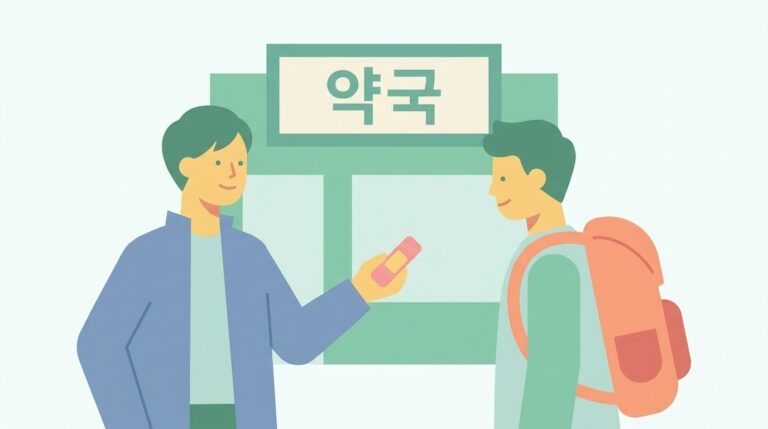
- You: 🎭 Pointing at the nearby pharmacy “저기… 약국 있어요?” (Jeogi… yakguk isseoyo? – Is there… a pharmacy over there?)
- Minho: “네, 바로 저기 있어요. 같이 가 드릴까요?” (Ne, baro jeogi isseoyo. Gati ga deurilkkayo? – Yes, it’s right over there. Shall I go with you?)
- You: “아니요, 괜찮아요. 고맙습니다.” (Aniyo, gwenchaneyo. Gomapseumnida. – No, I’m okay. Thank you.)
- Minho: “조심해서 가세요!” (Josimhaeseo gaseyo! – Go carefully!)
- You: “네, 안녕히 계세요.” (Ne, annyeonghi gyeseyo. – Yes, goodbye.)
🔀 Interactive Choice Point
What would you say next if the pain got worse?
* A) “병원 어디예요?” (Byung-won eo-di-yeo-yo? – Where is the hospital?)
* B) “안 아파요!” (An a-pa-yo! – It doesn’t hurt!)
* C) “119 불러주세요!” (Il-gu-gu bul-leo-ju-se-yo! – Please call 119!)
Feedback:
* Choosing A (Best): Perfect! If the cut is deep, finding a local clinic (병원) is the smartest choice.
* Choosing B (Bad): Oh no! Don’t lie to be polite if you’re actually bleeding!
* Choosing C (Risk): 119 is for life-threatening emergencies. For a scraped knee, calling 119 might be an overreaction, but useful if you absolutely cannot walk!
Phase 6: 10-Second Emotion Shadowing Drill (10초 감정 섀도잉)
Practice saying these with the correct dramatic pauses (/) and emotions!
[🥺 In pain & whiny]“아파요 / 진짜 / 아파요…” (Apayo / jinjja / apayo…) – It hurts… really… it hurts…[😰 Panicked & urgent]“여기 / 피가 / 나요!” (Yeogi / piga / nayo!) – Here… it’s bleeding![🙏 Appreciative but tired]“도와줘서 / 고맙습니다.” (Dowajwoseo / gomapseumnida.) – Thank you / for helping me.
Phase 7: K-Culture Mini-Dictionary (K-Culture 미니 사전)
- 약국 (Yak-guk) | Pharmacy | Unlike some countries where you buy medicine in supermarkets, in Korea, you must go to a 약국 for painkillers and bandages.
- 대일밴드 (Dae-il-baen-deu) | Brand-name Band-aid | The most famous bandage brand in Korea. If you ask for this, pharmacists will understand instantly.
- 연고 (Yeon-go) | Healing Ointment | The Korean equivalent of Neosporin. The most famous brand is “Fucidin” (후시딘) or “Madecassol” (마데카솔).
- 파스 (Pa-seu) | Medicated Patch | A pain-relief patch for muscle aches. If you twist your ankle, ask for “파스”.
Phase 8: Survival Kit for Travelers (여행자를 위한 생존 키트)
Emergency TOP 3 Phrases
- “도와주세요!” (Do-wa-ju-se-yo!) – Help me!
- “약국이 어디예요?” (Yak-guk-i eo-di-yeo-yo?) – Where is the pharmacy?
- “대일밴드 주세요.” (Dae-il-baen-deu ju-se-yo.) – Please give me a band-aid.
💡 Editor’s Travel Note: Download the 네이버 지도 – Naver Map App immediately. Type “약국” (Pharmacy) or “병원” (Hospital) in the search bar to find the closest open clinic. Google Maps is not very accurate for walking directions in South Korea!
Phase 9: One Step Deeper (한 발 더 깊이)
In Korea, when you trip or drop something, strangers around you will often gasp and say “아이구! (Aigu!)” or “어머! (Eomeo!)”. This is not them being dramatic; it is a cultural reflex of shared sympathy. Korea’s collective community culture means people feel a natural duty to make sure you are okay. If someone asks “괜찮아요?” (Are you okay?), a simple “네, 괜찮아요. 감사합니다” goes a long way in showing mutual respect.
💬 Your Turn: Have you ever had to ask for help or medicine in another country? Share your experience in the comments below!
Phase 10: FAQ & Common Mistakes (FAQ Schema)
Q: What is the emergency number in South Korea?
A: The emergency number for medical assistance and fire is 119. For police, it is 112.
Q: Can I buy painkillers in Korean convenience stores?
A: Yes, basic painkillers like Tylenol (타이레놀) and safety medicines are available 24/7 at most convenience stores (편의점) under the “상비약” (emergency medicine) section.
Q: How do I ask for a doctor who speaks English?
A: You can say, “영어 가능한 의사 선생님 계세요?” (Yeong-eo gang-neung-han uisa seonsaengnim gyeseyo?).
🚨 Common Mistakes Alert!
- Mistake 1: Saying “아파요” to mean you are angry. (It only means pain or sickness!).
- Mistake 2: Using the super casual “아파” to a doctor or pharmacist. (Always add “요” to be polite: 아파요).
- Mistake 3: Expecting grocery stores to sell bandages. (Go to a 약국 or 편의점 instead!).
Phase 11: Action Mission & K-Culture Mission
- Bronze Medal: Say “아파요” out loud 5 times with different facial expressions of pain.
- Silver Medal: Find a K-Drama clip where someone gets hurt, and write down the exact phrase they used in our comment section.
- Gold Medal: The next time you get a tiny paper cut, tell your friend or partner: “나 다쳤어! 피가 나!” (Casual style) to practice real immersion!
Phase 12: Interactive Quiz Challenge (인터랙티브 퀴즈 챌린지)
- What is the correct way to say “It hurts” politely?
- A) 아파
- B) 아파요
- C) 아픕니다만
- Which word means “Pharmacy”?
- A) 병원
- B) 편의점
- C) 약국
🎉 Click to see the answers!
- Answer: B (아파요). A is too casual for strangers, and C is too stiff!
- Answer: C (약국). 병원 is hospital, and 편의점 is convenience store!
“,







