

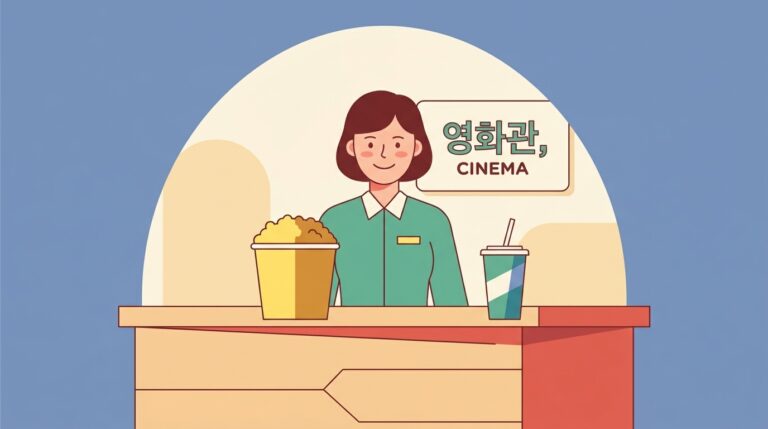
Going to the Cinema in Korea: Your Ultimate Survival Guide
Phase 1: Empathy (Welcome, Movie Lover!)
안녕하세요! (Annyeonghaseyo!) Hello there, fellow movie lover! I’m your Daily Hangul editor, and I’m so excited to help you step into the magical world of Korean cinema today.
Imagine this: You are standing in the middle of a futuristic-looking CGV or Lotte Cinema in Seoul. The sweet, buttery scent of caramel popcorn (which is a massive deal in Korea!) fills the air. You want to buy a ticket for the latest hit movie, but suddenly your mind goes blank. “How do I ask for a ticket?” “Where do I sit?”
Don’t worry! Many of our learners have told us they felt intimidated by the self-service kiosks or fast-talking staff. Today, we’re going to break down those barriers. By the end of this guide, you will comfortably walk up to any Korean cinema counter and order your ticket like a local. Let’s make your next K-Movie night unforgettable!
Phase 2: Deep Dive into 3 Essential Expressions
Let’s master the three most important phrases you’ll need at the box office.
1. 영화표 주세요. (Yeong-hwa-pyo ju-se-yo.)
- Pronunciation: Yong-hwa-pyo joo-seh-yo (Sounds like “Yong-hwa” + “pure” without the ‘r’ + “joo-sah-yo”)
- Meaning: “Please give me a movie ticket.”
- K-Culture Moment: You will hear this or say this directly to the staff at the ticketing desk. In Korea, we love efficiency, so getting straight to the point is totally polite!
- Editor’s Insight: Yeong-hwa (영화) means movie, pyo (표) means ticket, and ju-se-yo (주세요) is the magic Korean word for “please give me.” You can use ju-se-yo for everything from popcorn to water!
- Situation Spectrum: Casual ⚠️ | Semi-formal ✅ | Formal ✅
- 🤔 Think About It: In your home country, do you ask for a ticket by naming the movie first, or by just asking for “a ticket”? In Korea, stating the object first (Yeong-hwa-pyo) makes communication super clear!
2. 두 명 이요. (Du myeong-i-yo.)
- Pronunciation: Doo myung-ee-yo (Sounds like “Do” + “myung” + “ee-yo”)
- Meaning: “Two people, please.”
- K-Culture Moment: Going to the cinema is a classic date or friend hangout activity in Korea. When the staff asks how many people, you’ll use this.
- Editor’s Insight: Du (두) means “two” when counting things or people, and myeong (명) is the counter for people. I-yo (이요) is a polite ending. If you are alone, say 한 명 이요 (Han myeong-i-yo / One person, please).
- Situation Spectrum: Casual ⚠️ | Semi-formal ✅ | Formal ✅
- 🤔 Think About It: Korean uses different number systems and counters depending on what you are counting. Isn’t it fascinating how language categorizes the world?
3. 자리 있어요? (Jari isseoyo?)
- Pronunciation: Jah-ree eet-suh-yo? (Sounds like “Jah-ree” + “eat-soy-yo?” with a rising tone)
- Meaning: “Are there seats left?” / “Is there space?”
- K-Culture Moment: Popular blockbusters sell out fast in Korea! Before you get your hopes up, you can ask this while pointing at the screen.
- Editor’s Insight: Jari (자리) means seat or space, and isseoyo? (있어요?) means “is there?” or “do you have?”. Keep your intonation rising at the end to make it a question!
- Situation Spectrum: Casual ⚠️ | Semi-formal ✅ | Formal ✅
- 🤔 Think About It: Koreans value shared spaces, and asking if a “seat/space” exists is a very common way to check availability in restaurants, cafes, and cinemas alike.
Phase 3: Textbook vs. Real Korean
Let’s look at how textbooks teach cinema language versus how real Koreans actually talk!
Situation 1: Buying popcorn
- 📖 Textbook Korean: Popcorn과 콜라를 구입하고 싶습니다. (Popcorn-gwa col-la-reul gu-ip-ha-go sip-seum-ni-da. – “I would like to purchase popcorn and cola.”)
- 🗣️ 진짜 (Real) Korean: 팝콘이랑 콜라 주세요. (Popcorn-i-rang col-la ju-se-yo. – “Popcorn and cola, please.”)
- 💡 Why the difference? The textbook version is grammatically correct but sounds like a robot in a corporate meeting. In real life, using -랑/이랑 (-rang/i-rang / and) and 주세요 (ju-se-yo / please give me) is perfectly polite and natural.
Situation 2: Asking about movie times
- 📖 Textbook Korean: 영화가 몇 시에 시작합니까? (Yeong-hwa-ga myeot si-e si-jak-ham-ni-da? – “At what hour does the motion picture commence?”)
- 🗣️ 진짜 (Real) Korean: 몇 시 영화 있어요? (Myeot si yeong-hwa isseoyo? – “What time movies do you have?”)
- 💡 Why the difference? Real-life conversation favors brevity. “What time movies are there?” is the go-to phrase Koreans use at the counter.
Phase 4: K-Culture Deep Dive & Non-Verbal Manners
4-1. Nunchi (눈치) & Cinema Etiquette
In Korea, Nunchi (tact/situational awareness) is key. Korean movie theaters are incredibly quiet. During the film, talking, whispering, or even heavy rustling of chip bags is frowned upon.
* The Gesture: If you need to pass by someone in a row to get to your seat, slightly bow your head, tuck your arms in, and whisper 죄송합니다 (Joe-song-ham-ni-da / Sorry) as you pass. It shows you respect their space!
4-2. The Golden Popcorn Culture
Korean cinema food is next-level. Forget just salted popcorn. In Korea, you must try 반반 팝콘 (Ban-ban popcorn / Half-and-Half popcorn), where you can mix two flavors like Caramel and Garlic in one bucket! Also, look out for grilled butter squid—a classic Korean cinema snack!
Phase 5: Interactive Roleplay Scenario
Meet Min-ji, the friendly cinema staff member at CGV Yongsan. She is ready to help you buy your ticket!
[Scene: Min-ji is standing behind the ticket counter. You walk up to her.]

Min-ji: 안녕하세요! 어떤 영화 보세요?
        (An-nyeong-ha-se-yo! Eo-tteon yeong-hwa bo-se-yo?)
        [🎭 Greeting you with a warm smile]
        "Hello! Which movie are you watching?"

You: 영화표 주세요.
     (Yeong-hwa-pyo ju-se-yo.)
     [🎭 Pointing slightly to the movie poster]
     "Please give me a movie ticket."

Min-ji: 네, 몇 명 이세요?
        (Ne, myeot myeong-i-se-yo?)
        [🎭 Holding up a tablet showing the seating chart]
        "Great, how many people?"

You: 두 명 이요.
     (Du myeong-i-yo.)
     [🎭 Holding up two fingers]
     "Two people, please."

Min-ji: 네, 시간은 몇 시로 하세요?
        (Ne, si-gan-eun myeot si-ro ha-se-yo?)
        [🎭 Tapping the screen to show available times]
        "Okay, what time would you like?"

You: 세 시 영화 있어요?
     (Se si yeong-hwa isseoyo?)
     [🎭 Looking at the digital timetable]
     "Is there a 3 o'clock movie?"

Min-ji: 네, 자리 있어요! 좌석 선택해 주세요.
        (Ne, ja-ri is-seo-yo! Jwa-seok seon-taek-hae ju-se-yo.)
        [🎭 Turning the screen toward you]
        "Yes, there are seats! Please choose your seats."

You: 감사합니다!
     (Gam-sa-ham-ni-da!)
     [🎭 Giving a polite little bow]
     "Thank you!"
🔀 Your Turn! Choose Your Next Action:
What will you say to Min-ji to get some snacks?
* A) “팝콘이랑 콜라 주세요.” (Popcorn-i-rang col-la ju-se-yo.)
* B) “김치찌개 주세요.” (Kimchi-jjigae ju-se-yo.)
* C) “No English?”
Feedback:
- Best (A): Perfect! You just ordered delicious caramel popcorn and a drink. Enjoy the movie!
- Bad (B): Oops! Kimchi stew is delicious, but they don’t serve it in the cinema hall!
- Risk (C): While some staff speak English, trying Korean first makes a wonderful impression and is great practice!
Phase 6: 10-Second Emotion Shadowing Drill
Practice speaking like a native speaker! Pay attention to the pauses (/) and emotions.
[😊 Excited & Friendly]
영화표 / 주세요!
(Yeong-hwa-pyo / ju-se-yo!)-
[🤔 Curious & Hopeful]
자리 / 있어요?
(Ja-ri / is-seo-yo?) -
[🍿 Hungry & Polite]
팝콘 / 주세요!
(Pop-con / ju-se-yo!)
Phase 7: K-Culture Mini Dictionary
- 팝콘 (Pop-corn) | Popcorn | The ultimate Korean cinema snack, often ordered in “Half-and-Half” (반반) sweet/savory flavors.
- 상영관 (Sang-yeong-gwan) | Cinema Hall / Theater Room | The actual room where the movie is shown (e.g., 상영관 5 is Theater 5).
- 좌석 (Jwa-seok) | Seat | Your assigned seat. In Korea, you choose your seat at the time of booking.
- 매표소 (Mae-pyo-so) | Ticket Office | The physical booth where you buy tickets from a human staff member.
Phase 8: Survivor Kit for Travelers
Survival Phrases TOP 3
- 화장실 어디예요? (Hwa-jang-sil eo-di-yeo-yo?) – “Where is the restroom?”
- 물 주세요. (Mul ju-se-yo.) – “Water, please.”
- 이거 얼마예요? (I-geo eol-ma-yeo-yo?) – “How much is this?”
Editor’s Travel Note
Before you head to a mega-multiplex like CGV or Megabox, we highly recommend downloading the Naver Map App to find the nearest theater. Note that most ticket kiosks in major Korean cities have an “English” language option, but knowing these basic words will save your day if the system defaults to Korean! Please note: Cinema ticket prices can vary slightly by location and time of day.
Phase 9: “A Step Deeper” (Thoughtful Reflection)
In Korea, going to the movies is not just about the film; it’s a shared social ritual called “Cultural Life” (문화생활 – Mun-hwa-saeng-hwal). Koreans place a high value on group harmony, which is why theaters are kept pristine and quiet, allowing everyone to immerse themselves completely.
💬 Your Turn: How does cinema culture in your country compare to Korea? Do people cheer loudly, or is it quiet? Let us know in the comments below!
Phase 10: FAQ & Common Mistakes
Q: Can I buy tickets on the day of the show at the theater?
A: Yes! While many locals book in advance using apps, you can easily buy tickets on-site at the 매표소 (ticket counter) or using the touch-screen kiosks.
Q: Are foreign movies dubbed in Korean?
A: Usually, Hollywood movies are subtitled in Korean (자막 – jamak), keeping the original English audio. Children’s animated films, however, are often dubbed (더빙 – deobing).
Q: How do I find my seat number?
A: Your ticket will show a letter and a number (e.g., H12). The letter is the row (열 – yeol), and the number is the seat (번 – beon).
🚨 Common Mistakes Alert!
- Saying “Ticket please” as “표를 원해요” (Pyo-reul won-hae-yo): This sounds like “I desire a ticket” in a dramatic way. Keep it natural with “영화표 주세요” (Yeong-hwa-pyo ju-se-yo).
- Sitting anywhere: Korean theaters have strictly assigned seating. Never sit in an empty seat that isn’t on your ticket!
- Shouting “Excuse me” loudly: If you need the staff’s attention, say a soft “저기요” (Jeo-gi-yo) instead of shouting.
Phase 11: Action Mission
- Bronze: Say “영화표 주세요” (Yeong-hwa-pyo ju-se-yo) out loud 3 times in front of your mirror.
- Silver: Write a comment below telling us which K-Movie you want to watch using the phrase: “[Movie Name] 표 주세요!”
- Gold: The next time you watch a Korean drama, listen carefully for the word “주세요” (ju-se-yo) and spot what they are asking for!
Phase 12: Interactive Quiz Challenge
1. What does “자리 있어요?” (Jari isseoyo?) mean?
- A) Is there popcorn?
- B) Are there seats?
- C) What time is it?
Reveal Answer & Explanation
Correct Answer: B
“Jari” means seat or space, and “isseoyo?” means “is there?”. You use this to ask if there are available seats!
2. Fill in the blank: Popcorn and cola please = “팝콘____ 콜라 주세요.”
- A) 이랑 (i-rang)
- B) 은 (eun)
- C) 를 (reul)
Reveal Answer & Explanation
Correct Answer: A
“이랑” (i-rang) means “and” and connects two nouns naturally in spoken Korean!
3. True or False: You can sit anywhere you want in a Korean movie theater.
- True
- False
Reveal Answer & Explanation
Correct Answer: False
Korean cinemas use strict assigned seating. You must sit in the exact seat printed on your ticket!







