

Ouch! Cooking in a K-Kitchen: How to Handle Cuts and Burns Like a Native
Phase 1: Empathy (스토리 몰입형 오프닝)
안녕하세요! It’s your Korean bestie and Daily Hangul Editor, here to save your fingers and your Korean conversations!
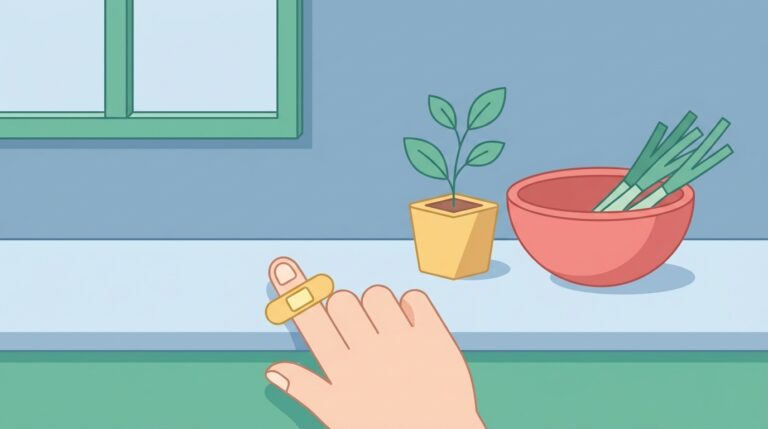
Picture this: You are in your cozy kitchen, trying to recreate that mouth-watering Kimchi-jeon (김치전 – Kimchi pancake) you saw in your favorite K-drama. You’re chopping the green onions, humming to a catchy K-pop tune, when—ouch! The knife slips, and you cut your finger.
We’ve all been there. Getting hurt while cooking is painful, but trying to explain what happened in a foreign language can be even more frustrating. Whether you need to ask a roommate for a band-aid, explain your wound to a pharmacist, or tell your Korean friend why your hand is wrapped in bandages, we’ve got you covered.
Our Daily Hangul community frequently shares that physical pain is when they suddenly forget all their Korean. Today, we’re going to fix that. Let’s learn how to express minor household accidents naturally so you can get the help—and sympathy—you need!
Phase 2: Core Expressions (핵심 표현 3선 심층 분석)
Let’s dive into three essential expressions you will need when a kitchen accident occurs.
1. 손을 베였어요. (Son-eul be-yeot-eo-yo)
- Pronunciation: Son-eul bay-yut-uh-yo (Sounds like “Son” + “ul” + “bay” as in bay + “yut” + “uh-yo”)
- Meaning: I cut my hand/finger. (Passive: My hand got cut.)
- K-Culture Moment: In K-Dramas, this is the ultimate romantic catalyst. A character is chopping vegetables, winces, and says, “아, 손 베였다…” (Ah, I cut my finger…). Immediately, the male lead rushes over, grabs the first-aid kit, and gently applies a band-aid while looking deeply concerned.
- Editor’s Insight: In English, you say “I cut my finger” (active). But in Korean, we usually say “손을 베였어요” (My hand got cut – passive) or “손을 벴어요” (I cut my hand – active). “베였어요” is extremely common because it emphasizes that it was an accident, not an intentional act!
- Situation Spectrum: Casual: 손 베였어 ⚠️ | Semi-formal: 손 베였어요 ✅ | Formal: 손을 베였습니다 ✅
- 🤔 Think About It: Why do you think Korean often uses passive voice for accidents? (It softens the action and focuses on the state of the wound rather than the blame!)
2. 칼에 살짝 긁혔어요. (Kal-e sal-jjak geulk-hyeot-eo-yo)
- Pronunciation: Kal-ay sal-jjak gulk-hyut-uh-yo (Think “Kal” as in calm + “sal-jjak” meaning slightly/a bit + “gulk-hyut” + “uh-yo”)
- Meaning: I got slightly scratched by a knife.
- K-Culture Moment: You might say this to your Korean mom or friend over FaceTime to reassure them. “It’s nothing big, just a scratch!”
- Editor’s Insight: “살짝” (Sal-jjak) is a magical Korean adverb meaning “slightly” or “a little bit.” Using it makes you sound incredibly natural and keeps people from worrying too much about your minor injury.
- Situation Spectrum: Casual: 칼에 살짝 긁혔어 ⚠️ | Semi-formal: 칼에 살짝 긁혔어요 ✅ | Formal: 칼에 살짝 긁혔습니다 🚫 (Too casual for highly formal settings)
- 🤔 Think About It: How does adding words like “slightly” (살짝) change how we show resilience in Korean culture?
3. 데였어요. (De-yeot-eo-yo)
- Pronunciation: Day-yut-uh-yo (Sounds like “Day” + “yut” + “uh-yo”)
- Meaning: I got burned (by something hot, like steam, hot oil, or a pan).
- K-Culture Moment: Preparing hot stone pot Dolsot Bibimbap (돌솥비빔밥) or pouring boiling hot broth from a Ttukbaegi (뚝배기 – clay pot) often leads to this exact exclamation!
- Editor’s Insight: Make sure not to confuse “베였어요” (cut) with “데였어요” (burned). They sound very similar to English speakers, but confusing them might get you hot water instead of a band-aid!
- Situation Spectrum: Casual: 데였어 ⚠️ | Semi-formal: 데였어요 ✅ | Formal: 데였습니다 ✅
- 🤔 Think About It: Since Korean food relies heavily on boiling stews and hot plates, why is “데이다” (to get burned) such a vital survival word?
Phase 3: Textbook vs. Real Korean (교과서 한국어 vs 진짜 한국어)
Let’s compare what textbooks teach you versus what real Koreans say when they are in pain.
Situation 1: Asking for a band-aid
- 📖 Textbook Korean: “대역창고용 반창고가 있습니까?” (Do you have an adhesive plaster for wounds?)
- Why it’s stiff: Nobody says “대역창고용 반창고”. It sounds like a medical manual written in the 1980s!
- 🗣️ Real Korean: “혹시 대역(밴드) 있어요?” (By any chance, do you have a band-aid/Band-Aid?)
- 💡 Why it’s different: Koreans colloquially refer to all small adhesive bandages as “대역” (Band) or “대역밴드”. Adding “혹시” (by any chance) makes the request polite and natural.
Situation 2: Expressing pain after a burn
- 📖 Textbook Korean: “뜨거운 냄비에 닿아 통증이 있습니다.” (I touched a hot pot, so I have pain.)
- Why it’s stiff: This sounds like a cold, robotic patient reporting symptoms to a doctor.
- 🗣️ Real Korean: “앗, 뜨거! 냄비에 살짝 데였나 봐요.” (Ah, hot! I think I got burned slightly by the pot.)
- 💡 Why it’s different: Real humans use interjections like “앗, 뜨거!” (Ouch, hot!) and soften the diagnosis with “~나 봐요” (it seems like / I think I…).
Phase 4: K-Culture Deep-Dive & Non-verbal Manners (비언어적 매너)
4-1. Physical Expressions of Concern
In Korea, when someone gets hurt, showing Jeong (정 – warm affection/empathy) is crucial.
* The “Sigh of Empathy” (쓰읍-): If a friend cuts their finger, you don’t just stand there. You make a sharp, sympathetic intake of breath (“Sss-up!”) as if you feel their pain.
* Gentle Scolding (걱정 섞인 잔소리): Don’t be offended if a older Korean coworker or friend says, “아이구, 조심하지 그랬어!” (Aigu, you should have been careful!). In Western cultures, this might sound like blaming, but in Korea, this “nagging” is a deep expression of worry and affection.
4-2. The “First Aid Kit” Culture in Korea
Almost every Korean household keeps a magical ointment called 마데카솔 (Madecassol) or 후시딘 (Fucidin). They are the Korean equivalents of Neosporin. If you cut your finger, Koreans will immediately ask, “후시딘 발랐어?” (Did you apply Fucidin?). Asking for these brand names at a pharmacy will instantly make you sound like a local!
Phase 5: Real-Life Roleplay Scenario (실전 롤플레이)
Background: You are cooking Tteokbokki (떡볶이) in the kitchen of your share-house in Seoul with your roommate, Min-ji (민지).
Characters:
- Min-ji (민지): Your helpful, caring Korean roommate who is an expert home cook.
- You: An exchange student who is slightly clumsy with a Korean chef’s knife.
[Scene: The shared kitchen. Sizzling sounds. You are chopping green onions.]

민지: (Smiling) 요리하는 모습 보니까 이제 진짜 한국인 다 됐네!
      (Yo-ri-ha-neun mo-seup bo-ni-ka i-je jin-jja Han-guk-in da dwaet-ne!)
      "Looking at you cook, you've really become a Korean now!"

유 (You): 앗! (Drops the knife, holding your left index finger)
      (At!)
      "Ouch!"

민지: (Genuinely worried, rushes over) 어머, 왜 그래? 손가락 베인 거야?
      (Eo-meo, wae geu-rae? Son-ga-rak be-in geo-ya?)
      "Oh my, what's wrong? Did you cut your finger?"

유 (You): 네, 칼에 살짝 베였어요. 피가 조금 나요.
      (Ne, kal-e sal-jjak be-yeot-eo-yo. Pi-ga jo-geum na-yo.)
      "Yes, I got slightly cut by the knife. It's bleeding a little."

민지: (Sighs with sympathy) 쓰읍, 아프겠다! 얼른 물로 씻고 와. 내가 구급상자 가져올게.
      (Sseup, a-peu-get-da! Eol-reun mul-lo ssit-go wa. Nae-ga gu-geup-sang-ja ga-jyeo-ol-ge.)
      "Ouch, that must hurt! Wash it with water quickly. I'll grab the first aid kit."

유 (You): (Under the tap) 고마워요, 민지 씨. 큰 상처는 아니에요.
      (Go-ma-wo-yo, Min-ji ssi. Keun sang-cheo-neun a-ni-e-yo.)
      "Thank you, Min-ji. It's not a big wound."

민지: (Brings a box) 자, 여기 마데카솔 바르고 대역(밴드) 붙이자. 쓰리겠지만 참아!
      (Ja, yeo-gi Ma-de-ka-sol ba-reu-go baen-deu but-i-ja. Sseu-ri-get-ji-man cham-a!)
      "Here, let's put on some Madecassol and a band-aid. It might sting, but bear with it!"

유 (You): (Gritting teeth) 휴, 이제 살 것 같아요. 정말 감사합니다.
      (Hyu, i-je sal geot gat-a-yo. Jeong-mal gam-sa-hap-ni-da.)
      "Phew, I feel much better now. Thank you so much."
🔀 Choose Your Response! (인터랙티브 분기점)
Min-ji asks: “많이 아파? 병원 가야 하는 거 아냐?” (Does it hurt a lot? Shouldn’t we go to the hospital?)
- Option A: “아니요, 병원은 너무 비싸요. 그냥 밴드만 주세요.”
- Feedback (Risk): While honest, saying hospitals are “too expensive” might make Min-ji worry about your financial situation, and actually, Korean healthcare is very affordable!
- Option B: “괜찮아요! 그냥 살짝 긁힌 거예요. 엄살 부려 죄송합니다.”
- Feedback (Bad): No need to apologize for “exaggerating” (엄살)! It sounds too self-deprecating for a simple accident.
- Option C: “괜찮아요, 진짜 살짝 베인 거라 밴드 붙이면 금방 나을 거예요!”
- Feedback (Best!): Reassuring and natural. It uses “금방 나을 거예요” (It will heal in no time), which shows a positive, friendly attitude.
Phase 6: 10-Second Emotion Shadowing Drill
Let’s practice speaking with real emotions! Pay attention to the pauses (/) and the emotional cues.
- [🥺 Pain & Surprise]
- “앗! / 칼에 / 손을 / 베였어요.” (At! / Kal-e / son-eul / be-yeot-eo-yo.)
- [😊 Reassuring & Calm]
- “괜찮아요, / 진짜 / 살짝 / 긁힌 거예요.” (Gwen-chan-a-yo, / jin-jja / sal-jjak / geulk-hin-geo-yeo-yo.)
- [🙏 Relieved & Grateful]
- “휴, / 밴드 / 붙이니까 / 이제 살 것 같아요!” (Hyu, / baen-deu / but-i-ni-kka / i-je sal geot gat-a-yo!)
Phase 7: K-Culture Mini-Dictionary (미니 사전)
- 연고 (Yeon-go) | Ointment / Cream
- Usage: Used for cuts, burns, or insect bites. “연고 좀 발라라” (Put some ointment on).
- 흉터 (Hyung-teo) | Scar
- Usage: Koreans care a lot about skincare, so avoiding “흉터” is a primary goal when treating a cut.
- 소독약 (So-dok-yak) | Antiseptic / Rubbing Alcohol
- Usage: Used to clean wounds. “빨간약” (red medicine/iodine) is the famous retro Korean term for this.
- 엄살 (Eom-sal) | Making a fuss over a small pain / Faking/exaggerating pain
- Usage: “엄살 부리지 마~” (Don’t make a big deal out of it – friendly teasing).
Phase 8: Survivor Kit for Travelers
Survival Phrases TOP 3
- “대역(밴드) 있어요?” (Do you have a band-aid?) – Pro Tip: Use this at any convenience store (Pyeon-ui-jeom).
- “약국이 어디에 있어요?” (Where is the pharmacy?) – Pro Tip: Look for the bright red sign that simply says “약” (Yak).
- “화상 연고 주세요.” (Please give me burn ointment.) – Pro Tip: Say this to a pharmacist if you burn your hand on hot street food or a barbecue grill.
Editor’s Travel Note:
If you get hurt late at night, most convenience stores like GS25, CU, and 7-Eleven carry basic emergency items like band-aids and ointment. If you need a pharmacy, search “약국” on the KakaoMap App to find the closest open location.
Phase 9: Deep Dive (한 발 더 깊이)
In Western cultures, privacy around personal health is highly respected, and asking someone detailed questions about an injury might seem intrusive. However, in Korea’s community-centric society, pointing out someone’s injury and offering help is a sign of affection. If a Korean colleague gasps and grabs your hand to inspect a tiny scratch, they aren’t crossing boundaries—they are showing 인정 (In-jeong – human warmth).
💬 Your Turn: Have you ever experienced a minor accident while traveling or cooking Korean food? How did you handle it? Let us know in the comments below!
Phase 10: FAQ & Common Mistakes (자주 묻는 질문)
Q: Can I buy antibiotic ointment like Neosporin at a Korean supermarket?
A: No. In Korea, medicated ointments like Fucidin or Madecassol are sold exclusively at pharmacies (약국), although some basic convenience stores might carry emergency packs.







