

Master the Art of Korean Business Gifting: How to Present Gifts Like a Local Insight
안녕하세요! Welcome back to Daily Hangul, your trusty Korean culture navigator. I’m your senior editor, and today we are diving into one of the trickiest, yet most rewarding parts of Korean business culture: Business Hospitality (비즈니스 접대), specifically giving gifts and explaining their meaning (선물 증정 및 의미 설명하기).
Imagine this: You are at a beautiful traditional Korean restaurant in Insadong, wrapping up a successful business dinner with Mr. Kim, your VIP client. You want to present him with a special gift from your home country. You reach into your bag, pull out the beautifully wrapped box, and hand it to him. But wait—do you hand it with one hand? What do you say? “Here is a gift”? That feels a bit cold. How do you explain why you chose this specific item without sounding boastful?
Don’t worry! Gifting in Korea is less about the price tag and more about jeong (정 – affection/bonding) and respect. Today, we’ll learn three premium expressions that will make you look incredibly respectful, culturally savvy, and professional. Let’s dive in!
Phase 2: Deep Dive into 3 Essential Expressions
1. 약소하지만 성의로 준비했습니다. (Yakssohajiman seong-uiro junbihaessseumnida.)
- Pronunciation: Yak-so-ha-ji-man (sounds like “yak-so” + “ha-ji-man” as in “but”) seong-ui-ro (sounds like “seong-we-ro”) jun-bi-haet-seum-ni-da.
- Meaning: It is humble/small, but I prepared it with sincerity.
- K-Culture Moment: You often see this in dramas like Misaeng or Suits when an employee presents a gift to a director or a client. It’s the ultimate golden standard of polite gifting.
- Editor’s Insight: Literally, yaksohada (약소하다) means “to be meager/small.” You might think, “Why would I call my expensive gift small?” In Korea, humbleness is the highest form of respect. By lowering the value of your gift, you elevate the recipient.
- Situation Spectrum: Casual 🚫 | Semi-formal ⚠️ | Formal ✅
- 🤔 Think About It: In western cultures, we often say, “Look at this amazing thing I got you!” Why does Korean culture value lowering the gift’s value? (It’s about making sure the receiver doesn’t feel burdened to return something of equal monetary value!)
2. 마음에 드셨으면 좋겠습니다. (Ma-eume deuseosseumyeon jokesseumnida.)
- Pronunciation: Ma-eum-e (sounds like “ma-um-eh”) deu-sheot-eu-myeon (sounds like “deu-shot-eu-myun”) jo-ket-seum-ni-da.
- Meaning: I hope you like it. (Literally: “I hope it enters your heart.”)
- K-Culture Moment: Commonly heard in daily life and K-Dramas when someone nervously hands over a thoughtfully picked gift.
- Editor’s Insight: This phrase focuses entirely on the recipient’s feelings. It is soft, polite, and can be used in almost any business or personal setting.
- Situation Spectrum: Casual ⚠️ | Semi-formal ✅ | Formal ✅
- 🤔 Think About It: The Korean word for “to like” here is ma-eume deulda (마음에 들다), which literally means “to enter the heart.” Isn’t that beautiful?
3. 대표님 생각이 나서 골라봤습니다. (Daepyonim saenggagi naseo gollabwasseumnida.)
- Pronunciation: Dae-pyo-nim (sounds like “dae-pyo-nim”) saeng-gak-i (sounds like “saeng-gak-ee”) na-seo (sounds like “na-seo”) gol-la-bwat-seum-ni-da.
- Meaning: I picked this because it reminded me of you, Director.
- K-Culture Moment: Used when presenting a personalized or unique gift to show that you didn’t just buy a random item at the airport duty-free.
- Editor’s Insight: Replace “대표님” (CEO/Director) with the recipient’s title (e.g., 부장님, 과장님, or name + 씨). This phrase builds a deep personal connection.
- Situation Spectrum: Casual ✅ | Semi-formal ✅ | Formal ⚠️
Phase 3: Textbook Korean vs. Real-Life Korean
Situation 1: Handing over the gift
- 📖 Textbook Korean: “이것은 선물입니다.” (Igeoseun seonmurimnida. – This is a gift.)
- 🗣️ 진짜 Korean: “작은 성의인데 한번 받아보세요.” (Jageun seong-uiinde hanbeon badaboseoyo. – It’s a small token of my appreciation, please accept it.)
- 💡 Why the difference? Direct translations sound robotic and demanding. Real-life Korean uses soft, humble framing to make the exchange smooth.
Situation 2: Wishing they enjoy it
- 📖 Textbook Korean: “즐겁게 사용하십시오.” (Jeulgeopge sayonghasipsio. – Use it happily.)
- 🗣️ 진짜 Korean: “부담 갖지 마시고 편하게 써 주세요.” (Budam gatji masigo pyeonhage sseo juseyo. – Please don’t feel burdened, just enjoy using it comfortably.)
- 💡 Why the difference? Koreans worry about budam (부담 – burden) when receiving gifts. Reassuring them that it’s a light gift is a highly polite mannerism.
Phase 4: K-Culture Deep Dive & Non-Verbal Manners
4-1. The Art of Hands and Eyes (Nunchi Gifting)
In Korea, how you hand over the gift is just as important as what is inside.
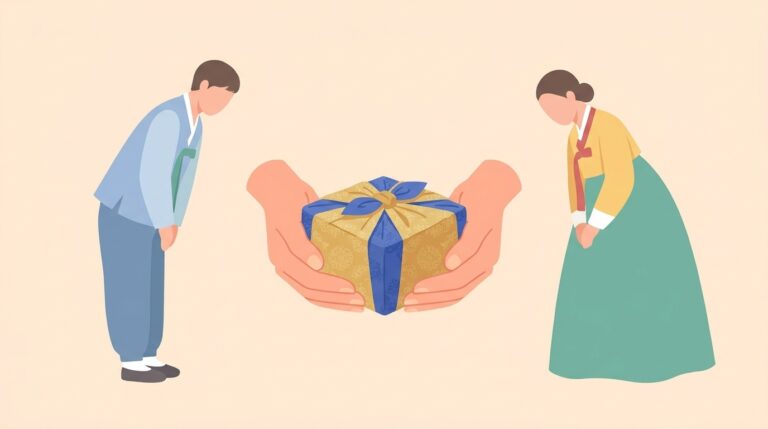
1. Two Hands Always: Never hand over a gift with one hand. Present it with both hands, with your palms facing up holding the bottom of the gift, and bow your head slightly.
2. The Receiving End: If you are receiving a gift, accept it with both hands, give a slight bow, and say, “감사합니다.” (Gamsahamnida).
3. Unwrapping Etiquette: Unlike in western cultures, do not open the gift immediately in front of the giver unless they explicitly ask you to (“열어보세요”). Opening it immediately can make you look greedy.
4-2. Culture Code: Red vs. White and the Red Ginseng Craze
- Wrapping Colors: Avoid wrapping gifts in pure white or red/black combinations (often associated with funerals). Gold, royal blue, or traditional green wrapping are highly favored in business.
- Popular Items: Health supplements (especially Hongsam – Red Ginseng extract), local specialty foods from your home country, or high-quality bookmarks/pens are safe and premium choices.
Phase 5: Real-Life Roleplay Scenario
Setting: A premium Korean Hanok restaurant. Sarah (a foreign marketing manager) is presenting a gift of premium local honey from her country to Director Han (한 부장님).
- 한 부장님: 오늘 저녁 정말 맛있었네요. 새로 시작하는 프로젝트도 잘 해봅시다. (Today’s dinner was wonderful. Let’s do great on the new project.)
- 사라: 🎭 (Holding the gift box with both hands and bowing slightly) 저도 오늘 정말 즐거웠습니다, 부장님. 실은 부장님 생각나서 작은 선물을 하나 준비했어요. (I really enjoyed today too, Director. Actually, I prepared a small gift because it reminded me of you.)
- 한 부장님: 어머나, 뭘 이런 걸 다 준비하셨어요? 부담스럽게 왜 그러세요~ (Oh my, why did you prepare all this? You didn’t have to do this~)
- 사라: 🎭 (Smiling warmly) 약소하지만 제 성의니까 받아주세요. 저희 지역 특산물인 천연 꿀이에요. (It’s humble, but it’s my sincere token, so please accept it. It is natural honey from our local region.)
- 한 부장님: 와, 귀한 선물이네요. 고마워요, 사라 씨. (Wow, what a precious gift. Thank you, Sarah.)
- 사라: 요즘 부장님 피곤해 보이셔서 건강에 좋은 걸로 골라봤어요. 마음에 드셨으면 좋겠어요. (Since you looked tired lately, I picked something good for health. I hope you like it.)
- 한 부장님: 아이구, 내 건강까지 신경 써주고… 정말 고마워요. 잘 먹을게요! (My, even worrying about my health… Thank you so much. I will enjoy it!)
- 사라: 🎭 (Nodding politely) 네, 부담 갖지 마시고 편하게 드세요! (Yes, please enjoy it comfortably without any burden!)
🔀 Choose Your Next Move!
Question: Han 부장님 asks: “Can I open it now?” (지금 열어봐도 될까요?)
- Option A: “아뇨, 집에 가서 열어보세요.” (No, open it when you get home.)
- Option B: “네! 부장님 편하실 대로 하세요. 마음에 드셨으면 좋겠어요.” (Yes! Please do as you feel comfortable. I hope you like it.)
- Option C: “네, 꼭 지금 열어서 제 정성을 확인하세요!” (Yes, make sure to open it now to check my sincerity!)
💡 Check the Feedback!
- Option A (Bad): Too direct and borders on rude. It shuts down the client’s excitement.
- Option B (Best): Polite, flexible, and keeps the polite vibe going!
- Option C (Risk): Too pushy. It sounds like you are forcing them to praise your gift on the spot.
Phase 6: 10-Second Emotion Shadowing Drill
Practice saying these with the right emotion and rhythm to sound like a native speaker! / means a short pause.
[😊 Humble & Warm]
약소하지만 / 제 성의로 / 준비했습니다.
(Yak-so-ha-ji-man / je seong-ui-ro / jun-bi-haet-seum-ni-da.)-
[🥺 Hopeful & Soft]
부장님 생각이 나서 / 골라봤어요.
(Bu-jang-nim saeng-gak-i na-seo / gol-la-bwat-eo-yo.) -
[🙏 Reassuring & Polite]
부감 갖지 마시고 / 편하게 / 써 주세요.
(Bu-dam gat-ji ma-si-go / pyeon-ha-ge / sseo ju-se-yo.)
Phase 7: K-Culture Mini Dictionary
- 성의 (Seong-ui) | Sincerity / Devotion. In business, it refers to the heart and effort you put into keeping the relationship strong.
- 부담 (Budam) | Burden or pressure. Koreans hate giving others the feeling of obligation. Gifting must balance respect without causing “budam.”
- 정 (Jeong) | Deep emotional bonding. The unseen invisible thread that connects people in Korea over shared meals, gifts, and time.
- 특산물 (Teuksanmul) | Local specialty. Gifting food or items unique to your hometown or country is highly respected because it has a story.
Phase 8: Traveler’s Survival Kit
Survival Expressions for Gifting
- 이거 제 작은 성의예요. (Igeo je jageun seong-ui-ye-yo.) – This is my small token of sincerity.
- 가족들과 같이 드세요. (Gajok-deul-gwa gati deuseoyo.) – Please share this with your family (Great for food gifts!).
- 김 과장님 덕분입니다. (Kim gwa-jang-nim deok-bun-im-ni-da.) – This is all thanks to you, Manager Kim.
📌 Editor’s Travel Note:
If you need to buy high-quality gifts in Seoul last minute, avoid typical souvenir shops. Instead, head to the basement food halls of Shinsegae Department Store (신세계백화점) or Lotte Department Store (롯데백화점). They have beautifully pre-wrapped traditional teas, premium snacks, and local sets perfect for business clients. You can find locations easily via Naver Map App.
Phase 9: “Going Deeper” (Thinking Question)
In Korean culture, gifting is not a transaction; it is a delicate dance of mutual respect. By saying “It’s nothing special,” you lower yourself to elevate the receiver, and by saying “I hope you don’t feel burdened,” you acknowledge their social obligation. It shows that in Korea, relationships are built on long-term emotional credit rather than instant returns.
💬 Your Turn: Have you ever experienced a similar gifting etiquette in your culture? Or is it completely different? Share your business gifting stories in the comments below!
Phase 10: FAQ & Avoiding Common Mistakes
Q: Can I gift a green cap or sharp items like scissors?
A: Absolutely avoid sharp objects (like knives, scissors) because they symbolize “cutting off the relationship.” Green hats are also avoided in some Asian cultures, but generally, sharp objects are the biggest taboo in Korean business gifting.
Q: Is it okay to gift cash?
A: In business, cash is generally not appropriate unless it is for family events like weddings or funerals (where specific money envelopes are used). Stick to physical goods.
Q: What if they reject my gift at first?
A: This is very common! It’s called Geojeol-ui mi-hak (거절의 미학 – the aesthetics of refusal). They are being polite. Gently push back twice saying, “아니에요, 정말 작은 거니까 편하게 받으세요” (No, it’s really small so please accept it comfortably), and they will accept it.
🚨 Common Mistakes Alert!
- Giving with one hand: Handing a gift like you’re throwing a flyer is a huge turnoff.
- Correct Action: Support your right arm with your left hand at the wrist or elbow while handing it over.
- Asking “Do you know how much this is?”: Sharing the price of the gift ruins the magic of sincerity (Seong-ui).
- Correct Action: Talk about the origin or why you chose it instead.
- Unwrapping instantly without asking: Don’t rip the paper open immediately.
- Correct Action: Keep it next to you and open it later, unless prompted.
Phase 11: Action Mission & K-Culture Mission
- Bronze Level 🥉: Record your voice saying “약소하지만 성의로 준비했습니다” on your phone 3 times.
- Silver Level 🥈: Next time you visit a friend’s house or host a meeting, bring a small coffee/cookie and use the phrase: “부담 갖지 말고 드세요.”
- Gold Level 🥇: Write a short thank-you email to a Korean colleague using “마음에 드셨으면 좋겠습니다.”
🎮 K-Culture Mission:
Watch any office-themed K-drama (like What’s Wrong with Secretary Kim or Start-Up). Look out for scenes where characters exchange gifts in the office. Notice their posture, hand placement, and what they say!
Phase 12: Interactive Quiz Challenge
1. Which of the following is the most polite phrase when presenting a gift to a Korean business VIP?
- A) 이거 비싼 거예요. (Igeo bissan geoyeyo.)
- B) 약소하지만 성의로 준비했습니다. (Yakssohajiman seong-uiro junbihaessseumnida.)
- C) 빨리 열어보세요. (Ppalli yeoreoboseoyo.)
🔍 Reveal Answer & Explanation
- Correct Answer: B
- Explanation: “약소하지만 성의로 준비했습니다” is the textbook gold standard for professional humbleness. Option A brag about the price, and Option C pressures them to open it instantly.
2. True or False: You should always use both hands when giving or receiving a gift in Korea.
- True
- False
🔍 Reveal Answer & Explanation
- Correct Answer: True
- Explanation: Using two hands shows respect, care, and attention. Using one hand can seem arrogant or dismissive in formal business situations.
See you in the next unit of Daily Hangul! 여러분, 오늘도 고생하셨습니다! (Great job today, everyone!)







