

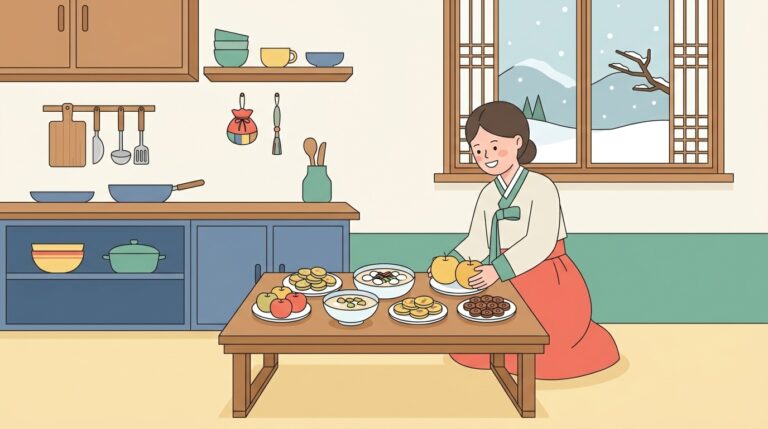
Sizzle, Stack, and Smile: Your Ultimate Guide to Helping with the Seollal Charye Table
Phase 1: Empathy (Your Invitation to the Korean Family Kitchen)
안녕하세요! (An-nyeong-ha-se-yo!) Your favorite Daily Hangul editor is back with another cozy slice of Korean life.
Imagine this: It’s the morning of Seollal (설날 – Lunar New Year). The aroma of freshly fried savory pancakes (jeon) fills the air, steam rises from a boiling pot of rice cakes (tteokguk), and your Korean friends or host family are bustling around the kitchen like busy bees. They are preparing the Charyesang (차례상)—the sacred table of food offerings for ancestral spirits.
You want to help, but you freeze. Where do you place the apples? Is it rude to grab that plate with one hand? What if you say the wrong thing and accidentally ruin the respectful atmosphere?
Don’t worry! This is the ultimate holiday survival guide built directly from the real-life experiences of our global learners. By the end of this guide, you won’t just stand in the corner feeling awkward; you’ll step into the kitchen with the confidence of a seasoned local and the warmth of a true family member. Let’s dive in!
Phase 2: Core Expressions Deep Dive
Here are the three golden keys to unlocking a warm reception in any Korean holiday kitchen.
1. 제가 무엇을 도우면 될까요? (Je-ga mu-eot-eul do-u-myeon doel-kka-yo?)
- Pronunciation: Jay-ga moo-ut-eul do-oo-myeon duel-gga-yo? (Soft ‘d’ sound on ‘do-u-myeon’)
- Meaning: What can I do to help? / How can I be of assistance?
- K-Culture Moment: You will see this in classic family K-dramas. The polite daughter-in-law or the helpful guest enters the chaotic kitchen, rolls up their sleeves, and asks this exact sentence to the matriarch of the house.
- Editor’s Insight: This uses the “-면 되다” (it is okay if…) grammar pattern. Instead of demanding a task, it politely asks, “If I do what, would it be helpful?” It shows incredible initiative without being pushy.
- Situation Spectrum:
- Casual: 🚫 (Too formal for close siblings)
- Semi-formal: ✅ (Perfect for host families or partners’ parents)
- Formal: ✅ (Excellent for elders or in-laws)
- 🤔 Think About It: Why does Korean culture prefer asking conditional questions (“If I do X, is it okay?”) over direct ones? How does this reflect the value of harmony in social spaces?
2. 이거 어디에 놓을까요? (I-geo eo-di-e no-eul-kka-yo?)
- Pronunciation: Ee-guh uh-dee-eh no-eul-gga-yo? (Make sure ‘no-eul’ sounds like a smooth wave, not two chopped syllables)
- Meaning: Where should I place this?
- K-Culture Moment: Holiday food tables have very strict, traditional geographic rules (more on this in Phase 4!). Asking this before placing any dish prevents a major holiday faux pas.
- Editor’s Insight: “이거” is the conversational shortcut for “이것” (this thing). Using “놓을까요?” (shall I place?) shows you respect the sacred layout of the Charye table.
- Situation Spectrum:
- Casual: ⚠️ (이거 어디다 놔? – Only for close friends/siblings)
- Semi-formal: ✅ (이거 어디에 놓을까요? – Highly recommended)
- Formal: ✅ (이것을 어디에 놓으면 되겠습니까?)
- 🤔 Think About It: In your home country, is table placement for holidays symbolic, or is it purely aesthetic? How does physical space dictate respect in your culture?
3. 손을 좀 보태고 싶어요. (So-neul jom bo-tae-go si-peo-yo.)
- Pronunciation: So-neul jom bo-tay-go shi-puh-yo.
- Meaning: I’d like to lend a hand. (Literally: “I want to add a hand.”)
- K-Culture Moment: This is the ultimate “warm-hearted” expression. When neighbors or distant cousins arrive and see the hosts overwhelmed with mountain-loads of food prep, they use this phrase to show deep solidarity and community spirit.
- Editor’s Insight: “손” (hand) is a common Korean metaphor for labor. By saying “보태고 싶어요” (I want to add/contribute), you are showing genuine affection and a desire to share the physical burden of holiday cooking.
- Situation Spectrum:
- Casual: ✅ (손 좀 보탤게!)
- Semi-formal: ✅ (손을 좀 보태고 싶어요.)
- Formal: ⚠️ (손을 보태고자 합니다 – A bit too poetic/dramatic for a kitchen setting)
- 🤔 Think About It: Compare this to the English “lend a hand.” While “lending” implies a temporary transaction, “adding” (보태다) implies combining resources to create a larger whole. Beautiful, isn’t it?
Phase 3: Textbook Korean vs. Real Conversational Korean
Let’s look at how textbooks teach holiday help versus how Koreans actually talk in the kitchen.
Scenario 1: Requesting to help
- 📖 Textbook style: “저를 도와주십시오.” (Jeo-reul do-wa-ju-sip-si-o.) — “Please assist me.”
- 🗣️ Real conversational style: “손 좀 빌려주세요!” (Son jom bil-ryeo-ju-se-yo!) — “Lend me a hand!”
- 💡 Why the difference? Textbook phrases can sound like a formal public announcement. Real kitchen environments are dynamic; asking to “borrow a hand” (손을 빌리다) is warm, collaborative, and immediate.
Scenario 2: Asking where to place a dish
- 📖 Textbook style: “이것은 어디에 놓아야 합니까?” (I-geot-eun eo-di-e no-a-ya hap-ni-ka?) — “Where must I place this?”
- 🗣️ Real conversational style: “이거 어디로 가요?” (I-geo eo-di-ro ga-yo?) — “Where does this go?”
- 💡 Why the difference? In real life, objects “go” (가다) to places. Saying “Where does this go?” sounds incredibly natural, flowing, and native.
Phase 4: K-Culture Deep Dive & Non-Verbal Etiquette
4-1. Nunchi (눈치) & Hand Gestures
When helping in a Korean kitchen during a major holiday, your non-verbal actions speak louder than your words.
* The Two-Hand Rule (양손): Whenever passing a plate, ingredient, or utensil to an elder, always use both hands. Holding it with one hand can look incredibly casual or even disrespectful.
* Postponed Sitting: Do not sit down or rest until the oldest person in the kitchen sits or tells you to relax. Keep your eyes open (눈치가 빠르다 – having fast “nunchi”) to see if trash cans need emptying or if water cups need refilling.
4-2. The Secret Code of the Charyesang (차례상)
Why is everyone so stressed about where the pear goes? Traditional Korean ancestor tables follow ancient directions and cardinal philosophies:
* 홍동백서 (Hong-dong-baek-seo): Red fruits (like apples) go to the East (Right), while white fruits (like peeled pears) go to the West (Left).
* 어동육서 (Eo-dong-yuk-seo): Fish dishes go to the East, while meat dishes go to the West.
Knowing these terms makes you look like a cultural expert!
Phase 5: Real-Life Roleplay Scenario
Setting: A warm, busy kitchen filled with the sizzle of jeon (savory pancakes).
Character: 어머님 (Eomoneim – Host Mother). She is wearing an apron, slightly sweating, but smiling warmly as she flips pancakes.
- 어머님: 아이고, 바쁘다 바빠! 왜 이렇게 할 일이 많지?
(Aigo, bappeuda bappa! Wae ireohke hal iri manji?)
🎭 She wipes her forehead with her sleeve, sighing playfully. -
You: 어머님! 제가 무엇을 도우면 될까요?
(Eomoneim! Je-ga mu-eot-eul do-u-myeon doel-kka-yo?)
🎭 You roll up your sleeves and step closer with an eager smile. -
어머님: 어머, 정말? 그러면 이 사과랑 배 좀 씻어서 물기 좀 닦아줄래?
(Eomeo, jeongmal? Geureomyeon i sagwa-rang bae jom ssiseoseo mulgi jom dakk-a-jullae?)
🎭 She points to a basket of fresh, round fruits near the sink. -
You: 네, 금방 할게요! … 다 닦았어요. 이거 어디에 놓을까요?
(Ne, geumbang halgeyo! … Da dakk-asseoyo. I-geo eo-di-e no-eul-kka-yo?)
🎭 You wash the fruits carefully and bring the dry plate to her using both hands. -
어머님: 사과는 빨간색이니까 동쪽에 놓아야 해. 저기 오른쪽 끝에 놔줘.
(Sagwa-neun ppalgansaek-ini-kka dong-jjok-e no-a-ya hae. Jeogi oreun-jjok kkeut-e nwa-jwo.)
🎭 She nods approvingly toward the right side of the wooden ritual table. -
You: 아! 홍동백서 맞죠? 빨간 사과는 오른쪽이군요.
(Ah! Hong-dong-baek-seo mat-jyo? Ppalgan sagwa-neun oreun-jjok-i-gun-yo.)
🎭 You place them down gently with both hands, making sure they don't roll. -
어머님: 세상에! 홍동백서도 알아? 우리 며느리/사위보다 낫네!
(Sesang-e! Hong-dong-baek-seo-do ara? Uri myeoneuri/sawi-boda natne!)
🎭 She laughs loudly, genuinely impressed by your cultural knowledge. -
You: 에이, 아니에요. 손을 좀 더 보태고 싶은데, 또 다른 건 없을까요?
(Ei, anieyo. Soneul jom deo botaego sipeunde, tto dareun geon eopseulkka?)
🎭 You blush slightly and look around the kitchen for the next task.
🔀 Interactive Choice Point
What will you say next to make 어머님 love you even more?
- [A] “어머님, 저 이제 힘들어서 좀 쉴게요.” (Eomoneim, I’m tired now, so I’ll rest.)
- [B] “전 부치는 것도 제가 해보고 싶어요!” (I want to try frying the pancakes too!)
- [C] “어머님, 한국 명절은 너무 힘들고 비합리적인 것 같아요.” (Eomoneim, Korean holidays seem too hard and irrational.)
💡 Feedback Matrix
- Choice [A] (Bad): While honest, saying you want to rest right after doing one small task ruins the hard-working vibe. It breaks the
Frequently Asked Questions (FAQ)
Q: What does "제가 무엇을 도우면 될까요? (Je-ga mu-eot-eul do-u-myeon doel-kka-yo?)" mean in Korean and how do you pronounce it?
A: In Korean, "제가 무엇을 도우면 될까요? (Je-ga mu-eot-eul do-u-myeon doel-kka-yo?)" is pronounced [Jay-ga moo-ut-eul do-oo-myeon duel-gga-yo? (Soft 'd' sound on 'do-u-myeon'] and means: What can I do to help? / How can I be of assistance?
Q: What does "이거 어디에 놓을까요? (I-geo eo-di-e no-eul-kka-yo?)" mean in Korean and how do you pronounce it?
A: In Korean, "이거 어디에 놓을까요? (I-geo eo-di-e no-eul-kka-yo?)" is pronounced [Ee-guh uh-dee-eh no-eul-gga-yo? (Make sure 'no-eul' sounds like a smooth wave, not two chopped syllables] and means: Where should I place this?
Q: What does "손을 좀 보태고 싶어요. (So-neul jom bo-tae-go si-peo-yo.)" mean in Korean and how do you pronounce it?
A: In Korean, "손을 좀 보태고 싶어요. (So-neul jom bo-tae-go si-peo-yo.)" is pronounced [So-neul jom bo-tay-go shi-puh-yo.] and means: I'd like to lend a hand. (Literally: "I want to add a hand.")







