

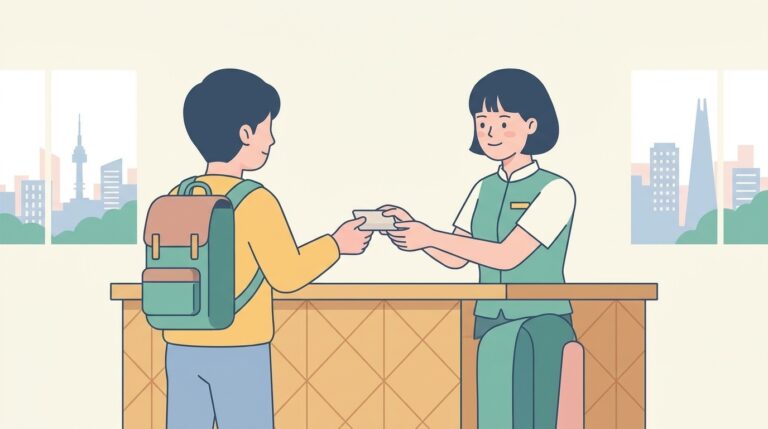
Say Goodbye to Hotel Check-in Anxiety: Speak Like a K-Drama Star! 🔑
Phase 1: Welcome to Seoul! (Let’s Tackle That Check-In Jitters Together)
안녕하세요! (Annyeonghaseyo!) Hello! I am your lead editor at Daily Hangul, your trusty native guide to mastering the Korean language and culture.
Picture this: You just landed at Incheon International Airport. After a long flight, a bumpy bus ride, and dragging your heavy bags through the vibrant, neon-lit streets of Seoul, you finally arrive at your gorgeous hotel. It looks exactly like the luxury lobby from the hit K-drama King the Land.
Your heart is pounding. You walk up to the sleek marble front desk. A friendly receptionist smiles and says, “어떻게 도와드릴까요? (How can I help you?)”
Suddenly, your mind goes blank. Should you just hand over your passport in awkward silence? No way! Today, we are going to transform that nerve-wracking moment into a super smooth, confident interaction. Based on years of teaching travelers just like you, I have put together the ultimate guide to hotel check-ins. Let’s dive in!
Phase 2: Three Golden Phrases for a Flawless Check-In
Here are the top three magic phrases that will make the hotel staff instantly smile and realize, “Wow, this guest really respects our culture!”
1. 예약했어요. (I made a reservation.)
- Pronunciation: Ye-yak-haes-seo-yo (Sounds like: “Yeah-yak-hace-saw-yo”)
- Meaning: “I have a reservation.” (Directly: Reservation + did)
- K-Culture Moment: Think of any romance K-drama where the main characters have to check into a hotel because of a sudden storm. They walk to the desk and confidently announce their booking status!
- Editor’s Insight: The root word 예약 (ye-yak) means “reservation” or “booking.” Adding 했어요 (haes-seo-yo), which means “did,” turns it into a polite, past-tense statement. It’s short, sweet, and perfectly polite for beginners.
- Situation Spectrum:
- Casual (with friends): 예약했어 (Ye-yak-haes-seo) 🚫 Do not use with hotel staff!
- Semi-formal (Polite): 예약했어요 (Ye-yak-haes-seo-yo) ✅ Perfect for general check-ins.
- Formal (Ultra-polite): 예약했습니다 (Ye-yak-haes-seom-ni-da) ✅ Used in ultra-luxury 5-star hotels.
- 🤔 Think About It: In English, we often say “I have a reservation” (owning an abstract concept). In Korean, we say “I did a reservation” (focusing on the action). How does this action-oriented mindset change how you view planning?
2. 체크인하고 싶어요. (I want to check in.)
- Pronunciation: Che-keu-in-ha-go si-peo-yo (Sounds like: “Cheh-koo-inn-ha-go she-paw-yo”)
- Meaning: “I would like to check in.”
- K-Culture Moment: You will hear this in almost every travel vlog when global tourists arrive at traditional Hanok guesthouses in Bukchon Hanok Village.
- Editor’s Insight: Korean has adopted many English words as ‘Konglish’ (Korean-English). 체크인 (Che-keu-in) is literally “check-in.” Combining it with ~하고 싶어요 (~ha-go si-peo-yo), which means “I want to do,” makes it a very clear, easy-to-use request!
- Situation Spectrum:
- Casual: 체크인하고 싶어 (Che-keu-in-ha-go si-peo) 🚫
- Semi-formal: 체크인하고 싶어요 (Che-keu-in-ha-go si-peo-yo) ✅ Highly recommended.
- Formal: 체크인을 하고자 합니다 (Che-keu-in-eul ha-go-ja ham-ni-da) ⚠️ Too stiff for basic travel.
3. 제 이름은 [Name]입니다. (My name is [Name].)
- Pronunciation: Je i-reum-eun [Name]-im-ni-da (Sounds like: “Chee ee-rum-oon [Name]-im-nee-dah”)
- Meaning: “My name is [Name].”
- K-Culture Moment: This is the universal self-introduction line. You’ve definitely heard idol group members say this during international press conferences!
- Editor’s Insight: 제 (Je) is the polite form of “my,” and 이름은 (i-reum-eun) means “name + topic marker.” Finish it with 입니다 (im-ni-da), which means “is/am/are.”
- Situation Spectrum:
- Casual: 내 이름은 [Name]야 (Nae i-reum-eun [Name]-ya) 🚫
- Semi-formal: 제 이름은 [Name]이에요 (Je i-reum-eun [Name]-i-e-yo) ✅ Friendly and natural.
- Formal: 제 이름은 [Name]입니다 (Je i-reum-eun [Name]-im-ni-da) ✅ Polite and professional; great for official desk work.
Phase 3: Textbook Korean vs. Real-Life Korean
When you open an old textbook, they teach you dry, robotic sentences. Let’s see how real Koreans talk at the front desk!
Situation 1: Presenting your passport
- 📖 Textbook Style: “여권을 제시해 주십시오.” (Yeogwoneul jesihae jusipsio. – “Please present your passport.”)
- 🗣️ Real-Life Korean: “여권 보여주세요~” (Yeogwon boyeojuseyo~ – “Please show me your passport~”)
- 💡 Why is it different? The textbook uses “제시하다” (to present), which sounds like a police officer asking for identification! Real hotel staff use “보여주다” (to show), which is much softer and warmer.
Situation 2: Asking for your room key
- 📖 Textbook Style: “방 열쇠를 주십시오.” (Bang yeolsoereul jusipsio. – “Give me the room key.”)
- 🗣️ Real-Life Korean: “카드키 드릴게요.” (Kadeuki deurilgeyo. – “I will give you the card key.”)
- 💡 Why is it different? Almost no modern hotels use physical keys (열쇠) anymore; they use “카드키” (card key). Also, polite staff will proactively offer it to you using “드릴게요” (I will give you – humble form) rather than waiting for you to command them.
Phase 4: K-Culture Deep Dive & Non-Verbal Manners
4-1. The “Two-Hand” Rule (두 손으로 주기)
In Korea, non-verbal manners are just as important as spoken words. When you hand over your passport or credit card, always hold it with both hands (or support your right wrist/elbow with your left hand). This shows deep respect. When the receptionist hands you the card key, receive it with both hands and do a slight, polite head bow. It’s a game-changer!
4-2. The “Nunchi” (눈치) of Hotel Front Desks
Korean service (called Service 서비스) is famously fast. Hotel clerks pride themselves on quick check-ins. If you see them typing furiously, don’t worry—they aren’t annoyed! They are practicing palli-palli (빨리빨리 – fast-fast) culture to get you to your room to rest as quickly as possible.
Phase 5: Real-Life Roleplay Scenario 🎭
Let’s practice! You have just walked into “Hotel Midnight Seoul” in Hongdae. You are greeting the receptionist, Min-su.
- Setting: A trendy, cozy boutique hotel lobby.
- Characters:
- Min-su (민수): The friendly front-desk clerk.
- You (유): The excited traveler (CEFR A2 level!).
1. 민수: 안녕하세요! 무엇을 도와드릴까요?
   (An-nyeong-ha-se-yo! Mu-eot-eul do-wa-deu-ril-ka-yo?)
   "Hello! How may I help you?"

2. 유: (😊 Smiling warmly) 안녕하세요. 체크인하고 싶어요.
   (An-nyeong-ha-se-yo. Che-keu-in-ha-go si-peo-yo.)
   "Hello. I would like to check in."

3. 민수: 네, 예약하셨나요?
   (Ne, ye-yak-ha-syeon-na-yo?)
   "Great, did you make a reservation?"

4. 유: 네, 예약했어요. 제 이름은 Alex입니다.
   (Ne, ye-yak-haes-seo-yo. Je i-reum-eun Alex-im-ni-da.)
   "Yes, I made a reservation. My name is Alex."

5. 민수: 아, 알렉스 님! 확인되었습니다. 여권 좀 보여주세요.
   (Ah, Al-lek-seu nim! Hwa-gin-doe-eot-seom-ni-da. Yeo-gwon jom bo-yeo-ju-se-yo.)
   "Ah, Mr./Ms. Alex! Confirmed. Please show me your passport."

6. 유: (🤲 Handing over your passport with both hands) 여기 있습니다.
   (Yeo-gi it-seom-ni-da.)
   "Here it is."

7. 민수: 감사합니다. 여기 카드키하고 방 번호 802호입니다.
   (Gam-sa-ham-ni-da. Yeo-gi ka-deu-ki-ha-go bang beon-ho pal-baek-i-ho-im-ni-da.)
   "Thank you. Here is your card key and room number 802."

8. 유: (🙇 Bowing slightly) 감사합니다!
   (Gam-sa-ham-ni-da!)
   "Thank you!"
🔀 Choose Your Adventure!
Min-su asks you: “혹시 아침 식사(조식) 추가하시겠습니까? (Would you like to add breakfast?)”
- Option A: “아니요, 괜찮아요.” (Aniyo, gwenchanh-ayo. – “No, it’s okay.”)
- Feedback: Best choice if you want to explore local cafes in the morning! Polite and concise.
- Option B: “응, 먹을래.” (Eung, meog-eul-rae. – “Yeah, I’ll eat.”)
- Feedback: Bad choice. This is casual banmal (informal language). It sounds rude to the staff.
- Option C: “네, 조식 주세요!” (Ne, josik juseyo! – “Yes, breakfast please!”)
- Feedback: Great choice! Simple, polite, and guarantees you yummy food.
Phase 6: 10-Second Shadowing Drill 🗣️
Let’s practice natural rhythm! Pause briefly at the slashes (/) and pay attention to the emotional guides.
- [😊 Brightly & Politely]
안녕하세요 / 체크인하고 싶어요.
(An-nyeong-ha-se-yo / che-keu-in-ha-go si-peo-yo.) - [🤲 Showing Respect]
예약했어요 / 제 이름은 / Alex입니다.
(Ye-yak-haes-seo-yo / je i-reum-eun / Alex-im-ni-da.) - [🙏 Expressing Gratitude]
감사합니다! / 방 번호가 / 몇 번이에요?
(Gam-sa-ham-ni-da! / bang beon-ho-ga / myeot beon-i-e-yo? – “Thank you! What is my room number?”)
Phase 7: K-Culture Mini Dictionary
- 예약 (Ye-yak) | Reservation
- Essential for restaurants, hair salons, and hotels. Always say “예약했어요” when arriving at a pre-booked place!
- 여권 (Yeo-gwon) | Passport
- Keep this handy! You cannot check in anywhere in Korea without showing your yeo-gwon.
- 카드키 (Kadeu-ki) | Card Key
- Koreans love English loanwords. Simply ask “카드키 주세요” if you lose yours.
- 조식 (Jo-sik) | Breakfast
- Shorthand for breakfast in hotels. Korean hotel breakfasts are legendary, often featuring a mix of Western food and hot Korean stews (soup and rice!).
Phase 8: The Ultimate Travel Survival Kit 🧳
Survival Phrases TOP 3
- 와이파이 비밀번호가 뭐예요? (Wa-i-pa-i bi-mil-beon-ho-ga mwo-ye-yo?)
- Meaning: “What is the Wi-Fi password?” (An absolute lifesaver for travelers!)
- 짐 좀 맡겨주실 수 있나요? (Jim jom mat-gyeo-ju-sil su in-na-yo?)
- Meaning: “Can you hold my luggage?” (Perfect for when you arrive before the 3:00 PM check-in time!)
- 따뜻한 물이 안 나와요. (Tta-tteut-han mul-i an na-wa-yo.)
- Meaning: “Hot water isn’t coming out.” (Just in case!)
📝 Editor’s Travel Note
Before leaving the airport, make sure you download the Naver Map App—Google Maps does not work well in South Korea due to security regulations. Also, carry some cash if you stay in small local guesthouses, though 99% of modern hotels in Seoul accept international credit cards!
Phase 9: “One Step Deeper” (Cultural Insight)
In Western cultures, checking in can be transactional and overly chatty. In Korea, respect is demonstrated through structured politeness called Jeong (정) and Jon-daet-mal (존댓말 – honorific language).
By ending your sentences with ~요 (-yo) or ~니다 (-nida), you are showing that you value the hard work of the hotel employees. Even as a foreigner, trying your best to use polite Korean bridges a huge cultural gap and shows high emotional intelligence.
💬 Your Turn: Have you ever checked into a hotel in Korea? What is your biggest fear when talking to hotel staff? Let us know in the comments below!
Phase 10: FAQ & Avoiding Common Mistakes
Q: Do I need to tip the hotel staff or the bellhop in Korea?
A: No! Tipping is not practiced in Korea. In fact, offering a tip can sometimes cause confusion or make people feel awkward. Excellent service is already included in the room rate.
Q: What should I do if the hotel receptionist doesn’t speak English?
A: Don’t panic! Use the key words you learned today: “예약했어요” (I made a reservation) and show them your phone screen with the booking confirmation. They will understand instantly.
Q: Can I check in early?
A: You can ask: “얼리 체크인 가능한가요?” (Eol-li che-keu-in ga-neung-han-ga-yo? – “Is early check-in possible?”). If the room is ready, they will gladly let you in!
🚨 Common Mistakes Board
- Mistake 1: Handing cards or passports with one hand.
- Correct Action: Use both hands to hand over and receive items.
- Mistake 2: Saying “너 이름이 뭐야?” (What is your name? – casual).
- Correct Action: Never ask a staff member’s name casually. Just look at their name tag or refer to them as “직원분” (staff member).
- Mistake 3: Assuming check-out is automatically late.
- Correct Action: Always check the standard check-out time (보통 11시 – usually 11 AM) to avoid extra fees.
Phase 11: Action Missions 🎯
- 🥉 Bronze Medal Mission: Practice saying “체크인하고 싶어요” out loud 5 times in front of your mirror with a bright smile!
- 🥈 Silver Medal Mission: Share this post on your social media and tag a friend you want to travel to Seoul with!
- 🥇 Gold Medal Mission: When you arrive at your next Korean accommodation, do not speak English first. Use “예약했어요. 제 이름은 [Name]입니다.” confidently!
- 🎬 K-Culture Mission: Watch the first episode of the K-drama King the Land or Hotel Del Luna. Spot at least one scene at the front desk and listen closely to how they greet each other!
Phase 12: Interactive Quiz Challenge 🧠
Test your knowledge before you pack your bags!
1. Match the Phrase!
Which phrase means “My name is…”?
* A) 예약했어요
* B) 카드키 주세요
* C) 제 이름은…입니다
View Answer
Correct Answer: C!
“제 이름은…입니다” means “My name is…”. A means “I made a reservation” and B means “Please give me the card key.”
2. True or False?
In Korea, it is polite to tip hotel staff when they help you with your bags.
* A) True
* B) False
View Answer
Correct Answer: B (False)!
Tipping is not customary in South Korea. Simply saying “감사합니다” (Thank you) with a warm bow is the best reward!
Disclaimer: Hotel policies, check-in times, and local rules in Korea can vary by location. Always double-check your booking confirmation details prior to arrival.







