

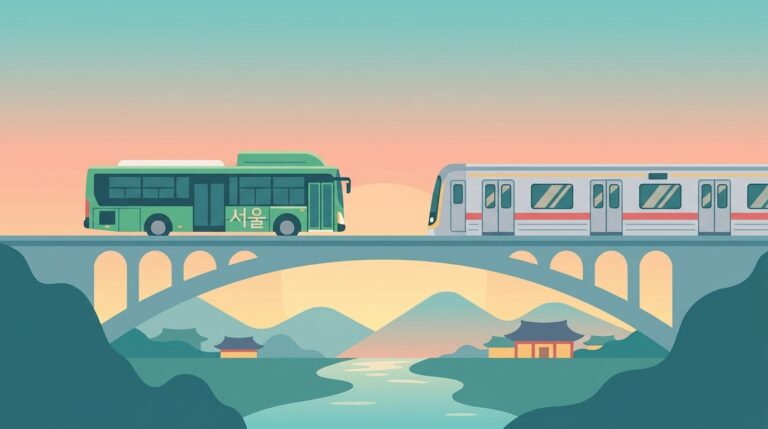
Seoul Commute Debate: Bus vs Subway in Korean (비교와 대조)
Phase 1: Empathy (스토리 몰입형 오프닝)
안녕하세요! 매일한글 (Daily Hangul)의 수석 에디터이자 여러분의 한국 생활 단짝 친구, 지우입니다! 🌸
Have you ever stood at a busy Seoul crossing, staring at your navigation app while holding a dripping iced americano, completely torn?
“The green bus (초록 버스) is arriving in 2 minutes, but what if the traffic on Mapo Bridge is a nightmare? On the other hand, the subway is super fast, but Line 9 during rush hour is basically a fitness challenge!”
Many of our intermediate (B1) students tell me: “Jiwoo, I know how to use basic particles like ~은/는 and ~보다, but when I try to naturally compare and contrast the pros and cons of buses and subways in Korean, my tongue gets tied! I end up sounding like a dry guidebook instead of a real Seoulite.”
Don’t worry! Today, we are moving past robotic textbook sentences. We will explore how to express real-life preferences, weigh pros and cons, and master the cultural nuances of navigating Seoul’s legendary transit system. Ready to level up your conversational flow? 가봅시다! (Let’s go!)
Phase 2: Core Expressions (핵심 표현 3선 심층 분석)
To talk about pros and cons like a native, you need transitional tools that show contrasting perspectives. Let’s master three high-impact B1-level expressions.
1. ~는 반면에 (~neun ban-myeone)
- Pronunciation: neun bahn-myeo-neh (Sounds like “noon bahn-myun-eh” with a soft ‘n’)
- Meaning: On the other hand / Whereas / While
- K-Culture Moment: You will hear this in K-dramas when a character compares two apartments or lifestyle choices. For example: “The subway is fast, while the bus allows you to see the beautiful Han River view.”
- Editor’s Insight: This grammar pattern is the gold standard for logical contrast. Use it when you want to highlight a sharp difference between two options in a single sentence.
- Situation Spectrum: Casual (⚠️ – a bit formal for close friends, but acceptable) | Semi-formal (✅) | Formal (✅)
- 🤔 Think About It: In English, we often use “but” for everything. In Korean, separating contrasting facts with ~는 반면에 makes you sound much more objective and sophisticated.
2. 그래도 (geuraedo)
- Pronunciation: gway-rah-doh (Quickly slide from ‘g’ to ‘ray’)
- Meaning: Still / Even so / But yet
- K-Culture Moment: Think of that classic scene where a character complains about their boss but says, “그래도 월급날이니까 참아야지” (Still, it’s payday, so I must endure it).
- Editor’s Insight: It acknowledges the previous negative point but pivots immediately to a positive or practical alternative. It’s the ultimate conversational bridge!
- Situation Spectrum: Casual (✅) | Semi-formal (✅) | Formal (✅)
- 🤔 Think About It: Koreans use “그래도” to soften criticisms. It shows a balanced, harmonious mindset—finding the silver lining even in a crowded subway train!
3. ~기 마련이다 (~gi maryeon-ida)
- Pronunciation: gi mah-ryeon-ee-dah (Rhymes with “key mar-yuhn-ee-da”)
- Meaning: It is bound to / It is natural that / It is destined to
- K-Culture Moment: Often heard in healing dramas like Our Blues when older characters offer wisdom about life’s ups and downs.
- Editor’s Insight: When discussing commuting, you might say, “If you take the bus during rush hour, you are bound to be late” (출퇴근 시간에 버스를 타면 늦기 마련이에요). It expresses an inevitable consequence based on common sense.
- Situation Spectrum: Casual (⚠️ – sounds slightly poetic/mature) | Semi-formal (✅) | Formal (✅)
- 🤔 Think About It: This expression shows how Korean speakers view the natural flow of cause and effect. Some things in life—like traffic jams—are just natural laws!
Phase 3: Textbook Korean vs. Real Korean (교과서 한국어 vs 진짜 한국어)
Let’s compare the dry, stiff textbook sentences with what you’ll actually hear at a trendy cafe in Hongdae.
Scenario 1: Discussing Subway Speeds
- 📖 Textbook Korean:
- “지하철은 빠릅니다. 하지만 버스는 경치가 좋습니다.”
- (Ji-ha-cheor-eun ppa-reub-ni-da. Ha-ji-man beor-seu-neun gyeong-chi-ga jo-seub-ni-da.)
- “Subways are fast. But buses have nice views.”
- 🗣️ 진짜 Korean:
- “지하철은 막힐 걱정 없어 좋은 반면에, 버스는 창밖 뷰를 볼 수 있어 탈 만해요.”
- (Ji-ha-cheor-eun mak-hil geok-jeong eop-seo jo-eun ban-myeo-ne, beor-seu-neun chang-bakk byu-reul bol su is-seo tal man-hae-yo.)
- “While the subway is great because you don’t worry about traffic, the bus is worth taking because you can look at the view outside.”
- 💡 왜 다를까? (Why the difference?):
Real Koreans rarely speak in short, choppy sentences using ~습니다 and 하지만. They link ideas naturally using ~는 반면에 and use conversational endings like ~탈 만해요 (worth taking/riding).
Scenario 2: Complaining about Rush Hour Traffic
- 📖 Textbook Korean:
- “출퇴근 시간에는 버스를 타지 마십시오. 길이 복잡합니다.”
- (Chul-toe-geun si-gan-eun beor-seu-reul ta-ji ma-sip-si-o. Gir-i bok-jap-hap-ni-da.)
- “Do not take the bus during commuting hours. The road is complicated.”
- 🗣️ 진짜 Korean:
- “출퇴근 시간엔 버스는 완전 헬이에요. 무조건 지하철이 답이에요.”
- (Chul-toe-geun si-gan-en beor-seu-neun wan-jeon hel-i-e-yo. Mu-jo-geon ji-ha-cheor-i dap-i-e-yo.)
- “During rush hour, the bus is absolute hell. The subway is absolutely the only answer.”
- 💡 왜 다를까? (Why the difference?):
Koreans love using vivid, slightly dramatic colloquialisms like “완전 헬 (absolute hell/extreme chaos)” and “X이 답이다 (X is the only answer/solution)” to express frustration and strong recommendations.
Phase 4: K-Culture Deep-Dive & Non-Verbal Manners
4-1. 눈치 (Nunchi) & Bus/Subway Etiquette
In Korea, public transit is a shared communal space governed by high level Nunchi (social sensing).
* Subway Silent Rule: You’ll notice Korean subways are incredibly quiet. Talking loudly on the phone or playing videos without headphones is a major social faux pas. If you must talk, keep your hand over your mouth and whisper.
* The Bus Balancing Act: Korean bus drivers are famous for their speedy acceleration. Non-verbal tip: The moment you tap your card, hold on to the handrails (손잡이) immediately! Standing still without holding on is a rookie mistake that might result in you accidentally sliding into a stranger’s lap!
4-2. The Romanticized Bus Ride vs. Practical Subway
In K-Dramas (like My Liberation Notes or Extraordinary Attorney Woo), characters often stare out the window of a bus or subway train crossing the Han River.
Crossing the Dangsan Bridge (당산철교) on Line 2 at sunset is a legendary Seoul experience. When debating transit with friends, mentioning this view is a great conversational icebreaker!
Phase 5: Practical Roleplay Scenario (실전 롤플레이)
🎬 Scenario: Meeting up at Gangnam Station (강남역)
- Characters:
- Yoon-a (윤아): A busy Seoulite who hates being late.
- You (학습자): A traveler trying to decide whether to take the bus or subway.
윤아: 오늘 금요일 저녁인데 강남역까지 어떻게 올 거야?
      [On-eul geum-yo-il jeo-nyeok-in-de Gang-nam-yeok-kka-ji eo-tteo-ke ol geo-ya?]
      (It's Friday evening, how are you coming to Gangnam Station?)
      🎭 [Curious, checking her watch]

나: 버스를 탈까 생각 중이야. 바깥 구경도 하고 싶어서.
    [Beor-seu-reul tal-kka saeng-gak jung-i-ya. Ba-kkat gu-gyeong-do ha-go sip-eo-seo.]
    (I'm thinking of taking the bus. I want to sightsee outside too.)
    🎭 [Smiling warmly]

윤아: 금요일 퇴근길엔 도로가 거의 주차장이야! 버스는 기어가기 마련이라고.
      [Geum-yo-il toe-geun-gil-en do-ro-ga geo-ui ju-cha-jang-i-ya! Beor-seu-neun gi-eo-ga-gi ma-ryeon-i-ra-go.]
      (During Friday's rush hour, the roads are basically a parking lot! The bus is bound to crawl.)
      🎭 [Playfully warning with wide eyes]

나: 아, 진짜? 지하철은 사람이 너무 많아서 조금 답답하잖아.
    [Ah, jin-jja? Ji-ha-cheor-eun sa-ram-i neo-mu man-ah-seo jo-geum dap-dap-ha-jan-a.]
    (Ah, really? But the subway is so crowded, it's a bit suffocating.)
    🎭 [Looking slightly worried, sighing softly]

윤아: 그렇지. 지하철은 복잡한 반면에, 막힐 걱정 없이 정해진 시간에 딱 도착하잖아.
      [Geu-reo-chi. Ji-ha-cheor-eun bok-jap-han ban-myeo-ne, mak-hil geok-jeong eop-si jeong-hae-jin si-gan-e ttak do-chak-ha-jan-a.]
      (True. While the subway is crowded, on the other hand, you arrive exactly on time without worrying about traffic.)
      🎭 [Nodding logically]

나: 음, 듣고 보니 그렇네. 그래도 환승하기 귀찮은데...
    [Eum, deut-go bo-ni geu-reon-ne. Geu-rae-do hwan-seung-ha-gi gwi-chan-eun-de...]
    (Hmm, now that I hear it, you're right. Still, transferring is such a hassle...)
    **[YOUR INTERACTIVE CHOICE BELOW]**
🔀 Choose Your Response:
- A) “그럼 그냥 지하철 탈게. 약속에 늦으면 안 되니까.”
- (Then I’ll just take the subway. I shouldn’t be late for our appointment.)
- B) “에이, 그래도 버스가 낭만 있잖아. 나 그냥 버스 탈래!”
- (Come on, still, buses have romance. I’m just gonna take the bus!)
- C) “택시 타는 건 어때? 돈은 더 들지만 편하잖아.”
- (How about taking a taxi? It costs more, but it’s comfortable.)
💡 Selection Feedback:
- If you chose A (Best Option – 100% Native Vibe):
Perfect! Yoon-a will love this. In Korea, being on time (시간 약속) is extremely important. You successfully balanced convenience with respect for her time. - If you chose B (Risk Option):
Yoon-a might sweat! If you take a bus to Gangnam on a Friday at 6:30 PM, you might arrive an hour late. Only choose this if you are prepared to apologize with bubble tea! - If you chose C (Bad Option for Friday Rush Hour):
Oh no! Taxis are stuck in the exact same traffic as buses, but you’ll watch the meter climb dynamically. It’s a double lose-lose situation on a Friday evening in Gangnam!
Phase 6: 10-Second Emotion Shadowing Drill
To sound natural, you must master the cadence, pauses (/), and emotional tones of Korean speech. Try saying these out loud!
- [🥺 Ah, slightly whiny, worried about crowd]
- “지하철은 / 빠르긴 한데… / 사람한테 / 치이기 마련이잖아요.”
- (Ji-ha-cheor-eun / ppa-reu-gin han-de… / sa-ram-han-te / chi-i-gi ma-ryeon-i-ja-na-yo.)
- “Subways are fast, but… you are bound to get squeezed by people.”
- [😊 Bright, trying to persuade a friend]
- “버스는 / 정체되면 / 답이 없는 반면에, / 창밖 구경하는 / 재미가 있잖아요!”
- (Beor-seu-neun / jeong-che-doe-myeon / dap-i eop-neun ban-myeo-ne, / chang-bakk gu-gyeong-ha-neun / jae-mi-ga it-ja-na-yo!)
- “While buses are hopeless when congested, they have the fun of looking out the window!”
Phase 7: K-Culture Mini-Dictionary
| Word (한글) | Romanization | English Translation | Real Life Context |
|---|---|---|---|
| 지옥철 | Ji-ok-cheol | “Hell-way” (Hell + Subway) | Refers to crowded subway lines (like Line 9 or Line 2) during rush hours. |
| 환승할인 | Hwan-seung har-in | Transfer Discount | Korea’s magical system where transferring between bus and subway is virtually free. |
| 대중교통 | Dae-jung gyo-tong | Public Transportation | The overall term for buses, subways, and trains. |
| 퇴근길 | Toe-geun-gil | Way home from work | The peak congestion period between 6 PM and 7:30 PM. |
Phase 8: Survival Kit for Travelers
Survival Phrases TOP 3
- “이거 강남역 가나요?” (I-geo Gang-nam-yeok ga-na-yo?)
- Meaning: Does this (bus) go to Gangnam Station?
- Pro Tip: Ask the bus driver this right as you step on if you’re unsure of the direction.
- “이번 정류장에 내릴게요!” (I-beon jeong-ryu-jang-e nae-ril-ge-yo!)
- Meaning: I’m getting off at this stop!
- Pro Tip: Say this to the driver if the bus is crowded and you need to squeeze through the back door.
- “몇 번 출구로 나가야 해요?” (Myeot beon chul-gu-ro na-ga-ya hae-yo?)
- Meaning: Which exit should I go out of?
- Pro Tip: Essential for massive transfer hubs like Bupyeong or Jamsil Station.
🗺️ Editor’s Travel Note
Before stepping foot in Seoul, download the KakaoMap app on Google Play or search for Apple App Store equivalents. Unlike global maps, local maps give you real-time bus positions, down to the exact second! Also, please keep in mind that public transit fares and transfer system details can change over time, so check official updates upon arrival.
Phase 9: “한 발 더 깊이” (Think Deeper)
In many Western cultures, public transportation is sometimes viewed as a secondary choice to owning a car. In Korea, however, public transportation is a source of national pride. The precision of the subway arrival times reflects Korea’s fast-paced “Ppalli-Ppalli” (빨리빨리 – Hurry, hurry) culture.
At the same time, the bus offers a slower, human-centered connection to the city. Older citizens prefer the bus because it avoids long stairs, and students prefer it to save energy while listening to music. Choosing your transport in Korea is not just a logistical decision; it’s a lifestyle choice.
💬 Your Turn: Which one do you prefer when traveling? Do you like the fast and efficient subway, or the scenic but unpredictable bus? Write your preference in the comments below using ~는 반면에 or 그래도! I will personally correct your sentences!
Phase 10: FAQ & Mistakes
Q: What is the difference between ~보다 and ~에 비해?
A: Excellent question! ~보다 is direct and simple comparison (e.g., “Subway is faster than the bus”). ~에 비해(서) translates to “compared to” and is used when analyzing general situations or statistics (e.g., “Compared to the subway, the bus is more comfortable”).
Q: Why do Korean buses have different colors (Blue, Green, Red)?
A: The colors classify their routes! Blue buses (간선) run long distances across Seoul districts, Green buses (지선) connect subways to nearby residential areas, and Red buses (광역) are express buses connecting Seoul to neighboring cities like Gyeonggi-do.
Q: Can I use my T-Money card on both?
A: Yes! You can use the same card for both systems. Just make sure to tap your card when getting off (하차 태그) to lock in your transfer discounts!
🚨 Common Mistakes Warning Board
- Mistake 1: Saying “지하철은 버스보다 더 빠르게요” (X)
- Correct Action: Use the adjective form: “지하철은 버스보다 더 빨라요” (O).
- Mistake 2: Forgetting to tap out when leaving the bus because “I don’t need a transfer today.”
- Correct Action: Always tap out! If you don’t, you will be charged a penalty fare on your next ride.
- Mistake 3: Confusing “지하철” (subway) with “기차” (inter-city train like KTX).
- Correct Action: Use “지하철” for urban subway commuting, and “기차” for cross-country travel.
Phase 11: Action Missions
- 🥉 Bronze Mission: Write a simple comparison sentence using the grammar
~는 반면에in the comment section. - 🥈 Silver Mission: Capture a picture of a bus or subway from your favorite Korean drama, share it on Instagram, tag
@DailyHangul, and write: “버스는 [insert adjective]한 반면에, 지하철은 [insert adjective]해요!” - 🥇 Gold Mission: Next time you go out, try planning your route entirely using a Korean transit app in Korean, and use the phrase “이번 정류장에 내릴게요!” when exiting the bus.
Phase 12: Interactive Quiz Challenge
Test your knowledge with these three quick questions!
1. Which grammar represents “It is bound to / It is natural that”?
- A) ~는 반면에
- B) ~기 마련이다
- C) 그래도
See Answer & Explanation
Correct Answer: B
Explanation: ~기 마련이다 signifies that a result is natural or bound to happen under certain conditions. (e.g., “If you travel during peak hours, it’s bound to be crowded.”)
2. Fill in the blank: “버스는 막히는 ( ), 지하철은 정확해요.”
- A) 반면에 (ban-myeo-ne)
- B) 때문에 (ttae-mun-e)
- C) 고 보니 (go bo-ni)
See Answer & Explanation
Correct Answer: A
Explanation: 반면에 is the correct contrast marker meaning “on one hand… on the other hand.”
3. True or False: You don’t need to tap your T-money card when exiting a Seoul bus if you are not transferring.
- A) True
- B) False
See Answer & Explanation
Correct Answer: B (False)
Explanation: You must always tap out when exiting the bus. Otherwise, you may get charged maximum fare penalty on your next trip!
Great job today! You are now fully equipped to compare and navigate Seoul’s public transit like a local. Keep practicing, stay curious, and see you in the next lesson! 다음에 또 만나요! (See you next time!)







