

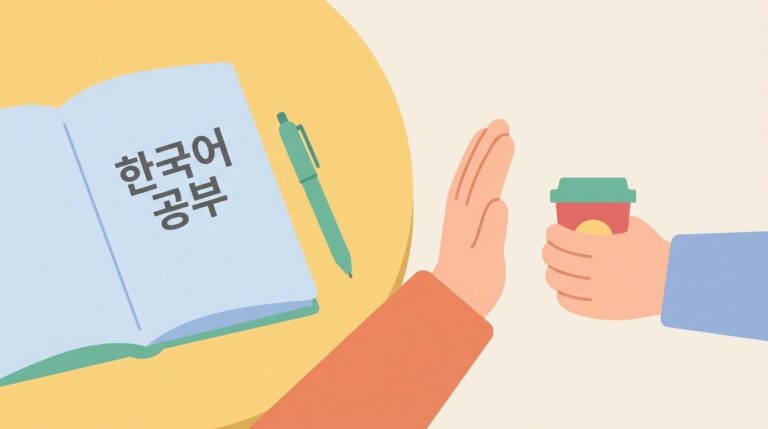
Saying No Politely: The Art of Soft Refusal in Korea
Phase 1: Empathy (The Polite Refusal Dilemma)
안녕하세요! (An-nyeong-ha-se-yo!) Welcome back, my dear friend! It’s your favorite Korean big sister and editor from Daily Hangul.
Imagine this: You are hanging out with your awesome Korean coworkers, and after a long day of work, your team lead suddenly says, “Sophie, let’s go grab dinner and drinks right now!” Your stomach is growling for the leftover pizza in your fridge, and you are absolutely exhausted. You want to go home, but you freeze. How do you say, “No, I can’t” without ruining the mood or seeming disrespectful?
In Korea, saying a direct “No” (아니요 – Ani-yo) can feel like a cold splash of water. Because Korean culture highly values harmony and “Nunchi” (tact), we use indirect ways to refuse. Today, we will learn how to say “It’s a bit difficult” like a true local, ensuring you keep your relationships strong while standing your ground! This lesson is specially designed based on real feedback from A2 learners who struggled to say “No” gracefully. Let’s dive in!
Phase 2: 3 Core Expressions for Polite Refusal
1. 좀 어려울 것 같아요. (Jom eoryeoul geot gatayo.)
- Pronunciation: Jom uh-ryuh-wool gut ga-tah-yo (Sounds like “Jom” + “oh-ryeo-wool” + “gut” + “gah-tah-yo”).
- Meaning: “I think it might be a bit difficult.”
- K-Culture Moment: You will hear this constantly in office dramas like Misaeng or Romance is a Bonus Book when an employee is gently turning down an unrealistic deadline from their boss.
- Editor’s Insight: This is the gold standard of polite refusal. The word 좀 (jom) means “a little,” and ~것 같아요 (~geot gatayo) means “I think/It seems like.” Together, they soften the impact of your rejection, making it sound polite and diplomatic.
- Situation Spectrum:
- Casual: ⚠️ (Use ‘어려울 것 같아’ without ‘요’)
- Semi-formal: ✅
- Formal: ✅
- 🤔 Think About It: Why do you think Koreans prefer to say “It seems difficult” instead of “I can’t do it”? How does this compare to your own culture?
2. 제가 지금은 좀 바빠서요. (Jega jigeumeun jom bappaseoyo.)
- Pronunciation: Jeh-gah jee-gum-eun jom bah-pah-suh-yo (Sounds like “Jay-gah” + “jee-gum-eun” + “jom” + “bah-pah-suh-yo”).
- Meaning: “Because I am a bit busy right now…”
- K-Culture Moment: Standard excuse used in daily life when someone asks you to hang out or help them with a task when you’re caught up in your own work.
- Editor’s Insight: Notice how the sentence ends in ~서요 (~seoyo – because…)? In Korean, leaving a sentence unfinished like this is a very polite way to imply, “…so I can’t make it, I’m so sorry!” without actually saying “No.”
- Situation Spectrum:
- Casual: ✅ (Remove ‘요’ for close friends)
- Semi-formal: ✅
- Formal: ⚠️ (Better to use official business templates)
- 🤔 Think About It: In English, we usually finish our sentences. How does it feel to leave a sentence “hanging” in Korean to show politeness?
3. 죄송하지만 이번에는 힘들 것 같아요. (Joesonghajiman iboneun himdeul geot gatayo.)
- Pronunciation: Joe-song-ha-jee-man ee-bun-eh-neun heem-deul gut ga-tah-yo.
- Meaning: “I am sorry, but it seems hard this time.”
- K-Culture Moment: Commonly used when declining a formal invitation or a favor from a senior classmate (“Seonbae”).
- Editor’s Insight: 이번에는 (iboneun-eun) means “this time.” By specifying this time, you are warmly implying that you would love to say yes next time! It keeps the door open for future plans.
- Situation Spectrum:
- Casual: 🚫 (Too formal for close friends)
- Semi-formal: ✅
- Formal: ✅
- 🤔 Think About It: How does adding “this time” make a refusal sound much friendlier?
Phase 3: Textbook Korean vs. Real Korean
Let’s compare the robotic textbook sentences with how real Koreans actually speak!
Scenario A: Being asked to work overtime or do an extra task
- 📖 Textbook Korean: “못 합니다.” (Mot hamnida. / I cannot do it.)
- Why it’s tough: This sounds extremely harsh, stubborn, and aggressive.
- 🗣️ Real Korean: “아, 그건 제가 지금은 조금 어려울 것 같아요.” (Ah, geugeon jega jigeumeun jogeum eoryeoul geot gatayo. / Ah, that might be a bit difficult for me right now.)
- 💡 Why it’s different: Adding “아 (Ah…)” and “조금 (jogeum – a little)” shows that you genuinely regret having to say no.
Scenario B: Declining a weekend hangout invitation
- 📖 Textbook Korean: “가지 않겠습니다.” (Gaji anketseumnida. / I will not go.)
- Why it’s tough: Sounds like you are protesting or angry!
- 🗣️ Real Korean: “이번 주말은 제가 일이 있어서 조금 힘들 것 같아요. 아쉬워요!” (Ibeon jumareun jega iri isseoseo jogeum himdeul geot gatayo. Aasiwoyo! / This weekend is a bit hard because I have some plans. So sad!)
- 💡 Why it’s different: Expressing regret (“아쉬워요! – Aswiwoyo!”) softens the refusal completely.
Phase 4: K-Culture Deep-Dive & Non-verbal Manners
4-1. The Body Language of “No”
To speak perfect Korean, you need the matching body language! When saying no:
1. The Head Tilt: Slightly tilt your head to the side. This shows you are thinking hard and feel bad.
2. The Hand Wave (The Gentle Fan): Bring one hand up near your chest and gently wave it left and right (like a slow fan). This visually signifies “no, no, thank you.”
3. The Neck Rub: Gently rub the back of your neck. This is the universal Korean gesture for “I am in a tight spot / I feel awkward.”
4-2. Understanding
Frequently Asked Questions (FAQ)
Q: What does "좀 어려울 것 같아요. (Jom eoryeoul geot gatayo.)" mean in Korean and how do you pronounce it?
A: In Korean, "좀 어려울 것 같아요. (Jom eoryeoul geot gatayo.)" is pronounced [Jom uh-ryuh-wool gut ga-tah-yo (Sounds like "Jom" + "oh-ryeo-wool" + "gut" + "gah-tah-yo"] and means: "I think it might be a bit difficult."
Q: What does "제가 지금은 좀 바빠서요. (Jega jigeumeun jom bappaseoyo.)" mean in Korean and how do you pronounce it?
A: In Korean, "제가 지금은 좀 바빠서요. (Jega jigeumeun jom bappaseoyo.)" is pronounced [Jeh-gah jee-gum-eun jom bah-pah-suh-yo (Sounds like "Jay-gah" + "jee-gum-eun" + "jom" + "bah-pah-suh-yo"] and means: "Because I am a bit busy right now..."
Q: What does "죄송하지만 이번에는 힘들 것 같아요. (Joesonghajiman iboneun himdeul geot gatayo.)" mean in Korean and how do you pronounce it?
A: In Korean, "죄송하지만 이번에는 힘들 것 같아요. (Joesonghajiman iboneun himdeul geot gatayo.)" is pronounced [Joe-song-ha-jee-man ee-bun-eh-neun heem-deul gut ga-tah-yo.] and means: "I am sorry, but it seems hard this time."







