

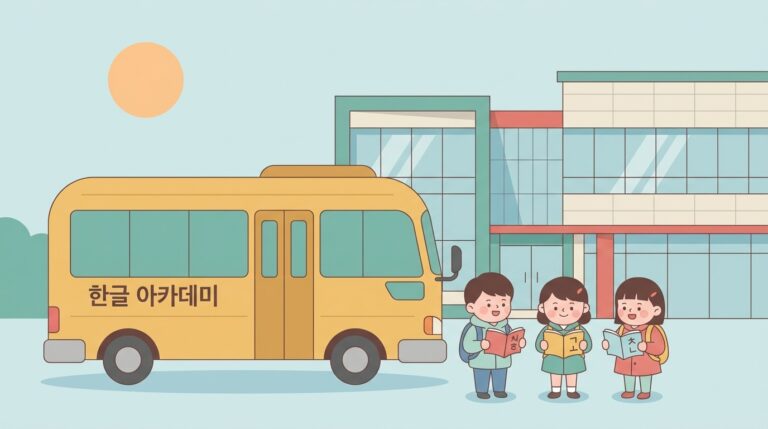
Understanding Korea’s Education Fever: The ‘English Kindergarten’ Craze
안녕하세요! Welcome back to Daily Hangul! It is your favorite Korean bestie and editor here. Have you ever walked down a Korean street at 3:00 PM and seen bright yellow shuttle buses zooming past? Or maybe you have watched a K-Drama where parents compete fiercely to get their kids into elite schools.
Today, we are diving deep into a fascinating part of Korean culture: Education Fever (교육열) and the famous English Kindergartens (영어 유치원). Learning about this will help you understand daily Korean life, K-Dramas, and give you great topics to chat about with your Korean friends!
Phase 2: Key Expressions of the Day
Let’s learn three essential words that define this cultural phenomenon. These are perfect for beginner (A2) learners!
1. 영어 유치원 (Yeong-eo yu-chi-won) / 영유 (Yeong-yu)
- Pronunciation: [Young-uh yoo-chee-won / Young-yoo] (Sounds like “Young” + “you”)
- Meaning: English Kindergarten
- K-Culture Moment: In dramas like Green Mothers’ Club, moms stress over sending their 5-year-olds to “영유” (the short, trendy slang version).
- Editor’s Insight: Legally, these are private academies (학원), but Koreans call them “영유” because kids spend all day there playing and learning in English.
- Situation Spectrum: Casual (영유 ✅) / Semi-formal (영어 유치원 ✅) / Formal (영어학원 ⚠️)
- 🤔 Think About It: At what age do children in your country start learning a second language?
2. 교육열 (Gyo-yuk-yeol)
- Pronunciation: [Gyoh-yook-yul] (Rhymes with “cool” but with a “y” sound)
- Meaning: Passion for education / Education fever
- K-Culture Moment: News anchors often use this word when talking about Korea’s top-tier academic scores.
- Editor’s Insight: This word describes the intense drive of parents to give their children the absolute best academic start in life.
- Situation Spectrum: Casual ✅ / Semi-formal ✅ / Formal ✅
- 🤔 Think About It: Is academic success seen as the most important thing in your culture?
3. 학원 (Hagwon)
- Pronunciation: [Hahg-won] (Sounds like “ha-gwan”)
- Meaning: Private academy / Cram school
- K-Culture Moment: You will see students of all ages eating cup noodles at convenience stores near “학원” streets late at night.
- Editor’s Insight: Almost every Korean child attends at least one hagwon for English, math, piano, or Taekwondo.
- Situation Spectrum: Casual ✅ / Semi-formal ✅ / Formal ✅
- 🤔 Think About It: Did you attend any after-school lessons when you were young?
Phase 3: Textbook Korean vs. Real Korean
Let’s look at how textbooks teach education topics versus how Koreans actually talk!
Situation 1: Asking if someone’s kid goes to a private academy
- 📖 Textbook: “자녀가 학원에 다닙니까?” (Does your offspring attend an academy?) – Too formal and robotic!
- 🗣️ Real Korean: “아이 학원 보내요?” (Do you send your kid to a hagwon?)
- 💡 Why? Koreans prefer using the friendly word “아이” (child/kid) and the verb “보내다” (to send) in daily conversations.
Situation 2: Expressing that studying is hard
- 📖 Textbook: “공부가 매우 어렵습니다.” (Studying is very difficult.)
- 🗣️ Real Korean: “공부하느라 힘들겠어요.” (It must be hard studying so much.)
- 💡 Why? Showing empathy is crucial in Korean culture. The grammar pattern “-느라 힘들다” acknowledges their hard work and struggle.
Phase 4: K-Culture Deep Dive & Mannerisms
4-1. Nodding and Humility (Nunchi & Gestures)
When discussing children or education with Korean parents (학부모), always nod your head sympathetically. It is polite to be humble. Even if your child is a genius, it is customary to say, “아니에요, 아직 부족해요” (No, they still have a lot to learn) to avoid looking boastful.
4-2. The K-Drama Connection
Have you watched the drama Sky Castle? While it shows high school education, the pressure starts at the “Yeong-yu” level. Parents queue overnight just to register their toddlers for admission tests. It is a real lifestyle!
Phase 5: Real-Life Roleplay
Imagine you are Sarah, an expat living in Seoul, chatting with Min-ji, a Korean mom, at a cafe in Gangnam.
- Min-ji: “새라 씨, 요즘 아이 영어 교육 고민 많죠?” (Sarah, are you worried about your kid’s English education lately?)
- Sarah: “네, 맞아요. 주변에서 다 영유 보낸다고 하니까 걱정돼요.” (Yes, that’s right. Everyone says they send kids to Yeong-yu, so I’m worried.)
- Min-ji: “대치동 학원가는 벌써 대기가 길어요.” (The waitlists in Daechi-dong academies are already long.)
- Sarah: “대기까지 있어요? 한국 교육열 진짜 대단해요!” (There’s even a waiting list? Korea’s education fever is really amazing!)
- Min-ji: “그렇죠? 그래도 아이가 스트레스 안 받는 게 제일 중요해요.” (Right? Still, the most important thing is that the kid doesn’t get stressed.)
- Sarah: “맞아요. 저도 학원보다는 놀이가 중요하다고 생각해요.” (Exactly. I also think play is more important than academy.)
- Min-ji: “그럼 놀이식 영유도 있으니까 같이 알아봐요.” (Then there are play-focused Yeong-yus too, let’s look them up together.)
- Sarah: “정말요? 고마워요, 민지 씨!” (Really? Thank you, Min-ji!)
🔀 Choose Your Path!
- Option A: Ask about the price: “학원비는 많이 비싸요?” (Are academy fees very expensive?)
- 💖 Feedback (Best): Super practical! Academy fees are a major talking point for Korean parents.
- Option B: Criticize the system: “한국 교육 시스템은 안 좋아 보여요.” (Korean education system looks bad.)
- ⚠️ Feedback (Risk): Too direct. It might make your friend feel uncomfortable.
- Option C: Change the subject: “오늘 날씨가 참 맑네요.” (The weather is very clear today.)
- 🚫 Feedback (Bad): It ruins the warm, helpful atmosphere of the conversation.
Phase 6: 10-Second Shadowing Drill
Let’s practice speaking with real Korean emotion! Use the pauses (/) and follow the emotional guides.
- “한국 / 교육열은 / 진짜 / 대단해요!”
- [Han-guk / gyo-yuk-yeol-eun / jin-jja / dae-dan-hae-yo!]
- [😲 Tone: With pure amazement and eyes wide open]
- “아이 / 학원 / 보내요?”
- [A-i / hag-won / bo-nae-yo?]
- [😊 Tone: Curious, friendly, and warm]
Phase 7: K-Culture Mini Dictionary
- 대치동 (Daechi-dong) | The famous neighborhood in Seoul known as the “Mecca” of private education.
- 학부모 (Hak-bu-mo) | School parents. A very influential social group in Korea.
- 선행학습 (Seon-haeng-hak-seup) | Pre-studying. Learning school subjects months or years in advance.
- 놀이식 영유 (Nori-sik Yeong-yu) | Play-based English kindergartens that focus on games rather than tests.
Phase 8: Traveler’s Survival Kit
Survival Vocab TOP 3
- “여기 유명한 학원 있어요?” [Yeo-gi yu-myeong-han hag-won is-seo-yo?] – Is there a famous academy here?
- “대기가 길어요?” [Dae-gi-ga gil-eo-yo?] – Is the waiting list long?
- “상담받고 싶어요.” [Sang-dam-bat-go sip-eo-yo.] – I would like to get a consultation.
🗺️ Editor’s Travel Note
If you want to feel the energy of Korea’s education craze, search for “Daechi-dong” on the Naver Map App and visit around 10:00 PM. You will see thousands of students exiting buildings at the exact same time!
Phase 9: Deep Dive Essay
Why is education so big in Korea? Historically, passing the royal civil service exams (과거시험) during the Joseon Dynasty was the only way to bring honor and wealth to a family. Today, that mindset remains. Entering a top university is seen as the ultimate goal for a stable life.
💬 Your Turn: Is education fever high in your country? Let me know in the comments below!
Phase 10: FAQ & Common Mistakes
Q: What is the difference between 학교 (Hak-gyo) and 학원 (Hagwon)?
A: 학교 is a regular public/private school (elementary, middle, high school). 학원 is a private after-school academy for specific subjects.
Q: Can foreigners send their kids to English Kindergartens in Korea?
A: Yes! Many expat families use them because they offer a blend of English instruction and Korean social environments.
Q: Do kids actually enjoy Yeong-yu?
A: It depends! “놀이식” (play-style) kindergartens are very popular because kids learn through games and singing.
🚨 Common Mistakes Warning Board!
- Mistake: Calling a private academy “학교” (school).
- Correct Action: Use 학원 for private lessons.
- Mistake: Using “너” (you) when talking to other moms.
- Correct Action: Call them “[Child’s Name] 어머니” (e.g., Min-su’s mother) or use their name with “씨” (e.g., Min-ji-ssi).
Phase 11: Action Mission!
- Bronze: Say “학원” (Hagwon) out loud 5 times.
- Silver: Share this post on your social media and tag #DailyHangul.
- Gold: Tell a Korean friend: “한국 교육열 대단해요!” and watch their surprised reaction.
Phase 12: Interactive Quiz
1. What does “영유” stand for?
- A) Young university
- B) English Kindergarten (영어 유치원)
- C) English academy
Click for Answer
Answer: B. “영유” is the short slang for 영어 유치원 (English Kindergarten).
2. True or False: Legally, “Yeong-yu” is registered as a regular school in Korea.
Click for Answer
Answer: False. Legally, they are registered as private academies (학원).






