

Welcome Back to Daily Hangul! 🇰🇷
안녕하세요! (Annyeonghaseyo!) It is your favorite Korean best friend and Chief Editor at Daily Hangul. If you are planning a trip to Korea, or simply want to live out your K-drama food dreams, visiting a traditional market (전통 시장 – jeontong sijang) is an absolute must-do!
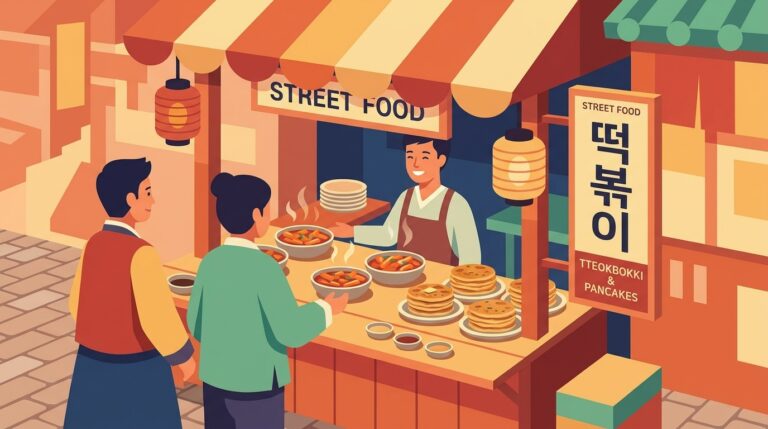
Imagine walking down a bustling alleyway in Gwangjang Market (광장시장) or Mangwon Market (망원시장). The air is thick with the aroma of sizzling, crispy Nokdu-jeon (녹두전 – mung bean pancakes), sweet and spicy Tteokbokki (떡볶이) bubbling in giant pans, and the sweet, cinnamon scent of freshly pressed Hotteok (호떡).
But here is the real pain point for intermediate (B2) learners: you know how to say “이것은 얼마입니까?” (How much is this?) from your textbooks, but when you stand in front of a busy stall run by an experienced Imo-nim (이모님 – auntie), those rigid sentences make you sound like a tourist robot! To truly unlock the warmth, hidden menus, and generous portions of Korean street food, you need to speak with the nuance, politeness, and playful charm of a local. Today, we are going to upgrade your market street cred so you can eat, chat, and connect like a true Seoulite.
Phase 2: Deep Dive into 3 Key Expressions
Let’s unpack three high-yield, natural expressions that will transform your market food tour from a basic transaction into a warm cultural experience.
1. 서비스로 좀 주실 수 있나요? (Seobiseu-ro jom jusil su innayo?)
- Pronunciation: [Suh-bee-seu-ro jom joo-shil soo een-nah-yo?]
- Meaning: “Could I possibly get this as a little complimentary ‘service’ side?”
- K-Culture Moment: Think of those classic lifestyle K-dramas where the characters are regular customers at a local cart. The owner casually slides a plate of extra fried dumplings or hot fish cake broth saying, “서비스야!” (It’s on the house!).
- Editor’s Insight: The word “서비스” (service) in Korea doesn’t mean customer service; it means freebies! However, as a B2 speaker, you must use this with high emotional intelligence. Don’t demand it! Use a soft, playful, rising tone when you have ordered quite a few items. It shows you understand the Korean culture of Jeong (정 – deep attachment/generosity).
- Situation Spectrum: Casual: ✅ | Semi-formal: ⚠️ | Formal: 🚫
- 🤔 Think About It: Why does Korean culture value these small, spontaneous freebies over a strict calculated discount? How does this foster a sense of community compared to the tipping or discount cultures in your home country?
2. 섞어서 1인분만 가능할까요? (Seokkeoseo irinbun-man ganeunghalkkayo?)
- Pronunciation: [Suhk-kuh-suh eer-een-boon-man gah-neung-hal-kah-yo?]
- Meaning: “Is it possible to mix them together into just one portion?”
- K-Culture Moment: You are standing in front of a red-hot Tteokbokki tray, but you also desperately want to try the Twigim (튀김 – assorted deep-fried snacks) and Soondae (순대 – blood sausage). Ordering one portion of each is way too much food for one person.
- Editor’s Insight: Market vendors are incredibly accommodating, but they appreciate clarity. By asking to “mix” (섞어서) into a “one-person portion” (1인분), you get a delicious medley of street food without wasting anything or overeating. It is the ultimate insider ordering hack.
- Situation Spectrum: Casual: ✅ | Semi-formal: ✅ | Formal: 🚫
- 🤔 Think About It: In many Western countries, mixing menu items is highly restricted. What does the Korean market vendors’ willingness to customize portions say about flexibility in Korean customer service?
3. 국물 좀 넉넉히 주시면 감사하겠습니다 (Gungmul jom neokneokhi jusimyeon gamsahagessseumnida)
- Pronunciation: [Goong-mool jom nuhk-nuhk-hee joo-shi-myun gahm-sah-hahg-et-seum-nee-dah]
- Meaning: “I would deeply appreciate it if you could give me a generous amount of broth/sauce.”
- K-Culture Moment: Enjoying warm fish cake soup (어묵탕 – eomuktang) on a freezing winter evening in Seoul, holding a paper cup of steaming broth that warms your entire body.
- Editor’s Insight: Notice the word 넉넉히 (neokneokhi). Instead of using the basic “많이 주세요” (give me a lot), using “넉넉히” shows a beautiful, refined command of Korean. It translates to “plentifully” or “generously” and carries a much warmer, softer tone that market owners absolutely love to hear from foreign visitors.
- Situation Spectrum: Casual: ✅ | Semi-formal: ✅ | Formal: ✅
- 🤔 Think About It: How does choosing softer, more descriptive adverbs like “넉넉히” change the relationship between the speaker and the listener compared to direct commands like “많이”?
Phase 3: Textbook Korean vs. Real Korean
Let’s look at how textbook learning compares to what actually happens on the cobblestone market streets.
Scenario 1: Adjusting the Spice Level
- 📖 Textbook Korean: “이것은 맵습니까?” (Is this spicy?)
- 🗣️ Real Korean: “제가 매운 걸 잘 못 먹는데, 혹시 덜 맵게 해주실 수 있어요?” (I’m not very good with spicy food, could you perhaps make it a little less spicy?)
- 💡 Why it matters: Asking “Is this spicy?” often gets a vague “A little bit” from vendors whose spice tolerance is vastly different from yours. By admitting your limit politely with “덜 맵게” (less spicy), you guarantee a delicious meal without burning your tongue.
Scenario 2: Asking for a Place to Sit Down
- 📖 Textbook Korean: “여기서 먹어도 됩니까?” (May I eat here?)
- 🗣️ Real Korean: “혹시 먹고 갈 건데, 안쪽에 자리 있을까요?” (I am planning to eat here and go, would there happen to be a seat inside?)
- 💡 Why it matters: Street stalls often have hidden indoor seating areas or stools behind the counter. Using the phrase “먹고 가다” (to eat and go) is the natural colloquial way to say you want to dine-in, as opposed to taking it to-go (“포장하다”).
Phase 4: K-Culture Deepdive & Non-verbal Etiquette
4-1. Nunchi (눈치) & Gesture Etiquette
When navigating a busy market food stall, your body language speaks volumes before you even open your mouth:
* The Two-Hand Rule: Whenever you receive your hot plate of food or hand over your cash/card, always use two hands. You can also support your right elbow with your left hand. This is a subtle yet powerful sign of respect that immediately endears you to older vendors.
* Nunchi (Spatial Awareness): Market aisles are extremely narrow. If a stall is packed, do not stand right in front of the food glass blocking other customers while deciding. Step slightly to the side, make eye contact, and give a polite nod to the owner to signal you are waiting for your turn.
4-2. The Culture of “Jeong” (정) through Food
In K-Travel shows like Street Food Fighter or K-Dramas like Our Blues, traditional markets are portrayed as the heart of Korean human connection. This is because of Jeong (정)—the invisible bond of affection, generosity, and warmth that develops between people over time. When an Imo-nim heaps extra food onto your plate without you asking, she is expressing Jeong. Acknowledging this with a bright smile and a hearty “맛있게 잘 먹겠습니다!” (I will eat this beautifully!) completes the cultural loop.
Phase 5: Real-Life Roleplay Scenario
Let’s put your skills to the test! You are at a bustling stall in Gwangjang Market. The owner, a busy but friendly middle-aged woman (Imo-nim), is flipping mung bean pancakes.
Characters:
- You (유): An eager intermediate Korean learner with a big appetite.
- 이모님 (Imo-nim): The warm-hearted, fast-moving stall owner.
이모님: 어서 와요! 뭐 드릴까? 빈대떡 하나 구워줄까?
(Eoseo wayo! Mwo deurikka? Bindaetteok hana guweojulka?)
"Welcome! What can I get you? Shall I fry up a mung bean pancake for you?"

유: 🎭 (Smiling warmly, pointing gently) 네, 이모님! 빈대떡 하나랑요, 혹시 떡볶이하고 튀김 섞어서 1인분만 가능할까요?
(Ne, Imo-nim! Bindaetteok hanarangyo, hoksi tteokbokkihago twigim seokkeoseo irinbun-man ganeunghalkkayo?)
"Yes, Auntie! One mung bean pancake, and by any chance, would it be possible to mix Tteokbokki and fried snacks into just a single portion?"

이모님: 🎭 (Laughs heartily, waving her spatula) 아이구, 원래 안 되는데 외국인 손님이 한국말을 너무 잘하니까 특별히 해줄게!
(Aigu, wonlae an doeneunde oegugin sonnimi hangungmareul neomu jalhanikka teukbyeorhi haejulge!)
"Oh my, we don't usually do that, but since our foreign guest speaks Korean so beautifully, I'll make a special exception for you!"

유: 🎭 (Clapping hands lightly with delight) 진짜요? 너무 감사합니다! 아, 그리고 국물 좀 넉넉히 주시면 감사하겠습니다.
(Jinjayo? Neomu gamsahamnida! Ah, geurigo gungmul jom neokneokhi jusimyeon gamsahagessseumnida.)
"Really? Thank you so much! Oh, and I would be so grateful if you could give us a generous amount of broth."

이모님: 🎭 (Placing a steaming bowl of fish cake soup with extra broth) 자, 여기 뜨거우니까 조심해서 먹어요. 맛있게 먹어!
(Ja, yeogi tteugeounikka josimhaeseo meogeoyo. Masitge meogeo!)
"Here you go, it's hot so eat carefully. Enjoy!"

유: 🎭 (Receiving the bowl with both hands and bowing head slightly) 와, 진짜 맛있어 보여요! 맛있게 잘 먹겠습니다!
(Wa, jinja masisseo boyeoyo! Masitge jal meokgessseumnida!)
"Wow, it looks absolutely delicious! I will eat this well!"

이모님: (Watching you eat with a proud smile) 맛이 어때? 입에 좀 맞아요?
(Masi eottae? Ibe jom majayo?)
"How's the taste? Is it to your liking?"

유: 🎭 (Giving a thumbs-up while chewing happily) 네, 대박이에요! 안 느끼하고 너무 맛있어요. 완전 제 스타일이에요!
(Ne, daebagieoyo! An neukkihago neomu masisseo. Wanjeon je seutairieoyo!)
"Yes, it's incredible! It's not greasy at all and so delicious. It's totally my style!"
🔀 Interactive Choice Points
How would you respond if the Imo-nim asks you if you want to try some spicy chicken feet (닭발 – dakbal), which you’ve never tried before?
* Option A: “아니요, 저 그거 안 먹어요.” (No, I don’t eat that.)
* Feedback: 🚫 Bad. While grammatically correct, it is too blunt and sounds cold, potentially killing the friendly atmosphere you built.
* Option B: “제가 닭발은 아직 잘 못 먹어서요, 다음에 꼭 도전해 볼게요!” (I’m not quite used to chicken feet yet, so I will definitely challenge myself next time!)
* Feedback: 👑 Best! It politely declines while showing cultural humility and a willingness to try in the future. It keeps the warm vibe alive.
* Option C: “비주얼이 좀 무서워서 못 먹겠어요.” (The visual is a bit scary so I can’t eat it.)
* Feedback: ⚠️ Risk. While honest and expressive, calling local food “scary” (무섭다) might offend some traditional sellers who take pride in their dishes.
Phase 6: 10-Second Emotional Shadowing Drill
To sound like a local, you must master the rhythmic flow and emotional color of Korean speech. Practice these two sentences aloud, paying attention to the breath pauses (/) and emotional cues.
- Asking for mixed portions with polite hopefulness:
“이모님, / 이거 섞어서 / 1인분만 / 가능할까요?”
[🥺 Soft eye contact, slightly rising pitch at the end, polite tone] - Expressing intense flavor satisfaction:
“우와, / 국물 진짜 / 시원하고 / 맛있어요!”
[😍 Genuine delight, emphasizing the '진짜' (jin-jja) and exhaling happily on '시원하고' (si-won-ha-go) which means refreshing/soul-warming]
Phase 7: K-Culture Mini Dictionary
| Word (Korean) | Romanization | English Translation | Real-world Context & Usage |
|---|---|---|---|
| 이모님 | Imo-nim | Auntie | The magic word to get the attention of middle-aged female restaurant or market stall owners respectfully. |
| 포장 | Pojang | Takeout / To-go | Use this if you want to take your food back to your hotel room. “포장해 주세요!” |
| 현금 | Hyeon-geum | Cash | While cards are widely accepted, cash is king at traditional stalls. Always keep some small bills handy. |
| 서서 먹기 | Seoseo meokgi | Eating while standing | The authentic style of eating street food directly at the stall front without sitting down. |
Phase 8: Traveler’s Survival Kit
Survival Expressions TOP 3
- 계좌이체 가능한가요? (Gyejwa-iche ganeunghankkayo?)
- Meaning: “Is bank transfer possible?”
- Pro Tip: If you run out of cash, almost all market vendors have their bank account numbers posted on the stall. You can easily do a domestic wire transfer if you have a local banking app!
- 남은 것 좀 싸주실 수 있나요? (Nameun geot jom ssajusil su innayo?)
- Meaning: “Could you wrap up the leftovers for me?”
- Pro Tip: Traditional market portions are massive. Don’t let good food go to waste; ask for a package to-go.
- 이게 요즘 제일 잘 나가요? (Ige yojeum jeil jal nagayo?)
- Meaning: “Is this the most popular item these days?”
- Pro Tip: If you are overwhelmed by options, ask this to get the absolute specialty of the stall.
🗺️ Editor’s Travel Note
Before stepping into any traditional market, make sure you download the Naver Map App (네이버 지도). Google Maps is notorious for not updating market stall layouts in Korea. Naver Map will guide you straight to the most famous pancake and dumpling corners with pinpoint accuracy!
Note: Stall operating hours and cash card policies may change without prior notice, so carrying around 10,000 to 20,000 KRW in cash is always a smart backup plan.
Phase 9: “한 발 더 깊이” (Go One Step Deeper)
Traditional markets are the living archives of Korea’s modern history. During and after the Korean War, markets were spaces of survival where people shared whatever resources they had. This shared struggle gave rise to the deep sense of Jeong (정) and Heung (흥 – collective joy/energy). When you sit closely with strangers on a narrow wooden bench, rubbing shoulders while slurping hot noodles, social status melts away. In a fast-paced, highly digitized country like South Korea, the traditional market remains one of the last physical sanctuaries of raw, unpolished human warmth.
💬 Your Turn: Have you ever visited a traditional market in Korea or your own country? What is the one street food you absolutely must try? Let us know in the comments below!
Phase 10: FAQ & Common Mistakes
Q: Is it rude to bargain (깎아주세요 – kkakkajuseoyo) for food prices in a traditional market?
A: Yes, bargaining for prepared food is generally considered bad manners in Korea. Traditional market food is already incredibly cheap and labor-intensive. Instead of asking for a discount, show your appreciation and ask for a little “서비스” (freebie) if you are ordering a massive amount!
Q: Can I pay with my international credit card at street food stalls?
A: Most permanent market stalls now accept cards, but mobile carts or very small traditional vendors might only accept cash or domestic bank transfers. To avoid awkward situations, it is highly recommended to keep some 1,000 and 5,000 KRW bills in your pocket.
Q: How do I grab the owner’s attention politely when the market is extremely loud?
A: Simply raise your hand slightly, make eye contact, and call out clearly, “이모님, 주문할게요!” (Imo-nim, jumun-halgeyo! – Auntie, I’d like to order!). Avoid using “여기요” (Yeogiyo – Over here) which can sound slightly transactional compared to the warm “이모님”.
🚨 Common Mistakes Alert!
- Mistake 1: Calling a younger female vendor “아줌마” (Ajumma).
- Why: “Ajumma” can feel heavy, outdated, or slightly offensive to some women. Always stick to 이모님 (Imo-nim) which feels sweet and respectful.
- Mistake 2: Grabbing street food directly with your hands or chopsticks from the display tray.
- Why: This is highly unhygienic. Always wait for the vendor to plate the food and serve it to you.
- Mistake 3: Expecting free refills of main dishes because of the “free side dish” (Banchan) culture.
- Why: Broth and small side dishes like pickled onions are refillable, but asking for extra main items (like Tteokbokki) for free is a big no-no.
Phase 11: Action Mission & Engagement
Ready to take this knowledge into the real world? Here is your customized 3-step mission:
* 🥉 Bronze Mission: Practice the 10-Second Shadowing Drill in front of a mirror until you can say “국물 좀 넉넉히 주세요” naturally in one breath.
* 🥈 Silver Mission: Share this post on your Instagram Story and tag @DailyHangul with the name of the Korean traditional market you want to visit first!
* 🥇 Gold Mission: Next time you visit a Korean restaurant or market, use the phrase “먹고 갈 건데, 자리 있을까요?” to secure your seat like a local.
🎮 K-Culture Mission
Watch an episode of the K-drama Warm and Cozy or a Korean food vlog on YouTube. Listen closely to how the characters order food. Can you spot them using the words “이모님” or “서비스”? Drop the timestamps in the comments!
Phase 12: Interactive Quiz Challenge
Test your intermediate market vocabulary and cultural knowledge!
1. Situational Judgment
You want to order spicy rice cakes (Tteokbokki) and fried snacks (Twigim), but you only want a single portion combined. What is the most natural way to say this to the owner?
* A) 떡볶이랑 튀김을 많이 주세요.
* B) 떡볶이하고 튀김 섞어서 1인분만 가능할까요?
* C) 떡볶이랑 튀김 따로따로 1인분씩 주세요.
👉 Click to see the Answer & Explanation
Correct Answer: B
- Explanation: “섞어서” (mixed) and “1인분만” (just one portion) is the perfect combination to ask for a custom-mixed portion politely. Option A is too demanding, and Option C would result in way too much food (two separate portions).
2. Fill in the Blank
Complete this sentence to ask for generous broth in a beautiful, warm way:
“국물 좀 __________ 주시면 감사하겠습니다.”
👉 Click to see the Answer & Explanation
Correct Answer: 넉넉히 (neokneokhi – generously/plentifully)
- Explanation: While “많이” (many/lots) is grammatically correct, “넉넉히” carries a much softer, more polite, and culturally rich tone that will make the vendor smile!
3. True or False
Calling any female stall owner “아줌마” (Ajumma) is the friendliest way to get their attention at a traditional market.
* True
* False
👉 Click to see the Answer & Explanation
Correct Answer: False
- Explanation: “아줌마” can sound abrasive or imply that the vendor looks old. Utilizing 이모님 (Imo-nim – Auntie) is always the safest, friendliest, and most culturally appropriate term to use.







