

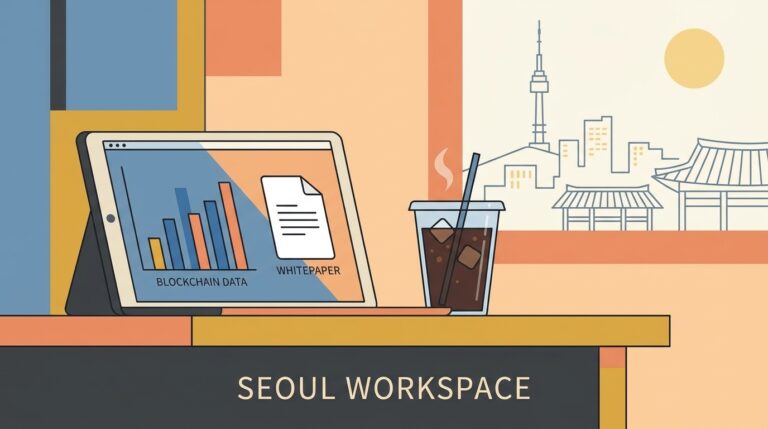
Dissecting K-Crypto: Master the Art of Reading Korean ICO Whitepapers Like a Local Insider
Phase 1: Empathy (An Immersive K-Culture Opening)
안녕하세요! (An-nyeong-ha-se-yo!) Your favorite Daily Hangul Editor is back! 🇰🇷 Have you ever scrolled through Korean financial forums, entered a frantic KakaoTalk crypto “reading room” (리딩방), and felt completely overwhelmed by the fast-paced, high-tech slang?
South Korea is famous for its passionate adoption of blockchain technology. You’ve likely heard of the “Kimchi Premium” (김치 프리미엄) or how young professionals risk it all—affectionately called “Yeong-ggeul” (영끌, dragging even your soul)—on the latest altcoins. But when it comes to analyzing an ICO (Initial Coin Offering) and analyzing a Whitepaper (백서), the stakes are incredibly high.
In this advanced C1 guide, we are looking past basic vocabulary. We’re diving straight into the sophisticated, highly natural Korean expressions that seasoned Yeouido financial analysts and local Web3 builders use to dissect projects and spot red flags. Let’s turn you into a local crypto navigator! 🚀
Phase 2: Deep Dive into 3 Key Expressions
1. 백서를 뜯어보다 (baek-seo-reul tteud-eo-bo-da)
- Pronunciation: [baek-seo-reul tteud-eo-bo-da] (Sounds like peck-suh-ruhl tteud-uh-bo-da)
- Meaning: To dissect/scrutinize a whitepaper (Literally: “To tear open and look at the whitepaper”).
- K-Culture Moment: In high-stakes tech and finance K-dramas like Start-Up, sharp venture capitalists never just “read” (읽다) a business proposal. They “뜯어봐” (tear it apart piece by piece) to expose any structural flaws.
- Editor’s Insight: The verb 뜯어보다 is a beautiful C1-level physical metaphor. It shows you aren’t just scanning the pages; you are analyzing the smart contract logic, the tokenomics, and the consensus mechanism with high suspicion.
- Situation Spectrum: Casual (✅) / Semi-formal (✅) / Formal (⚠️ – in highly official boardrooms, favor “면밀히 분석하다”).
- 🤔 Think About It: In Korean business culture, deep analytical scrutiny is often expressed through intense physical verbs. Why do you think Koreans favor physical action words like “뜯어보다” (to tear open) over passive verbs for business analysis?
2. 뜬구름 잡는 소리 (tteun-gureum jab-neun so-ri)
- Pronunciation: [tteun-gu-reum jam-neun so-ri] (Sounds like tuhn-goo-rum jam-nun so-ree)
- Meaning: A pipe dream / completely unrealistic talk (Literally: “The sound of trying to catch floating clouds”).
- K-Culture Moment: This is the ultimate reaction of skeptical Korean investors when a hyped-up blockchain startup promises 100,000 TPS (Transactions Per Second) on a mobile network with absolutely zero technical proof in their whitepaper.
- Editor’s Insight: If an ICO whitepaper relies on heavy marketing jargon and buzzwords (AI, Metaverse, Web3) without clear utility, a local Korean investor will sigh and say, “이거 완전 뜬구름 잡는 소리네” (This is just catching floating clouds).
- Situation Spectrum: Casual (✅) / Semi-formal (✅) / Formal (🚫 – avoid in official press releases!).
- 🤔 Think About It: How does your native language describe highly unrealistic, overhyped business promises? Is there a nature-based metaphor similar to Korea’s “floating clouds”?
3. 먹튀의 우려가 있다 (meok-twi-ui u-ryeo-ga it-da)
- Pronunciation: [meok-twi-ui u-ryeo-ga eet-da] (Sounds like muk-twee-ee oo-ryuh-gah eet-dah)
- Meaning: There is a risk of a rug pull / exit scam (Literally: “There is concern of eating and running”).
- K-Culture Moment: 먹튀 (Meok-twi) is a legendary compound slang of 먹고 튀다 (eat and run). It applies to everything from a customer dodging a barbecue restaurant bill to a multimillion-dollar DeFi protocol suddenly locking withdrawals.
- Editor’s Insight: This is an exceptionally sophisticated C1 phrase because it seamlessly blends a gritty, colloquial slang (먹튀) with a highly formal noun construction (~의 우려가 있다, “there is a concern/risk of”). Using this combination shows native-level fluency.
- Situation Spectrum: Casual (✅) / Semi-formal (✅) / Formal (⚠️ – in formal legal documents, use “자금 유출 및 사기 발생 가능성”).
- 🤔 Think About It: The ease of “먹튀” in the decentralized web has led to highly strict regulations in South Korea. How does the blend of slang and formal grammar help you sound both street-smart and professional?
Phase 3: Textbook Korean vs. Real-World Korean
Situation 1: Critiquing a weak, over-ambitious whitepaper.
- 📖 Textbook Korean: “이 사업 계획서는 실현 가능성이 다소 부족합니다.”
(This business plan somewhat lacks feasibility.) - 🗣️ 진짜 한국어: “이 백서 제대로 뜯어보니까 완전 뜬구름 잡는 소리만 가득하네요.”
(I dissected this whitepaper thoroughly, and it’s just filled with unrealistic pipe dreams.) - 💡 Why the Difference? The textbook phrase is grammatically correct but sounds like a dry, automated translation. Real-world crypto investors use colorful, cutting metaphors like “뜬구름 잡는 소리” to instantly convey their skepticism.
Situation 2: Warning a colleague about a potential exit scam.
- 📖 Textbook Korean: “해당 프로젝트는 투자금을 회수하고 사라질 위험이 존재합니다.”
(The project in question has a risk of retrieving investment funds and disappearing.) - 🗣️ 진짜 한국어: “이 코인은 잘못하면 진짜 먹튀의 우려가 있으니 보수적으로 접근해야 해요.”
(If things go wrong, there’s a real risk of a rug pull with this coin, so we must take a conservative approach.) - 💡 Why the Difference? While the textbook phrase is clinical, “먹튀의 우려가 있다” strikes the perfect balance for private investment chats—highly natural, punchy, and instantly understood by Korean partners.
Phase 4: K-Culture Deep-Dive & Non-Verbal Manners
4-1. Eyes, Hands, and Nunchi (눈치)
When discussing highly volatile financial investments with Korean business partners, your body language should project razor-sharp analytical focus:
* The Squinters: When looking at a whitepaper screen, narrow your eyes slightly, tilt your head, and emit a deep “흠… (Hmm…)” of calculation. In Korea, overly enthusiastic nodding can make you look naive or easy to exploit.
* The Tech Touch: When dismissing a weak point, do not use aggressive hand-waving. Instead, tap the specific paragraph on your screen with a pen and ask, “이 부분, 현실적으로 가능한가요?” (Is this part realistically possible?). This shows you are focusing strictly on the tech, not making a personal attack.
4-2. The “Kimchi Premium” and FOMO Culture
Why is the Korean crypto market so fiercely unique? South Korea has strict capital controls, making it difficult for foreign capital to move freely in and out of domestic exchanges like Upbit. When massive domestic demand crashes into limited local supply, Korean crypto prices shoot up higher than global averages—this is the famous Kimchi Premium (김치 프리미엄). Because the market moves at lightning speed, local investors are hyper-sensitive to “먹튀” risks and are always trying to find the next legitimate project early.
Phase 5: Real-World Roleplay Scenario
Setting: A sleek, concrete-designed cafe in Seongsu-dong (Seoul’s hipster startup hub). You are sitting with Ji-hoon (지훈), a brilliant local blockchain developer who is helping you evaluate a new Korean Layer-1 project.
Ji-hoon: 🎭 (아이패드로 새로 나온 코인의 백서를 띄우며)
"이번에 국내에서 새로 런칭하는 K-프로토콜 백서인데, 혹시 시간 있을 때 읽어봤어?"

You: 🎭 (아이패드 화면을 손가락으로 짚으며 진지하게)
"네, 어제 보내주신 백서 링크로 꼼꼼하게 다 뜯어봤어요. 근데 좀 걸리는 부분이 많더라고요."

Ji-hoon: 🎭 (눈을 반짝이며 커피 잔을 내려놓는다)
"오, 그래? 개발자 관점에서 볼 때 어디가 가장 이상하던가요?"

You: 🎭 (미간을 약간 찌푸리며 한숨을 쉰다)
"특히 이 합의 알고리즘이랑 로드맵 부분이요. 구체적인 구현 방식이 없어서 완전 뜬구름 잡는 소리 같아요."

Ji-hoon: 🎭 (크게 공감하며 고개를 끄덕인다)
"정답! 나도 그 합의 모델 보고 헛웃음이 나왔어. 백서에 적힌 처리 속도는 현실적으로 불가능해."

You: 🎭 (목소리를 조금 낮추며 비밀스럽게 수다를 떨듯)
"게다가 개발팀 멤버들 링크드인 프로필도 다 비공개잖아요. 잘못하면 진짜 먹튀의 우려가 있을 것 같아요."

Ji-hoon: 🎭 (주위를 슥 둘러보며 동의의 윙크를 보낸다)
"맞아. 요즘 이런 무늬만 K-블록체인인 스캠 프로젝트가 너무 판을 치네. 역시 분석력이 대단한데?"

You: 🎭 (밝게 웃으며 아메리카노를 마신다)
"하하, 지훈 씨 덕분에 눈이 높아져서 그래요. 우리 다음에는 진짜 제대로 빌딩하고 있는 깃허브 코드나 뜯어봐요!"
🔀 Choose Your Path!
How do you respond to Ji-hoon’s praise and his warning about the coin?
- Option A: “그래도 요즘 떡상하고 있으니까, 영끌해서 소액만 한 번 태워볼까요?” (Even so, it’s skyrocketing lately, so should we drag our souls and throw in a small amount?)
- 🚨 Feedback (Risk): Yikes! Playing with highly suspected “먹튀” projects purely based on FOMO is a recipe for disaster. Ji-hoon will admire your risk tolerance but worry about your investment sanity!
- Option B: “네, 개발진 신원도 확실하고 실제 깃허브(GitHub) 업데이트가 활발한 오픈소스 프로젝트 위주로 다시 필터링해 봐요.” (Yes, let’s filter again, focusing on open-source projects with verified developer identities and highly active GitHub updates.)
- 🏆 Feedback (Best): Brilliant! This response highlights your professional, analytical C1-level Web3 literacy. You sound like a true venture capitalist.
- Option C: “그냥 복잡한 거 분석하지 말고, 대장주인 비트코인이나 더 살까요?” (Should we stop analyzing complicated things and just buy more of the market leader, Bitcoin?)
- ⚠️ Feedback (Neutral): A safe choice, but it completely derails the fun of analyzing new startup whitepapers with your developer friend!
Phase 6: 10-Second Emotion Shadowing Drill
Practice these sentences out loud to master the natural prosody, pauses (/), and emotional delivery of an experienced Korean crypto researcher.
- Sentence 1 (Skeptical & Meticulous):
“이 백서 / 솔직히 / 구체적인 기술 명세가 없어서 / 완전 뜬구름 잡는 소리만 가득해요.”- Emotion Guide: [😒 Narrow your eyes and sound dryly unimpressed]
- Sentence 2 (Warning & Urgent):
“이 프로젝트는 / 개발자 신원이 불투명하니까 / 진짜 먹튀의 우려가 있어요.”- Emotion Guide: [😨 Speak with a low, confidential, and warning tone]
- Sentence 3 (Motivated & Confident):
“우리가 / 속지 않으려면 / 백서 토큰노믹스부터 / 다시 제대로 뜯어봅시다!”- Emotion Guide: [🔥 Firm, passionate, and ready to work]
Phase 7: K-Culture Mini-Dictionary (Tech & Crypto Slang)
- 떡상 (tteok-sang) | Mooning / Skyrocketing price | Used when a coin or stock shoots up dramatically overnight. (Opposite: 떡락 – tteok-rak, crashing).
- 영끌 (yeong-ggeul) | Dragging your soul | Gathering every single asset, loan, and penny to invest in something. Often used to describe the desperate housing and crypto market rush.
- 가즈아 (ga-jeu-a) | Let’s go! / To the moon! | The legendary Korean crypto war cry. It originated in sports betting but became the universal chant for crypto gains.
- 스캠 (seu-kaem) | Scam / Fraudulent project | Directly borrowed from English, but used universally in Korean crypto communities to describe fraudulent coins with fake whitepapers.
Phase 8: The Crypto Traveler’s Survival Kit
Survival Expressions TOP 3
- “이거 스캠 코인 아니에요?” [ee-geo seu-kaem ko-in a-ni-e-yo?]
- Pro Tip: Use this when a suspicious friend or an online group tries to shill you a dodgy new token.
- “백서 한글판 링크 좀 보내주세요.” [baek-seo han-geul-pan ring-keu jom bo-nae-ju-se-yo.]
- Pro Tip: Essential when analyzing localized crypto projects to get the official Korean-language whitepaper.
- “조정 오면 진입할게요.” [jo-jeong o-myeon ji-nip-hal-ge-yo.]
- Pro Tip: A incredibly polished, professional way to say “I’ll buy the dip” or “I’ll enter when a market correction occurs.”
📝 Editor’s Travel Note
If you want to track real-time crypto prices in Korea, the locals mostly use the 업비트(Upbit) 모바일 앱 or the 빗썸(Bithumb) 공식 홈페이지. Note: Due to strict local financial regulations (Real-Name Verification System), foreign tourists may face limitations registering and trading on local Korean exchanges. Always check current policy updates before setting up an account!
(Disclaimer: Crypto trading involves high financial risk. This content is for educational purposes only.)
Phase 9:
Frequently Asked Questions (FAQ)
Q: What does "백서를 뜯어보다 (baek-seo-reul tteud-eo-bo-da)" mean in Korean and how do you pronounce it?
A: In Korean, "백서를 뜯어보다 (baek-seo-reul tteud-eo-bo-da)" is pronounced [baek-seo-reul tteud-eo-bo-da] and means: To dissect/scrutinize a whitepaper (Literally: "To tear open and look at the whitepaper").
Q: What does "뜬구름 잡는 소리 (tteun-gureum jab-neun so-ri)" mean in Korean and how do you pronounce it?
A: In Korean, "뜬구름 잡는 소리 (tteun-gureum jab-neun so-ri)" is pronounced [tteun-gu-reum jam-neun so-ri] and means: A pipe dream / completely unrealistic talk (Literally: "The sound of trying to catch floating clouds").
Q: What does "먹튀의 우려가 있다 (meok-twi-ui u-ryeo-ga it-da)" mean in Korean and how do you pronounce it?
A: In Korean, "먹튀의 우려가 있다 (meok-twi-ui u-ryeo-ga it-da)" is pronounced [meok-twi-ui u-ryeo-ga eet-da] and means: There is a risk of a rug pull / exit scam (Literally: "There is concern of eating and running").






