

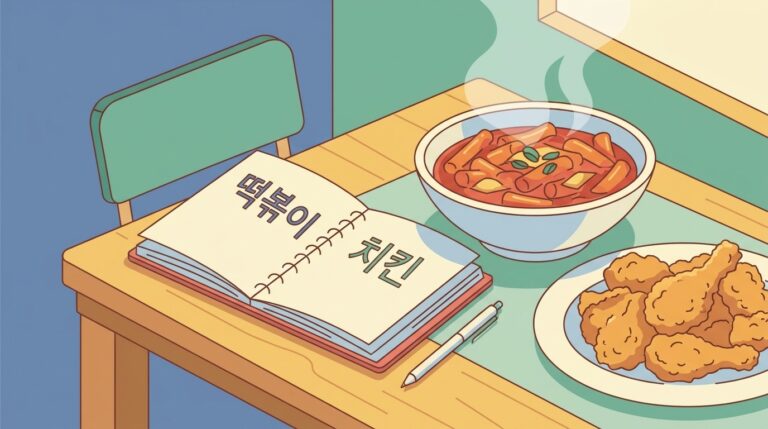
Master Mukbang Talk: How to React to Korean Food Like a Variety Show Star
안녕하세요! I’m your Daily Hangul Editor-in-Chief. Have you ever stayed up past midnight, staring at your screen while a Korean variety show host devours a plate of steaming hot tteokbokki or crispy Korean fried chicken? You hear the crunch, you see the gloss, and suddenly your mouth is watering. But as you watch, you notice the captions flashing words like 겉바속촉 (Geot-ba-sok-chok) or 순삭 (Sun-sak).
You check your standard textbook, but these words are nowhere to be found! Textbooks teach you “이것은 맛있습니다” (This is delicious), but real Koreans—especially on food variety shows like Delicious Guys or Three Meals a Day—use a colorful palette of sensory slang. Today, we are bridging that gap so you can express food cravings and satisfaction like a true B2-level native speaker!
Phase 2: Deep Dive into 3 Core Culinary Expressions
1. 겉바속촉 (Geot-ba-sok-chok)
- Pronunciation: Geot-ba-sok-chok (Sounds like “guht-bah-sohk-chohk”)
- Meaning: Crispy on the outside, tender and moist on the inside.
- K-Culture Moment: This is the ultimate praise for fried chicken, freshly baked hotteok, or perfectly seared pork belly on shows like I Live Alone.
- Editor’s Insight: This is a trendy portmanteau (줄임말) combining 겉 (outer/surface) + 바삭 (crispy) + 속 (inner) + 촉촉 (moist). It represents the holy grail of food textures in Korean gastronomy.
- Situation Spectrum: Casual (✅) / Semi-formal (✅) / Formal (⚠️ – Acceptable in lifestyle journalism, but avoid in academic papers)
- 🤔 Think About It: Contrast of textures is highly celebrated in Korean food culture. How does your language describe this perfect textural duality?
2. 순삭 (Sun-sak)
- Pronunciation: Sun-sak (Sounds like “soon-sahk”)
- Meaning: Devoured in seconds / Vanished instantly.
- K-Culture Moment: When the cast of Running Man finishes a massive feast in under five minutes, the editor flashes “순삭!” on the screen.
- Editor’s Insight: Originating from gaming slang where a character’s health bar gets “instantly deleted” (순간 삭제), foodies adopted this to describe food so delicious that it vanished from the table in a flash.
- Situation Spectrum: Casual (✅) / Semi-formal (⚠️) / Formal (🚫)
- 🤔 Think About It: In some cultures, eating quickly is frowned upon. Why do you think Korean culture proudly celebrates “순삭” as a compliment to the chef?
3. 면치기 (Myeon-chi-gi)
- Pronunciation: Myeon-chi-gi (Sounds like “myeohn-chee-gee”)
- Meaning: Slurping noodles loudly in one continuous motion without cutting them.
- K-Culture Moment: On Omniscient Interfering View, you often see celebrities dramatically slurping cold noodles (naengmyeon) or ramyeon, making a loud, satisfying sound.
- Editor’s Insight: Literally meaning “noodle hitting,” this has become a performance art on Korean TV. It signifies that the noodles are incredibly bouncy and delicious.
- Situation Spectrum: Casual (✅) / Semi-formal (⚠️) / Formal (🚫)
- 🤔 Think About It: Slurping is often considered impolite in Western dining etiquette. How do you feel about the expressive sensory nature of Korean eating habits?
Phase 3: Textbook Korean vs. Real Native Korean
Scenario 1: Reacting to Spicy Food
- 📖 Textbook Korean: 이 음식은 매워요. 하지만 괜찮습니다. (This food is spicy. But it is okay.)
- 🗣️ Real Korean: 와, 이거 진짜 맛있게 매워요! (Wow, this is a “deliciously spicy” heat!)
- 💡 Why the difference? Koreans distinguish between artificial, painful heat and a deep, addictive spiciness that keeps you coming back for more. Saying “맛있게 매워요” is a huge compliment.
Scenario 2: Expressing Satisfaction with Hot Soup
- 📖 Textbook Korean: 국물이 따뜻해서 좋습니다. (The soup is warm, so it is good.)
- 🗣️ Real Korean: 국물이 엄청 시원하고 칼칼해요! (The broth is so sharp and incredibly refreshing!)
- 💡 Why the difference? To a Korean, a hot, spicy broth is “시원하다” (literally “cool”). It refers to the physical sensation of sweat breaking, sinuses clearing, and feeling absolute bodily relief.
Phase 4: K-Culture Deep Dive & Non-verbal Manners
4-1. Nunchi & Table Gestures
When eating something deliciously spicy, fan your face lightly with your hand and let out a soft “후-하-” (hoo-ha) sound. If the soup is phenomenal, close your eyes, shake your head slightly from side to side, and sigh “크으~” (keuuu~). This non-verbal communication shows your host that you are genuinely enjoying the soul of the food.
4-2. The Spirit of “Jeong” (정) in Eating
In Korean variety shows, eating is never just a biological necessity; it is a shared performance of affection. The word for family in Korean is 식구 (Sik-gu), which literally translates to “those who share food/mouths to feed.” Reacting passionately to food is how Koreans build warm community bonds.
Phase 5: Real-Life Roleplay Scenario
The Scene
You (Alex) are at a trendy local Tteokbokki and fried food spot in Mapo, Seoul, with your foodie Korean friend, Minji.
- Minji: 알렉스, 여기 튀김 대박이야. 완전 겉바속촉의 정석이라니까!
- Alex: (Drooling) 우와, 냄새부터 장난 아니다. 진짜 침샘 자극 제대로 되네!
- Minji: 자, 식기 전에 어서 먹어봐! 국물에 찍어 먹는 게 국룰인 거 알지?
- Alex: (Takes a bite) 🎭 [Eyes widening in amazement] 음! 대박! 겉은 바삭한데 속은 즙이 살아있어. 완전 겉바속촉 맞네!
- Minji: 그치? 이제 떡볶이 국물도 한번 떠먹어봐. 어때?
- Alex: 🎭 [Letting out a deep breath] 크으~ 뜨거운데 신기하게 엄청 시원하고 칼칼해!
- Minji: 와, 너 리액션 보니까 이거 완전히 순삭 각이다! 한국인 다 됐는데?
- Alex: 당연하지! 여기 국물이 대박이라 라면 사리 추가해서 면치기 가야겠어!
🔀 Interactive Branching Point
Minji smiles and says, “Wow, you really understand the magic of hot, spicy soup!” How do you reply?
- A. “응, 진짜 시원하다! 완전 해장되는 기분이야.”
- B. “응, 근데 국물이 뜨거운데 왜 차갑다고(시원하다고) 말하는 거야?”
- C. “아니, 너무 매워서 입천장 다 까질 것 같아.”
Feedback
- Selection A (Best): Fantastic choice! Using the word 해장 (hangover cure) alongside “시원하다” proves you have reached an advanced cultural mindset. Minji will be deeply impressed!
- Selection B (Bad/Risk): While a logical question, it breaks the momentum of the fun food atmosphere. Remember, in this context, “시원하다” refers to physical relief, not temperature!
- Selection C (Acceptable/Risk): A bit too literal and a tiny bit of a party pooper. While honest, it misses the opportunity to share the fun sensory vocabulary of Mukbang.
Phase 6: 10-Second Emotional Shadowing Drill
[😊 Excited & Amazed]“와, / 겉은 진짜 바삭한데 / 속은 촉촉해! / 완전 겉바속촉이야!”
(Wa, / geot-eun jin-jja ba-sak-han-de / sok-eun chok-chok-hae! / wan-jeon geot-ba-sok-chok-i-ya!)[🤤 Drooling & Hungry]“음식 냄새가 / 진짜 장난 아니야… / 침샘 자극 제대로네!”
(Eum-sik naem-sae-ga / jin-jja jang-nan a-ni-ya… / chim-saem ja-geuk jae-dae-ro-ne!)[😎 Confident & Satisfied]“이 칼칼한 국물은 / 진짜 순삭 각인데? / 어서 먹자!”
(I kal-kal-han guk-mul-eun / jin-jja sun-sak gak-in-de? / eo-seo meok-ja!)
Phase 7: K-Culture Mini-Dictionary
- 국룰 (Guk-rul) | National / Unwritten Rule | The universally agreed-upon best way to do something (e.g., dipping fries in milkshakes, or dipping fried seaweed rolls in tteokbokki sauce).
- 침샘 자극 (Chim-saem Ja-geuk) | Salivary Gland Stimulation | Visually stunning or incredibly delicious-smelling food that instantly makes your mouth water.
- 칼칼하다 (Kal-kal-hada) | Spicy & Clear | Broth spiced cleanly with red chili flakes or fresh peppers, giving a sharp but light kick rather than a heavy, thick curry-like spice.
- ~각 (~Gak) | Likely Scenario / Perfect Angle | Street slang meaning “highly likely to happen” or “perfect timing for…” (e.g., 퇴근 각 = perfect time to head home from work).
Phase 8: Traveler’s Foodie Survival Kit
Survival Expressions TOP 3
- “이거 덜 맵게 해주세요.” (I-geo deol maep-ge hae-ju-seo-yo.) | Pro Tip: “Make this less spicy, please.” Essential for enjoying spicy stews if your spice tolerance is still developing.
- “여기에 라면 사리 추가해 주세요!” (Yeo-gi-e ra-myeon sa-ri chu-ga-hae ju-se-yo!) | Pro Tip: “Please add a ramen noodle refill to this!” Perfect for stews or tteokbokki.
- “남은 거 포장해 갈게요.” (Nam-eun geo po-jang-hae gal-ge-yo.) | Pro Tip: “I will take the leftovers to go.” Don’t let delicious food go to waste!
Editor’s Travel Note
When hunting for Mukbang-certified restaurants in Seoul, download the Catch Table app. It allows you to reserve spots at trendy culinary landmarks where long queues are the norm. (Note: App policies and availability are subject to change over time.)
Phase 9: “One Step Deeper” (Reflective Thought)
In many Western cultures, dining is traditionally a quiet, polite affair. However, the lively world of Korean variety shows treats dining as an interactive sensory playground. From loud slurping (면치기) to dramatic physical sighs (크으), expressing your culinary joy is a sign of gratitude and shared passion.
💬 Your Turn: Do you prefer quiet, meditative dining, or do you enjoy the loud, expressive, and highly interactive food culture seen in Korean Mukbangs? Let us know your thoughts in the comments below!
Phase 10: FAQ & Avoiding Common Pitfalls
Q: Is slurping (면치기) considered rude in normal, everyday Korean dining?
A: While variety shows romanticize myeon-chi-gi as an art form, in normal everyday life, excessively loud slurping can still be viewed as slightly messy. Moderate slurping to cool down hot noodles is perfectly fine, but avoid splashing broth on the person sitting across from you!
Q: Can I use words like “순삭” and “겉바속촉” during a formal business dinner?
A: These are very casual slang terms. While they are great icebreakers during an informal team dinner (회식), avoid using them in formal corporate presentations or official documents unless you work in trendy food marketing.
Q: Why do Koreans call boiling hot soup “시원하다” (cool/refreshing)?
A: This is a physical and emotional translation. When hot, spicy soup relieves internal stress, opens up your airways, and makes you break a healthy sweat, your body experiences a deep sense of refreshing lightness. That feeling is what Koreans call “시원하다!”
🚨 Common Mistakes Warning Board
- Mistake 1: Reacting to a great texture by just saying “맛있어요” (delicious).
- Correct Action: Show off your intermediate skill by specifying 겉바속촉 (crispy-moist)!
- Mistake 2: Using “바삭해요” (crispy) for something that is soft or chewy.
- Correct Action: Reserve “바삭해요” for dry crunch, and “겉바속촉” for fried foods with juicy interiors.
- Mistake 3: Translating “instant deletion” literally as “즉시 삭제” when talking about eating quickly.
- Correct Action: Use the trendy slang 순삭했어요 instead.
Phase 11: Action Mission & Engagement
- Bronze Mission: Watch a short clip of a Korean Mukbang on YouTube and spot at least one food caption we discussed today.
- Silver Mission: Take a photo of your next meal, upload it on social media, and use the hashtag
#겉바속촉or#순삭! - Gold Mission: Visit your local Korean restaurant, order a boiling bowl of soup, and practice letting out a satisfied “크으~ 국물이 시원해요!” when the owner brings it.
Phase 12: Interactive Quiz Challenge
1. Fill in the blank:
“This Korean fried chicken is incredibly crispy on the outside, yet amazingly juicy on the inside! It is totally ________!”
Click here to check the Answer
Answer: 겉바속촉 (Geot-ba-sok-chok)
Explanation: It perfectly describes the “crispy outside, moist inside” textural contrast!
2. True or False:
“In Korea, calling a boiling hot spicy stew ‘시원하다’ (cool/refreshing) means the temperature of the soup is cold.”
Click here to check the Answer
Answer: False
Explanation: It refers to the physical relief, detoxification, and refreshing feeling inside the body, not the actual physical temperature of the soup!







