

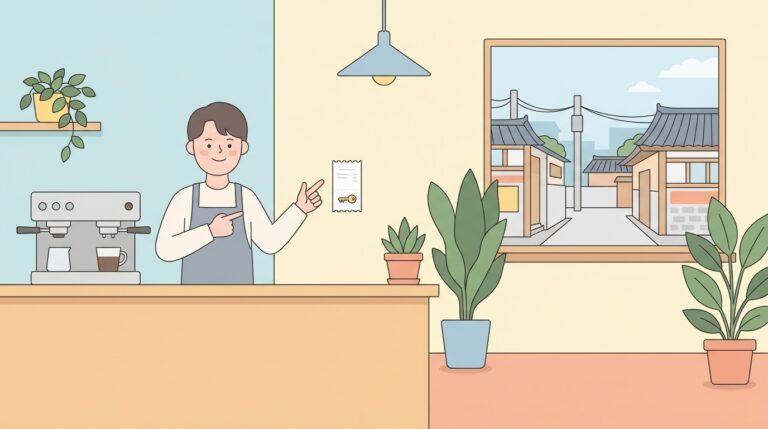
Locked Out? Master the Cafe Restroom Code in Korean!
Phase 1: Oh No, It’s Locked! (Empathy & K-Culture Entry)
안녕하세요! (Annyeonghaseyo!) Hello! I am your lead editor from Daily Hangul, your trusty local culture navigator.
Picture this: You are sitting in a gorgeous, aesthetic cafe in the trendy streets of Seongsu-dong, Seoul. You’ve just finished a delicious, ice-cold Iced Americano (affectionately called 아아 – A-A by locals). Suddenly, nature calls. You walk confidently toward the restroom door, only to find a digital keypad glowing back at you. It is locked!
You look around. There is no key. This is a classic Korean cafe “pain point” for many global travelers! But don’t panic. Getting the restroom code is super easy once you know a few beginner-friendly phrases. Today, we’ll teach you exactly how to ask for the code like a local, so you can save yourself from an awkward dance at the counter. Let’s dive in!
Phase 2: Core Expressions (Top 3)
1. 화장실 어디에 있어요? (Hwajangsil eodie isseoyo?)
- Pronunciation: Hwa-jang-sil eo-di-eh it-seo-yo? (Sounds like: Hwa-jang-sil uh-dee-eh it-suh-yo?)
- Meaning: Where is the restroom?
- K-Culture Moment: This is the universal phrase you hear in K-Dramas when a character urgently looks around a restaurant or cafe.
- Editor’s Insight: Even if you see a door, it’s polite to ask. Sometimes the restroom is outside the main cafe area, down the hall, or on another floor!
- Situation Spectrum: Casual ⚠️ | Semi-formal ✅ | Formal ✅
- 🤔 Think About It: Why does Korean use the soft “isseoyo” (exists/is there) instead of a direct demand? It shows respect for the shared space.
2. 비밀번호가 뭐예요? (Bimilbeonhoga mwoyeyo?)
- Pronunciation: Bi-mil-beon-ho-ga mwo-yeh-yo? (Sounds like: Bee-meel-bun-ho-gah mwo-yeh-yo?)
- Meaning: What is the password?
- K-Culture Moment: Korea is highly digital. Almost all building doors in Seoul use smart locks, making “비밀번호” (password) one of the most common daily words you will hear.
- Editor’s Insight: Don’t worry about memorizing long numbers! Staff will say it slowly or write it down for you.
- Situation Spectrum: Casual ⚠️ | Semi-formal ✅ | Formal ✅
- 🤔 Think About It: Think about how digital security shapes daily language in Korea compared to your home country.
3. 영수증에 있어요? (Yeongsujeunge isseoyo?)
- Pronunciation: Yeong-su-jeung-eh it-seo-yo? (Sounds like: Young-soo-jung-eh it-suh-yo?)
- Meaning: Is it on the receipt?
- K-Culture Moment: To prevent non-customers from using facilities, busy cafes print the restroom code and Wi-Fi password right at the bottom of your receipt.
- Editor’s Insight: Before running to the counter, check your receipt (영수증)! You might find the code there without even having to ask.
- Situation Spectrum: Casual ⚠️ | Semi-formal ✅ | Formal ✅
- 🤔 Think About It: Keeps the transaction seamless and reduces the staff’s repetitive answers!
Phase 3: Textbook Korean vs. Real-Life Korean
Scenario 1: Asking for the Key
- 📖 Textbook Korean: 화장실 열쇠를 주십시오. (Hwajangsil yeolsoereul jusipsio. – Please give me the restroom key.)
- 🗣️ Real-Life Korean: 화장실 카드키(열쇠) 있어요? (Hwajangsil kadeuki/yeolsoe isseoyo? – Is there a restroom card key/key?)
- 💡 Why the difference? The textbook version sounds like a military command! Modern cafes use modern card keys or fobs. Simply asking “Do you have it?” (isseoyo?) is much warmer and more natural.
Scenario 2: Asking for the Password
- 📖 Textbook Korean: 비밀번호를 저에게 가르쳐 주십시오. (Bimilbeonhoreul jeoege gareucheo jusipsio. – Please teach the password to me.)
- 🗣️ Real-Life Korean: 비밀번호 뭐예요? (Bimilbeonho mwoyeyo? – What’s the password?)
- 💡 Why the difference? Keep it short and sweet! Asking to be “taught” sounds far too formal and academic for a busy cafe environment.
Phase 4: K-Culture Deep-Dive & Non-Verbal Manners
4-1. Nunchi (눈치) & Gestures
When asking for the restroom, Koreans appreciate a quiet, polite tone.
* The Tilt: Lean in slightly toward the barista and speak in a slightly lowered voice. Restroom topics are kept discreet.
* The Receipt Present: If you have your receipt, hold it with both hands as you ask. This proves you are a customer, which instantly unlocks the friendliest customer service!
4-2. The Digital Lock Culture
Why is everything locked in Korea? It’s all about maintenance and cleanliness. Because Seoul is a bustling metropolis, public restrooms can get crowded. Locking cafe restrooms ensures that only paying customers use them, keeping the facilities clean, stocked with toilet paper, and safe!
Phase 5: Cafe Real-Life Roleplay
Setting: A hip cafe in Hongdae. You are talking to Minjun (민준), a friendly college-student barista working the counter.
- Sophia: 저기요, 화장실 어디에 있어요?
(Jeogiyo, hwajangsil eodie isseoyo?)
“Excuse me, where is the restroom?”
🎭 [Politely waving hand slightly] -
Minjun: 아, 화장실은 카페 밖에 있어요.
(Ah, hwajangsil-eun kape bakke isseoyo.)
“Ah, the restroom is outside the cafe.”
🎭 [Pointing toward the exit door] -
Sophia: 아, 밖에 있어요?
(Ah, bakke isseoyo?)
“Ah, it is outside?”
🎭 [Nodding understandly] -
Minjun: 네, 문이 잠겨 있어서 카드키를 가져가셔야 해요.
(Ne, muni jamgyeo isseoseo kadeukireul gajyeogasyayeo haeyo.)
“Yes, the door is locked so you have to take the card key.”
🎭 [Holding up a cute wooden key ring with a card attached] -
Sophia: 비밀번호도 필요해요?
(Bimilbeonhodo piryohaeyo?)
“Do I need a password too?”
🎭 [Tilting head curiously] -
Minjun: 아니요, 이 카드키만 찍으시면 돼요.
(Aniyo, i kadeukiman jjigeusimyeon dwaeyo.)
“No, you just need to tap this card key.”
🎭 [Handing the card key over with both hands] -
Sophia: 아, 네! 감사합니다.
(Ah, ne! Gamsahabnida.)
“Ah, yes! Thank you.”
🎭 [Receiving the key with both hands and bowing head slightly] -
Minjun: 다 쓰시고 꼭 돌려주세요!
(Da sseusigo kkok dollyeojuseyo!)
“Please be sure to return it when you are done!”
🎭 [Smiling warmly]
🔀 Choose Your Next Move!
- Option A: You tap the card on the lock but it doesn’t open. You go back and ask: “안 열려요. 도와주세요.” (An yeollyeoyo. Dowajuseyo. – It doesn’t open. Please help.) -> [Best! Clear and gets quick help.]
- Option B: You leave the card on the restroom sink. -> [Bad! The next customer won’t be able to enter, and the cafe loses their key.]
- Option C: You take the card key and put it in your pocket, walking out of the cafe. -> [Risk! The barista will have to chase you down the street!]
Phase 6: 10-Second Emotion Shadowing Drill
Practice these with natural emotion! Pay attention to the pauses (/).
저기요, / 화장실 어디에 / 있어요?
[🥺 Urgently but politely]비밀번호 / 뭐예요?
[👀 Curious and focused]영수증에 / 있어요?
[💡 Realizing with a bright smile]
Phase 7: K-Culture Mini Dictionary
- 비밀번호 (Bimilbeonho) | Password / PIN. Essential for digital life in Korea.
- 영수증 (Yeongsujeung) | Receipt. Always check the very bottom for codes!
- 도어락 (Doeorak) | Digital door lock. The keypad system used on doors.
- 휴지 (Hyuji) | Toilet paper/Tissues. Sometimes you need to grab this from the cafe counter before heading out!
Phase 8: Traveler’s Survival Kit
Survival Expressions TOP 3
- 휴지 있어요? (Hyuji isseoyo?) – Is there toilet paper? (Crucial for older buildings!)
- 와이파이 비밀번호 뭐예요? (Waipai bimilbeonho mwoyeyo?) – What is the Wi-Fi password?
- 카드키 주세요. (Kadeuki juseyo.) – Please give me the card key.
Editor’s Travel Note
Sometimes, smaller cafes don’t have restrooms at all. Don’t worry! Use the 네이버 지도 앱 다운로드 (Naver Map App) to find the nearest subway station. Subway stations in Korea have incredibly clean, free public restrooms!
Phase 9: Go One Step Deeper
In Korea, space is highly optimized. Because land is precious, small cafe owners share buildings with other businesses. This means restrooms are often located in communal hallways rather than inside the cafe itself. Locking them is a way of keeping the shared community space clean and safe for everyone.
💬 Your Turn: Does your country have locked restrooms in cafes? How do you ask for access back home? Let us know in the comments below!
Phase 10: FAQ & Common Mistakes
Q: Do I always have to buy a drink to use the restroom?
A: Yes, absolutely. It is considered basic manners in Korea. Always buy at least one item before asking for the key or code.
Q: What do the “*” and “#” symbols on the keypad mean?
A: Usually, you must type the numbers followed by the star (*) or pound (#) key to register the password. For example: 1234*.
Q: Can I throw toilet paper in the trash bin?
A: In most modern Korean buildings, you can flush toilet paper down the toilet. However, if you see a trash bin with a sign saying “휴지는 쓰레기통에” (Tissues in the trash can), please throw it in the bin to prevent old pipes from clogging.
🚨 Common Mistakes Alert!
- Mistake 1: Demanding “화장실 비밀!” (Restroom secret!). Correct Action: Always add the polite ending: “비밀번호 뭐예요?” (Bimilbeonho mwoyeyo?).
- Mistake 2: Forgetting to return the card key to the counter. Correct Action: Always place it back on the tray or return it directly to the barista.
- Mistake 3: Slamming the digital lock. Correct Action: Pull the handle gently after you hear the electronic “unlock” chime.
Phase 11: Action Missions!
- Bronze: Say “화장실 어디에 있어요?” out loud 3 times in front of your mirror.
- Silver: Take a screenshot of this page and share your favorite expression on Instagram, tagging #DailyHangul!
- Gold: The next time you visit a local Korean restaurant or simulated space, ask for the “비밀번호” (bimilbeonho) entirely in Korean!
-
🎮 K-Culture Mission: Watch your favorite slice-of-life K-Drama. Spot the digital door locks on the doors. They are everywhere!
Phase 12: Interactive Quiz Challenge
Test your skills before you head out to the cafe!
1. Which phrase means “Where is the restroom?”
- A) 비밀번호 뭐예요?
- B) 화장실 어디에 있어요?
- C) 영수증 주세요.
2. Fill in the blank: If you want to ask if the code is printed on the receipt, say: “_______에 있어요?”
3. True or False: You should always throw toilet paper in the toilet in every single building in Korea.
Click to reveal answers!
- Answer 1: B (화장실 어디에 있어요?)
- Answer 2: 영수증 (Yeongsujeung – Receipt)
- Answer 3: False. While modern buildings allow flushing, some older buildings still require you to use the trash bin to prevent clogs. Always check for signs!







