

Phase 1: Empathy (스토리 몰입형 오프닝)
안녕하세요! 매일한글(Daily Hangul)의 수석 에디터이자 여러분의 든든한 한국 생활 내비게이터입니다.
Imagine this: You are working at a trendy cafe in Seoul, or perhaps dealing with a client in a Korean office. Suddenly, an angry customer storms in, slamming an half-eaten dessert on the counter, demanding a full refund while raising their voice. You feel your heart race. In K-dramas like Queen of Tears or Daily Dose of Sunshine, we often see retail and service workers bowing deeply, absorbing the emotional blows of difficult clients.
In Korea, these highly unreasonable customers are known as ‘Black Consumers’ (블랙컨슈머), and dealing with them is one of the most stressful parts of working in Korea. Many intermediate learners (B2) know how to say a polite “no” in casual situations, but when faced with professional hostility, they freeze. Today, we will arm you with linguistic shields—polite, sharp, and legally sound Korean expressions to handle demanding customers confidently without losing your cool or your professionalism.
Phase 2: 핵심 표현 3선 심층 분석
1. 규정상 어렵습니다 (gyujeongsang eoryeopseumnida)
- Pronunciation: gyu-jeong-sang eo-ryeop-seum-ni-da (Sounds like “ggyu-jung-sang uh-ryup-sum-nee-da”)
- Meaning: “According to our company policy, it is difficult (to accommodate this).”
- K-Culture Moment: This is the ultimate corporate shield used by hotel concierges or airline agents in K-dramas when a wealthy guest demands an VIP upgrade that they did not pay for.
- Editor’s Insight: In Korean business culture, “어렵습니다” (it is difficult) is a polite but definitive code for “No.” Directly saying “안 됩니다” (It’s not allowed) can trigger aggressive customers because it sounds like a personal rejection. By saying “규정상” (according to regulations), you shift the boundary from “me vs. you” to “you vs. the company policy.”
- Situation Spectrum: Casual 🚫 | Semi-formal ⚠️ (규정상 어려워요) | Formal ✅ (규정상 어렵습니다)
- 🤔 Think About It: In your culture, is it better to explain the exact reason behind a policy, or does stating “it is the policy” suffice to close the argument?
2. 더 이상 도움을 드리기 어렵습니다 (deo isang doumeul deurigi eoryeopseumnida)
- Pronunciation: deo ee-sang do-um-eul deu-ri-gi eo-ryeop-seum-ni-da (Sounds like “duh ee-sang do-um-ul deu-ri-gee uh-ryup-sum-nee-da”)
- Meaning: “We are unable to assist you any further.”
- K-Culture Moment: Used by customer center supervisors when a caller keeps repeating the same illogical demands for hours.
- Editor’s Insight: This phrase is your psychological exit ticket. It signals that you have exhausted all standard procedures and that continuing the conversation is fruitless. It is professional, firm, and leaves no room for negotiation.
- Situation Spectrum: Casual 🚫 | Semi-formal 🚫 | Formal ✅
- 🤔 Think About It: How does your native language politely signal that a professional conversation is officially over?
3. 영업 방해로 조치하겠습니다 (yeongeop banghaero jochihagessumnida)
- Pronunciation: yeong-eop bang-hae-ro jo-chi-ha-ges-seum-ni-da (Sounds like “yung-up bang-hae-ro jo-chee-ha-get-sum-nee-da”)
- Meaning: “We will take action for business obstruction.”
- K-Culture Moment: You might hear this in a late-night convenience store scene in a thriller drama when a drunk customer refuses to leave and starts throwing products.
- Editor’s Insight: “영업방해” (Obstruction of Business) is a specific criminal charge in South Korea. Uttering this phrase is a serious legal warning. It communicates that the customer’s behavior has crossed from “demanding” to “illegal.”
- Situation Spectrum: Casual 🚫 | Semi-formal 🚫 | Formal ✅
- 🤔 Think About It: At what point does a customer’s behavior cross the line from a “complaint” to a “security threat” in your country?
Phase 3: 교과서 한국어 vs 진짜 한국어
Situation 1: Refusing a refund for a heavily used item
- 📖 교과서 한국어: “이거 이미 써서 환불 안 돼요.” (You already used this, so no refund.)
- 🗣️ 진짜 한국어: “고객님, 이미 제품에 사용 흔적이 발견되어 규정상 환불은 어렵습니다.” (Customer, as signs of use have been detected on the product, a refund is difficult according to company policy.)
- 💡 왜 다를까? The textbook version sounds accusatory and blunt. The real-life version uses the professional noun “사용 흔적” (signs of use) to present objective evidence while leaning on the “규정상” shield to soften the blow.
Situation 2: Stopping a customer who is screaming
- 📖 교과서 한국어: “소리 지르지 마세요.” (Do not yell.)
- 🗣️ 진짜 한국어: “고객님, 다른 손님들께 피해가 되니 고성은 삼가 주시기 바랍니다.” (Customer, as it causes inconvenience to other guests, please refrain from shouting.)
- 💡 왜 다를까? “소리 지르지 마세요” sounds like a parent scolding a child. Using words like “고성” (loud voice/shouting) and “삼가 주시기 바랍니다” (please refrain from) elevates the tone to a formal, objective boundary-setting level.
Phase 4: K-Culture 딥다이브 & 비언어적 매너
4-1. 눈치(Nunchi) & 제스처 (The Art of Standing Your Ground)
When dealing with a difficult Korean customer, your body language speaks louder than your words.
* The Eye Contact: Do not look down or look away; this is interpreted as a sign of weakness or guilt in a high-stress conflict. Maintain calm, steady eye contact.
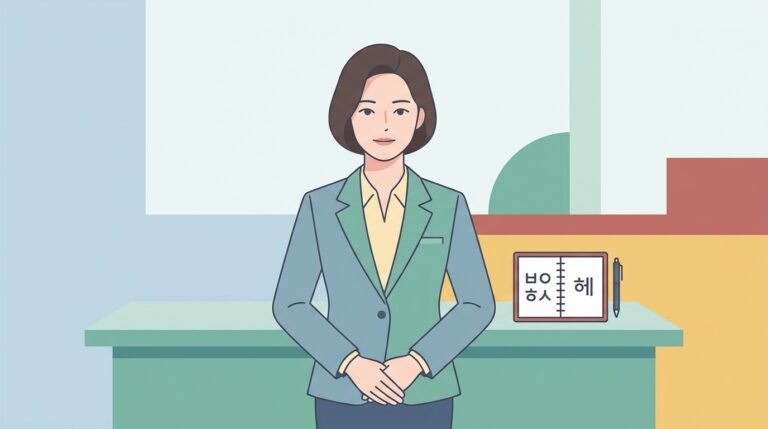
* The Hand Position (공수 자세 – Gongsu): Fold your hands gently in front of your lower stomach. However, do not bow deeply if the customer is verbally abusive. Keep your back straight to signal that while you are respectful, you are not submissive.
* The Tone Shift: Normally, service workers use a high-pitched “sol-tone” (솔톤) to sound welcoming. When setting boundaries, drop your pitch to a low, calm, flat “fa-tone” (파톤). Speak slower than usual.
4-2. 문화 코드 분석 (The Shift from ‘Customer is King’ to Employee Protection)
Historically, South Korea had an intense service culture encapsulated by the phrase “고객은 왕이다” (The customer is king). This gave rise to extreme 갑질 (Gapjil)—the abuse of power by consumers over service workers. However, public sentiment has shifted dramatically. Korea implemented the 감정노동자 보호법 (Customer Service Worker Protection Act). Now, retail workers have the legal right to hang up on abusive callers or refuse service to violent customers. Standing your ground is no longer seen as bad service; it is seen as self-defense.
Phase 5: 실전 롤플레이 시나리오
[Scene: A high-end clothing boutique in Gangnam. A customer (진상) has brought back a coat that clearly smells of heavy perfume and barbecue, demanding a full cash refund.]
- 진상 (Customer): 🎭 (Slamming the bag on the counter) 이거 어제 샀는데 마음에 안 들어서 환불해 줘요. 얼른요!
(I bought this yesterday, but I don’t like it. Refund it. Hurry up!) - 지민 (Jimin – Manager): 🎭 (Calmly checking the receipt and inspecting the coat) 아, 고객님. 구매해 주신 코트 확인해 드리겠습니다. 잠시만 기다려 주십시오.
(Ah, customer. Let me check the coat you purchased. Please wait a moment.) - 진상 (Customer): 🎭 (Impatiently tapping fingers) 딱 봐도 한 번도 안 입은 새 옷인데 뭘 그렇게 확인해요? 대충 하고 빨리 돈이나 줘요.
(Anyone can see it’s a new coat that hasn’t been worn once, why check so thoroughly? Just do it quickly and give me my money.) - 지민 (Jimin – Manager): 🎭 (Pointing to a smudge on the collar) 고객님, 제품 소매와 깃 부분에 오염이 있고 향수 냄새가 강하게 남아 있습니다.
(Customer, there are stains on the cuffs and collar of the product, and a strong scent of perfume remains.) - 진상 (Customer): 🎭 (Raising their voice) 내가 그런 거 아니에요! 원래 매장에 있을 때부터 묻어 있던 거라니까요? 지금 사람 의심해요?
(I didn’t do that! I’m telling you it was already stained when it was in the store! Are you doubting me right now?) - 지민 (Jimin – Manager): 🎭 (Maintaining flat tone, standing straight) 저희 매장은 출고 전에 정밀 카메라로 검수를 진행합니다. 이미 착용하신 흔적이 발견된 제품은 규정상 환불이 어렵습니다.
(Our store inspects all items with a high-precision camera before release. Products showing signs of wear are difficult to refund according to our policy.) - 진상 (Customer): 🎭 (Screaming and kicking a stool) 아 진짜 서비스 엉망이네! 사장 나오라 그래! 환불해 줄 때까지 나 여기서 절대 안 나가!
(Ah, seriously, the service is a mess! Call the owner! I am absolutely not leaving until I get my refund!) - 지민 (Jimin – Manager): 🎭 (Looking directly at the customer) 고객님, 매장에서 고성을 지르시고 영업을 방해하시면 저희도 조치를 취할 수밖에 없습니다.
(Customer, if you shout in the store and obstruct our business, we have no choice but to take action.)
🔀 인터랙티브 분기점
If the customer continues to scream, what should Jimin do next?
* Option A: “죄송합니다 고객님, 이번 한 번만 특별히 환불 처리해 드리겠습니다.” (I’m sorry, customer. I will process the refund as a special one-time exception.)
* Feedback: 🚫 Bad Choice! Giving in to a ‘Black Consumer’ in Korea only reinforces their abusive behavior and makes you a target for future extortion.
* Option B: “고객님, 지속해서 소란을 피우시면 경찰에 신고하겠습니다.” (Customer, if you continue to make a scene, I will report this to the police.)
* Feedback: Best Choice! Clearly warning them of police intervention is the standard professional escalation when business obstruction persists.
* Option C: “시끄러우니까 당장 나가세요! 경찰 부르기 전에!” (You are being noisy, so get out right now! Before I call the police!)
* Feedback: ⚠️ Risk! Raising your voice or using emotional, informal phrasing can escalate their physical aggression and might make you look like the instigator on CCTV.
Phase 6: 10초 감정 섀도잉 드릴
Speak these aloud. Pay attention to the pauses (/) and the emotional cues in the brackets!
- “고객님, / 이미 사용하신 제품은 / 규정상 / 환불이 어렵습니다.”
- [😐 Firm, calm, and objective tone]
- “더 이상 / 소란을 피우시면 / 저희도 / 조치를 취할 수밖에 없습니다.”
- [😠 Low-pitched, serious, and warning tone]
- “다른 고객님들께 / 피해가 되니 / 고성은 / 삼가 주시기 바랍니다.”
- [🤫 Quiet but cold, boundary-setting tone]
Phase 7: K-Culture 미니 사전
- 진상 (Jinsang) | Demanding/Unreasonable Customer | Originally referred to low-quality goods presented to the king, it now universally describes consumers who act out of line.
- 갑질 (Gapjil) | Power-tripping | Derived from ‘Gap’ (the dominant party in a contract) and ‘jil’ (a derogatory suffix for an action). It refers to superiors bullying subordinates.
- 감정노동 (Gamjeong-nodong) | Emotional Labor | The mental exhaustion service workers experience when they have to force a smile despite being mistreated.
- 블랙컨슈머 (Black Consumer) | Malicious Customer | A Konglish term referring to individuals who intentionally buy products to use them and return them, or make fake complaints to get compensation.
Phase 8: 여행자를 위한 생존 키트
Survival Expressions for Extreme Situations:
- “CCTV 녹화 중입니다.” (CCTV is currently recording.)
- Pro Tip: Points to the camera. It is a highly effective physical deterrent for aggressive behavior.
- “이러시면 다른 고객님들께 피해가 됩니다.” (Doing this causes inconvenience to other customers.)
- Pro Tip: Shifts the moral burden onto the customer by highlighting collective public manners (민폐).
- “경찰에 신고하겠습니다.” (I will report this to the police.)
- Pro Tip: Use only when there is threat of physical violence or damage to property.
📌 Editor’s Travel Note:
If you ever find yourself working or traveling in Korea and facing physical threats or severe harassment, do not hesitate to contact local authorities. Google Maps is often unreliable in Korea; instead, use the Naver Map App Download to find the nearest 파출소 (police box) or call 112 directly. (Note: Emergency hotlines support English and other foreign languages).
Phase 9: “한 발 더 깊이” (생각 질문)
South Korea’s rapid economic development was fueled by a hyper-efficient, highly attentive customer service culture. The concept of 정 (Jeong – deep connection/affection) meant that service workers often went above and beyond to treat customers like family. However, this blurred professional boundaries, giving some consumers the illusion of supreme authority. Today’s younger generation in South Korea is actively rewriting this script, championing the idea of “워라밸” (Work-Life Balance) and employee dignity.
💬 Your Turn: Have you ever experienced or witnessed ‘Gapjil’ (power-tripping) in your home country, or noticed a difference in how customer service limits are set? Share your stories in the comments below!
Phase 10: FAQ & 오해 방지
Q: Can I record a conversation with an abusive customer in Korea without their consent?
A: Yes. Under Korean law, it is legal to record a conversation you are actively participating in, even without the other party’s consent. This is highly recommended as evidence if they make false claims later.
Q: What should I do if a customer speaks to me in Banmal (informal/rude Korean)?
A: Never drop your level of politeness to match theirs. Maintain high formal language (존댓말) to highlight their lack of manners. You can say: “고객님, 말씀 낮추지 말아 주십시오” (Customer, please do not speak down to me).
Q: Is it always illegal for a business to refuse a refund in Korea?
A: No. Under the Consumer Protection Act in Korea, refunds can be legally denied if the product is damaged, shows signs of use, or is custom-made.
🚨 흔한 실수 (Common Mistakes) 경고판
- Saying “죄송합니다” (I am sorry) too quickly.
- Why: In professional disputes, apologizing immediately can be legally construed as admitting fault.
- Correct Action: Use neutral phrases like “확인해 보겠습니다” (Let me check) instead.
- Bowing too low while receiving verbal abuse.
- Why: It signals to ‘black consumers’ that their intimidation is working.
- Correct Action: Keep your posture upright, head level, and hands folded quietly.
- Shouting back in anger.
- Why: You lose professional credibility and might violate store policy or local laws on public disturbance.
- Correct Action: Use a flat, monotonous “fa-tone” to deliver dry, objective facts.
Phase 11: 액션 미션 & 참여 유도
- Bronze Mission 🥉: Practice saying “규정상 어렵습니다” 5 times in front of a mirror with a completely neutral, calm expression.
- Silver Mission 🥈: Share this post on social media with your own reflection on Korean “Nunchi” or “Gapjil” using the hashtag
#DailyHangulCS. - Gold Mission 🥇: The next time a friend asks you for an unreasonable favor, playfully use “규정상 어렵습니다” to set your boundary!
- 🎮 K-Culture Mission: Watch a K-drama set in a hotel, department store, or office. Write down the exact phrase the employee uses when they transition from polite service to setting firm boundaries.
Phase 12: 인터랙티브 퀴즈 챌린지
Test your skills! Click the boxes below to reveal the correct answers.
Q1. Which expression is the most professional way to tell a demanding customer “No”?
- Answer: 규정상 어렵습니다 (gyujeongsang eoryeopseumnida).
- Explanation: It shifts the negative decision to the company policy rather than making it personal, making it the safest professional shield.
Q2. What does the term “갑질” (Gapjil) mean?
- Answer: Power-tripping / abuse of power by a superior over a subordinate.
- Explanation: It refers to the systemic issue of those in power (the ‘Gap’) treating others (the ‘Eul’) with disrespect.
Q3. True or False: You should always bow deeply (90 degrees) when a customer is shouting to show supreme customer service.
- Answer: False.
- Explanation: Bowing deeply during abusive shouting invites further intimidation. Keep your posture upright and professional to maintain steady boundaries.







