

Phase 1: Welcome to the Digital Gates of Korea!
안녕하세요! (An-nyeong-ha-se-yo!) Your favorite Korean bestie and Daily Hangul editor is here!
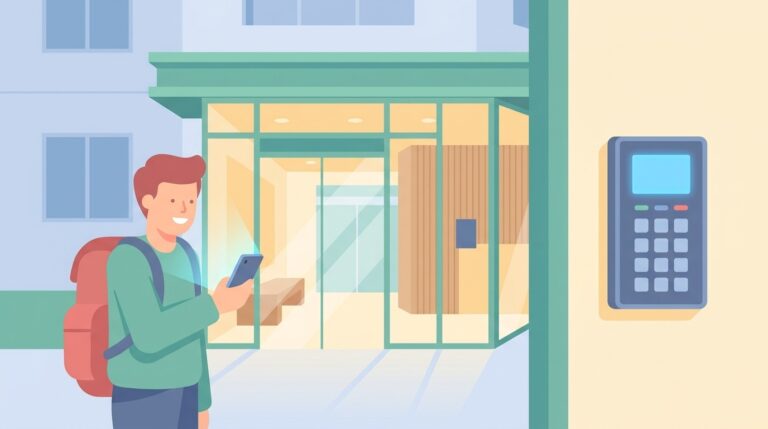
Imagine this: You’ve just arrived in Seoul, excited to visit your Korean friend’s apartment. You find the beautiful building, but as you approach, you’re stopped by a massive, high-tech glass door. There is a digital keypad blinking at you, and people are walking in and out using secret codes or key cards. You feel a sudden wave of panic. How do I call my friend? What do I say if someone asks where I’m going?
Don’t worry! This is a very common rite of passage for anyone visiting Korea. In this guide, we are going to master the simple, real-world phrases you need to conquer the 공동 현관 (gong-dong hyeon-gwan – common entrance). After reading this, you’ll walk through those doors like a local!
Phase 2: Three Golden Keys (Core Expressions)
1. 몇 호예요? (myeot ho-ye-yo?)
- Pronunciation: “Myeot ho-yeh-yo?” (Sounds like Myut ho-yay-yo?)
- Meaning: Which unit/room number is it?
- K-Culture Moment: You will hear this constantly when delivery drivers (“택배 기사님”) call your phone from the lobby entrance.
- Editor’s Insight: “호” (ho) means unit or room number. Even if you forget the word for apartment, just saying this number will get you through!
- Situation Spectrum: Casual ✅ | Semi-formal ✅ | Formal ⚠️
- 🤔 Think About It: In your home country, do you usually tell people your apartment number before they arrive, or do they have to find it themselves?
2. 문 열어 주세요. (mun yeol-eo ju-se-yo.)
- Pronunciation: “Mun yul-uh ju-seh-yo.” (Sounds like Moon yuhl-uh joo-say-yo)
- Meaning: Please open the door.
- K-Culture Moment: In K-Dramas, characters standing outside in the cold often press the call button and say this cutely to their partners inside.
- Editor’s Insight: “문” (mun) means door, and “열어 주세요” (yeol-eo ju-se-yo) is the polite way of asking someone to open something for you.
- Situation Spectrum: Casual ⚠️ | Semi-formal ✅ | Formal ✅
- 🤔 Think About It: Notice how polite Korean requests end with “주세요” (ju-se-yo)? It makes every request sound soft and respectful.
3. 비밀번호 눌러 주세요. (bi-mil-beon-ho nul-leo ju-se-yo.)
- Pronunciation: “Bi-mil-bun-ho nul-luh ju-seh-yo.”
- Meaning: Please press the passcode.
- K-Culture Moment: When a friend is busy cooking inside, they might talk to you through the wall-pad intercom and tell you to just type the code yourself.
- Editor’s Insight: “비밀” (bi-mil) means secret, and “번호” (beon-ho) means number. Together, they make “password”!
- Situation Spectrum: Casual ✅ | Semi-formal ✅ | Formal ⚠️
- 🤔 Think About It: Why do you think Korean apartments prefer digital keypads over physical keys? It’s all about fast-paced convenience!
Phase 3: Textbook Korean vs. Real-Life Korean
Let’s compare what dusty old textbooks teach you versus what Koreans actually say at the entrance lobby!
Situation 1: Asking someone to unlock the entrance door
- 📖 Textbook Korean: “공동 현관문을 열어 주십시오.” (gong-dong hyeon-gwan-mun-eul yeol-eo ju-sip-si-o.) – “Please open the common entrance door (highly formal).”
- 🗣️ Real-Life Korean: “문 좀 열어 주세요.” (mun jom yeol-eo ju-se-yo.) – “Please open the door (for me).”
- 💡 Why is it different? The textbook version is way too robotic and stiff. Adding “좀” (jom – a soft ‘please/just’) makes you sound natural and warm.
Situation 2: Asking for the door passcode
- 📖 Textbook Korean: “공동 현관 비밀번호가 무엇입니까?” (gong-dong hyeon-gwan bi-mil-beon-ho-ga mu-eot-im-ni-ka?) – “What is the common entrance passcode?”
- 🗣️ Real-Life Korean: “비밀번호 뭐예요?” (bi-mil-beon-ho mwo-ye-yo?) – “What’s the passcode?”
- 💡 Why is it different? In daily life, we want answers fast! Dropping complex particles and using the friendly “뭐예요?” (mwo-ye-yo) is the default way to ask.
Phase 4: K-Culture Deep Dive & Non-verbal Manners
4-1. The “Nunchi” (눈치) of the Lobby
When entering a Korean apartment building, you might encounter a neighbor walking right behind you.
* The Elevator Hold: If you enter the lobby first, always hold the elevator door if you see someone coming behind you. A small bow of the head (목례 – mok-rye) is the perfect silent thank-you when someone holds it for you.
* The Delivery Protocol: If you see a delivery person with lots of boxes, it is polite to let them enter the lobby first.
4-2. The Sound of Safety
Korean apartments are famous for their digital door locks. When you type the correct code, you’ll hear a cheerful musical chime (usually a tiriring! sound). In K-dramas, this sound is used to build suspense—characters inside holding their breath as they hear the beep-beep-beep of the lock outside. It symbolizes the ultimate boundary of privacy and safety in Korea’s busy cities.
Phase 5: Real-Life Roleplay Scenario
Setting: You have arrived at your Korean friend Minjun’s apartment building. You are standing outside the locked glass doors of the 공동 현관 (common entrance), looking at the intercom screen.
Characters:
* Minjun (민준): Your Korean friend who is currently in his apartment (Unit 1004).
* You (유): A friendly traveler trying to get inside.
[Scene starts: You press 1-0-0-4 and the Call (호출) button on the keypad. The screen flickers on.]

민준: 여보세요? 누구세요?
     (yeo-bo-se-yo? nu-gu-se-yo?)
     "Hello? Who is this?"

유: 🎭 (Smiling at the camera) 민준 씨, 저예요!
     (min-jun ssi, jeo-ye-yo!)
     "Minjun, it's me!"

민준: 아! 왔어요? 잠깐만요.
     (a! wat-eo-yo? jam-kan-man-yo.)
     "Ah! You're here? Hold on a second."

유: 🎭 (Nervously looking at the closed glass door) 문 좀 열어 주세요.
     (mun jom yeol-eo ju-se-yo.)
     "Please open the door for me."

민준: 어? 지금 공동 현관문이 고장 났어요.
     (eo? ji-geum gong-dong hyeon-gwan-mun-i go-jang nat-eo-yo.)
     "Oh? The common entrance door is broken right now."

유: 🎭 (Confused) 진짜요? 그럼 어떻게 들어가요?
     (jin-짜-yo? geu-reom eo-tteoh-ge deu-reo-ga-yo?)
     "Really? Then how do I get in?"

민준: 옆에 경비실 문으로 오세요. 경비 아저씨께 말씀드리세요.
     (yeop-e gyeong-bi-sil mun-eu-ro o-se-yo. gyeong-bi a-jeo-ssi-kke mal-sseum-deu-ri-se-yo.)
     "Come to the security office door next to it. Talk to the security officer."

유: 🎭 (Nodding) 알겠어요. 경비실로 갈게요!
     (al-get-eo-yo. gyeong-bi-sil-lo gal-ke-yo!)
     "Understood. I'll go to the security office!"
🔀 Interactive Choice Point!
What should you say to the security officer (경비 아저씨) to get inside?
- Option A: “문 열어!” (mun yeol-eo!)
- Option B: “안녕하세요, 1004호 갈게요.” (an-nyeong-ha-se-yo, cheon-sa-ho gal-ke-yo.)
- Option C: “비밀번호 뭐예요?” (bi-mil-beon-ho mwo-ye-yo?)
Feedback:
- Choosing A (Bad): Oh no! Saying “문 열어!” is extremely rude informal language (반말). The security officer might get upset and keep the door locked! 🚫
- Choosing B (Best): Perfect! You greeted him politely and clearly stated which unit (1004호) you are visiting. He will happily buzz you in! ✅
- Choosing C (Risk): Saying “What’s the passcode?” to a security guard is highly suspicious. He might think you are an intruder! ⚠️
Phase 6: 10-Second Shadowing Drill
Let’s practice speaking with real Korean rhythm and emotion. Read these aloud! (The / marks where you should take a tiny breath).
[😊 Friendly & Exciting]
저 / 왔어요! / 문 / 열어 주세요!
(jeo / wat-eo-yo! / mun / yeol-eo / ju-se-yo!)
“I’m here! Please open the door!”-
[🤔 Polite but Curious]
실례지만, / 몇 호예요?
(sil-rye-ji-man, / myeot ho-ye-yo?)
“Excuse me, but which unit number is it?”
Phase 7: K-Culture Mini Dictionary
- 공동 현관 (gong-dong hyeon-gwan) | Common Entrance
The main shared glass entrance lobby of a Korean apartment building where you must enter a code or call a resident. - 비밀번호 (bi-mil-beon-ho) | Passcode / Password
Often shortened to 비번 (bi-beon) in casual conversations. - 호출 (ho-chul) | Call / Paging button
The button you must press on the keypad after typing the unit number to ring the apartment. - 경비실 (gyeong-bi-sil) | Security Office
The small office located near the lobby where the friendly neighborhood guard keeps watch.
Phase 8: Traveler’s Survival Kit
Survival Phrases
- 열렸어요! (yeol-lyeot-eo-yo!) – “It’s open!” (Say this when the door finally clicks open).
- 들어가세요 (deu-reo-ga-se-yo) – “Please go in first.” (Polite way to let a neighbor pass).
- 잠시만요 (jam-si-man-yo) – “Excuse me / Hold on.” (Great for pausing the elevator door).
Editor’s Travel Note
When navigating modern Korean apartment complexes, finding the right building can be tricky. Some complexes have over twenty buildings! To find your way easily, download the Naver Map app download which shows precise building numbers and even points you to the exact entrance lobby location.
(Note: Real-time map data may vary based on GPS connection.)
Phase 9: Think Deeper (Our Cultural Mirror)
In many Western cultures, homes have individual front lawns and direct street access. In Korea, urban density led to the rise of massive apartment complexes (“아파트 단지”). Because of this shared living style, the 공동 현관 acts as a buffer zone—a boundary between the public world and private family space. It represents Korea’s balance of high-tech security with dense, respectful community living.
💬 Your Turn: How do visitors access your home or apartment? Do you have a physical key, or a digital lock like in Korea? Let me know in the comments below!
Phase 10: FAQ & Avoiding Mistakes
Q: What if I press the wrong buttons on the intercom keypad?
A: Don’t panic! Just press the 취소 (chwi-so – Cancel) button, which is usually marked with an ‘X’ or the word ‘취소’. Then start over by typing the unit number followed by 호출 (ho-chul – Call).
Q: Can I just follow a resident inside without dialing?
A: While locals sometimes do this if they are walking in together, as a visitor, it’s best to call your friend or use the security door. Tailgating too closely might look suspicious!
Q: Is there a specific way to read unit numbers in Korean?
A: Yes! Read them as individual numbers + “호” (ho). For example, Unit 502 is 오백이호 (o-baek-i-ho), not just five-zero-two.
🚨 Common Mistakes Alert!
- Mistake 1: Forgetting to press the 호출 (Call) button after typing the unit number.
- Correct Action: Type
[Unit Number]+호출! Otherwise, it won’t ring.
- Correct Action: Type
- Mistake 2: Saying “문 열어” (casual) to the delivery driver or neighbor.
- Correct Action: Always use polite form: “문 열어 주세요” (yeol-eo ju-se-yo).
Phase 11: Your Daily Hangul Action Mission
- 🥉 Bronze Medal: Write down “몇 호예요?” on a sticky note and say it out loud 3 times.
- 🥈 Silver Medal: Record yourself saying “문 좀 열어 주세요” with your best friendly K-drama voice and listen to your rhythm.
- 🥇 Gold Medal: Next time you watch a Korean drama, listen closely to the sound of the apartment doors opening and try to identify the chime sound!
Phase 12: Interactive Quiz Challenge
Test your knowledge below! Click on the tabs to reveal the answers.
1. What does “비밀번호” (bi-mil-beon-ho) mean?
🔍 Click to reveal the answer
Answer: Passcode / Password!
Explanation: “비밀” means secret, and “번호” means number. Always keep your apartment’s 비밀번호 safe!
2. Fill in the blank: “문 ___ 열어 주세요.” (Please open the door for me.)
🔍 Click to reveal the answer
Answer: 좀 (jom)
Explanation: Adding “좀” (which means ‘a little’ or ‘please’) makes the request sound much more polite and natural to native Korean speakers.
3. True or False: You should say “문 열어!” to a security guard.
🔍 Click to reveal the answer
Answer: False!
Explanation: “문 열어” is informal (반말) and impolite. You should always use the polite form “문 열어 주세요” when talking to elders or strangers.
See you in the next lesson! 다음에 또 만나요! (da-eum-e tto man-na-yo!)






