

The Call of Duty: Navigating the Deep Emotional and Linguistic Nuances of South Korea’s Enlistment Notice
Phase 1: Empathy (An Immersive Opening)
안녕하세요! Welcome back to another Master Edition of Daily Hangul, your premium window into the beating heart of Korean language and culture. I’m your senior editor and resident cultural navigator.
Imagine this: You are sitting at a cozy, bustling cafe in Mapo-gu with your close Korean friend, Min-woo. The autumn breeze is crisp, and you are discussing your plans for the upcoming year. Suddenly, Min-woo’s phone chimes. He looks down, and his bright smile instantly dissolves into a solemn, quiet gaze. He shows you his screen. It’s a digital notification from the 병무청 (Military Manpower Administration). The dread, anticipation, and profound gravity in his eyes tell you everything. It is his 입영 통지서 (Enlistment Notice).
For foreign observers—even advanced C2 learners—the sudden shift in dynamic when a young Korean man receives this notice can feel like stepping into an entirely different cultural reality. This isn’t just a bureaucratic letter; it is a monumental rite of passage that reshapes relationships, careers, and personal identities. Today, we will dive deep into the highly nuanced, emotional vocabulary surrounding this life-altering transition, ensuring you can navigate these profound conversations with the empathy, linguistic precision, and cultural depth of a true native companion. Let’s explore the weight of “the call.”
Phase 2: Deep-Dive Analysis of 3 Core Expressions
1. 나라의 부름을 받다 (Nara-ui bureum-eul batda)
- Pronunciation: [Nara-ui bureum-eul batda] (Sounds like nah-rah-wee boo-reum-eul baht-dah)
- Meaning: Lit. “To receive the call of the nation” | Actual: To be officially drafted or called up for mandatory military service.
- K-Culture Moment: This expression is frequently used in news broadcasts, high-stakes military K-dramas (like D.P. or Descendants of the Sun), and official press releases when K-pop idols or top-tier actors announce their upcoming enlistment dates to their fandoms.
- Editor’s Insight: While the literal meaning sounds highly patriotic and almost cinematic, Koreans use this phrase with a bittersweet, sometimes dryly humorous undertone. At the C2 level, you should recognize that using “나라의 부름” elevates the conversation from mere administrative duty to an existential, shared societal destiny.
- Situation Spectrum: Casual ⚠️ | Semi-formal ✅ | Formal ✅
- 🤔 Think About It: How does your home culture conceptualize national service or civic duty? Is there a linguistic equivalent that carries this mix of solemn patriotism and personal sacrifice?
2. 머리를 밀다/깎다 (Meori-reul milda/kkakda)
- Pronunciation: [Meori-reul milda/kkakda] (Sounds like muh-ree-reul meel-dah/kkahk-dah)
- Meaning: Lit. “To shave/cut one’s head” | Actual: The physical act of getting a buzz cut, symbolizing the ultimate psychological transition from civilian to soldier.
- K-Culture Moment: Every Korean entertainment outlet and social media platform goes wild when a major star posts their “shaved head selfie” (삭발 사진) the night before enlistment. It is the definitive visual declaration that their civilian life is temporarily on pause.
- Editor’s Insight: While “머리를 자르다” means a standard haircut, “밀다” (to shave/buzz) or “깎다” (to shear) carries a visceral weight. It marks the moment of stripping away personal vanity. In Korean male bonding, going together to the barbershop to watch a friend “머리를 밀다” is an intimate, emotional ritual often accompanied by a quiet round of drinks.
- Situation Spectrum: Casual ✅ | Semi-formal ✅ | Formal 🚫
- 🤔 Think About It: Hair often represents personal identity and freedom. Why do you think military structures worldwide begin with this specific act of uniformity, and how does Korean society process this sudden visual transformation?
3. 입대 장정 (Ipdae jangjeong)
- Pronunciation: [Ipdae jangjeong] (Sounds like eep-dae jahng-jeong)
- Meaning: Lit. “Enlisting robust youth” | Actual: The official, highly respectful, yet archaic term used by the military to address new recruits during their initial processing phase.
- K-Culture Moment: When you accompany a friend to the training camp gates (like the massive Nonsan Training Center), you will see giant banners reading “환영! 입대 장정 여러분” (Welcome, enlisting youth!). It is also heard over loudspeakers as officers guide thousands of nervous young men away from their crying families.
- Editor’s Insight: The word “장정” (壯丁) historically refers to an able-bodied young man fit for labor or war. By using this term, the state elevates the raw recruit from a mere “newbie” to an honorable protector of the country. It is a word heavy with collective historical memory.
- Situation Spectrum: Casual 🚫 | Semi-formal ⚠️ | Formal ✅
- 🤔 Think About It: Consider how language is used to dignify difficult tasks. How does transitioning from a “citizen” (시민) to a “jangjeong” (장정) change a person’s psychological contract with their nation?
Phase 3: Textbook Korean vs. Real-World Korean
Situation 1: Informing someone that you received your military notice
- 📖 Textbook Style: “군대 입영 통지서를 받았습니다.” (I have received my military enlistment notice.)
- 🗣️ Real-World Style: “드디어 군대 영장 나왔어. 갈 때가 됐나 봐.” (My military warrant finally came out. I guess it’s my time to go.)
- 💡 Why the Difference? Textbook Korean treats the notice purely as a document (통지서). In real-world conversation, Koreans almost universally refer to the enlistment notice as a 영장 (Yeongjang – warrant/subpoena). This linguistic choice emphasizes the mandatory, legally binding nature of the draft. To say “갈 때가 됐다” (my time has come) reflects a stoic acceptance of this inevitable phase of life.
Situation 2: Discussing what to prepare before enlisting
- 📖 Textbook Style: “훈련소 입소 준비물을 챙기십시오.” (Pack your training center entry supplies.)
- 🗣️ Real-World Style: “어차피 다 뺏기니까, 나라사랑카드랑 전자시계 하나만 차고 가.” (They’ll take everything anyway, so just wear your Narasarang Card and a digital watch.)
- 💡 Why the Difference? While official brochures list various items, veteran soldiers (예비역) know that standard personal belongings are confiscated and mailed back home in a cardboard box (the dreaded “유품 상자” or “소지품 상자”). Real-world advice focuses on absolute survival essentials: the official debit card (나라사랑카드) and a cheap, waterproof military watch (군인 시계) with a backlight.
Phase 4: K-Culture Deep Dive & Non-Verbal Etiquette
4-1. The Choreography of Farewells: Gestures & Posture
When a young man receives his notice, the physical interaction with his peers changes. It is marked by “어깨 툭툭” (gentle shoulder taps) and “묵직한 포옹” (heavy, lingering hugs) rather than overly loud, energetic high-fives.
On the day of enlistment at the camp gates:
* The Salute (경례): Young recruits often do not salute yet, as they haven’t been trained. However, older friends or relatives who have served might offer a crisp salute as a sign of mutual respect. If you are a foreign friend, a deep bow with eye contact that communicates “몸 조심히 다녀와” (Return safely, in good health) is infinitely more powerful than any casual wave.
* The Hair Touch: It is a common, intimate gesture for close friends and romantic partners to gently pat or stroke the newly shaved head. It is a physical way of coping with the sudden vulnerability of the recruit.
4-2. Cultural Code: The Sound of “Enlistment Day”
To truly understand this phase, you must listen to Kim Kwang-seok’s legendary song, “이등병의 편지” (A Soldier’s Letter). Its melancholic harmonica intro is the universal soundtrack of enlistment in Korea. When someone shaves their head, this song automatically plays in the minds of every Korean present. It encapsulates the deep, existential sorrow of leaving behind youth, romance, and freedom for the cold, regimented life of the barracks.
Phase 5: Real-Life Roleplay Scenario
The Setting
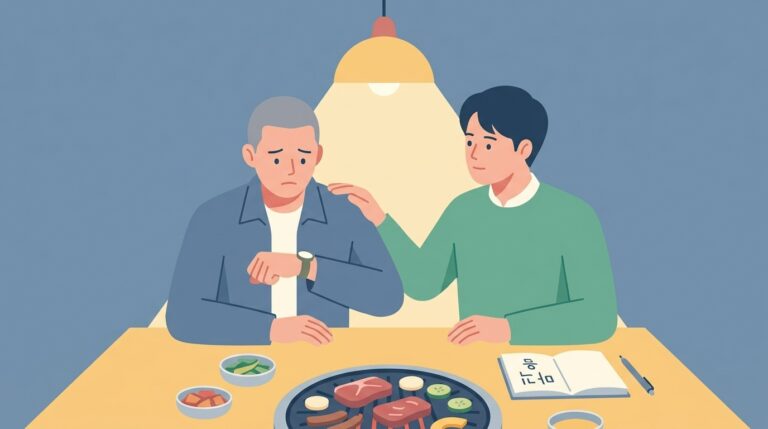
A dimly lit, retro Korean BBQ joint near the Nonsan Army Training Center (논산훈련소). The air is thick with the smell of grilling pork belly (삼겹살) and heavy sighs. Min-woo is enlisting tomorrow morning. His older, already discharged friend, Jun-ho, and their foreign friend (You) are holding a farewell dinner.
The Cast
- 민우 (Min-woo): The enlistee. Highly anxious, staring blankly at the grill, rubbing his newly buzzed head.
- 준호 (Jun-ho): The seasoned veteran (예비역). Calm, offering realistic advice with a touch of tough love.
- You (C2 Korean Speaker): The supportive, culturally empathetic friend.
민우: (까칠한까까머리를 어색하게 만지며) 아... 진짜 적응 안 된다. 거울 볼 때마다 딴 사람 같아.

준호: (소주잔을 채워주며) 원래 다 그래. 야, 그래도 두상 예뻐서 군복 잘 어울리겠다.

You: 민우야, 내일 입소할 때 마음은 좀 어때? 막상 전날 밤이 되니까 실감 나지?

민우: (한숨을 크게 쉬며) 솔직히 오늘 낮까지만 해도 그냥 멍했거든? 근데 아까 나라사랑카드 챙기면서 영장 다시 보니까 가슴이 턱 막히더라고.

준호: (삼겹살 한 점을 앞접시에 놓아주며) 훈련소 정문 들어설 때가 피크야. 근데 다 사람 사는 곳이다. 몸 성히 전역하는 게 최고니까 몸부터 사려.

You: 맞어, 준호 형 말이 백번 옳아. 군인 시계는 라이트 잘 들어오는 걸로 잘 샀지?

민우: 응, 네가 추천해 준 방수 시계로 준비했어. 이거 없으면 불침번 설 때 시간도 못 본다면서?

준호: 그렇지. 시간 안 가는 군대에서 시계만 보게 될 거다. 자, 다들 잔 들어. 우리 민우 건강하게 군 생활 마칠 수 있도록 건배하자!
🔀 Interactive Choice Point
As Min-woo holds his shot glass, looking visibly overwhelmed, what is the best C2-level response to reassure him?
- Option A: “민우야, 군대 별거 아니야! 시간 금방 가니까 너무 걱정하지 마.”
- Option B: “나라의 부름을 받은 만큼, 당당하고 멋지게 대한민국 육군의 자존심을 보여주고 와!”
- Option C: “민우야, 힘들면 언제든 편지해. 인터넷 편지 매일 써줄게. 다치지만 말고 건강하게만 돌아와.”
🧐 Option Analysis & Feedback
- Option A (The Cliché – Bad): Saying “Time flies, don’t worry!” (시간 금방 가) to someone enlisting the next day can feel incredibly dismissive. To an enlistee, those 18 months feel like an eternity. It lacks the deep empathy expected at a C2 level.
- Option B (The Overly Patriotic – Risk): While patriotic, this response sounds like a propaganda poster or a commanding officer’s speech. It puts unnecessary pressure on Min-woo, who is currently grieving his temporary loss of freedom.
- Option C (The Best Friend – Best!): This is the ultimate C2-level response. It acknowledges the difficulty, offers a tangible lifeline of connection (인터넷 편지 – online letters sent via the Camp app), and focuses on the single most important value in modern Korean military culture: returning home healthy and uninjured (다치지 말고 건강하게).
Phase 6: 10-Second Emotional Shadowing Drill
To master the complex emotions of this transition, practice these sentences with precise pauses (/) and emotional inflection.
Drill 1: Expressing the heavy weight of receiving the notice
- Sentence: “막상 / 나라의 부름을 받고 나니까, / 평범했던 일상이 / 얼마나 소중했는지 / 뼈저리게 느껴져요.”
- Emotional Anchor:
[😔 Bitter, reflective, and deeply solemn] - Translation: Now that I’ve actually received the nation’s call, I feel in my very bones how precious my ordinary daily life truly was.
Drill 2: Comforting a friend who is about to shave his head
- Sentence: “머리 밀고 나면 / 마음이 싱숭생숭하겠지만, / 우리가 매주 편지 쓸 테니까 / 군대 안에서 / 너무 외로워하지 마.”
- Emotional Anchor:
[🥺 Warm, reassuring, with absolute sincerity] - Translation: You might feel incredibly bittersweet after shaving your head, but we will write to you every single week, so don’t feel too lonely in there.
Phase 7: K-Culture Mini-Dictionary
- 짬밥 (Jjambap)
- Definition: Military food / Military experience.
- Usage: Originally referring to the rice served in the military, it now metaphorically represents one’s career seniority or “years on the job” in civilian corporate culture (e.g., “내가 이 회사에서 먹은 짬밥이 몇 년인데!”).
- 나라사랑카드 (Narasarang Card)
- Definition: “Love Country” Card.
- Usage: A multi-functional smart card issued by the government that serves as a military ID, debit card, salary account, and public transit card. Every male citizen must get one during his physical exam (신체검사).
- 군대 영장 (Gundae Yeongjang)
- Definition: Military Warrant (Enlistment Notice).
- Usage: Though officially named “입영 통지서,” citizens use the term “영장” because of its legal weight. To say “영장 나왔다” instantly shifts the atmosphere to one of impending departure.
- 곰신 (Gomsin)
- Definition: Rubber shoes (Short for 고무신).
- Usage: Refers to a girlfriend waiting for her boyfriend to finish his military service. It comes from the idiom “고무신 거꾸로 신다” (to put rubber shoes on backward, meaning to cheat on/leave someone in the military).
Phase 8: The Ally’s Survival Kit
If you have a Korean friend, colleague, or loved one enlisting, these three phrases are your ultimate linguistic survival tools:
- Survival Phrase 1: “몸 조심히 잘 다녀와. 다치지 않는 게 제일 중요해.”
- Romanization: [Mom josimhi jal danyeowa. Dachiji anneun ge jeil jungyohae.]
- Pro Tip: The golden rule of military farewells. Avoid wishing them “glory” or “success”; wish them safety.
- Survival Phrase 2: “인터넷 편지(인편) 많이 써줄 테니까 훈련소에서 기죽지 마!”
- Romanization: [Inteonet pyeonji mani sseojul tenikka huryeonso-eseo gijukji ma!]
- Pro Tip: In training camps, letters are printed out and distributed daily. The recruit with the most letters is the “king of the barracks.” Promising online letters is the greatest gift.
- Survival Phrase 3: “건강하게 전역해서 진짜 멋진 모습으로 다시 만나자.”
- Romanization: [Geonganghage jeonyeokhaeseo jinjja meotjin moseub-euro dasi mannaja.]
- Pro Tip: Focuses on the future reunion, giving the enlistee a mental goalpost to look forward to.
📌 Editor’s Travel & Companion Note: If you are accompanying your friend to their enlistment site, you will likely need to navigate rural areas like Nonsan or Chuncheon. Ensure you have the 네이버 지도 앱 다운로드 (Naver Map App Download) completed beforehand, as Google Maps does not provide accurate routing or military base perimeters due to national security regulations.
Phase 9: One Step Deeper (Reflective Insight)
In South Korea, mandatory military service is not merely a legal obligation; it is the silent, structural scaffolding of the entire society. It is the crucible where boyhood is forcibly forged into manhood, creating a shared generational trauma, resilience, and unique camaraderie known as 전우애 (jeonwoo-ae – comradeship).
This shared experience explains why Korean corporate culture so heavily mirrors military hierarchy (such as the rigid top-down communication and drinking rituals). It also explains the immediate, unspoken bond formed between two Korean men when they discover they served in the same division. To truly speak Korean at a C2 level is to understand that behind the neon lights of K-Pop and modern prosperity lies a nation of young men who have all stared at the same barbed wire fences, guarding the fragile peace of their homeland.
💬 Your Turn: How does your home country view mandatory national service? If you have ever supported a friend through a major, life-changing transition, how did you express your support? Share your thoughts in the comments below!
Phase 10: FAQ & Common Mistakes
Q: Can foreigners send letters to Korean soldiers in training camps?
A: Yes! Through apps like The Camp (더 캠프), anyone worldwide can register with the soldier’s name, birthdate, and enlistment date to send daily internet letters. These are printed out by officers and handed to the recruits, providing an immense morale boost.
Q: What happens if a Korean citizen ignores the 입영 통지서 (Enlistment Notice)?
A: Under Article 88 of the Military Service Act, failing to enlist without a valid justification leads to immediate criminal prosecution, resulting in up to three years of imprisonment, social ostracization, and permanent employment limitations.
Q: Why do soldiers need a specific “Narasarang Card” instead of their regular bank cards?
A: The Narasarang Card acts as their official military identity card, receives their monthly military salary, and offers specific discounts on military phone plans, post-exchange (PX) items, and public transportation tailored for active-duty personnel.






