

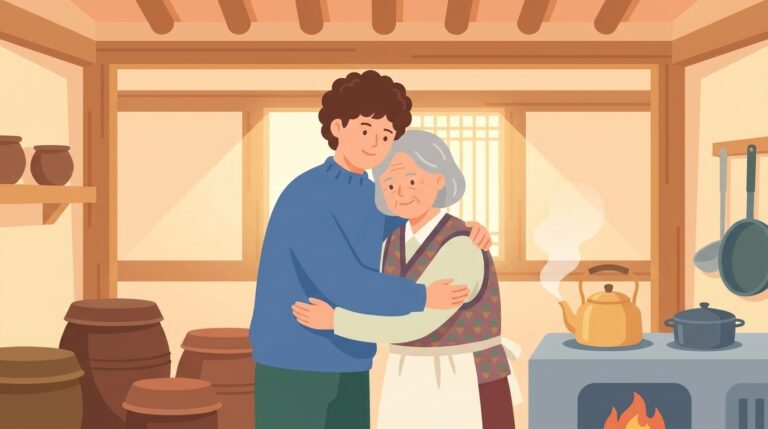
Why Leaving Korea Is So Hard: The Bittersweet Magic of ‘Jeong’ (정)
Phase 1: Empathy (Welcome to the Sweet Trap of Korea!)
안녕하세요! (An-nyeong-ha-se-yo!) Hello, my dear Korean learners and cultural explorers! It’s your favorite Daily Hangul editor and your 10-year local guide.
Picture this: You came to Korea for a short exchange program, a teaching gig, or a three-month backpacking trip. You thought you’d just eat some delicious K-BBQ, visit a few cafes, and head home. But then, something unexpected happened.
The lady at the local gimbap shop started throwing in extra mandu (dumplings) for free. Your Korean coworker spent two hours helping you set up your home wifi. Your study partner cried when you said you had to book your flight back. Suddenly, looking at your packed suitcase, your heart feels incredibly heavy.
In Korea, we have a saying: “정 들이면 떠나기 힘들다” (Once you develop ‘Jeong’, it’s hard to leave). If you are feeling tears well up at the thought of leaving Korea, congratulations—you have been infected by the most beautiful Korean emotional superpower: 정 (Jeong, 情).
Today, we are going to dive deep into this unique cultural concept, learn how to express this bittersweet attachment in natural, native-level Korean (B1), and make sure you have the perfect words to say your beautiful goodbyes.
Phase 2: Deep Dive into Key Expressions
To truly understand and express this deep bond, let’s master 3 vital expressions that native speakers use when they talk about “Jeong.”
1. 정이 들다 (Jeong-i deul-da)
- Pronunciation: [Jeong-i deul-da] (Sounds like “Jung-ee dul-dah“)
- Meaning: To grow attached / To develop mutual affection over time.
- K-Culture Moment: You see this in K-Dramas when two characters who initially hated each other (enemies-to-lovers trope!) realize they’ve grown fond of one another. One looks at the other and sighs, “정이 들어버렸어” (I’ve grown attached to you).
- Editor’s Insight: Deul-da (들다) means “to enter” or “to seep in.” Jeong isn’t something that strikes you instantly like romantic love (사랑 – Sarang). It slowly seeps into your heart like morning mist. It takes time, shared meals, and shared struggles.
- Situation Spectrum: Casual ✅ | Semi-formal ✅ | Formal ⚠️
- 🤔 Think About It: Is there a single word in your native language that captures this slow-growing, comfortable, and unconditional attachment? How does it differ from love?
2. 정 때문에 못 떠나다 (Jeong ttae-mune mot tteo-na-da)
- Pronunciation: [Jeong ttae-mu-ne mot tteo-na-da] (Sounds like “Jung ttae-moo-neh mote ttuh-nah-dah“)
- Meaning: Cannot leave because of the deep bond/attachment.
- K-Culture Moment: Think of an expat who planned to stay in Seoul for one year but is now on year seven. When their family back home asks when they are returning, they smile helplessly and say this exact phrase.
- Editor’s Insight: Ttae-mune means “because of” and mot tteo-na-da means “cannot leave.” It represents that warm, invisible gravity pulling at your ankles when you try to step onto the plane.
- Situation Spectrum: Casual ✅ | Semi-formal ✅ | Formal ⚠️
- 🤔 Think About It: Have you ever stayed in a place, a job, or a relationship longer than planned just because of the people? That is Jeong keeping you anchored.
3. 정을 떼다 (Jeong-eul tte-da)
- Pronunciation: [Jeong-eul tte-da] (Sounds like “Jung-ul tteh-dah“)
- Meaning: To detach oneself / To break off affection (often intentionally to make parting easier).
- K-Culture Moment: Often seen in emotional breakup scenes in dramas where one character acts cold or mean on purpose to help the other person move on.
- Editor’s Insight: Tte-da (떼다) means “to peel off” like a sticker. Peeling off Jeong is painful because it feels like ripping off a piece of your own skin. It’s a bittersweet, active effort to prepare for a physical separation.
- Situation Spectrum: Casual ✅ | Semi-formal ✅ | Formal 🚫
- 🤔 Think About It: Why do you think humans sometimes act cold right before a big move? Is it a universal coping mechanism to “peel off” the attachment?
Phase 3: Textbook Korean vs. Real Conversational Korean
Let’s upgrade your Korean from a dry textbook style to the warm, emotional tone of a real local!
Situation 1: Expressing that you became close friends with someone.
- 📖 Textbook Korean: “저는 한국 친구들과 친해졌습니다.” (I became close with Korean friends.)
- 🗣️ Real Conversational Korean: “한국 친구들이랑 정이 듬뿍 들었어요.” (I’ve grown super attached to my Korean friends.)
- 💡 Why the difference? Chinhada (친하다) just means friendly or close. Adding Jeong-i deumpuk deureosseoyo (filled with Jeong) adds a layer of deep, family-like emotional bonding that cozy nights of eating chicken and beer (chimaek) bring.
Situation 2: Expressing sadness about leaving Korea.
- 📖 Textbook Korean: “떠나기가 아쉽습니다.” (It’s a pity to leave.)
- 🗣️ Real Conversational Korean: “정들어서 발걸음이 안 떨어져요.” (We’ve bonded so much that my feet won’t lift off the ground to leave.)
- 💡 Why the difference? Balgeoreumi an tteoreojyeoyo is a beautiful Korean idiom. It literally means “my footsteps won’t separate/peel off from the floor.” It physically describes the heavy feeling of wanting to stay.
Phase 4: K-Culture Deep Dive & Non-Verbal Manners
4-1. The Body Language of ‘Jeong’
In Korea, Jeong is rarely spoken aloud; it is felt through actions.
* The Double-Hand Handshake: When saying goodbye to an elder or someone you respect, hold their hand with both of your hands. It communicates warmth and a reluctance to let go.
* The Head Tilt and Eye Contact: When a local grandma or shop owner is talking to you, tilt your head slightly and keep warm eye contact. It shows you are absorbing their warmth.
* The “Slipping” of Food: If someone puts a piece of food on your rice bowl during a meal, do not put it back! This is the ultimate, quiet gesture of Jeong. Eat it with a bright smile.
4-2. The Cultural Code: “Reply 1988” and the Magic of Sharing
If you want to witness Jeong in its purest form, watch the K-drama Reply 1988. In the very first episode, the mothers of Ssangmun-dong continuously send their children to deliver side dishes to neighbors. By dinner time, everyone’s table is filled with dishes from someone else’s kitchen. This is Jeong—the blur of boundaries between “mine” and “yours” to create
Frequently Asked Questions (FAQ)
Q: What does "정이 들다 (Jeong-i deul-da)" mean in Korean and how do you pronounce it?
A: In Korean, "정이 들다 (Jeong-i deul-da)" is pronounced [Jeong-i deul-da] and means: To grow attached / To develop mutual affection over time.
Q: What does "정 때문에 못 떠나다 (Jeong ttae-mune mot tteo-na-da)" mean in Korean and how do you pronounce it?
A: In Korean, "정 때문에 못 떠나다 (Jeong ttae-mune mot tteo-na-da)" is pronounced [Jeong ttae-mu-ne mot tteo-na-da] and means: Cannot leave because of the deep bond/attachment.
Q: What does "정을 떼다 (Jeong-eul tte-da)" mean in Korean and how do you pronounce it?
A: In Korean, "정을 떼다 (Jeong-eul tte-da)" is pronounced [Jeong-eul tte-da] and means: To detach oneself / To break off affection (often intentionally to make parting easier).







