

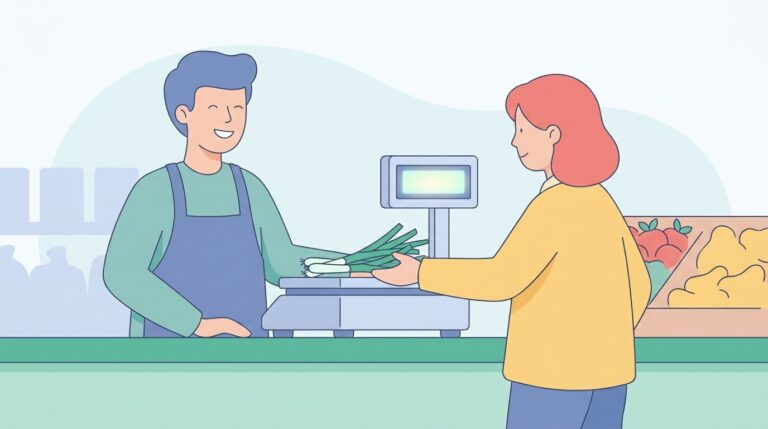
Weighing Your Veggies in Korea: Master Mart Scaling with Confidence
Phase 1: Empathy (Your Korean Mart Dilemma)
안녕하세요! (An-nyeong-ha-se-yo!) Welcome back to Daily Hangul, your trusty neighborhood guide to living and breathing Korean culture like a local.
Picture this: You are standing in the middle of a brightly lit Korean supermarket like E-Mart or Lotte Mart. You’ve successfully picked out a bag of beautiful, plump Korean strawberries (딸기) and some fresh sweet potatoes (고구마) for a cozy home-cooked dinner. But as you head to the checkout counter, you notice something is missing—there are no price tags on your produce bags!
You look around and spot a busy weighing station (저울) with a line of shoppers. The staff member is quickly placing bags on a scale, printing barcodes, and sticking them on. Your heart beats a little faster. How do you ask them to weigh your bag without sounding awkward?
Don’t worry! This is one of the most common “cultural speedbumps” our A2 students face. Today, we will learn the exact phrases, cultural manners, and survival tips you need to weigh your groceries like a pro. No more hesitation, just pure shopping victory!
Phase 2: Core Expressions (The Mart Survival Trio)
Here are the three most important phrases you need to know when standing in front of the grocery scale.
1. 이거 무게 좀 달아주세요. (Please weigh this for me.)
- Pronunciation: I-geo mu-ge jom dal-a-ju-se-yo. (Sound Analogy: “I-gum” without the ‘m’ + “moo-geh” + “jom” + “doll-ah-joo-say-yo” like a doll in a toy shop)
- Meaning: “Please weigh this for me.” (Directly: “As for this, please weigh the weight a little.”)
- K-Culture Moment: You will hear this constantly in Korean lifestyle vlogs and family K-Dramas whenever characters are preparing for a big outdoor barbecue or family feast.
- Editor’s Insight: The word “좀” (jom) literally means “a little,” but in Korean culture, it acts as a magical politeness booster. It softens your request, making you sound friendly and natural.
- Situation Spectrum: Casual (⚠️ – too polite for close friends) | Semi-formal (✅ – Perfect for store staff) | Formal (✅)
- 🤔 Think About It: In your home country, do you usually weigh fruits yourself, or does the cashier do it? Why do you think Korean marts prefer having a dedicated staff member at the weighing station?
2. 가격표는 어디서 붙여요? (Where do I stick/get the price tag?)
- Pronunciation: Ga-gyeok-pyo-neun eo-di-seo but-yeo-yo? (Sound Analogy: “Gah-gyuck-pyoh-noon” + “uh-dee-suh” + “boot-yuh-yo” like booting up a computer)
- Meaning: “Where do I put the price tag on?” or “Where is the scale station?”
- K-Culture Moment: Imagine a cute scene in a romantic comedy where the main lead gets lost in a huge mega-mart and has to ask the staff this exact question while holding a single onion.
- Editor’s Insight: “붙이다” (but-i-da) means “to stick” or “to paste”. In Korean marts, the price tag is usually a sticky barcode label, so Koreans ask where to “stick” it rather than just where to “buy” or “find” it.
- Situation Spectrum: Casual (⚠️) | Semi-formal (✅) | Formal (✅)
- 🤔 Think About It: How does your language describe the action of putting a label on a package? Is it “sticking,” “labeling,” or “printing”?
3. 이거 바코드 뽑아주세요. (Please print the barcode for this.)
- Pronunciation: I-geo ba-ko-deu ppob-a-ju-se-yo. (Sound Analogy: “I-guh” + “bah-koh-deu” + “pohb-ah-joo-say-yo” like pulling out a card)
- Meaning: “Please print the barcode for this.”
- K-Culture Moment: Often used when you bring a loose bag of garlic or loose chili peppers to the weighing station and the staff member is waiting for your instruction.
- Editor’s Insight: “뽑다” (ppob-da) means “to pull out” or “to extract,” but it is also widely used for printing labels, tickets, and photos from automated machines.
- Situation Spectrum: Casual (⚠️) | Semi-formal (✅) | Formal (✅)
- 🤔 Think About It: Notice how “please print” uses “뽑아주세요” instead of the formal word “인쇄해주세요” (in-swae-hae-ju-se-yo). Everyday Korean favors simple, active physical verbs!
Phase 3: Textbook Korean vs. Real-Life Korean
Let’s compare what dry grammar books teach you versus what native Koreans actually say at the mart.
Case 1: Asking to weigh an item
- 📖 Textbook Korean: “이 채소의 무게를 측정해 주십시오.” (Please measure the weight of this vegetable.) — Too robotic, sounds like a science lab experiment!
- 🗣️ Real-Life Korean: “이거 무게 좀 달아주세요.” (Please weigh this for me.)
- 💡 Why the difference? Real Koreans use “달다” (to weigh/hang) instead of the technical “측정하다” (to measure) for groceries. It is warm, simple, and standard.
Case 2: Asking where the scale is
- 📖 Textbook Korean: “식료품 저울의 위치가 어디입니까?” (What is the location of the grocery scale?) — Way too formal! Sounds like you are a detective searching for evidence.
- 🗣️ Real-Life Korean: “이거 어디서 재요?” (Where do I weigh this?)
- 💡 Why the difference? “재다” (jae-da) means “to measure/weigh.” Asking “Where do I weigh this?” is much faster and highly natural in a busy supermarket setting.
Phase 4: K-Culture Deep Dive & Non-verbal Manners
4-1. Nunchi (눈치) & Scale Gestures
When approaching the weighing station, observation is key!
1. The Bow and Handover: When handing your bag of veggies to the mart auntie (이모님), hold the bag with both hands. In Korea, using two hands shows respect. Give a slight, friendly head nod.
2. The Eye Contact: Make eye contact, point gently to the bag, and say your phrase.
3. Wait Patiently: The staff member will stick the barcode directly onto your plastic bag. Once they hand it back, accept it with both hands and say “감사합니다” (Gam-sa-ham-ni-da).
4-2. The “Jeong” (정) of Traditional Markets vs. Big Marts
In large discount stores (like E-mart), scales are digital and exact down to the gram. But if you visit a traditional Korean market (재래시장 – jae-rae-si-jang), weighing is a beautifully social event!
The seller might weigh your onions on an old-school scale, and then toss in an extra green pepper or garlic clove for free. This extra freebie is called 덤 (deom). It represents 정 (Jeong)—the warm, sticky cultural feeling of affection, generosity, and human connection in Korea.
Phase 5: Real-Life Roleplay Scenario
Let’s practice! You are at a local supermarket in Seoul. You want to buy some delicious apples (사과). You approach the weighing station where a friendly mart clerk named Minjun (민준) is working.
Characters:
* Sarah (You): An eager expat shopping for fresh fruit.
* Minjun (Mart Staff): A helpful, busy mart employee.
- Sarah: 🎭 (Approaches the scale holding a bag of red apples with both hands)
저기요, 이거 무게 좀 달아주세요.
(Jeo-gi-yo, i-geo mu-ge jom dal-a-ju-se-yo.)
“Excuse me, please weigh this for me.” -
Minjun: 🎭 (Smiles and takes the bag)
네, 알겠습니다! 사과 다섯 개네요.
(Ne, al-get-seum-ni-da! Sa-gwa da-seot gae-ne-yo.)
“Sure, I got it! Five apples, right?” -
Sarah: 🎭 (Nods gently)
네, 맞아요. 가격표는 여기에 붙여주세요.
(Ne, ma-ja-yo. Ga-gyeok-pyo-neun yeo-gi-e but-yeo-ju-se-yo.)
“Yes, that’s right. Please stick the price tag on here.” -
Minjun: 🎭 (Places the apples on the scale, presses the button, prints the sticker)
네, 여기 바코드 붙였습니다. 다른 건 없으세요?
(Ne, yeo-gi ba-ko-deu but-yeot-seum-ni-da. Da-reun geon eop-seu-se-yo?)
“Okay, I stuck the barcode here. Anything else?” -
Sarah: 🎭 (Points to a tray of loose mushrooms)
아, 저 버섯도 바코드 뽑아주세요.
(Ah, jeo beo-seot-do ba-ko-deu ppob-a-ju-se-yo.)
“Ah, please print the barcode for those mushrooms too.” -
Minjun: 🎭 (Quickly weighs and sticks the tag on the mushrooms)
자, 다 됐습니다!
(Ja, da dwaet-seum-ni-da!)
“Here you go, all done!” -
Sarah: 🎭 (Receives both bags with two hands and bows slightly)
아, 감사합니다! 수고하세요.
(Ah, gam-sa-ham-ni-da! Su-go-ha-se-yo.)
“Ah, thank you! Keep up the good work.” -
Minjun: 🎭 (Bows back with a bright smile)
네, 즐거운 쇼핑 되세요!
(Ne, jeul-geo-un syo-ping doe-se-yo!)
“Yes, have a nice shopping trip!”
🔀 Interactive Branch Points: What would you do?
Imagine Minjun asks you, “비닐봉지 필요하세요?” (Do you need a plastic bag?) How do you respond?
- Choice A: “아니요, 괜찮아요. 장바구니 있어요.” (No, thank you. I have a shopping bag.)
- Feedback (Best): Perfect! Eco-friendly and extremely natural. Most Koreans carry reusable bags (장바구니) because plastic bags cost 50-100 KRW in Korea.
- Choice B: “네, 주세요.” (Yes, give me.)
- Feedback (Risk): Grammatically correct, but can sound slightly blunt. Try adding “좀” (jom): “네, 봉투 한 개만 주세요” (Yes, please give me one bag).
- Choice C: “봉지 싫어요.” (I hate bags.)
- Feedback (Bad): Oops! This sounds very aggressive and impolite in Korean. Always keep it gentle!
Phase 6: 10-Second Emotion Shadowing Drill
Let’s train your mouth muscles! Pay attention to the pauses (/) and the emotional tones.
- [😊 Politely & Hopeful]
이거 / 무게 좀 / 달아주세요.
(I-geo / mu-ge jom / dal-a-ju-se-yo.) -
[🤔 Slightly Lost but Courteous]
가격표는 / 어디서 / 붙여요?
(Ga-gyeok-pyo-neun / eo-di-seo / but-yeo-yo?) -
[💖 Warm & Grateful]
감사합니다! / 수고하세요!
(Gam-sa-ham-ni-da! / Su-go-ha-se-yo!)
(Note: “수고하세요” is a lovely way to say “thank you for your hard work” to workers in Korea!)
Phase 7: K-Culture Mini Dictionary
| Word (Hangul) | Romanization | English Translation | Real-Life Usage Hint |
|---|---|---|---|
| 저울 | jeo-ul | Scale | Look for the sign that says “저울” in the produce section. |
| 가격표 | ga-gyeok-pyo | Price Tag | If an item doesn’t have a sticker, you need to find the scale. |
| 비닐봉지 | bi-nil-bong-ji | Plastic Bag | Often shortened to just “봉투” (bong-tu) or “봉지” (bong-ji) by staff. |
| 이모님 | i-mo-nim | Auntie | A respectful, warm way to call older female staff in markets and restaurants. |
Phase 8: Survival Kit for Travelers
Survival Expressions TOP 3
- 이거 얼마예요? (I-geo eol-ma-yeo?) — “How much is this?” (Use this if you can’t find a price tag anywhere).
- 봉투에 넣어주세요. (Bong-tu-e neo-eo-ju-se-yo.) — “Please put it in a bag for me.”
- 따로 담아주세요. (Tta-ro dam-ah-ju-se-yo.) — “Please bag these separately.”
🗺️ Editor’s Travel Note
Before heading out to shop, make sure to download the Naver Map App on your phone. Standard global map apps do not update well in Korea, but Naver Map will show you the exact location of nearby local supermarkets (like E-Mart Everyday, Lotte Super, or local Hanaro Marts) along with their operating hours!
Note: Supermarkets in Korea usually close on the 2nd and 4th Sunday of every month due to local laws, so plan ahead! (Information current as of 2024).
Phase 9: ” 한 발 더 깊이” (One Step Deeper)
In western countries, self-checkout scales where you weigh, press the fruit type on a screen, and print your own sticker are very common. However, in Korea, you will notice that almost all major marts still hire human staff specifically to sit at the weighing scales and stamp your bags for you.
Why? It comes down to efficiency and service speed. Koreans value high efficiency (the “Pali-Pali” culture). Having a trained employee who knows all the product codes by heart is actually much faster than letting confused customers search for “organic sweet potato” on a touchscreen. Plus, it maintains a warm touch of human interaction in our daily lives. Next time you see them, remember to give them a warm smile!
💬 Your Turn: Have you ever experienced a self-weighing system in your country? Do you prefer human staff or automated machines? Let us know in the comments below!
Phase 10: FAQ & Common Mistakes
Q: What if there is no staff member at the weighing scale?
A: Don’t panic! Sometimes they step away for a minute. You can wait nearby, or look for a call button on the scale machine. Alternatively, you can ask a nearby staff member: “여기 사람 언제 와요?” (When does someone come here?).
Q: Do I need to weigh packaged items like pre-bagged onions?
A: No! If a bag of onions or potatoes already has a barcode printed directly on the plastic packaging or a pre-attached price sticker, you can take it straight to the cashier checkout.
Q: Can I use my own reusable produce bags?
A: Yes, absolutely! Hand your reusable mesh bag to the scale clerk. They will weigh it and stick the label on a tag or a flat spot on the bag. It is becoming very common in modern Korea!
🚨 Common Mistakes Alert!
- Mistake 1: Handing the bag over with one hand.
- Correct Action: Always hand over and receive items with both hands. It shows respect to the worker!
- Mistake 2: Forgetting to weigh items before going to the checkout cash register.
- Correct Action: The cashier cannot weigh items at the checkout counter. If you forget, they will have to send you back, which delays the line. Always double-check!
- Mistake 3: Saying “이것을 측정하십시오” (This is textbook robotic language).
- Correct Action: Just say: “이거 무게 좀 달아주세요.”
Phase 11: Action Mission & Engagement
Let’s put your skills to the test with three levels of missions!
- 🥉 Bronze Mission (Solo Practice): Stand in front of your mirror, hold a bag of apples, and practice saying “이거 무게 좀 달아주세요” with a warm, polite smile 5 times.
- 🥈 Silver Mission (SNS Share): Take a photo of your favorite Korean food or grocery item and share it on Instagram! Tag
@DailyHanguland use the caption: “이거 무게 좀 달아주세요!” - 🥇 Gold Mission (Real Life): Next time you visit an Asian grocery store or a mart in Korea, buy some loose grapes or vegetables, use the phrase with the staff, and get your sticker successfully!
🎮 K-Culture Mission
Watch a video of a Korean supermarket tour or a cooking vlog on YouTube. Spot the moment they weigh their vegetables. Can you spot the scale sticker? Write down the Korean words you see on the packaging!
Phase 12: Interactive Quiz Challenge
Test your knowledge! Click on the toggle buttons below to reveal the correct answers.
1. Situation Quiz
You have a bag of fresh green onions with no barcode. You want the clerk to print the label. What do you say?
* A) 이거 무게 좀 달아주세요.
* B) 이거 바코드 뽑아주세요.
* C) 이거 얼마예요?
🔍 Click here to see the answer!
Correct Answer: B (이거 바코드 뽑아주세요) or A (이거 무게 좀 달아주세요) are both excellent! B is highly specific for printing the barcode sticker. Good job!
2. Fill-in-the-Blanks
“Where do I stick the price tag?” ->






