

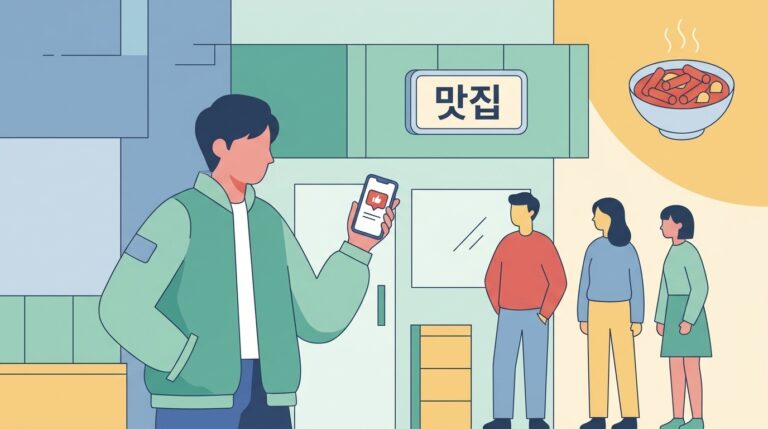
Is It Real or Just TV Hype? Master the Art of Verifying Korean TV Restaurants Like a Local
Phase 1: Empathy (Welcome to the Real Foodie World!)
안녕하세요! Welcome back to another episode of Daily Hangul, your trusty cultural compass! I’m your host and senior editor, your Korean bestie who has spent over a decade navigating the vibrant, delicious, and sometimes dizzying food scene of Seoul.
Picture this: You are watching your favorite K-Drama or a legendary food show like Tasty Guys (맛있는 녀석들) or Baek Jong-won’s Alley Restaurants (백종원의 골목식당). The cheese pull is majestic, the steam rises in slow motion, and the hosts look like they’ve just witnessed a culinary miracle. Your stomach rumbles. You pin the location, travel all the way to Korea, queue up in a line that wraps around three blocks… only to take a bite and think, “Wait… is this it? It’s just… ordinary?”
Don’t worry, you are not alone! This is the ultimate pain point for global foodies. In Korea, where new restaurants trend and vanish overnight, telling a genuine local gem apart from a temporary TV sensation (방송 효과) is an art form. Today, we are upgrading your food-verification skills to an intermediate (B2) level. You won’t just order food; you’ll critique it, banter with your friends like a true Seoulite, and decode the subtle hints locals use to avoid tourist traps. Let’s dive in!
Phase 2: Deep Dive into 3 Key Expressions
To navigate this culinary minefield, you need to speak like an insider. Here are three sophisticated B2-level phrases that will instantly elevate your food game.
1. 소문난 잔치에 먹을 것 없다더니… (Somunnan janchie meog-eul geot eopdadeoni…)
- Pronunciation: So-moon-nan jan-chee-eh meog-eul geot eop-da-deo-nee (Sounds like: “So-moon-nan giant-cheese-eh mug-ul gut up-da-dun-ee”)
- Meaning: Literally: “They say there is nothing to eat at a famous feast.” / Idiomatic: “Much ado about nothing” or “Overhyped.”
- K-Culture Moment: You see this idiom constantly on Korean blogs and lifestyle vlogs. It’s the ultimate phrase of mild disappointment when a highly publicized event or restaurant fails to live up to its reputation.
- Editor’s Insight: The ending “~더니” implies that you are directly confirming an old saying or a rumor through your own personal, disappointing experience.
- Situation Spectrum: Casual ✅ | Semi-formal ⚠️ | Formal 🚫
- 🤔 Think About It: Is there a similar proverb in your native language that warns against believing the hype? Why do you think human cultures across the globe share this skepticism toward trendiness?
2. 방송 탈 만하네요! (Bangsong tal manhaneyo!)
- Pronunciation: Bang-song tal man-ha-ne-yo (Sounds like: “Bahng-song tahl mahn-ha-neh-yo”)
- Meaning: “It is definitely worthy of being broadcasted!” / “The hype is real!”
- K-Culture Moment: Used when you take a bite of food at a TV-famous restaurant and your eyes widen in pure bliss. You turn to the owner or your friend and give them this ultimate compliment.
- Editor’s Insight: “~을 만하다” is a powerful B2 grammatical structure meaning “to be worth doing.” Using this shows you appreciate the culinary craftsmanship.
- Situation Spectrum: Casual ✅ | Semi-formal ✅ | Formal ⚠️
- 🤔 Think About It: When was the last time you visited a place featured on media that truly deserved its fame? How did you express that satisfaction to the staff?
3. 거품이 좀 꼈네요. (Geopumi jom kkyeotneyo.)
- Pronunciation: Geo-pum-ee jom kkyeot-ne-yo (Sounds like: “Guh-poom-ee jom kyut-neh-yo”)
- Meaning: Literally: “Some bubbles have formed [on it].” / Idiomatic: “It’s a bit overrated.” or “There’s a lot of bubble/hype in the price/reputation.”
- K-Culture Moment: Frequently used in financial markets, but highly popular among Korean foodies and tech reviewers to describe something whose marketing budget is clearly larger than its actual quality.
- Editor’s Insight: The verb “끼다” here means to collect or accumulate (like dust or foam). Saying the “bubble has accumulated” is a polite yet sharp way to criticize a restaurant’s inflated status.
- Situation Spectrum: Casual ✅ | Semi-formal ⚠️ | Formal 🚫
- 🤔 Think About It: How does comparing reputation to “bubbles” (거품) change the way we view trendiness? Bubbles look beautiful but pop easily—just like bad food trends!
Phase 3: Textbook Korean vs. Real Korean
Let’s bridge the gap between classroom Korean and the street slang of Hongdae and Gangnam.
Scenario 1: Describing a crazy long queue
- 📖 Textbook Korean: “이 식당은 아주 유명해서 손님이 많습니다.” (This restaurant is very famous, so there are many customers.)
- 🗣️ 진짜 Korean: “여기 완전 웨이팅 지옥이에요!” (This place is absolute waiting hell!)
- 💡 Why the difference? While the textbook version is polite, locals use the term “웨이팅 지옥” (Waiting Ji-ok) to vividly describe the chaotic, soul-crushing experience of waiting 2 hours in the freezing winter or humid summer for a table.
Scenario 2: Evaluating average food
- 📖 Textbook Korean: “음식 맛이 보통 수준입니다.” (The taste of the food is of average standard.)
- 🗣️ 진짜 Korean: “맛은 그냥 평타는 치네요.” (The taste at least hits average / It’s decent enough.)
- 💡 Why the difference? “평타 치다” (Pyeong-ta chida) originates from gaming terminology (meaning a standard, normal attack). In modern Korean, it has evolved into a super-useful slang phrase meaning “to meet basic expectations” or “to not disappoint, but not blow you away either.”
Phase 4: K-Culture Deep Dive & Non-verbal Manners
4-1. The Art of Nunchi (눈치) in Hyped Restaurants
When you enter a restaurant featured on TV, do not immediately trust the framed celebrity autographs (싸인) on the wall. Instead, use your Nunchi (눈치 – situational wit):
1. The Sound Check: Are the customers quietly chewing and scrolling on their phones, or are they making deep, guttural sounds of satisfaction (“크으~ 시원하다!”)? Real local satisfaction sounds like a sigh of relief.
2. The Age Ratio: If the restaurant is packed only with young tourists taking selfies, be cautious. If you see middle-aged Korean men (Ajussis) drinking Soju in their hiking gear at 2 PM, you have hit the jackpot. This is the ultimate seal of approval.
4-2. The “Broadcasting Effect” (방송 빨)
Koreans call the temporary surge in popularity due to media exposure “방송 빨” (Bangsong-bbal). “빨” is a suffix meaning “influence” or “effect.” Once a restaurant gets on TV, its quality often drops temporarily due to the sudden influx of crowds. To verify before going, savvy locals look for 내돈내산 (Nae-don-nae-san) reviews on blogs, which means “My own money, my own purchase” (i.e., not a sponsored post).
Phase 5: Real-Life Roleplay Scenario
Setting: A famous tteokbokki (spicy rice cake) spot in Mapo, Seoul, which was recently featured on a major variety show.
Characters:
* 혜원 (Hye-won): Your sassy, food-expert Korean bestie who hates wasting money on bad food.
* Alex (You): An intermediate learner eager to test out new foodie lingo.
[Scene: Standing in front of a tiny restaurant with a line of 30 people.]

혜원: (한숨을 쉬며) 와, 대박... 줄 선 것 좀 봐. 여기 완전 웨이팅 지옥이네.
      Wa, daebak... jul seon geot jom bwa. Yeogi wanjeon waiting ji-ok-i-ne.
      (Sighing) Wow, crazy... Look at this line. This place is absolute waiting hell.

Alex: (휴대폰으로 식당 정보를 검색하며) 방송에 나온 지 일주일밖에 안 돼서 그런가 봐요.
      Bangsong-e naon ji il-ju-il-bak-ke an dwaeseo geureon-ga bwayo.
      (Searching the restaurant on their phone) It must be because it's only been a week since it aired on TV.

[30 minutes later, they finally get their bowls of tteokbokki and take their first bite.]

혜원: (눈을 가늘게 뜨고 음미하며) 흠... 알렉스, 맛이 어때?
      Heum... Alex, mas-i eo-tteae?
      (Narrowing her eyes, tasting carefully) Hmm... Alex, how is the taste?

Alex: (고개를 갸우뚱하며) 어... 맛은 있는데, 소문난 잔치에 먹을 것 없다더니 딱 그 꼴이네요.
      Eo... mas-eun it-neun-de, somunnan janchie meog-eul geot eopdadeoni ttak geu kkol-i-ne-yo.
      (Tilting head) Uh... it's tasty, but as the saying goes, 'nothing to eat at a famous feast'—that's exactly the case.

혜원: (웃음을 터뜨리며) 박수! 표현 대박이다! 맞아, 맛은 평타는 치는데 솔직히 거품이 좀 꼈어.
      Bak-su! Pyo-hyeon daebak-i-da! Maja, mas-eun pyeong-ta-neun chi-neun-de sol-jik-hi geopumi jom kkyeot-seo.
      (Bursting into laughter) Claps! Your phrasing is amazing! You're right, the taste hits average, but honestly, it's a bit overrated.

Alex: (끄덕이며) 양념이 너무 평범해요. 방송 탈 만한 정도는 아닌 것 같아요.
      Yang-nyeom-i neo-mu pyeong-beom-hae-yo. Bangsong tal man-han jeong-do-neun anin geot gat-ae-yo.
      (Nodding) The sauce is too ordinary. I don't think it's worthy of being on TV.

혜원: (엄지를 치켜세우며) 그러니까. 진짜 로컬 맛집은 골목 안쪽에 숨어있다고. 가자, 내가 진짜를 보여줄게!
      Geu-reo-ni-kka. Jin-ja local mat-jip-eun gol-mok an-jjok-e sum-eo-it-da-go. Ga-ja, nae-ga jin-ja-reul bo-yeo-jul-ge!
      (Giving a thumbs up) Exactly. Real local gems are hidden deep inside the alleys. Let's go, I'll show you the real deal!

Alex: (신나서 가방을 챙기며) 좋아요! 내돈내산 찐맛집으로 고고!
      Jo-ha-yo! Nae-don-nae-san jjin-mat-jip-eu-ro go-go!
      (Excitedly packing up) Sounds great! Let's go to a genuine self-paid local favorite!
🔀 Choose Your Way!
If Hye-won asked you right after the first bite, “How do you honestly like it?”, how would you respond?
- Option A: “여기 진짜 대박이에요! 방송 탈 만하네요!”
- 💖 Best/Authentic Feedback: Perfect if you genuinely love it! It shows high energy and uses advanced grammar correctly to express maximum satisfaction.
- Option B: “음식이 나쁘지 않아요. 평타는 쳐요.”
- ⚠️ Risk/Neutral Feedback: Safe and very natural. It shows you are analytical and not easily swayed by TV marketing.
- Option C: “여기 맛없어요. 거품이 너무 꼈어요.”
- 🚫 Bad/Too Harsh Feedback: While grammatically correct, saying “맛없어요” (tastes bad) directly to a friend who waited in line with you can sound a bit too blunt and dampens the mood. Better to soften it with “평타는 치는데 거품이 꼈다.”
Phase 6: 10-Second Emotion Shadowing Drill
Let’s practice expressing disappointment and satisfaction with authentic Korean cadence. Pay attention to the pauses (/) and the emotion tags!
- Drill 1: The Disappointed Food Critic
- Emotion:
[😒 Disappointed and slightly complaining] - Sentence: 아… / 소문난 잔치에 / 먹을 것 없다더니 / 딱 그 꼴이네.
- Romanization: Ah… / so-mun-nan jan-chee-eh / meog-eul geot eop-da-deo-nee / ttak geu kkol-ee-neh.
- Emotion:
- Drill 2: The Pleasantly Surprised Foodie
- Emotion:
[🤩 Highly impressed and excited] - Sentence: 오! / 웨이팅 할 만했어! / 여기 진짜 / 방송 탈 만하네!
- Romanization: Oh! / waiting hal man-haet-seo! / yeo-gi jin-jja / bang-song tal man-ha-neh!
- Emotion:
Phase 7: K-Culture Mini Dictionary
| Word (Hangul / Romanization) | Translation | Real-Life Usage Notes |
|---|---|---|
| 맛집 (Mat-jip) | Famous/Delicious restaurant | Used for any place with good food. Opposed to “멋집” (Mut-jip – aesthetically pleasing place but mediocre food). |
| 내돈내산 (Nae-don-nae-san) | “Bought with my own money” | Search hashtag used on Naver/Instagram to filter out paid advertisements or sponsored food reviews. |
| 평타 (Pyeong-ta) | Average / Decent | From gaming (“standard attack”). “평타 치다” means a place is decent enough to not regret going. |
| 웨이팅 (Waiting) | Queuing / Waiting | Konglish for waiting at restaurants. “웨이팅 있다” means there is a queue. |
Phase 8: Survival Kit for Travelers
🚨 Survival Expressions TOP 3
- “대기 몇 팀 남았어요?” (Dae-gi myeot tim nam-at-seo-yo?)
- Pro Tip: “How many teams/groups are ahead of us in the waiting line?”
- “여기 대기 등록 어떻게 해요?” (Yeo-gi dae-gi deung-rok eo-tteo-ke hae-yo?)
- Pro Tip: “How do I register for the waiting list?” (Use this when you see an electronic tablet at the entrance).
- “포장하면 바로 가져갈 수 있나요?” (Po-jang-ha-myeon ba-ro ga-jeo-gal su in-na-yo?)
- Pro Tip: “If I do takeout, can I get it right away?” (A great hack to bypass a 2-hour queue if you don’t mind eating in a park!).
📝 Editor’s Travel Note: The Digital Tools
Do not rely on Google Maps in Korea—it doesn’t update restaurant data well. Instead, download Naver Map (네이버 지도) or KakaoMap (카카오맵). Read the 1-star and 2-star reviews specifically. If multiple reviewers write “방송 빨이에요” (It’s just TV hype) or “거품 꼈음” (Overrated), skip it!
Phase 9: “One Step Deeper” (Societal Insight)
Why are Koreans so obsessed with finding the “real” restaurants, and why does a TV broadcast cause such an explosive reaction?
In Korea’s hyper-collectivist society, sharing a culinary trend is a form of social currency. Eating at a trending spot makes you feel connected to the cultural zeitgeist. However, because Koreans also possess high 눈치 (Nunchi), there is a counter-cultural pride in discovering “나만 알고 싶은 맛집” (a restaurant only I want to know about). It represents authenticity in a rapidly changing commercial landscape.
💬 Your Turn: Do people in your country also rush to restaurants featured on TV or TikTok, or do you prefer secret local spots? Let me know in the comments below!
Phase 10: FAQ & Common Mistakes
Q: Can I trust the “Broadcasting Mark” (방송 출연 액자) hung in restaurant windows?
A: Not unconditionally! Some of those marks are from 10 years ago, or from obscure morning shows where restaurants pay to be featured. Look for shows known for strict standards, like Heo Young-man’s Food Travel (식객 허영만의 백반기행).
Q: What does it mean when a local says “맛이 변했다” (Masi byeon-haet-da)?
A: It means “The taste has changed.” This is a common complaint after a restaurant becomes famous; they have to mass-produce food, leading to a drop in quality.
Q: Is it rude to leave a queue after putting my name on the digital pad?
A: No, but make sure to cancel your registration via KakaoTalk if the system allows, so the next people can get in faster. It’s polite nunchi!
🚨 Common Mistakes Board
- Mistake 1: Translating “Overrated” directly as “과대평가되었어요.”
- Why: It’s grammatically correct but sounds like a formal economic report. Use “거품이 좀 꼈네요” instead!
- Mistake 2: Saying “웨이팅 지옥” directly to the restaurant owner.
- Why: It sounds too aggressive to say “hell” to the host. Save this slang for talking secretly with your friends.
- Mistake 3: Assuming a long line always means good food.
- Why: Often, it just means the place has good Instagram aesthetics. Check Naver reviews for “내돈내산” to find the truth.
Phase 11: Action Mission & Engagement
Complete these missions to turn theory into muscle memory!
- 🥉 Bronze Mission: Pronounce “소문난 잔치에 먹을 것 없다더니…” out loud three times in front of the mirror using our Shadowing Drill emotional guidelines.
- 🥈 Silver Mission: Go to YouTube, search for a Korean food show or Mukbang (먹방), and check the comments section. See if you can spot terms like 평타, 맛집, or 내돈내산.
- 🥇 Gold Mission: Next time you visit a hyped restaurant (in Korea or your local K-town), tell your friend: “생각보다 거품이 좀 꼈네” or “오, 방송 탈 만하다!” based on your honest critique.
Phase 12: Interactive Quiz Challenge
Test your foodie intuition with these quick questions!
1. Which phrase means “The hype is real, this place deserves its TV spot!”?
- A) 거품이 좀 꼈네요.
- B) 소문난 잔치에 먹을 것 없네요.
- C) 방송 탈 만하네요!
🔍 Click to reveal the answer
Correct Answer: C
Explanation: “방송 탈 만하네요!” means it’s totally worthy of being broadcasted. A and B are used for disappointing, overhyped places.
2. What does “평타는 치다” mean when evaluating a restaurant?
- A) The food is absolute trash.
- B) The food meets basic expectations (it’s average/decent).
- C) The food is the best in the country.
🔍 Click to reveal the answer
Correct Answer: B
Explanation: “평타는 치다” means it lands on a decent, average standard—neither a complete failure nor an amazing masterpiece.
3. True or False: If you want to find authentic, unsponsored blog reviews in Korea, you should search for the keyword “내돈내산” (Nae-don-nae-san).
- A) True
- B) False
🔍 Click to reveal the answer
Correct Answer: A (True)
Explanation: “내돈내산” (My own money, my own purchase) is the go-to keyword to filter out commercialized, sponsored reviews.







